As of 2026, the gap between companies that use AI powered content generation tools strategically and those that use them tactically has become a meaningful competitive moat. The tactical camp prompts ChatGPT for a blog post, edits it manually, and publishes it — same labor bottleneck, slightly faster. The strategic camp deploys autonomous content agents that research, write, optimize, internally link, and publish without a human in the loop for every step. Understanding what actually separates these two approaches — mechanically, not just philosophically — is what this guide is for.
2026 data from Semrush's State of Content Marketing report shows that 68% of marketing teams now use AI in some part of their content workflow, but fewer than 12% have moved to fully autonomous pipelines. That gap represents a real opportunity for founders and SEO managers who want to scale organic and AI search visibility simultaneously without growing headcount. We'll break down the architecture, quality signals, and differentiation factors that matter most — for both traditional Google rankings and the newer AI search surfaces like ChatGPT, Claude, Perplexity, and Gemini.
The core thesis: AI powered content generation tools are not all the same. The difference between a prompt interface and an autonomous content engine is structural — and that structure determines whether you get one article or a compounding content operation.
What AI Powered Content Generation Tools Actually Are
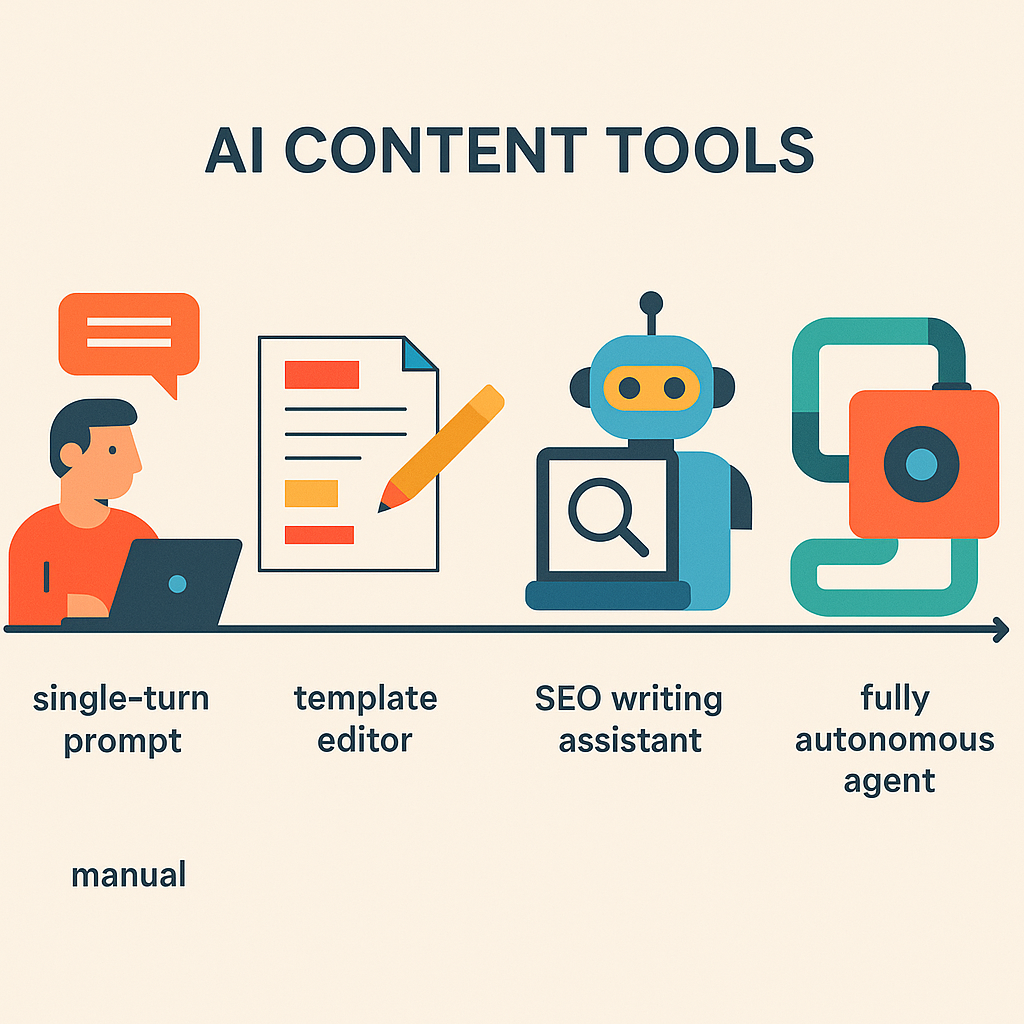
AI powered content generation tools are software systems that use large language models — and increasingly, multi-agent orchestration layers on top of those models — to produce written content at a pace and cost that human writers cannot match at scale. The category spans a wide range: single-turn prompt interfaces (you ask, it outputs), template-driven editors with AI fill-in, SEO-focused writing assistants that pull keyword data and generate outlines, and fully autonomous agents that manage an entire content lifecycle from keyword discovery through CMS publication. The underlying model quality matters less than you might think; the workflow architecture and the signals the tool is optimized for are what determine real-world outcomes. A GPT-4-class model wrapped in a manual prompt interface will underperform a well-orchestrated autonomous agent running a slightly older model — because the agent handles research, internal linking, schema markup, and distribution steps that a single model call simply cannot.
The Spectrum from Prompt Tool to Autonomous Agent
It helps to think of this category as a spectrum rather than a binary. At one end, tools like Jasper or Copy.ai give you a well-designed prompt interface with templates — fast to start, limited in autonomy. In the middle, platforms like Surfer SEO layer in keyword data and on-page scoring but still require a human to commission and edit each piece. At the far end are autonomous content engines that run recurring agents: keyword research fires on a schedule, articles are written and scored against search intent, schema and internal links are injected automatically, and the piece is published directly to your CMS — with no human prompt per article required. This last category is where the compounding growth model actually lives.
How These Tools Handle SEO and E-E-A-T Signals
Google's helpful content guidance makes clear that E-E-A-T — Experience, Expertise, Authoritativeness, and Trustworthiness — is a core quality signal for organic rankings. AI powered content generation tools vary dramatically in how they approach this. A basic prompt tool generates text without any awareness of E-E-A-T signals; it will produce fluent content that lacks the specificity, sourcing, and structural markers that Google's quality raters look for. Better tools inject structured data (schema markup), include FAQ blocks, add internal links to related content, and are trained or prompted to generate content that demonstrates subject-matter depth rather than surface coverage. The distinction matters because fluency alone stopped being a ranking differentiator in 2026 — nearly all AI-written content at scale is fluent. What separates ranking content from non-ranking content is structural optimization: schema, internal link density, topic cluster coherence, and demonstrated topical authority through citation patterns.
On-Page Signals AI Tools Should Be Generating
- Schema markup (Article, FAQ, HowTo, BreadcrumbList) injected at publish time, not as an afterthought
- FAQ blocks structured to match conversational query patterns used in voice and AI search
- Internal links to semantically related content, automatically mapped to a site's existing topic graph
- Semantically relevant heading structures (H2/H3 hierarchy) that signal document organization to crawlers
- Alt text on all images optimized for both accessibility and keyword relevance
- Meta descriptions and title tags generated to match click-through-rate best practices, not just keyword stuffing
- Word count and content depth calibrated to the competitive landscape for each target keyword
Schema is non-negotiable. Tools that publish articles without structured data are leaving FAQ rich results and article carousels on the table. According to Ahrefs' 2025 study on rich results, pages with FAQ schema earn a measurably higher click-through rate for informational queries — the exact query type most AI-generated articles target.
Internal linking is the compounding mechanism. A single article is an island; a network of internally linked articles is a topic cluster that builds PageRank and topical authority over time. Autonomous tools that auto-build internal links as they publish new content create a compounding SEO effect that manual workflows cannot replicate at scale — each new article strengthens the ones already published.
GEO: Why AI Search Visibility Is a Separate Problem
Generative Engine Optimization — GEO — is the practice of structuring content so that AI search engines like ChatGPT, Claude, Perplexity, and Gemini cite it when answering user queries. This is structurally different from traditional SEO. Google's algorithm ranks pages in a list; AI engines synthesize an answer and select sources to cite, often without showing a traditional results page at all. The implication is significant: a page can rank on page one in Google and still receive zero citations from AI engines, because the citation criteria are different. AI engines favor content that is answer-dense, factually specific, well-structured with clear headings, and sourced with real attributions. In 2026, as AI-driven search queries represent a growing share of informational traffic, brands that optimize only for Google are leaving a meaningful discovery channel uncaptured.
How AI Engines Decide What to Cite
The citation logic of large language model-based search engines prioritizes content that is semantically dense, factually grounded, and structurally navigable. Headers allow the model to locate and extract specific answers. FAQ blocks match the question-answer format models use internally. Specific statistics with named sources increase citability because the model can reference a verifiable claim. Content that covers a topic comprehensively — not just one angle — is more likely to be cited across a range of related queries. This is why topic cluster architecture, where one pillar article links to multiple supporting pieces that each cover a sub-concept in depth, outperforms isolated long-form articles in AI citation rates. According to Semrush's AI Search Behavior study, content with clear answer-first structure sees up to 70% higher citation frequency in AI-generated responses compared to content with buried answers.
GEO is not a future concern — it is a 2026 present-tense revenue problem. If your brand does not appear when a buyer asks ChatGPT or Perplexity about your category, you are invisible to a growing share of your addressable audience.
The Architecture of an Autonomous Content Pipeline
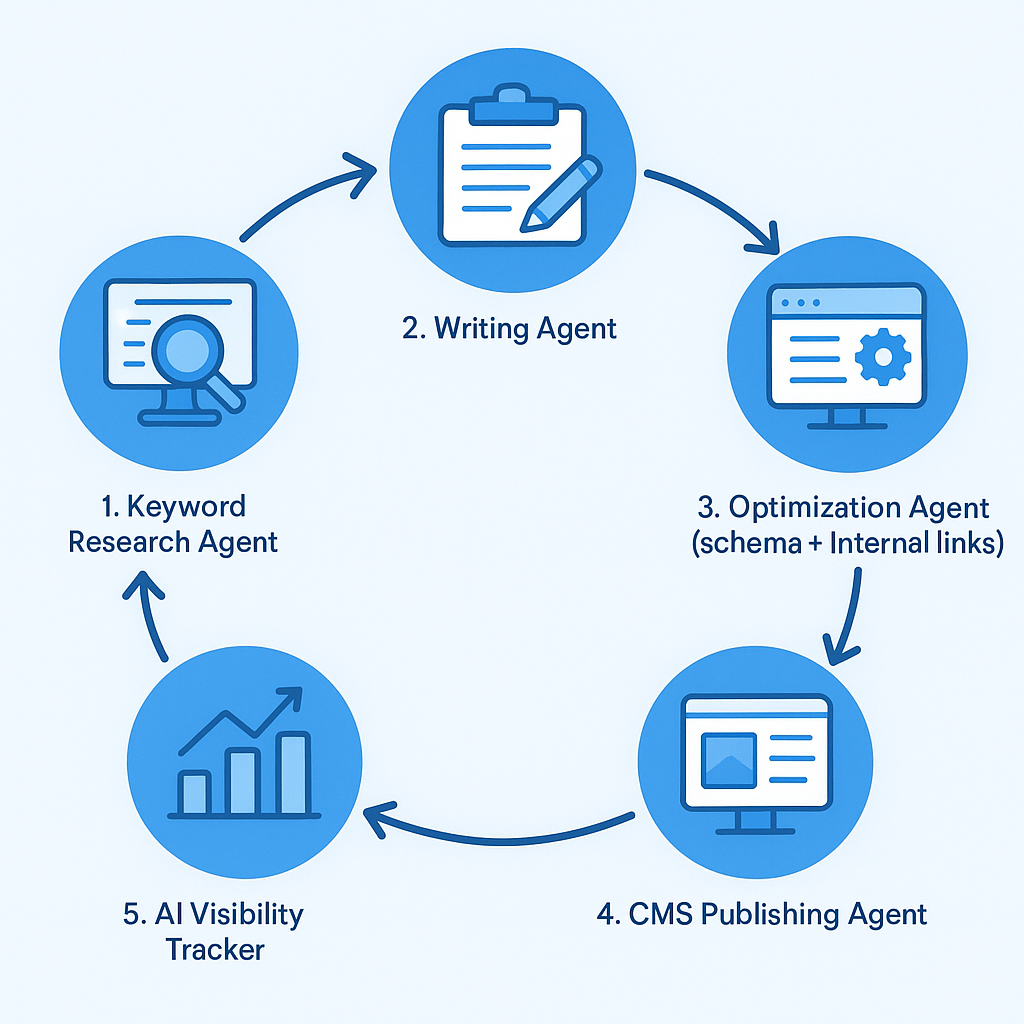
An autonomous content pipeline is best understood as a set of coordinated agents, each owning a discrete step in the content lifecycle, with outputs passing between agents without human prompts at each handoff. The pipeline typically looks like this: a keyword research agent identifies opportunities based on search volume, keyword difficulty, and competitive gap analysis; a writing agent produces a full draft optimized for the target keyword and related semantics; an optimization agent injects schema markup, internal links, and on-page metadata; a CMS publishing agent formats and pushes the article to the connected platform; and a monitoring agent tracks ranking movement, AI citations, and engagement signals post-publish. What makes this structurally different from a human content workflow is that none of these handoffs require a human decision. The agents run on schedule, and the output compounds — 30 articles per month means 360 indexed, internally linked, schema-marked pieces per year, each reinforcing the others' authority.
Scale changes the math. Gofylo's Content Engine has generated over 48,000 articles, with each piece produced end-to-end in under 4 minutes. At 30 articles per month on the standard plan, a company running the platform for 12 months has a 360-article topic cluster — built without a content team. That volume is not achievable with manual workflows at a comparable cost, and it is the volume required to build genuine topical authority in most competitive B2B SaaS categories.
Feedback loops matter. The most sophisticated autonomous pipelines don't just publish — they monitor. Post-publish agents that track AI citation rates (across ChatGPT, Claude, Perplexity, Gemini), social mention velocity, and ranking movement can feed signals back into the keyword and content strategy, creating a self-improving system rather than a static production line. This is where AI Visibility Scores — like the average of 94 across Gofylo's active accounts — become a meaningful operational benchmark rather than a vanity metric.
Language, Scale, and Programmatic Use Cases
One dimension of AI powered content generation tools that often gets underweighted in evaluations is multilingual capability and programmatic landing page generation. For B2B SaaS companies with international addressable markets, the ability to generate SEO-optimized content in 18+ languages — without separate translation workflows or localization agencies — is a genuine force multiplier. Programmatic landing page generation takes this further: instead of writing individual location pages, product comparison pages, or integration pages manually, an autonomous agent can generate hundreds of structurally consistent, keyword-targeted pages from a template and data layer. Google's guidance on programmatic SEO acknowledges this approach as legitimate when pages provide unique value — the key requirement being that each page must answer a distinct user query rather than being a thin variant. Tools that generate programmatic pages with genuine content differentiation per page, not just token swaps, are the ones that survive quality filters.
- International SEO at scale: generate localized content in 18+ languages without translation overhead
- Programmatic landing pages: spin out integration pages, comparison pages, and city/vertical pages from structured data
- Topic cluster build-out: rapidly cover an entire keyword universe around a core product category
- Competitor gap filling: identify keywords where competitors rank and you don't, then generate targeted content systematically
- CMS agnosticism: connect to WordPress, Webflow, Shopify, Ghost, Framer, and others without custom dev work
Evaluating Tools: What to Actually Compare
When comparing AI powered content generation tools, the surface-level comparison — output quality, pricing, integrations — misses the structural question: does this tool create a compounding content operation, or does it just make individual articles faster? The compounding question is what separates platforms worth building on from tools that plateau. To evaluate meaningfully, look at five dimensions: autonomy level (does it require a human prompt per article, or does it run on schedule?), SEO signal coverage (schema, internal linking, meta optimization — are they automatic?), AI search visibility tracking (does it tell you whether your content is being cited by AI engines, not just ranked by Google?), content volume and CMS integration depth, and total cost including the labor that would otherwise be required to match the same output manually.
- Autonomy depth: does the tool run without per-article human prompts, or does it require constant input?
- SEO signal completeness: schema markup, internal linking, meta generation — are all of these automatic?
- AI search visibility: does the platform track citations across ChatGPT, Claude, Perplexity, and Gemini?
- Volume and velocity: how many articles per month, and at what end-to-end production time?
- CMS and workflow integration: does it publish directly to your stack, or export for manual upload?
- Multilingual and programmatic support: can it scale into new languages and generate landing pages systematically?
The right question isn't 'which tool writes the best single article?' It's 'which platform builds the largest, best-structured content operation over the next 12 months without adding headcount?' Those are different evaluations with different answers.
Frequently Asked Questions About AI Content Generation Tools
These are the questions we see most often from founders, SEO managers, and demand generation leads evaluating this category — answered directly, without the standard marketing hedging.
Does AI-generated content rank on Google in 2026?
Yes, with important qualifications. Google's position since the 2023 helpful content update has been consistent: content quality and user value determine rankings, not the method of production. AI-generated content that is accurate, well-structured, and genuinely useful ranks. AI-generated content that is thin, generic, or lacks E-E-A-T signals does not. According to Google's published guidance on AI content, the focus is on helpfulness, not on whether a human or machine wrote the piece. The practical implication: autonomous tools that generate content with schema, internal links, topical depth, and factual specificity produce content that ranks. Tools that generate fluent but shallow drafts do not.
How do AI content tools affect AI search visibility (GEO)?
AI content tools that produce answer-first structured content with clear headings, FAQ blocks, and specific attributable claims are more likely to be cited by AI search engines than content without those signals. The mechanism is direct: language models extracting answers from the web favor content that is easy to parse and quote. Tools that build these structural signals into every article by default — not as optional features — are the ones that generate genuine GEO lift. Tracking this lift requires an AI visibility layer that monitors citations across ChatGPT, Claude, Perplexity, and Gemini, not just Google rankings.
What is a realistic content output for an autonomous tool?
A well-configured autonomous content engine should produce 20–40 fully optimized articles per month, each with schema markup, internal linking, and CMS publication included. At Gofylo, the standard plan delivers 30 articles per month with an end-to-end generation time under 4 minutes per article. Over 12 months, that is 360 indexed, interlinked pieces — a volume that would require a full-time content team of 3–4 people to match manually, at a fraction of the cost.
Is there a risk of content duplication or thin content penalties?
Yes, if the tool uses low-diversity generation with minimal keyword variation per article. The mitigation is keyword-specific generation: each article is commissioned against a distinct target keyword and search intent, with unique research, structure, and supporting points. Platforms that generate from a shared template with token substitution are high-risk. Platforms that run a full research and writing pipeline per article — pulling fresh keyword data, competitive context, and topic-specific information — produce differentiated content that avoids duplication penalties.
Bottom line on tool selection. The decision framework is straightforward: if you need one article, use any capable AI writing assistant. If you need a content operation that builds topical authority, ranks in traditional search, gets cited by AI engines, and runs without a content team, you need an autonomous pipeline — not a prompt interface. The structural difference is not marginal; it is the difference between a tool and a system.
GEO is the emerging moat. As AI-driven search continues to displace traditional query-and-results behavior, the brands that appear in ChatGPT, Claude, and Perplexity answers will compound inbound interest in a way that pure Google rankings cannot replicate. Building that AI visibility requires content structured for citation — and tracking whether it is actually being cited. Both capabilities need to be in your stack by 2026, not on your roadmap for next year.
Related: Your Guide to LLM Visibility Tools That Actually Work
Related: Top 8 AI Powered Content Creation Platforms Ranked for 2026
Related: 14 AI Tools for Content Creation Ranked by Real Workflow Impact
Related: 15 Best AI Writing Tools Ranked for SEO and AI Search in 2026
Related: 9 AI Powered Writing Tools Ranked by Real B2B Impact in 2026
Related: 12 AI Tools for SEO Ranked by Search and AI Visibility Impact
Related: Beyond Jasper: 8 AI Writing Tools Honestly Compared for 2026
Related: Claude vs ChatGPT for B2B Teams: What the 2026 Benchmarks Show
Related: What Separates a Real AI SEO Platform From the Hype
Related: Auto SEO Platforms Explained: What They Do and Why It Matters
Related: B2B SaaS Content Tools Compared: SEO, AI Search, and Autopublish
Related: 11 AI Powered Content Generation Tools Ranked for 2026
Related: 8 AI Writing Services Ranked by Compounding SEO Impact
Related: Best AI Tools for Content Creators in 2026: Ranked and Compared
Related: Comparing 12 AI SEO Tools: Rankings, Citations, and Autopublish
Related: SEO AI Tools for B2B SaaS: 10 Ranked for 2026 Performance
Related: 10 Auto SEO Tools Ranked by Automation Depth in 2026
Related: 8 AI SEO Content Generators Ranked for Organic Growth in 2026
If you want to see where your brand stands right now in AI search — across ChatGPT, Claude, Perplexity, and Gemini — Gofylo's free AI Search Grader gives you an actionable visibility score in minutes. No credit card required. Or start a 3-day free trial of the full platform and let the autonomous Content Engine publish your first articles to your CMS before your next sprint review. Start at gofylo.com.