Jasper AI had a strong run as the default choice for marketing teams that wanted AI-assisted content at scale. But as of 2026, the category has fragmented significantly — there are now tools purpose-built for SEO, for brand consistency, for autonomous publishing, and for budget-conscious solo operators who need output without overhead. The question isn't whether to use AI for content anymore; it's which tool actually fits the workflow you're trying to build.
If you've been searching for Jasper AI alternatives — on Reddit, in Slack groups, or by testing trials yourself — you've likely run into the same tension: most tools optimize for one dimension (usually raw generation speed) and underdeliver on the others (SEO structure, AI search citation, autonomous publishing, or real content strategy). This guide evaluates eight serious alternatives across the same axes so you can match the right tool to your actual use case in 2026.
Thesis: No single Jasper alternative dominates every use case. The right pick depends on whether you're optimizing for content volume, SEO depth, AI search visibility, team size, or budget. This guide gives you a side-by-side view across all eight.
Why Teams Are Moving Away from Jasper AI in 2026
Jasper built its reputation on a clean interface and solid GPT-4 integration — but several structural limitations have pushed teams to look elsewhere. First, Jasper's pricing scales in a way that punishes volume users: teams producing 30 or more articles per month often hit per-word or seat costs that add up quickly. Second, the platform's SEO features remain surface-level. You get keyword insertion, but not the kind of topical cluster planning, internal linking, or schema generation that actually moves rankings in 2026. Third — and most critically — Jasper has no native AI search visibility layer. It doesn't tell you whether your content is getting cited by ChatGPT, Perplexity, Claude, or Gemini. As AI-driven search increasingly displaces traditional blue-link results, that blind spot is becoming expensive. Many teams on forums like Reddit have raised the same concerns: the output is fine, but the surrounding workflow — from research to publication to tracking — is still entirely manual. That's the gap every tool in this list is trying to fill, in different ways.
- Pricing that scales poorly for high-volume content teams
- Limited native SEO tooling beyond basic keyword insertion
- No built-in AI search citation or GEO tracking
- Manual research and publishing steps still required
- No programmatic landing page generation
- Weak CMS integrations outside of the Jasper editor
- No autonomous agent loop — every piece still requires a human prompt
How We Evaluated These Alternatives
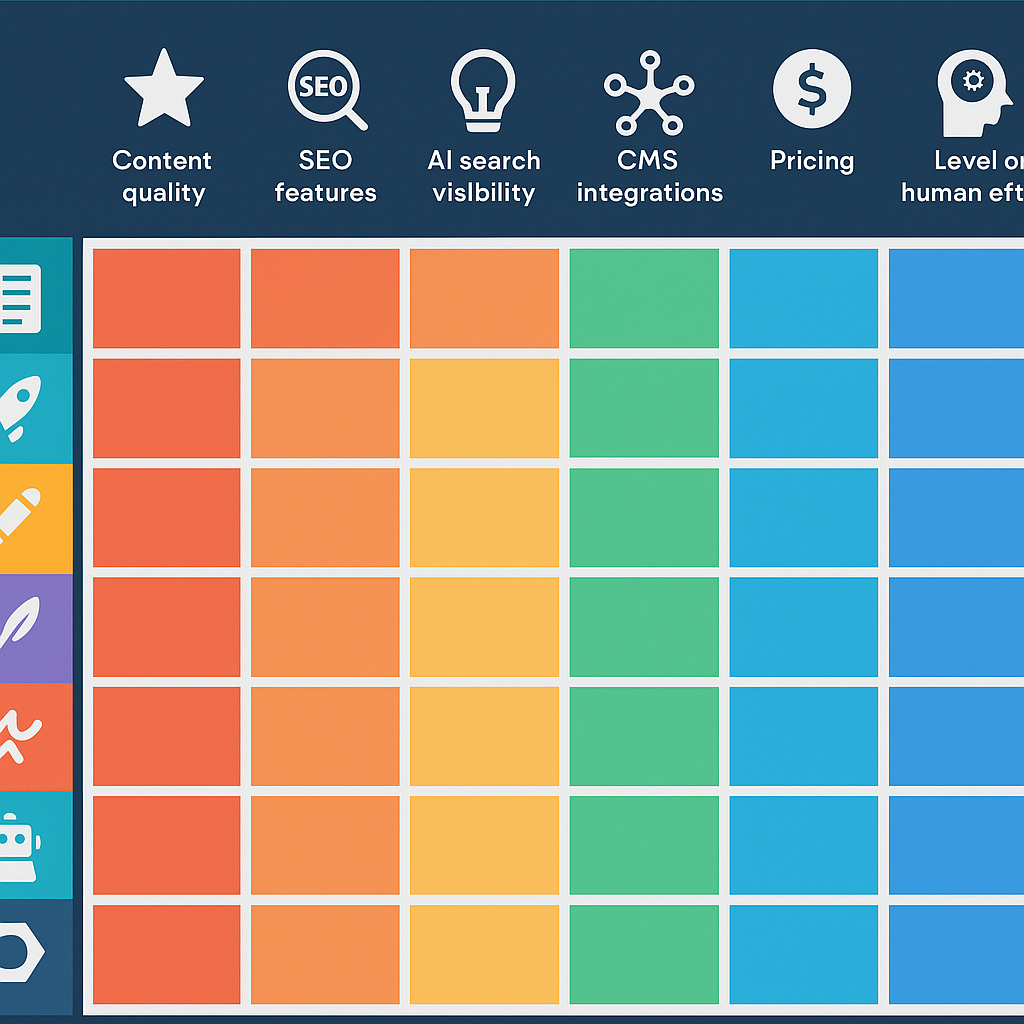
Every tool in this comparison was evaluated across seven consistent axes: content quality and depth, SEO feature set (on-page optimization, schema, internal linking), AI search visibility and GEO capability, CMS integrations and autonomous publishing, pricing and scalability for B2B SaaS teams, speed and volume capacity, and the degree of human effort still required per published piece. We applied the same framework to each tool so the comparison is apples-to-apples rather than cherry-picking each platform's best marketing claims. Tools that only address one or two axes are noted as specialized rather than dismissed — there are legitimate use cases for a focused tool. But for teams that want a compounding organic growth system rather than a writing assistant, the full-stack options matter more.
The 8 Best Jasper AI Alternatives, Compared
The eight tools below represent the strongest options in the market as of 2026, spanning the full spectrum from autonomous end-to-end publishing platforms to lean single-feature writing assistants. Each section follows the same evaluation structure so you can scan vertically across a dimension or read each tool's full profile horizontally.
1. Gofylo — Autonomous Content Engine with AI Visibility Tracking
Gofylo is the only platform in this comparison that closes the full loop from keyword research through content writing, CMS publishing, and AI search citation tracking — without requiring a human prompt for each step. Where every other tool in this list produces a document that a human must then optimize, export, and publish, Gofylo researches keywords, writes articles in the customer's brand voice, and publishes them to their CMS without requiring a human prompt for each step. Each article is written in a few minutes and published to the customer's CMS — 30 articles per month on the standard plan. That's the structural difference: other tools are writing assistants; Gofylo is a compounding growth system. For B2B SaaS founders and content leads who don't want to hire a content team but need consistent, high-quality output that ranks on both Google and AI engines simultaneously, the platform's architecture is meaningfully different from any Jasper alternative that requires a human in the loop at each stage.
- Content quality: E-E-A-T compliant, includes schema markup, FAQ blocks, internal links, and AI-generated images in 5 styles
- SEO features: Topic cluster research and article generation, internal links, schema markup, FAQ blocks, 18+ language support
- AI search visibility: AI visibility score from asking ChatGPT and Claude about your brand; free AI Search Grader available at gofylo.io
- CMS integrations: WordPress, WordPress.com, Webflow, Shopify, Wix, Notion, Ghost, Framer, Feather, plus API webhook for custom setups
- Pricing: $79/month all-in, 3-day free trial.
- Speed and volume: ~4 minutes per article end-to-end, 30 articles/month included
- Human effort required: Near-zero after initial configuration — agents research, write, optimize, and publish autonomously
Best for: B2B SaaS companies and growth-stage startups that want to scale organic content and AI search visibility simultaneously without building a content team. Also strong for bootstrapped founders who need compounding output at a fixed, predictable cost.
Watch out for: If you need highly bespoke editorial voice or are producing content that requires extensive manual subject matter expert interviews per piece, a fully autonomous workflow will need supplemental human review. Gofylo is best treated as a force multiplier, not a replacement for strategic content direction.
2. Writesonic — High-Volume Generation with SEO Integration
Writesonic is one of the most widely adopted Jasper AI alternatives on the market, and the user numbers bear that out. By 2025, Writesonic served over 10 million marketers globally and reached a valuation of over $250 million through product expansion and data integration — a signal of genuine market pull, not just venture marketing. The platform covers a broad content surface: blog posts, landing pages, ad copy, product descriptions, and an AI chatbot feature called Chatsonic. Its Surfer SEO integration adds on-page scoring inside the editor, which is useful for teams that want keyword targeting without switching tools. The user ratings reflect the satisfaction: Writesonic received a 4.7/5 rating on G2 based on 2,029 reviews and a 4.8/5 on Capterra based on 2,102 reviews. Where Writesonic falls short is on the autonomous layer — you still need to brief, prompt, and edit each article, and there's no native AI search visibility tracking. It's a powerful writing tool that still requires a writer.
- Content quality: Strong output with factual citations; quality varies by template and model selection
- SEO features: Built-in keyword targeting, Surfer SEO integration, on-page scoring
- AI search visibility: No native GEO tracking or AI citation monitoring
- CMS integrations: WordPress, Shopify, and a handful of others via direct export
- Pricing: Free tier available; paid plans scale with word volume — pricing increases meaningfully at higher outputs
- Speed and volume: Fast per-piece generation; volume depends on plan tier
- Human effort required: Moderate — prompting, brief creation, and editing still manual
Best for: Marketing teams that produce a high mix of content types — blog posts, ads, landing pages, and social copy — and want a single tool with a solid SEO scoring layer built in.
Watch out for: Writesonic's output quality can vary significantly depending on which model and template you select. Teams that want consistent long-form quality without heavy editing will need to invest time in prompt engineering.
3. Copy.ai — Workflow Automation for Go-to-Market Teams
Copy.ai has made a notable pivot from AI copywriting tool to go-to-market workflow automation platform. In 2026, its strongest positioning is around GTM workflows — sequences of AI-driven steps that handle lead research, personalized outreach, and sales enablement content, rather than just drafting individual blog posts. For demand generation and sales-led growth teams, this is a genuinely differentiated capability that other Jasper alternatives don't offer. The tradeoff is that Copy.ai's pure content creation and SEO tooling is relatively shallow. It generates clean copy, but if your primary goal is building topical authority and ranking on Google or getting cited in AI search, Copy.ai isn't architected for that. It's closer to a CRM-adjacent workflow tool than a content engine, and teams that expect a direct Jasper replacement for blog content at scale often find themselves surprised.
- Content quality: Clean marketing copy; less depth for long-form SEO articles
- SEO features: Minimal — no on-page scoring, schema, or topical cluster tooling
- AI search visibility: No GEO tracking or AI citation monitoring
- CMS integrations: Limited direct publishing; mainly export-based
- Pricing: Free tier available; paid plans are team-focused with seat-based pricing
- Speed and volume: Fast for short-form; slower and more manual for long-form
- Human effort required: Moderate to high for content strategy and long-form workflows
Best for: Sales-led and product-led growth teams that need AI-assisted GTM workflows, outreach personalization, and marketing copy — not primarily for SEO content at scale.
Watch out for: Copy.ai is often recommended as a Jasper alternative in general roundups, but the use cases diverge significantly. If your primary need is organic search content at volume, you'll likely outgrow Copy.ai's content tooling quickly.
4. Rytr — Budget-Friendly Option for Solo Operators
Rytr consistently surfaces as the cheapest Jasper AI alternative in community discussions, and the pricing is genuinely accessible. Rytr's paid plans start at $7.50/month, and the free plan gives you 10,000 characters per month — which is enough for light users to evaluate the output before committing. For bootstrapped founders, solo content operators, and early-stage teams that need a writing aid without a significant budget line, Rytr delivers solid value. The platform supports over 40 use cases and 30+ languages, with a tone selector and plagiarism checker included at paid tiers. User satisfaction is strong — Rytr holds a G2 rating of 4.7/5 based on user reviews. The clear limitation is scale and depth: Rytr doesn't have SEO scoring, doesn't track AI search visibility, doesn't integrate with most CMS platforms natively, and isn't built for teams generating dozens of articles monthly. It's a capable writing companion for individuals, not an organic growth engine for companies.
- Content quality: Solid for short-to-medium content; less reliable for deep long-form
- SEO features: Basic keyword insertion; no on-page scoring, schema, or clustering
- AI search visibility: No GEO or AI citation tracking features
- CMS integrations: Limited; mainly copy-paste or export workflow
- Pricing: Free tier (10,000 characters/month); paid from $7.50/month — the most affordable option in this list
- Speed and volume: Fast for individual pieces; no batch or autonomous publishing
- Human effort required: High — all prompting, editing, and publishing is manual
Best for: Solo operators, freelancers, and bootstrapped founders who need an affordable writing assistant for a handful of pieces per month and don't require SEO depth or autonomous publishing.
Watch out for: Rytr's character-based pricing model means that teams scaling to real content volume will hit plan limits quickly. What looks inexpensive at low volume becomes a constraint at growth stage.
5. Anyword — Predictive Performance Scoring
Anyword's differentiated capability is its Predictive Performance Score — a proprietary metric that estimates how well a piece of copy will convert before you publish it. The platform trains this scoring model on aggregated performance data from paid campaigns, email sequences, and landing pages, which makes it genuinely useful for performance-marketing teams that A/B test copy at volume. For blog content and organic SEO, Anyword's toolset is more limited — it wasn't primarily designed for long-form editorial. In 2026, it sits in an interesting position: valuable for conversion-focused teams that want data to back copy decisions, less relevant for founders whose primary goal is building topical authority and organic search compounding. Anyword also lacks native AI search visibility tracking, which means you're flying blind on how your content performs in LLM-driven search environments. Teams that run paid and organic in parallel may find the combination of Anyword plus a dedicated content engine (like Gofylo) more effective than trying to use Anyword alone.
- Content quality: Strong for conversion copy; adequate for blog content
- SEO features: On-page suggestions included; not as deep as dedicated SEO writing tools
- AI search visibility: No native GEO tracking or AI citation monitoring
- CMS integrations: WordPress and basic export options
- Pricing: Paid plans start in the mid-range; business tiers can get expensive for teams
- Speed and volume: Moderate — predictive scoring adds review time
- Human effort required: Moderate — performance scoring helps decision-making but doesn't automate publishing
Best for: Performance marketing teams and demand gen leads who A/B test copy at scale and want predictive conversion scores to guide decisions before committing ad spend or publishing.
Watch out for: Anyword's predictive model is trained primarily on paid channel data. Its scoring is less reliable for informational SEO content where conversion signals are indirect and long-cycle.
6. Scalenut — SEO-First Content Planning and Writing
Scalenut takes a content-marketing-strategy-first approach that other Jasper alternatives often skip. The platform combines keyword clustering, SERP analysis, and AI writing in a unified workflow, which means you start with a topical roadmap rather than an empty prompt. For SEO managers at growth-stage companies who want a structured content calendar backed by keyword data, Scalenut's planning layer adds real value. The user base is substantial — Scalenut is used by 100,000+ marketers across the world, which reflects both brand recognition and practical utility. Where Scalenut loses points in this comparison is on automation depth. You still manually trigger each article, review AI drafts, and handle publishing. The SEO planning is strong but the execution is still writer-assisted rather than autonomous. And like most tools in this list, there's no AI search visibility layer — you won't know how your Scalenut content performs in Perplexity, Claude, or ChatGPT without a separate tracking tool.
- Content quality: Good — structured around NLP terms and SERP data for each target keyword
- SEO features: Strong — keyword clustering, topic research, SERP briefs, on-page scoring
- AI search visibility: No native GEO or AI citation tracking
- CMS integrations: WordPress integration; other platforms via export
- Pricing: Paid plans in the mid-range; competitive for the SEO tooling included
- Speed and volume: Moderate — planning layer adds upfront time but improves article quality
- Human effort required: Moderate — research is guided but writing and publishing still manual
Best for: SEO managers and content leads at growth-stage companies who want a structured, data-driven content planning workflow before writing — and are comfortable with a human-in-the-loop execution model.
Watch out for: Scalenut's interface can feel heavyweight for teams that just want fast output. If you're not using the planning features, you're paying for capabilities you're not extracting.
7. Koala AI — Lean Publishing for Affiliate and Blog Content
Koala AI positions itself as a fast, lightweight alternative for bloggers and affiliate content operators who want to generate SEO-structured articles quickly without a complex interface. The tool pulls real-time SERP data to inform article outlines and supports WordPress auto-publishing, which is a genuine workflow accelerator for operators managing multiple content sites. In 2026, Koala occupies a specific niche: high-frequency, high-volume publishing for affiliate marketers and niche site builders who prioritize output speed and basic SEO structure over deep content strategy or brand differentiation. For B2B SaaS content teams, it's likely too light — the output tends toward the informational and lacks the depth needed for competitive enterprise keywords. It also doesn't offer AI search visibility tracking, brand citation monitoring, or programmatic landing page generation. It's a solid tool within its niche but not a direct Jasper alternative for serious B2B content programs.
- Content quality: Good for informational content; thin for competitive B2B topics
- SEO features: Real-time SERP data integration, basic on-page structure
- AI search visibility: No GEO tracking or AI citation monitoring
- CMS integrations: WordPress auto-publish; limited beyond that
- Pricing: Competitive — usage-based pricing accessible for indie operators
- Speed and volume: Fast; designed for high-frequency publishing
- Human effort required: Low for setup; moderate for quality control at scale
Best for: Affiliate marketers, niche site operators, and indie bloggers who need fast, SERP-informed article generation with WordPress auto-publishing and don't require deep B2B content strategy.
Watch out for: Koala's output depth can struggle on competitive, high-intent keywords where comprehensive coverage and authoritative sourcing are requirements for ranking. B2B SaaS teams often need more than Koala can reliably deliver.
8. Surfer SEO — Document-Level On-Page Optimization
Surfer SEO isn't a direct Jasper alternative in the sense of being an AI writing tool — it's primarily an on-page optimization platform that happens to include an AI writing feature. The distinction matters because teams that swap Jasper for Surfer are actually changing their workflow type, not just their writing tool. Surfer's real strength is its Content Score, which benchmarks your article against top-ranking SERP competitors across semantic keyword coverage, structure, and word count. For SEO managers who want document-level feedback before publishing, it's genuinely one of the best tools in the market. The AI writing feature (Surfer AI) can generate a draft with the on-page framework pre-applied, which saves time. But like other tools here, Surfer doesn't offer autonomous publishing, AI search citation tracking, or programmatic content at scale. It's a precision instrument for individual document optimization, not a volume content engine. According to Ahrefs' content marketing research, on-page optimization remains one of the highest-leverage activities for organic ranking — which validates Surfer's core value proposition even as broader automation becomes more common.
- Content quality: High when used as an optimization layer on well-researched drafts
- SEO features: Best-in-class on-page scoring; keyword density, NLP terms, structure guidance
- AI search visibility: No native GEO or AI citation tracking
- CMS integrations: WordPress, Google Docs; export-based for others
- Pricing: Mid-to-high range; scales with keyword research volume and team seats
- Speed and volume: Moderate — optimization-focused rather than generation-focused
- Human effort required: Moderate to high — still requires research, prompting, editing, and publishing
Best for: SEO specialists and content teams that already have a writing workflow and want a rigorous on-page optimization layer applied to each article before publishing — not teams that need to generate content autonomously.
Watch out for: Surfer's pricing model can become expensive for teams generating high article volumes. If you're publishing 20 or more articles per month, the per-document cost adds up relative to all-in-one alternatives.
Head-to-Head: Comparing All Eight Across Key Axes
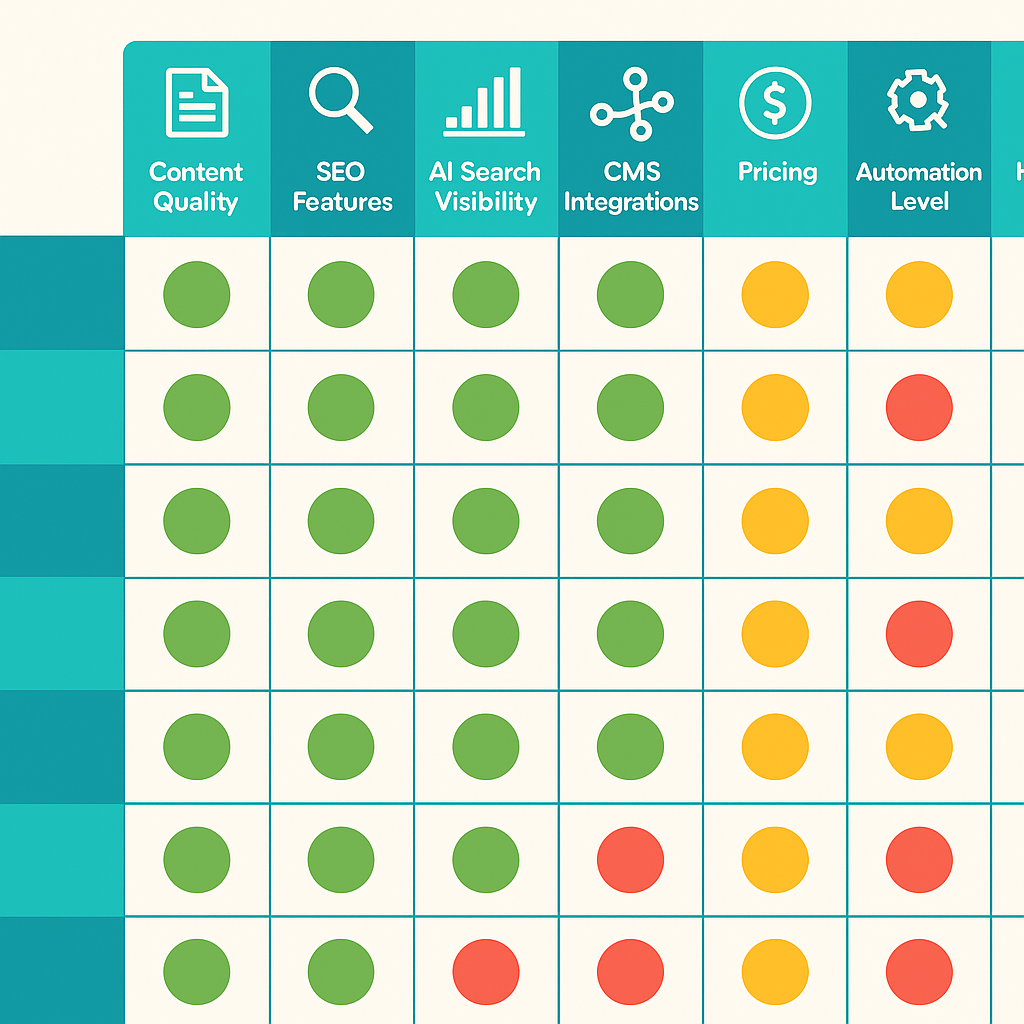
With all eight tools evaluated individually, the pattern that emerges is clear: the market has bifurcated into writing assistants (Rytr, Copy.ai, Anyword) and content systems (Gofylo, Writesonic, Scalenut, Surfer SEO). Koala sits in the middle as a volume-publishing tool for a specific niche. The critical dimension that almost no competitor covers adequately is AI search visibility — the ability to track whether your content is being cited in ChatGPT, Perplexity, Claude, or Gemini. According to Gartner's 2025 research on AI-augmented search, AI-assisted search is reshaping how buyers discover vendors and evaluate solutions — which means brand visibility in AI-generated answers is rapidly becoming as important as traditional SERP rankings. Most Jasper alternatives treat this as a future problem; Gofylo is the only platform in this comparison with a native AI Visibility Score built in.
- Autonomous publishing without human prompts: Gofylo only
- AI search visibility tracking (GEO): Gofylo only
- On-page SEO scoring built into the editor: Writesonic, Scalenut, Surfer SEO
- Budget-accessible entry point (under $10/month): Rytr
- GTM and sales workflow automation: Copy.ai
- Predictive conversion scoring: Anyword
- SERP-informed article generation with WordPress auto-publish: Koala AI
- Comprehensive content planning + keyword clustering: Scalenut
Verdict on specialization: If you're buying a tool that does one thing very well — conversion copy scoring (Anyword), on-page optimization (Surfer), or GTM workflows (Copy.ai) — those single-axis tools are solid. If you need an all-in-one system that compounds organic traffic without a content team, Gofylo is structurally different from everything else in this list.
The AI Search Visibility Gap Most Tools Miss
Every tool in this comparison helps you produce content. Almost none of them help you understand whether that content is actually being surfaced when a buyer asks ChatGPT, Perplexity, or Gemini a question your company should be answering. This gap is significant in 2026, and it's worth dwelling on because it changes how you should think about tool selection. Traditional SEO tools measure Google rankings, organic impressions, and click-through rates. Those metrics still matter, but they're an incomplete picture of your brand's discoverability. As AI search engines synthesize answers from indexed content — and increasingly surface specific brand citations in those answers — the teams that aren't tracking AI share of voice are flying blind on a growing portion of their addressable discovery surface.
According to Search Engine Land's 2025 analysis of AI-driven search behavior, the content attributes that drive AI citations differ meaningfully from what traditional PageRank signals optimize for. Structured content with clear answer formatting, FAQ schema, entity-rich descriptions, and authoritative sourcing is consistently cited more often in LLM-generated responses. This means the content strategy required to rank in AI search — structured, cited, schema-marked, entity-dense — is different from the template-based generation that most writing tools default to. Gofylo's Content Engine is designed around these requirements: every article ships with schema markup, FAQ blocks, internal linking, and AI-generated images, and the AI Visibility Score tells teams how ChatGPT and Claude see their brand by asking those two engines directly. The AI Visibility Score gives teams a single number for how ChatGPT and Claude see their brand, based on asking those two engines directly.
What AI visibility tracking actually measures: Rather than counting keyword rankings, an AI visibility layer tracks how often your brand, products, or content appear in direct responses generated by ChatGPT, Claude, Perplexity, and Gemini for relevant queries. This is structurally different from impressions — it measures authoritative citation, which is the new definition of organic reach in AI-mediated search.
Why it matters for B2B SaaS specifically: B2B buyers increasingly research categories and compare vendors through AI-assisted queries before they ever visit a vendor website. If your brand isn't being cited in those AI-generated answers, you're invisible at the top of the funnel — regardless of how well your content ranks in traditional Google search. The teams that build AI citation into their content strategy now will compound that advantage over the next several years.
The content attributes that drive AI citation: According to Semrush's 2025 research on AI search optimization, content with structured headings, clear entity definitions, FAQ sections with precise answers, and outbound citations to authoritative sources is significantly more likely to be cited in AI search responses. These are exactly the attributes Gofylo's Content Engine builds into every article automatically.
Which Tool Should You Actually Pick?
The honest answer to the 'best Jasper AI alternative' question is that it depends on what you're trying to solve. There is no universal winner here, but there are clear winners for specific use cases — and being honest about which problem you actually have will save you time and money on tool trials. Here's how we'd distill the decision across the most common buyer profiles.
You're a B2B SaaS founder or growth lead: You need consistent, high-quality content that ranks on Google and gets cited in AI search, but you don't have a dedicated content team. You want a system that runs autonomously and compounds over time. The choice is Gofylo. The all-in-one plan at $79/month covers content generation, publishing, and AI visibility tracking in a single workflow — and the autonomous agent architecture means you're not trading your time for output. According to many Jasper AI alternatives Reddit threads, the recurring complaint is that tools require too much manual effort to produce consistent volume. Gofylo addresses that directly.
You're an SEO manager who needs structured content planning: You have a writer or two on staff and want a data-driven planning layer that ensures every article targets the right keyword cluster before writing begins. Scalenut's topic research and brief generation workflow is the most mature in this category. Combine it with a publishing integration for the best results.
You're a demand gen or performance marketing lead: You need AI copy that converts across multiple channels and want predictive scoring to guide decisions before spending budget. Anyword's performance prediction model is the strongest here. For pure copy volume and variety (ads, landing pages, email, social), Writesonic's breadth covers more surface area at a reasonable price point.
You're a solo operator or bootstrapped founder on a tight budget: You need a writing assistant that's affordable and capable enough for light content output. Rytr's free tier and $7.50/month entry point make it the most accessible option in this list. For slightly more SEO structure without much more cost, Koala AI's SERP-informed generation is worth testing. For the AI search visibility angle, the Gofylo free AI Search Grader is a no-commitment starting point.
Final Verdict: For pure writing assistance across content types, Writesonic offers the best breadth. For SEO planning depth, Scalenut leads. For budget accessibility, Rytr wins. But for B2B SaaS teams that need an autonomous system that generates, publishes, and tracks AI-cited content without a content team, Gofylo is the only platform in this comparison built for that outcome end-to-end.
Frequently Asked Questions
These are the questions we see most often from teams evaluating Jasper AI alternatives in 2026 — answered directly based on how these tools actually perform.
Who competes with Jasper AI?
The primary competitors to Jasper AI as of 2026 include Writesonic, Copy.ai, Rytr, Anyword, Scalenut, Koala AI, and Surfer SEO on the writing and SEO side — and Gofylo on the autonomous content engine and AI search visibility side. Each competes on different dimensions: some on price, some on SEO tooling depth, some on conversion copy features, and Gofylo on end-to-end autonomous publishing with native AI citation tracking. The competitive landscape has expanded significantly since Jasper's early dominance, giving buyers more specialized and more capable alternatives across every use case.
Is there a free alternative to Jasper?
Yes — several tools in this comparison offer free tiers. Rytr's free plan gives you 10,000 characters per month, which is enough to evaluate output quality before committing. Writesonic and Copy.ai both offer limited free tiers as well. Gofylo offers a free AI Search Grader tool that grades your current AI search visibility and provides actionable scoring — a useful entry point even if you're not yet ready to commit to a full content engine plan.
Is Jasper AI still worth it?
For teams that specifically value Jasper's brand voice customization features and already have a workflow built around it, Jasper can still deliver value. However, for teams starting fresh in 2026 or re-evaluating their stack, the alternatives in this guide generally offer more capability per dollar — especially on SEO depth, autonomous publishing, and AI search visibility. The category has moved faster than Jasper's product roadmap, and the value gap between Jasper and tools like Gofylo or Scalenut has widened meaningfully.
What is the cheapest alternative to Jasper?
Rytr is the most affordable Jasper AI alternative in this comparison, with a free tier (10,000 characters/month) and paid plans starting at $7.50/month. For teams that need slightly more SEO structure, Koala AI and Writesonic's entry tiers offer more per dollar at modest price points. If budget is the primary constraint but you also need AI search visibility tracking, Gofylo's all-in-one plan at $79/month covers far more functional territory than any of the budget tools when you factor in what you'd otherwise pay separately for content generation, SEO tooling, CMS publishing, and AI visibility monitoring.
Which Jasper AI alternative is best for B2B SaaS content specifically?
For B2B SaaS teams, the key requirements are topical depth, SEO structure, E-E-A-T compliance, CMS integration, and increasingly — AI search citation visibility. Gofylo is built specifically for this profile: autonomous article generation with schema markup, FAQ blocks, and internal linking, plus an AI visibility score based on how ChatGPT and Claude see your brand. Scalenut is the strongest alternative if you prefer a planning-first workflow with a human writer executing the drafts. Writesonic works well for teams that produce a high mix of content types across organic and paid channels.
Do any Jasper AI alternatives support AI search visibility tracking?
As of 2026, Gofylo is the only platform in this comparison with native AI search visibility tracking built in. Its AI Visibility Score is generated by asking ChatGPT and Claude about the brand, giving teams a benchmark for how those two engines perceive them. Other tools in this comparison focus exclusively on traditional Google SEO metrics, leaving teams without visibility into the growing portion of discovery that happens through AI-generated search answers.
Ready to replace the manual content workflow entirely? Gofylo's autonomous content engine generates, publishes, and tracks AI-cited content across your CMS and AI search platforms — 30 articles per month, under 4 minutes each, starting at $79/month. Start your 3-day free trial at gofylo.io. Or run your free AI Search Grader to see exactly where your brand stands in AI search right now.