As of 2026, the search landscape has fractured. A meaningful share of your potential buyers never hit a Google results page — they ask ChatGPT, query Perplexity, or get an answer synthesized by Claude or Gemini. If your brand isn't cited in those responses, you're invisible to a growing segment of high-intent, research-ready buyers. Traditional SEO dashboards show you keyword rankings and organic traffic, but they have no concept of whether an LLM knows your product exists. That gap is exactly what LLM visibility tools are built to close.
2026 data from Gartner's AI search forecast projects that by 2028, AI-powered search interfaces will influence over 70% of B2B software research journeys. The implication for SaaS founders and marketing teams is direct: ranking on Google is necessary but no longer sufficient. You need to understand both dimensions of discoverability — traditional SERP presence and AI citation presence — at the same time. LLM visibility tools are the instrumentation layer that makes that dual-track measurement possible.
Thesis: LLM visibility tools are the category of software that monitors, measures, and improves how your brand appears inside AI-generated answers. Understanding what they track, how they work, and what differentiates the best platforms from basic implementations is the foundation of any serious GEO strategy in 2026.
What LLM Visibility Tools Actually Measure
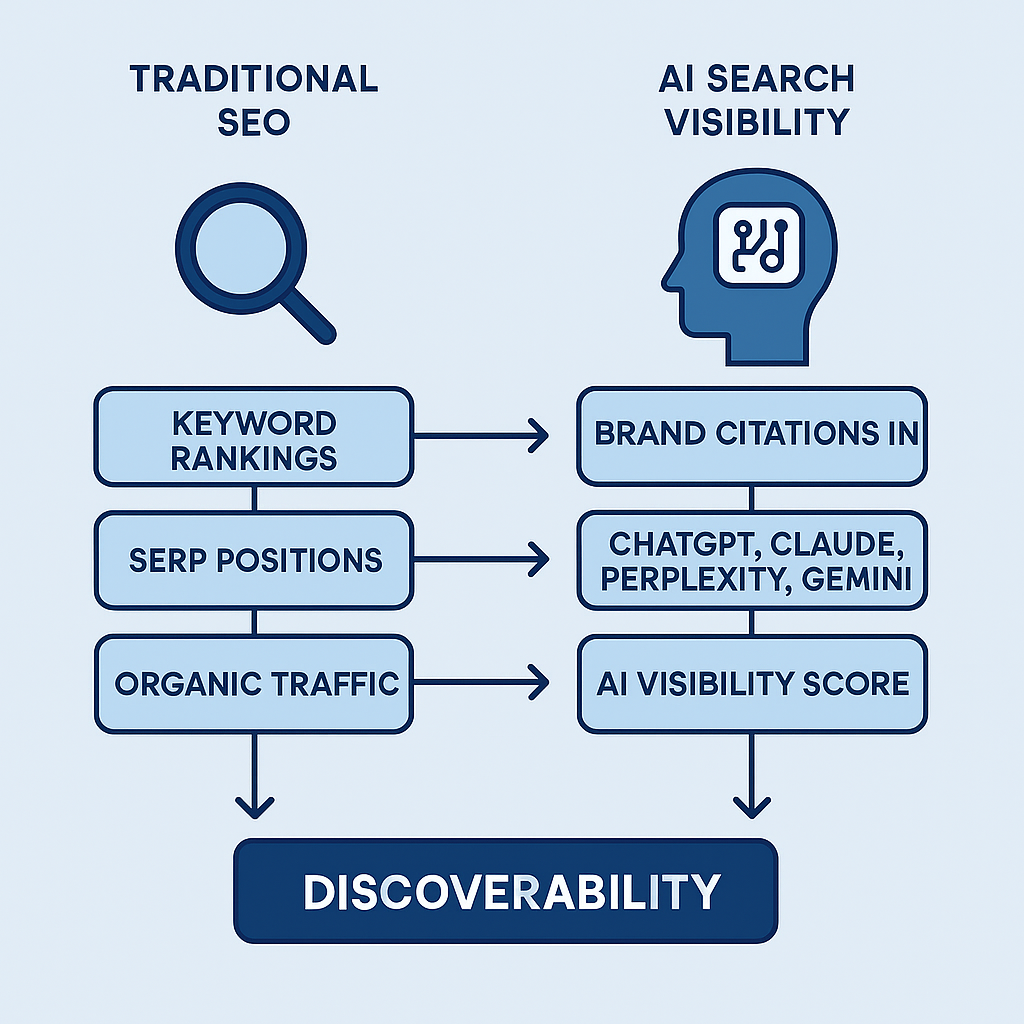
LLM visibility tools monitor how frequently and favorably a brand, product, or domain is mentioned or cited inside AI-generated responses. Unlike traditional rank trackers that query a search engine and record a position number, LLM visibility tools submit prompts — usually buyer-intent queries relevant to a category — to AI engines like ChatGPT, Claude, Perplexity, and Gemini, then analyze the response. The tool records whether your brand was named, whether it was cited as a source, how prominently it appeared relative to competitors, and whether the framing was positive, neutral, or absent. Over time, running this process repeatedly across dozens or hundreds of prompts builds a quantified picture of your AI share of voice.
Citation tracking vs. ranking tracking
The distinction between citation tracking and keyword ranking is conceptually important. A keyword rank tells you where a page lands in a list. A citation tells you whether an AI system treated your content as authoritative enough to reference when constructing an answer for a user. These are related but not equivalent. A page can rank #1 on Google and never appear in a Claude response. Conversely, a piece of deeply structured, well-cited content may not rank in the top five organically but gets pulled into LLM answers regularly because it demonstrates the kind of semantic clarity and sourced specificity that language models favor. LLM visibility tools surface that second signal, which most SEO platforms ignore entirely.
How AI Search Differs From Traditional Search Indexing
Traditional search engines like Google index documents, score them against hundreds of ranking signals, and return a ranked list. Users navigate to pages. AI search works differently: the model synthesizes an answer from its training data and real-time retrieval, presenting a response that may never require the user to click anywhere. This shifts the competitive dynamic significantly. You're no longer just competing for a click — you're competing to be the information source the AI trusts and quotes. The factors that drive that trust include content depth, citation quality, entity clarity, schema markup, and the structural legibility of your content to a language model. According to Search Engine Land's 2025 GEO analysis, brands that structured content with clear definitions, FAQ blocks, and explicit sourcing saw a 3x improvement in AI citation frequency compared to traditionally formatted blog posts.
Why content structure changes everything for LLMs
Language models don't read your website the way a human does. They ingest text as tokens and extract meaning through pattern recognition. Content that uses clear H2/H3 hierarchy, defines terms explicitly, answers questions in the first sentence of each section, and includes structured data like FAQ schema is dramatically easier for a model to parse and attribute. This is why the llms.txt standard has gained traction — it gives site owners a machine-readable way to communicate what their content covers. The relationship between content structure and AI citation rates is not theoretical; it's measurable, which is exactly why LLM visibility tools that track structure-related changes alongside citation rates are more useful than those that only report citation counts.
The Core Components of a Serious LLM Visibility Tool
Not every tool marketed under the LLM visibility umbrella measures the same things or provides the same strategic value. At the foundational level, a serious platform needs to do three things well: run structured prompt queries across multiple AI engines on a scheduled basis, return normalized data that lets you compare citation presence across ChatGPT, Claude, Perplexity, and Gemini in one view, and track changes over time so you can correlate content or technical actions with visibility shifts. Beyond that baseline, the differentiation comes in how the tool helps you act on what it finds — not just report the numbers.
AI Visibility Score: the benchmark metric that matters
A single composite score that aggregates citation frequency, sentiment, and competitive share of voice is more actionable than raw citation counts. Gofylo's AI Visibility Score, for example, is an AI Visibility Score derived from asking ChatGPT and Claude about a brand — a single benchmark that tells a team at a glance how visible they are in AI-driven search. The score is tracked over time and broken down by AI engine, so you can see if you're strong on Perplexity but absent from Claude, which informs where your content remediation should focus. This kind of composite metric is structurally similar to Domain Authority for traditional SEO — a single number that compresses complex multi-signal data into something a founder or CMO can act on without becoming a data analyst.
- Multi-engine coverage: tracks citations across ChatGPT, Claude, Perplexity, and Gemini simultaneously
- Prompt library management: lets you define the buyer-intent queries relevant to your category
- Competitor benchmarking: shows your citation share relative to named competitors
- Trend tracking: records changes over time so you can attribute visibility shifts to specific content or technical actions
- Sentiment analysis: distinguishes between being cited favorably versus being mentioned as a cautionary example
- Alerting: notifies you when your citation rate drops or a competitor's rises significantly
The difference between a basic LLM visibility tool and a best-in-class platform is whether it closes the loop between measurement and action — not just reporting where you stand, but giving you a clear path to improving it.
How LLM Visibility Tools Integrate With Traditional SEO
The most common mistake teams make when they discover LLM visibility tracking is treating it as a replacement for traditional SEO metrics. It isn't — it's an additional layer. Google's organic traffic still represents a substantial portion of most B2B SaaS acquisition funnels as of 2026, and the technical and content signals that improve Google rankings (E-E-A-T compliance, internal linking, schema markup, page speed) also improve AI citation rates. According to Ahrefs' 2025 content study, pages with strong backlink profiles and clear topical authority are significantly more likely to be surfaced by AI retrieval systems than pages with similar word counts but weaker link equity. The two channels reinforce each other when your content strategy is built correctly.
The dual-channel content strategy
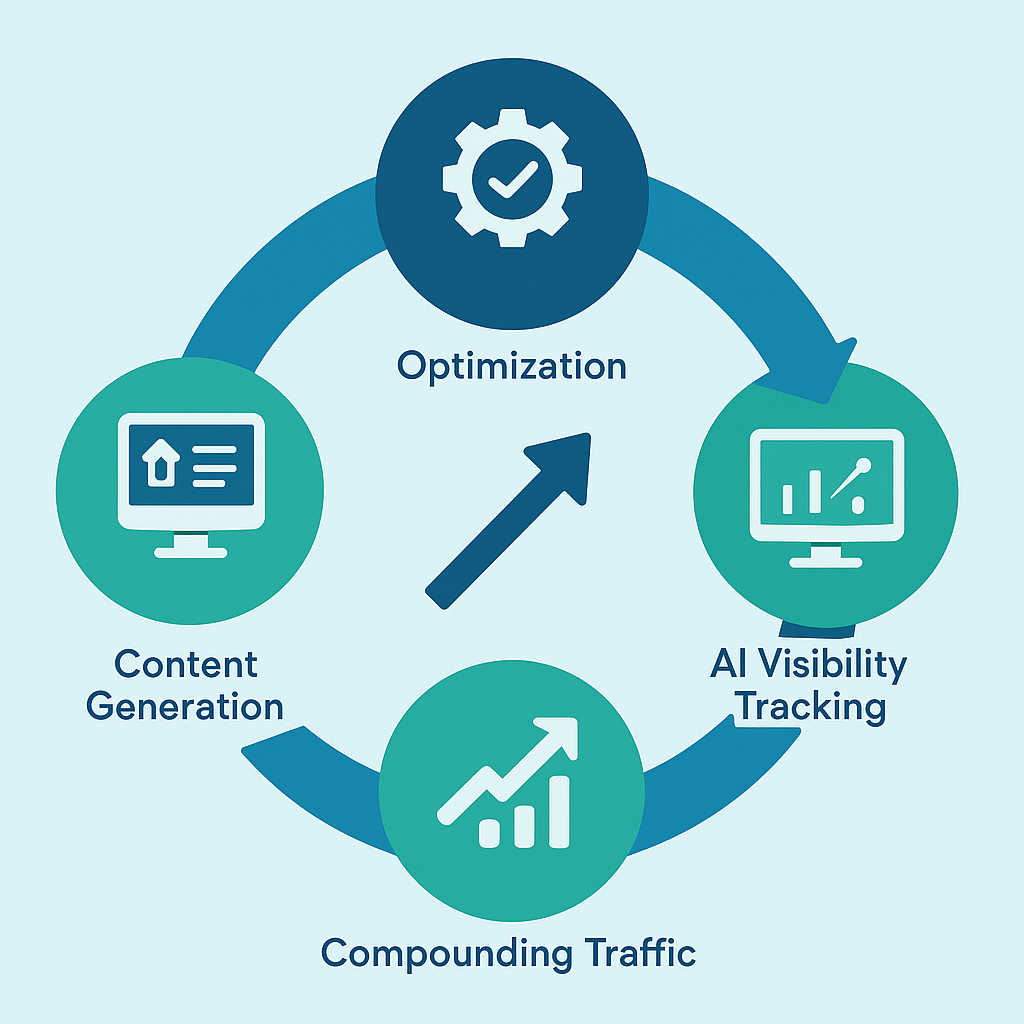
A dual-channel content strategy means producing content that satisfies both Google's crawlers and LLM retrieval simultaneously. In practice, that means structuring every article with an answer-first paragraph under each heading (for LLM snippet extraction), using schema markup for FAQs and how-tos (for both Google rich results and model-readable structure), building internal links that establish topical clusters (for Google authority and LLM entity resolution), and generating content at the volume and consistency that compounds over time. This is why the content generation and AI visibility tracking capabilities need to be considered together — publishing one article per week manually while watching your AI Visibility Score is disconnected. The compounding effect comes when content output, optimization, and tracking happen in the same system.
What Separates Basic from Best-in-Class Platforms
Most entry-level LLM visibility tools do the same thing: they run a set of prompts against one or two AI engines on a manual or weekly schedule and return a spreadsheet of citations. That's useful as a one-time audit but insufficient as an operational system. Best-in-class platforms close the loop between measurement and the content actions required to improve the score. They connect visibility tracking to the content pipeline, so when your AI Visibility Score drops on a particular topic cluster, the system can flag which articles need updating or which gaps in your content library are contributing to the absence. According to SEMrush's 2026 State of Search, brands that ran automated content programs alongside AI visibility monitoring saw 2.4x more AI citations over a 6-month period compared to brands that only monitored without publishing new content.
Autonomous content generation as an LLM visibility lever
The mechanism behind that 2.4x lift is straightforward: LLMs favor brands that demonstrate topical depth. If you cover five articles on a topic and a competitor covers fifty, the competitor's content is more likely to be retrieved because it covers more angles, answers more query variations, and has more internal linking density signaling authority. This is why autonomous content generation — not just assisted writing, but fully automated research, writing, optimization, and publishing — is structurally different from manual content workflows. Gofylo researches keywords, writes articles in the customer's brand voice, and publishes 30 per month on the standard plan, each written in a few minutes. Each article includes schema markup, internal linking, FAQ blocks, and AI-generated images — the exact structural signals that both Google and LLMs use to evaluate content quality and authority. When tracked alongside Gofylo's AI visibility score — which reflects how ChatGPT and Claude see a brand — teams get a closed loop: more content, higher topical coverage, and a measurable read on AI visibility.
Volume creates authority. LLMs learn topical authority from content breadth. A brand that covers a subject cluster from 20 angles is more likely to be cited than one that published a single definitive post. Autonomous generation at scale is the mechanism, not a shortcut.
Structure drives citation. Answer-first paragraphs, FAQ schema, clear entity definitions, and internal linking clusters are the structural signals LLMs use to extract and attribute information. Content without these signals gets read but rarely cited.
Tracking closes the loop. Publishing without measuring AI citation impact is flying blind. An AI Visibility Score that moves in response to content actions gives teams the feedback cycle they need to prioritize work — and justify budget.
Integration removes friction. LLM visibility tools that connect to your CMS (WordPress, Webflow, Shopify, Ghost, Framer, and others) and deliver alerts to Slack eliminate the dashboard-checking overhead that kills adoption of monitoring tools.
How to Evaluate LLM Visibility Tools for Your Stack
When you're comparing LLM visibility tools, the evaluation criteria should reflect what actually moves the needle for a growth-stage SaaS team: engine coverage, data freshness, actionability, and integration depth. A tool that only monitors one AI engine is a partial picture. A tool that delivers weekly reports with no alerting misses the real-time shifts that matter. And a tool that exists in isolation from your content workflow forces a manual translation step between insight and action that most small teams won't sustain. The question isn't just 'does this tool track AI citations' — it's 'does this tool help my team improve AI citations without adding operational overhead.'
- Engine breadth: does it cover ChatGPT, Claude, Perplexity, and Gemini — or just one or two?
- Prompt customization: can you define the exact buyer-intent queries relevant to your category and ICP?
- Competitive benchmarking: does it show your citation share relative to specific named competitors?
- Integration depth: does it connect to your CMS and deliver alerts where your team already works (e.g., Slack)?
- Content loop closure: does it connect visibility gaps to content recommendations, or just report numbers?
- Pricing transparency: is it a flat plan without seat-based or usage-based surprises?
- Trial availability: can you validate the data quality against your own brand before committing?
Platforms like rankai.ai focus on AI visibility reporting in isolation. The structural difference with a platform like Gofylo is that visibility scoring is one layer of a unified system — connected to autonomous content generation, CMS publishing, and competitor keyword research. Measurement without the mechanism to improve the metric is just a dashboard.
Frequently Asked Questions About LLM Visibility Tools
These are the questions we see most often from founders and marketing leads who are evaluating LLM visibility tools for the first time. The answers reflect how the category actually works in 2026, not theoretical best practices.
Do I need an LLM visibility tool if I already use a traditional SEO platform?
Yes. Traditional SEO platforms like Ahrefs or SEMrush measure Google rankings, backlink profiles, and keyword traffic — none of which tells you whether ChatGPT or Perplexity cites your brand in responses to buyer queries. These are different data streams. As AI-assisted search captures a larger share of research journeys, you need both instruments running in parallel to have a complete picture of your organic discoverability.
How often should LLM visibility tracking run?
Daily or near-daily tracking is ideal for brands actively publishing content or running competitive markets. Weekly is acceptable as a baseline. Monthly is too infrequent to catch the correlation between a content publish and a citation lift — or to catch a competitor's content surge before it erodes your position.
What content signals most improve LLM citation rates?
The signals with the highest lift are: answer-first structure (directly answering the implied question within the first 150 words of a section), FAQ schema markup, explicit source citations within the content itself, internal linking that establishes topical clusters, and publishing volume within a defined subject area. These are the same signals Gofylo bakes into every article by default — schema markup, FAQ blocks, internal links, and verified source citations.
Is there a free way to check my current AI visibility before buying a tool?
Yes. Gofylo offers a standalone AI Search Grader that grades your brand's current AI search visibility and returns actionable scoring without requiring a paid account. It's a useful starting benchmark before committing to a full LLM visibility monitoring platform.
How does llms.txt relate to LLM visibility tools?
The llms.txt standard is a machine-readable file placed at your domain root that communicates what your site covers and what content is available for AI retrieval. It's a technical signal that can improve how LLMs index and attribute your content — conceptually similar to robots.txt for traditional crawlers. LLM visibility tools measure the outcome (citation rates), while llms.txt is one lever that influences that outcome. They work together: you implement llms.txt to improve discoverability, and you use an LLM visibility tool to measure whether it worked.
Related: What llms.txt Actually Does for Your AI Search Visibility
Related: What an SEO Agent Actually Does — And Why It Matters in 2026
Related: Top 9 LLM Optimization Tools Ranked by AI Visibility Impact
Related: Get Cited by ChatGPT Without Paying for Ads in 2026
Related: Software Showdown: Top AI Visibility Platforms Compared for 2026
Related: From Zero Citations to AI-Cited Brand: LLM Seeding in 2026
Related: llms.txt Decoded: What It Is and Why AI Search Changes Everything
Related: What Does an AI Visibility Checker Actually Tell a SaaS Team?
Related: How AI Checkers Score Your Content, and How to Test Them Yourself
Related: Profound Pricing Buys Visibility Data, Not Content: How It Compares
If you're not sure where your brand stands in AI-driven search right now, Gofylo's free AI Search Grader gives you a visibility score from ChatGPT and Claude — no commitment. Or start a 3-day free trial of the full platform to see your AI Visibility Score alongside automated content generation and competitor tracking, all at $79/month with no-questions-asked cancellation. Start at gofylo.io.