As of 2026, the market for AI powered writing tools has crossed $3.64 billion and is accelerating — according to the AutoFaceless Blog's 2026 AI Writing Statistics report, the global AI writing assistant software market is projected to reach $9.09 billion by 2033, growing at a compound annual growth rate of 12.1%. That's not a trend worth tracking; it's a structural shift in how content teams operate. If you're a founder or marketing lead at a B2B SaaS company, the question stopped being 'should we use AI writing tools' a while ago. The question now is which tools produce compounding returns — content that ranks on Google, gets cited by ChatGPT and Perplexity, and doesn't require a team of editors to clean up.
Most tools in this category are, bluntly, expensive wrappers around the same foundation models. They charge $50–$200/month for a GPT-4-class interface with a few templates bolted on. A small subset are actually workflow systems — they research, write, optimize, publish, track, and improve content without someone prompting each step. That distinction matters enormously for lean teams. This list covers both categories honestly, evaluates each tool for both traditional SEO and AI search visibility (how ChatGPT, Claude, Perplexity, and Gemini surface your content), and positions each for the workflow context where it genuinely performs.
Thesis: Not all AI powered writing tools are equal. The best ones for B2B SaaS teams in 2026 don't just generate text — they handle the full content lifecycle and produce content visible in both Google and AI search engines. Here's how the leading options stack up.
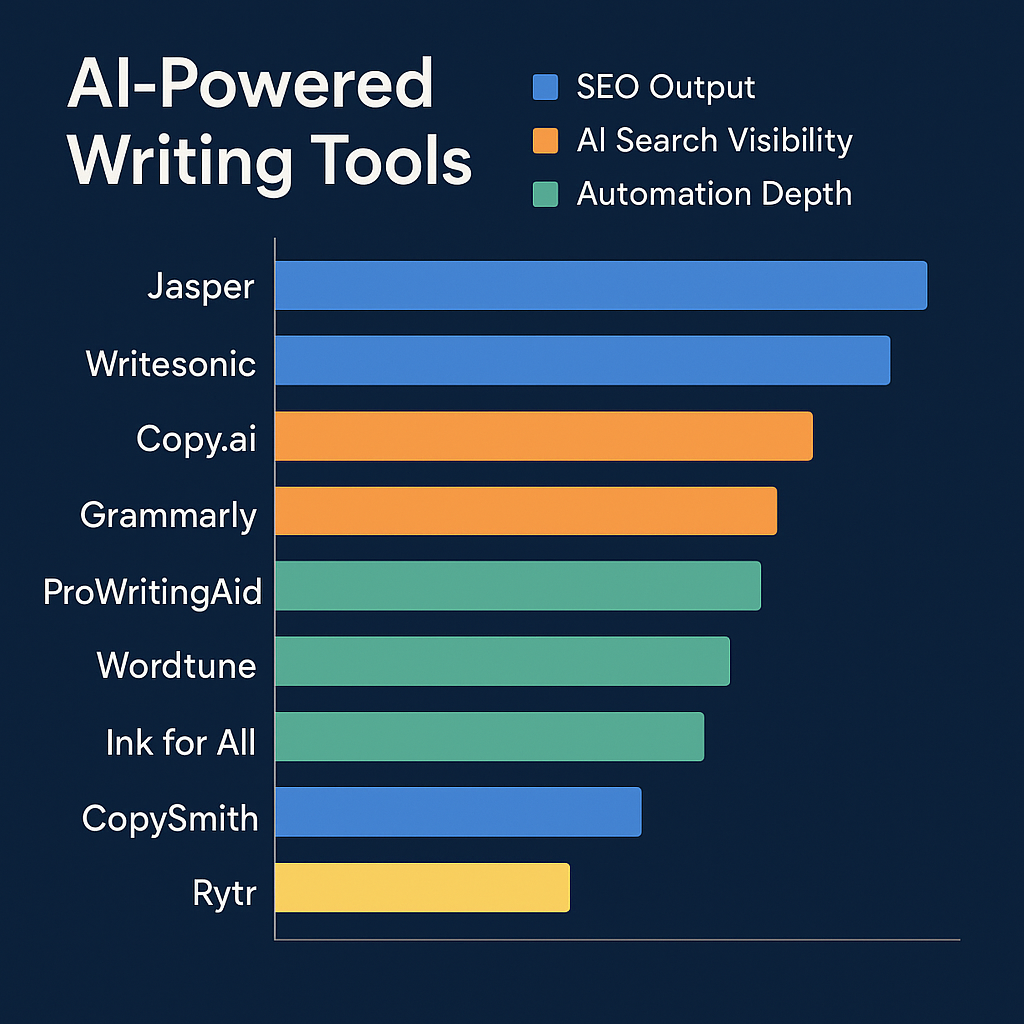
All 9 Tools at a Glance
Before diving into each tool individually, here's the complete list covered in this article. Each tool is categorized by its primary use case for B2B SaaS teams. The order reflects overall compounding value for content-driven organic growth — not feature count or brand recognition.
- Gofylo — Autonomous full-lifecycle content engine with AI search visibility tracking
- Jasper AI — Brand-controlled long-form content with campaign workflow integration
- Copy.ai — Go-to-market workflow automation across sales and marketing content
- Surfer SEO — On-page SEO optimization layered onto any writing workflow
- Writesonic — Budget-friendly AI writing with built-in SEO scoring
- Claude (Anthropic) — Complex reasoning, nuanced drafting, and structured analysis
- Rytr — Fast, low-cost content generation for solo operators and bootstrapped teams
1. Gofylo — Best for Autonomous, Full-Lifecycle Content
Gofylo is structurally different from every other tool on this list. While most AI powered writing tools require a human to initiate, prompt, review, and publish each piece of content, Gofylo handles keyword research, article writing, and CMS publishing without manual prompts. Each article is written in a few minutes — 30 articles per month on the standard plan. Every article ships with schema markup, internal links, FAQ blocks, AI-generated images in five styles, and verified source citations.
AI search visibility built in. Gofylo's AI visibility score is generated by asking ChatGPT and Claude about your brand — giving you a single score that reflects how those two engines see you. This is a capability gap most tools in this space don't even acknowledge. As AI-driven search displaces traditional rankings, knowing whether your content gets cited by large language models is as important as knowing your Google position. Gofylo surfaces both in one dashboard.
Publishing integrations. Gofylo connects directly to your CMS — plus an API webhook for custom CMS setups. Slack integration handles monitoring alerts. Content is generated in 18+ languages, and articles are grouped into topic clusters for teams targeting keywords at scale.
Pricing and access. Gofylo runs at $79/month with a 3-day free trial. A free AI Search Grader tool is available as a standalone entry point if you want to benchmark your current AI search visibility before committing to the full platform. For B2B SaaS founders and marketing leads who need compounding organic growth without a content team, this is the most complete option in the 2026 market.
2. Jasper AI — Best for Brand-Controlled Long-Form Content
Jasper AI is one of the most established AI powered writing tools for marketing teams. Its core differentiator is brand voice control — you can train Jasper on your company's tone, style guide, and product vocabulary, then produce long-form content (blog posts, whitepapers, case studies) that sounds distinctly on-brand rather than generically AI-generated. Jasper integrates with Surfer SEO for on-page optimization scoring and supports campaign workflows that link individual content pieces to broader marketing programs. Pricing starts around $49/month for the Creator plan, with team and business tiers scaling up. The platform does not auto-publish, does not track AI search visibility, and does not autonomously surface keywords — it's a high-quality writing assistant that still requires a human to direct each session. If you already have a content strategist and just need faster drafting, Jasper is a strong fit. If you're trying to replace the content strategy function entirely, it won't get you there. For context on how Jasper compares to alternatives, see our related coverage on jasper ai alternatives.
3. Copy.ai — Best for Go-to-Market Workflow Automation
Copy.ai has evolved significantly from its early days as a short-form copy generator. In 2026, it positions itself as a GTM (go-to-market) AI platform — connecting sales sequences, outbound email personalization, product marketing copy, and content workflows into automated pipelines. For demand generation and sales enablement teams that need to produce high volumes of personalized outreach alongside content marketing assets, Copy.ai's workflow automation is genuinely useful. Its Workflows feature lets teams build multi-step AI processes without code: research a prospect, pull their LinkedIn data, generate a personalized email, draft a follow-up sequence. The platform's blog and long-form SEO content capabilities are competent but secondary to its GTM positioning. Pricing starts around $49/month; enterprise tiers add custom workflows and integrations. It does not publish autonomously, does not track AI search visibility, and doesn't handle technical SEO elements like schema markup or internal linking at scale.
4. Surfer SEO — Best for On-Page SEO Optimization
Surfer SEO is a specialized tool that sits alongside AI writers rather than replacing them. Its primary function is analyzing the top-ranking pages for a given keyword and providing a content score based on word count, keyword density, heading structure, NLP terms, and entity coverage — then giving you real-time feedback as you write or as your AI tool generates content. Surfer integrates with Jasper, Google Docs, and WordPress, making it a useful layer on top of any writing workflow. As of 2026, Surfer has added an AI writing function that generates SEO-optimized first drafts based on its own SERP analysis — but this is secondary to its scoring and optimization engine. Pricing starts around $89/month. For SEO managers who want rigorous on-page optimization and are already using a separate AI writing tool, Surfer adds measurable value. It doesn't address AI search visibility, programmatic publishing, or autonomous content generation. For broader coverage on AI tools for SEO, see our related article on ai tool for seo.
Key distinction: Tools like Surfer SEO optimize content for Google's ranking signals. Tools like Gofylo optimize for both Google and AI engine citations — a necessary dual focus as AI-driven search queries increase year over year. If your tool only addresses one of these surfaces, you're leaving a growing share of discovery traffic on the table.
5. Writesonic — Best Budget Option with SEO Features
Writesonic occupies the budget-friendly tier of AI powered writing tools while including more SEO functionality than many tools at its price point. Its Chatsonic feature is a GPT-4-powered chat interface with real-time web access, useful for generating content that references current events or recent data. Its AI Article Writer can produce 1,500–3,000 word articles from a keyword or brief, with basic on-page optimization guidance built in. Writesonic also offers a factual article mode and a Botsonic chatbot builder as part of its platform. Pricing is genuinely accessible — a free tier exists with word limits, and paid plans start around $16/month for the small team plan. The trade-offs are real: content quality requires more editing than Jasper or Claude-based outputs, the SEO optimization is lighter than Surfer, and there's no autonomous publishing or AI visibility tracking. For bootstrapped founders and solo operators who need a writing AI tools free online option or a very low-cost paid tier, Writesonic is the most feature-complete budget entry.
6. Claude (Anthropic) — Best for Complex Reasoning and Nuance
Claude (built by Anthropic) is less a content marketing tool and more a high-capability reasoning engine that produces exceptionally well-structured, nuanced writing. If you're drafting a technical whitepaper, structuring a complex comparison piece, writing analyst-style reports, or producing content that requires synthesizing multiple documents and maintaining coherence over long outputs, Claude's 200k+ context window and analytical depth outperform most alternatives. As of 2026, Claude is widely regarded as producing the most naturally human-sounding long-form content among foundation model interfaces — we've covered the comparison in depth in our related article on is claude ai better than chatgpt. The catch: Claude is a raw model interface, not a content workflow tool. There's no keyword research, no publishing integration, no SEO scoring, no AI visibility tracking. You get an exceptionally capable writing assistant that requires you to bring the strategy, the prompts, and the publishing workflow. Claude Pro runs around $20/month; API access is available for teams wanting to build Claude-powered pipelines. Many teams use Claude as the generation layer inside broader stacks — including inside Gofylo's content pipeline.
7. Rytr — Best for Solo Operators on a Tight Budget
Rytr is one of the most accessible AI powered writing tools free tiers available — its free plan gives 10,000 characters per month, enough for a solo founder testing AI-assisted content. The platform covers 40+ use cases (blog posts, email, LinkedIn posts, ad copy, product descriptions) with tone selection and a built-in plagiarism checker. Rytr doesn't compete on depth or SEO sophistication — it competes on accessibility and speed for straightforward copy tasks. Paid plans start at $9/month (Saver) and $29/month (Unlimited). The quality ceiling is lower than Claude or Jasper, the SEO features are minimal, and there's no publishing automation. But for a solo operator who needs a low-friction tool to accelerate first drafts across a variety of short-form content types, Rytr over-delivers at its price point. It's a genuinely useful entry-level writing AI tools free online option before you scale into a more capable platform.
8. Sudowrite — Best for Long-Form Narrative Writing
Sudowrite is purpose-built for long-form structured writing — it gained its initial reputation in fiction writing communities (as many readers searching 'Sudowrite' already know), but its story engine, feedback tools, and structured narrative generation capabilities transfer well to other forms of long-form content: in-depth guides, narrative case studies, serialized content, and thought leadership pieces that require sustained voice and structure across thousands of words. Sudowrite's Write, Describe, Brainstorm, and Shrink/Expand tools give writers control over pacing and density in a way that generic AI interfaces don't. Pricing starts around $22/month. Like Claude, Sudowrite is a writing tool, not a content marketing platform — no keyword research, no SEO optimization, no publishing integrations, no AI visibility tracking. For content teams producing narrative-heavy assets who want the best long-form writing experience available, it's worth evaluating. For teams that need SEO-optimized content at scale, it's not the right category of tool.
9. Notion AI — Best for Teams Already Living in Notion
Notion AI is the most contextually convenient AI powered writing tool for teams whose knowledge base, documentation, project management, and drafting workflow already live in Notion. It sits directly inside Notion pages and databases, letting you generate, summarize, improve, translate, or transform content within your existing workspace. For internal documentation, meeting notes, draft briefs, and knowledge base articles, Notion AI reduces tool-switching friction significantly. The writing quality is solid for internal use cases; for SEO-optimized external content, it lacks the structural features (schema, NLP optimization, internal linking automation) that purpose-built content tools provide. Notion AI is included in Notion's Plus plan ($16/month per user) and above, making it a near-zero marginal cost addition for existing Notion subscribers. It's worth activating if you're already paying for Notion — it's not worth switching to Notion for.
How to Evaluate AI Powered Writing Tools for B2B SaaS
The 2026 landscape of AI powered writing tools has a clear bifurcation: tools that write, and tools that compound. Writing tools help a human produce content faster. Compounding tools research, generate, optimize, publish, and track content autonomously — creating a flywheel where each article strengthens the next through internal links, topical authority signals, and AI citation density. For B2B SaaS teams specifically, the evaluation framework should cover at least three dimensions before committing budget.
SEO Output Quality
Not all AI-generated content ranks. Google's guidance on AI-generated content is clear: the standard is helpfulness and E-E-A-T (Experience, Expertise, Authoritativeness, Trustworthiness), not whether a human or machine produced the text. AI powered writing tools that produce thin, keyword-stuffed, or structurally weak content will not rank regardless of how fast they generate it. Evaluate tools on: whether they produce structured outlines (H2/H3 hierarchy), whether they include FAQ blocks and schema markup, whether they handle internal linking, and whether output quality holds up under editorial review without heavy rewriting. According to data cited by allaboutai.com, AI tools speed up content creation by 430% on average (Nielsen Norman Group, 2025) — but speed without quality is a liability, not an asset.
AI Search Visibility (GEO)
As of 2026, a growing share of organic discovery happens through AI search interfaces — ChatGPT's Browse mode, Perplexity's answer engine, Google's AI Overviews, and Claude's Projects feature. Content that gets cited in these contexts drives qualified referral traffic that never appears in traditional rank tracking. Generative Engine Optimization (GEO) is the practice of structuring content to be cited rather than just ranked. This includes clear source attribution, structured data, direct answer formatting, and entity-rich content. Very few AI powered writing tools address this dimension at all — Gofylo produces every article formatted to be cited by AI assistants, and gives an AI visibility score based on how ChatGPT and Claude see a brand. For deeper context on how this tracking layer works, see our related piece on ai powered content generation tools.
Publishing Automation
Manual publishing is a bottleneck that compounds negatively. A tool that generates content well but requires a human to format, add schema, insert internal links, upload images, and publish to the CMS still consumes significant team time per article. For teams targeting 10–30 articles per month, this overhead is manageable but not scalable. For teams targeting 100+ articles per month (programmatic SEO, content cluster buildout), it's a hard ceiling. Evaluate whether a tool auto-publishes to your CMS, whether it handles schema markup and image generation autonomously, and whether it manages internal linking across your content library. The gap between 'writes content' and 'publishes optimized content autonomously' is the single largest capability difference in the 2026 market.
Adoption data from the AutoFaceless Blog's 2026 AI Writing Statistics report shows 97% of content marketers plan to use AI writing tools in 2026, with teams reporting 44% productivity gains and 42% more content published monthly. The teams reporting the highest gains are using tools that automate publishing — not just generation.
The Free AI Powered Writing Tools Worth Knowing
Several AI powered writing tools free tiers are genuinely useful as starting points, not just stripped-down demos. Here's a realistic assessment of the free options worth spending time on in 2026, along with the honest trade-offs of each.
- Claude.ai (free tier): Excellent long-form reasoning and nuanced writing; limited to a context window and rate limits; no SEO or publishing features; strong for drafting and synthesis tasks.
- Rytr free tier: 10,000 characters/month across 40+ use cases; suitable for solo operators testing AI-assisted copy before committing to a paid plan.
- Writesonic free tier: Limited word count but includes GPT-4-class output with basic SEO guidance; most complete free AI writing tier for content teams evaluating options.
- ChatGPT free tier: Broad capability for drafting, summarizing, and ideation; writing being the single most common work task users actually perform with it (CleverType, 2026); no native SEO or publishing integration.
- Gofylo AI Search Grader: Free standalone tool that grades your brand's current AI search visibility across ChatGPT, Claude, Perplexity, and Gemini; not a writing tool per se, but the best free entry point for understanding your AI citation coverage before scaling content production.
Free AI powered writing tools serve a clear purpose: they let you validate whether AI-assisted content production fits your workflow before committing budget. The meaningful limitations kick in at scale — word limits, no SEO optimization, no publishing automation, no AI visibility tracking. Every free tier on this list will show you enough to know whether to upgrade, but none of them will compound your organic growth without a paid workflow around them. The best free AI writing tools for students and for professional content teams serve different needs — students benefit from Rytr and Claude's reasoning depth; content teams need the SEO and publishing layers that only paid tiers or dedicated platforms like Gofylo provide.
The adoption curve is steep. According to Siege Media's 2025 analysis cited by allaboutai.com, content marketer adoption of AI writing tools jumped from 64.7% in 2023 to 83.2% in 2024 — a 28.6% year-over-year increase. By 2026, that number approaches near-universal adoption. The competitive advantage has shifted from 'using AI tools' to 'which AI tools, at what depth of automation.' Teams still running manual content workflows in 2026 aren't just slower — they're structurally disadvantaged.
Time savings compound. Companies are saving about 2.2 hours per week per employee from AI writing tool adoption (CleverType, 2026). Across a four-person content and marketing team, that's nearly a full-time equivalent in recaptured capacity per month — capacity that can go toward strategy, distribution, or additional content initiatives rather than rote production tasks.
Market growth signals long-term investment. The broader AI writing assistant software market was valued at $2.3 billion in 2024 and is projected to reach $8.3 billion by 2030, growing at a 24.3% CAGR according to Research and Markets' 2026 outlook report. This level of investment signals sustained R&D, integration depth, and competitive pressure across the category — meaning the tools available in 12 months will be meaningfully more capable than what's listed here. Choosing a platform with an autonomous architecture now positions your content program to absorb those improvements without workflow disruption.
AI search is the new frontier. The competitive gap that matters most in 2026 isn't writing speed — it's AI search visibility. Content that gets cited by ChatGPT, Perplexity, and Gemini in response to high-intent B2B queries generates qualified traffic that traditional rank tracking doesn't measure and most content teams don't optimize for. The tools that address this — specifically Gofylo's AI visibility score, which reflects how ChatGPT and Claude see a brand — represent a structural advantage that will widen as AI-driven discovery continues to displace traditional search clicks. For context on how AI powered content creation platforms are evolving on this dimension, see our related piece on ai powered content creation platforms.
Frequently Asked Questions
What's the best AI powered writing tool?
For B2B SaaS teams that need compounding organic growth without a dedicated content team, Gofylo autonomously handles keyword research, article writing, CMS publishing, internal linking, schema markup, and an AI visibility score based on how ChatGPT and Claude see a brand. For teams with existing content strategists who need better drafting tools, Jasper AI (brand voice control) or Claude (reasoning depth and nuance) are the strongest individual writing assistants. For tight budgets, Writesonic offers the best balance of features at a low price point.
Is there any AI tool for writing?
Yes — there are dozens of AI writing tools available in 2026 across every price tier, including genuinely capable free options like Claude's free tier, Rytr's free plan, and Writesonic's free tier. The tools vary significantly in output quality, SEO optimization depth, publishing automation, and AI search visibility coverage. The nine tools covered in this article represent the strongest options across different use cases and budget ranges for B2B SaaS and content-driven businesses.
Can I legally write a book with AI?
In most jurisdictions as of 2026, using AI tools to assist in writing a book is legal — there is no law prohibiting AI-assisted authorship. The copyright status of AI-generated content is more nuanced: in the United States, the Copyright Office has consistently held that works produced entirely by AI without human creative input are not eligible for copyright protection, while human-authored works that incorporate AI-generated elements may qualify with appropriate registration disclosures. If you're writing a book using AI assistance and plan to publish commercially, consulting a copyright attorney familiar with AI authorship is advisable given the rapidly evolving legal landscape.
What are the top 5 most popular AI tools?
By active user base and adoption in 2026, the most widely used AI tools overall are ChatGPT (700 million active users by 2025, according to CleverType 2026), Claude, Google Gemini, Microsoft Copilot, and Perplexity — though these are general-purpose AI assistants rather than dedicated writing platforms. Among purpose-built AI writing tools for content teams, Jasper AI, Copy.ai, Writesonic, Surfer SEO, and Gofylo represent the most widely adopted options in the B2B and content marketing segment.
Do AI powered writing tools work for technical B2B content?
Yes, with the right configuration. Technical B2B content — integration guides, API documentation explanations, technical comparison pieces — benefits from tools with strong reasoning capabilities (Claude is particularly strong here) and factual accuracy controls. The key limitation is that AI tools work best when given accurate source material to synthesize; for highly specialized technical content, human SME review remains important. Platforms like Gofylo that generate E-E-A-T-compliant articles with schema markup are well-suited to technical B2B content clusters where topical authority and structured data signals matter for both Google and AI engine citations.
How do AI writing tools affect AI search visibility?
Most AI writing tools have no direct effect on AI search visibility — they generate content but don't optimize it for citation by ChatGPT, Perplexity, Claude, or Gemini. AI search visibility (GEO) depends on content structure, entity coverage, direct answer formatting, and schema markup — factors that need to be intentionally built into content architecture, not just generated. Gofylo is the only tool on this list that both generates content and tracks AI search citations, giving teams a measurable AI Visibility Score and the content structure needed to improve it over time.
If you're evaluating AI powered writing tools and want to see where your brand currently stands in AI search before committing to a platform, Gofylo's free AI Search Grader gives you a visibility score from ChatGPT and Claude. Or start the 3-day free trial of the full platform and see 30 autonomously published, SEO-optimized articles in your CMS within the first month. Start at gofylo.io.