
As of 2026, the AI writing tool market has moved well past novelty. According to Siege Media's 2025 research, 90% of content marketers now use AI writing tools — up from 64.7% in 2023. The question most growth-stage teams are actually asking isn't 'should we use AI for content?' It's 'which tool gives us the best return on the time we put in, and will it show up when buyers search on ChatGPT or Perplexity?' Those are two very different performance bars, and most tool roundups still ignore the second one entirely.
This list covers 15 tools — general-purpose writers, SEO-focused platforms, creative assistants, and one autonomous platform built specifically for compounding organic and AI search growth. Each entry covers what it does, where it excels, where it falls short, and whether it produces content that gets cited by AI engines — not just indexed by Google. The AI writing assistant market reached $681.52 million in 2025 and is projected to hit $2.58 billion by 2033 (Axis Intelligence), which means the tooling landscape is getting noisier fast. Use this list to cut through it.
Thesis: The best AI writing tools in 2026 aren't just fast — they produce structured, E-E-A-T-compliant content that ranks in traditional search AND gets cited by ChatGPT, Claude, Perplexity, and Gemini. This list ranks tools on both dimensions.
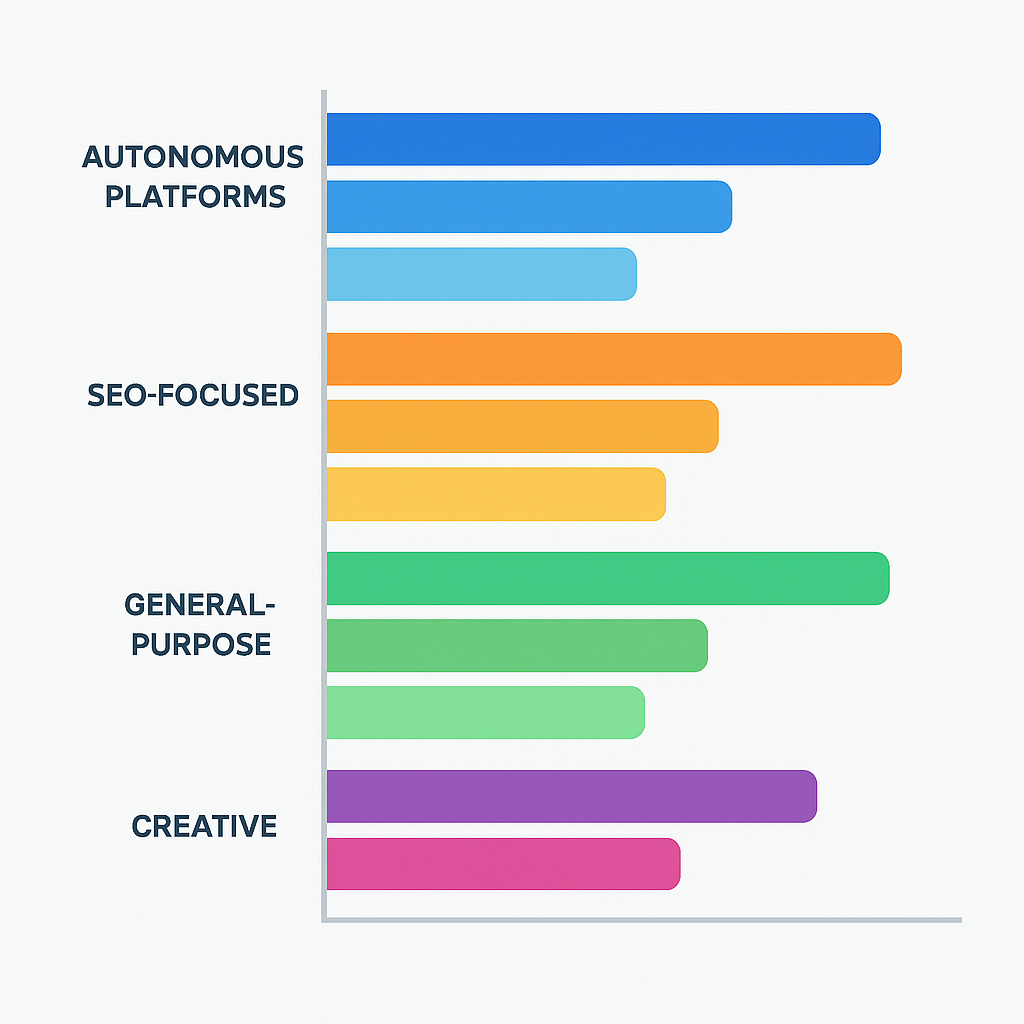
All 15 Tools at a Glance
- Gofylo — Autonomous content engine with GEO tracking and CMS publishing
- Jasper — Business content creation at scale with brand voice controls
- Surfer SEO — Real-time SEO guidance layered into the writing editor
- ChatGPT (OpenAI) — General-purpose LLM dominant in mindshare and usage
- Claude (Anthropic) — Long-form nuance, instruction-following, and tone fidelity
- Writesonic — Affordable AI copywriting with Surfer integration
- Rytr — High-volume text generation with a generous free tier
1. Gofylo — Autonomous Content Engine with GEO Tracking
Gofylo occupies a structurally different category from the other tools on this list. While most AI writing tools require a human to prompt, draft, edit, and publish — Gofylo researches keywords from competitors and live search results, groups them into topic clusters, writes articles in the customer's brand voice, and publishes them to their CMS, including internal links and schema markup. It produces 30 articles per month on the standard plan, each written in a few minutes. Content includes FAQ blocks, AI-generated images in 5 styles, schema markup, internal links, and verified source citations, published to the customer's CMS.
What sets Gofylo apart in 2026 is the AI visibility score — a measure of how ChatGPT and Claude see your brand. It reports a single AI Visibility Score based on asking ChatGPT and Claude about your brand, giving teams a benchmark for AI share of voice. For B2B SaaS companies competing in categories where buyers ask AI engines for recommendations, this isn't a nice-to-have. It's the difference between showing up in the answer or funding a competitor's citation. Pricing is $79/month all-in, with a 3-day free trial.
Best for: Growth-stage B2B SaaS teams, founders, and solo operators who want to scale organic and AI search presence simultaneously without building a content team. Gofylo is the only tool on this list that compounds content output autonomously — you set the strategy, the agents execute and publish.
Standout features: Researches keywords from competitors and live search results, groups them into topic clusters, writes articles in your brand voice and publishes them to your CMS; AI Visibility Score from ChatGPT and Claude; 18+ language support; integrates with your CMS.
Limitation: Because Gofylo is optimized for autonomous, compounding output rather than one-off creative drafts, teams looking for a free-form creative writing assistant or ad-hoc copy tool will find it overbuilt for casual use cases. It's a system, not a chatbox.
2. Jasper — Business Content at Scale
Jasper remains one of the most recognized enterprise-grade AI writing platforms in the market. Built on top of multiple foundation models, Jasper allows teams to establish brand voice profiles, create templated workflows for different content types (blog posts, email sequences, ad copy, landing pages), and collaborate across marketing and content teams. Its 'Campaigns' feature lets you input a goal and generate a suite of coordinated assets — from social posts to long-form articles — in a single workflow. Jasper integrates with Surfer SEO for on-page optimization and supports a broad template library covering 50+ content types.
For teams that need brand-consistent, multi-format content generation with human review baked into the workflow, Jasper is a solid choice. It's particularly well-suited for larger marketing teams where multiple writers need to produce consistent-sounding output at scale. The limitation is that Jasper doesn't natively track AI search visibility — you'd need a separate tool to measure whether Jasper-generated content is being cited by AI engines. Pricing starts at $49/month for individuals, with team and business tiers scaling up from there.
Best for: Mid-market and enterprise marketing teams that need brand-controlled, multi-format content at volume with human-in-the-loop review steps. Strong for ad copy, email, and multi-asset campaign creation.
GEO consideration: Jasper generates readable content but doesn't produce structured schema blocks, FAQ markup, or AI citation tracking natively. Teams serious about AI search visibility will need to layer in additional tooling — or switch to a platform that handles GEO as a first-class output.
3. Surfer SEO — SEO-Driven Writing Support
Surfer SEO is purpose-built for ranking in traditional Google search. Its Content Editor scores articles in real time against the top-ranking SERP competitors for a target keyword, surfacing NLP terms to include, optimal word count, heading structure, and image count. Surfer's Topical Map feature helps content teams plan clusters of articles that build semantic authority across a domain — a meaningful structural advantage for B2B SaaS teams trying to own a category. The platform integrates with Google Docs, WordPress, and Jasper, making it a natural layer in many existing content stacks.
Surfer's core strength is optimization depth: it makes human-written or AI-generated content more likely to rank. The gap is that it doesn't generate content autonomously — a human or another AI tool still needs to write the draft. Surfer also doesn't have native AI visibility tracking, so its optimization frame is entirely Google-centric. For teams running a hybrid workflow (AI drafts, human edits, Surfer optimization), it's a strong middle layer. For teams that want fully autonomous publishing, it's a component — not a complete solution.
Best for: Content and SEO managers who want data-driven optimization guidance layered into their writing workflow. Strong complement to any AI writing tool that doesn't include SERP analysis natively.
4. ChatGPT (OpenAI) — The Dominant General-Purpose Writer
ChatGPT is the category-defining AI writing tool by raw usage volume. As of 2026, it processed 2.5 billion daily requests and served 900 million weekly active users (AutoFaceless AI, 2026). That scale reflects both its versatility and its accessibility — ChatGPT handles everything from first-draft blog posts to customer email templates to technical documentation outlines. GPT-4o and the o-series models offer reasoning-level capabilities that make it useful for structuring complex arguments, generating comparative analyses, and adapting tone across content types.
For B2B SaaS founders and solo operators who need a capable general-purpose writing assistant without committing to a specialized platform, ChatGPT's free tier is a meaningful entry point. The paid tier ($20/month for ChatGPT Plus) unlocks GPT-4o, image generation, and custom GPTs. The structural limitation: ChatGPT doesn't publish to your CMS, doesn't track SEO performance, doesn't monitor AI search citations, and doesn't build topical clusters autonomously. Every output requires a human to prompt, review, format, and deploy. That's a real per-article labor cost that doesn't compound.
Best for: Quick drafts, ideation, repurposing existing content, and teams that want maximum flexibility in how they use an AI model. Free and Plus tiers are genuinely useful for solo operators.
GEO consideration: Interestingly, ChatGPT cites content from the web in its responses — meaning content that's well-structured, authoritative, and schema-marked is more likely to appear in ChatGPT's answers. Using ChatGPT to write content doesn't improve your AI search visibility; you still need a GEO layer to track and optimize citations.
5. Claude (Anthropic) — Long-Form and Nuanced Writing
Claude from Anthropic has developed a strong reputation among content professionals for instruction-following fidelity and tonal nuance — qualities that matter when you're producing B2B content that needs to sound like a practitioner wrote it, not an LLM. Claude 3.5 Sonnet and the Claude 3 Opus models handle long-context documents well (up to 200K tokens on the API), which makes them useful for processing full research documents, competitor analyses, or lengthy brand guidelines before generating content. Many content teams use Claude specifically for editing and rewriting AI-generated drafts that sound too generic.
Like ChatGPT, Claude is a model interface — not a publishing pipeline. It doesn't push to CMS, doesn't optimize for SERP structure, and doesn't generate schema markup. The free tier is capable; the Pro tier ($20/month) unlocks priority access and higher usage limits. For teams with an existing content workflow who want a high-quality AI writing assistant that stays close to their instructions, Claude is often the preference over ChatGPT for long-form drafting. For teams without a workflow — or without the headcount to run one — it doesn't solve the pipeline problem.
Best for: Long-form drafts, editorial refinement, and nuanced B2B writing where generic AI tone is a problem. Also strong for synthesizing research documents into structured content.
6. Writesonic — Affordable Copywriting with SEO Features
Writesonic targets teams that want capable AI copywriting at a lower price point than Jasper, with built-in SEO features that make it more actionable than a bare LLM interface. Its Article Writer 6.0 generates long-form SEO articles using real-time Google search data, which helps ground outputs in current SERP context rather than training-data snapshots. Writesonic also includes Chatsonic — a ChatGPT-style conversational interface — and integrations with Surfer SEO for optimization scoring. The platform covers blog articles, landing pages, ad copy, product descriptions, and email sequences.
Pricing is competitive — a free tier exists with limited credits, and paid plans start around $16/month. For small teams or solo operators looking for the best AI writing tools free of high price commitments, Writesonic's entry tier is genuinely useful. The ceiling is lower than Jasper or a full autonomous platform: Writesonic still requires human prompting per piece, doesn't track AI search visibility, and doesn't build internal linking structures or schema markup automatically. It's a good middle-ground tool for teams that need volume on a budget.
Best for: Bootstrapped founders and small marketing teams that need a capable multi-format AI writer at an accessible price. The SEO-grounded article writer is a genuine differentiator at this price tier.
7. Rytr — Entry-Level Text Generation for High Volume
Rytr is one of the most widely adopted AI writing platforms at the entry level — with over 6.5 million users as of 2026 (EmailVendorSelection). Its value proposition is simple: a broad library of use-case templates (40+), a clean writing interface, and a free plan that includes a meaningful monthly character allowance. Rytr covers blog intros and outlines, email copy, social captions, product descriptions, ad variants, and call-to-action copy. It supports 30+ languages and allows tone selection across 20+ options.
Rytr's paid plans start at $9/month, which makes it the most affordable full-featured AI writing tool on this list. The trade-off is depth: Rytr is excellent for short-form copy generation and ideation, but its long-form article output requires more human editing than higher-end tools. It lacks SEO optimization layers, doesn't generate schema markup, and has no AI search visibility functionality. For teams generating high volumes of social copy, email variants, or short ad content, Rytr's value-to-price ratio is hard to beat. For SEO-compounding content at scale, it's underpowered.
Best for: Teams that need high-volume short-form copy generation on a tight budget. Excellent free tier makes it one of the top free AI writing tools available. Also popular with students and individual creators exploring AI writing tools for the first time.
8. Copy.ai — GTM Workflows and Sales Copy
Copy.ai has evolved from a simple AI copywriting tool into a GTM (go-to-market) workflow platform. Its 2026 positioning centers on automating sales and marketing workflows — building sequences of AI-assisted tasks that cover prospecting, outreach, content personalization, and sales enablement. For demand generation and sales-led growth teams at B2B SaaS companies, Copy.ai's Workflows feature allows you to chain together prompts, data inputs, and outputs into repeatable processes without engineering support. It integrates with CRMs and SEO tools.
Copy.ai's free tier allows up to 2,000 words per month — enough for evaluation but not production use. The Pro tier starts around $49/month. Its strength is in sales copy, cold outreach, and GTM asset generation rather than long-form SEO content. If your primary content need is blog articles and search visibility, Copy.ai is not the right fit. If you're running a sales-led motion with a need for personalized outreach at scale, it's worth serious evaluation alongside dedicated sales engagement platforms.
Best for: Demand gen and sales-aligned marketing teams at B2B SaaS companies. Strong for outbound sequences, product positioning copy, and GTM asset generation. Less suited for SEO content at scale.
9. Sudowrite — Creative and Fiction Writing
Sudowrite is the most purpose-built creative writing tool on this list, and it's intentionally narrow. Designed specifically for fiction writers and novelists, Sudowrite offers features like 'Write,' 'Rewrite,' 'Describe,' and 'Brainstorm' — each tuned for narrative prose rather than business content. Its 'Story Engine' guides writers through plot structure, character development, and scene construction. For teams looking for the best AI writing tools for novels or long-form fiction, Sudowrite is the category leader. It appears frequently in discussions about best AI writing tools on Reddit writing communities for good reason.
Sudowrite is not a B2B content tool. It doesn't produce SEO articles, schema markup, or AI-search-optimized content. For founders, marketing leads, and content managers at SaaS companies, it's the wrong fit — but it's included here because it comes up in tool comparisons and understanding where its strengths genuinely lie helps teams avoid the wrong purchase. Pricing starts at $19/month. If you're evaluating tools for marketing content, skip Sudowrite. If someone on your team is writing a business book or thought leadership narrative, it's worth a trial.
Best for: Fiction writers, novelists, and creative long-form storytellers. Not suitable for B2B marketing content, SEO articles, or AI search optimization workflows.
10. Reword — Collaborative Writing with Memory
Reword differentiates itself through a 'knowledge base' model — the platform learns from your existing published content and brand voice, then generates new content that stays consistent with how you've written before. This persistent memory layer reduces the tonal drift that most AI-generated content suffers from when you're producing at scale. Reword is built for teams that publish frequently and want AI assistance without losing editorial voice. It includes collaboration features and a clean, distraction-free editor.
Reword is best positioned as an all-round writing assistance platform for editorial teams with established brand voices. It doesn't offer autonomous publishing, schema markup, or AI visibility tracking. Pricing is mid-tier, starting around $38/month. For content teams that have a strong editorial identity and want AI to extend their voice rather than replace it, Reword solves a real problem. For teams starting from scratch or needing to scale from zero to 30 articles a month without headcount, it still requires a human driver per article.
Best for: Editorial teams and content managers with established brand voices who want AI assistance that learns from and stays consistent with existing content. Strong for maintaining tonal consistency at volume.
11. GrowthBar — SEO Blogging for Non-Specialists
GrowthBar is designed for founders, small business owners, and solo operators who want to produce SEO-optimized blog content without deep SEO expertise. It combines keyword research, SERP analysis, and AI-generated article outlines with a writing interface — effectively collapsing what would normally require three separate tools into one. GrowthBar generates full blog posts with header structures, meta descriptions, and internal link suggestions. It also includes a Chrome extension that surfaces SEO data while you browse competitor sites.
GrowthBar sits between a pure AI writer and a full SEO suite. It's more opinionated than ChatGPT (it guides you toward SEO-friendly structures) but less powerful than Surfer or a full autonomous platform. Pricing starts at $29/month. For solo operators or early-stage founders who want one tool that handles research and writing without hiring an SEO agency, GrowthBar is a reasonable starting point. It doesn't publish to CMS autonomously, doesn't track AI search visibility, and tops out in usefulness before teams reach serious content velocity.
Best for: Non-specialist founders and solo operators who need a guided, SEO-aware writing experience without separate keyword research tooling. Good entry point before teams outgrow it.
12. Perplexity AI — Research-First AI Writing
Perplexity AI is primarily an AI search engine, but its Pro tier includes writing capabilities that make it genuinely useful for research-grounded content drafting. Unlike ChatGPT or Claude, Perplexity pulls live web citations into its responses, meaning drafts include inline references to real, current sources rather than training-data recall. For content teams that prioritize factual accuracy and cited sourcing — particularly in technical B2B categories — Perplexity's research-first approach reduces the fact-checking burden significantly.
Perplexity's writing output is more functional than editorial — it excels at structured summaries, research overviews, and sourced comparisons rather than opinionated, brand-voiced long-form content. The free tier is useful for research; the Pro tier ($20/month) unlocks higher usage and access to multiple models including GPT-4o and Claude. It's increasingly relevant as an AI search engine itself — which means being cited in Perplexity responses is a GEO goal, not just a nice framing.
Best for: Research-heavy content drafting where factual accuracy and inline citations are priorities. Also valuable as a GEO research tool — understanding what Perplexity cites informs content strategy for AI search visibility.
13. Frase — Content Briefs and SERP Optimization
Frase occupies the content brief and SERP research niche. It analyzes the top-ranking pages for a keyword, extracts the key topics, questions, and headers they cover, and generates structured content briefs that writers (human or AI) can follow. Frase also includes an AI writing assistant that generates content against the brief, and an optimization score that tracks how well your draft covers the target topic relative to competitors. It's particularly strong for teams that outsource writing and need a brief-generation layer to maintain quality.
Frase starts at $15/month for the basic plan, making it accessible for small teams. Its limitation is that it's primarily a research and brief tool — the AI writing output isn't as polished as Jasper or Claude, and it doesn't handle publishing, schema, or AI search visibility. For content managers who spend significant time on brief creation and SERP analysis, Frase compresses that process meaningfully. For teams that need end-to-end autonomous content production, it's one component of a larger stack.
Best for: Content managers and SEO teams that produce high volumes of briefs, especially when working with freelance writers or multiple contributors. The SERP analysis layer is genuinely strong for topical gap identification.
14. Notion AI — In-Workflow Writing for Ops Teams
Notion AI embeds AI writing directly into Notion workspaces — making it most valuable for teams that already live in Notion for project management, documentation, and content planning. It can draft, summarize, translate, and rewrite content within any Notion page, and integrates with Notion databases to pull in structured data for generation. For ops-heavy teams where content production happens inside the same tool as everything else, Notion AI removes context-switching friction.
Notion AI is priced as an add-on ($10/month per member on paid plans), which makes it the most naturally bundled option on this list for teams already paying for Notion. Its limitation is obvious: it's context-bound to Notion. It doesn't have keyword research, SEO optimization, schema generation, or AI search tracking. It also connects to Gofylo's CMS integration — meaning teams can use Gofylo to autonomously generate and publish content to a Notion-connected CMS while using Notion AI for internal documentation and editing. They're complementary, not competing.
Best for: Teams that run content planning and internal knowledge management in Notion and want a low-friction AI writing layer without switching tools. Not a standalone content production solution.
15. Scalenut — Full SEO Content Lifecycle
Scalenut attempts to cover the full SEO content lifecycle — from keyword clustering and topical planning through article generation and optimization scoring. Its Cruise Mode generates full-length SEO articles in a guided multi-step flow: keyword input, SERP analysis, outline review, content generation, and optimization review. Scalenut also includes a 'Fix it' feature that identifies SEO gaps in existing content and suggests targeted edits. For teams that want a single platform covering research, writing, and optimization — without stitching together Surfer, Jasper, and Frase — Scalenut is a reasonable consolidation.
Pricing starts at $39/month. The limitation is that Scalenut still requires human-driven prompts and review per article — it compresses the workflow but doesn't remove the human from it. It also doesn't track AI search visibility or publish directly to CMS without manual export steps. For content teams at growth-stage companies that want a more integrated tool than a bare LLM but aren't ready for a fully autonomous platform, Scalenut is a strong mid-market option.
Best for: Content and SEO managers who want research, writing, and optimization in a single interface without assembling a multi-tool stack. Solid mid-market consolidation play.
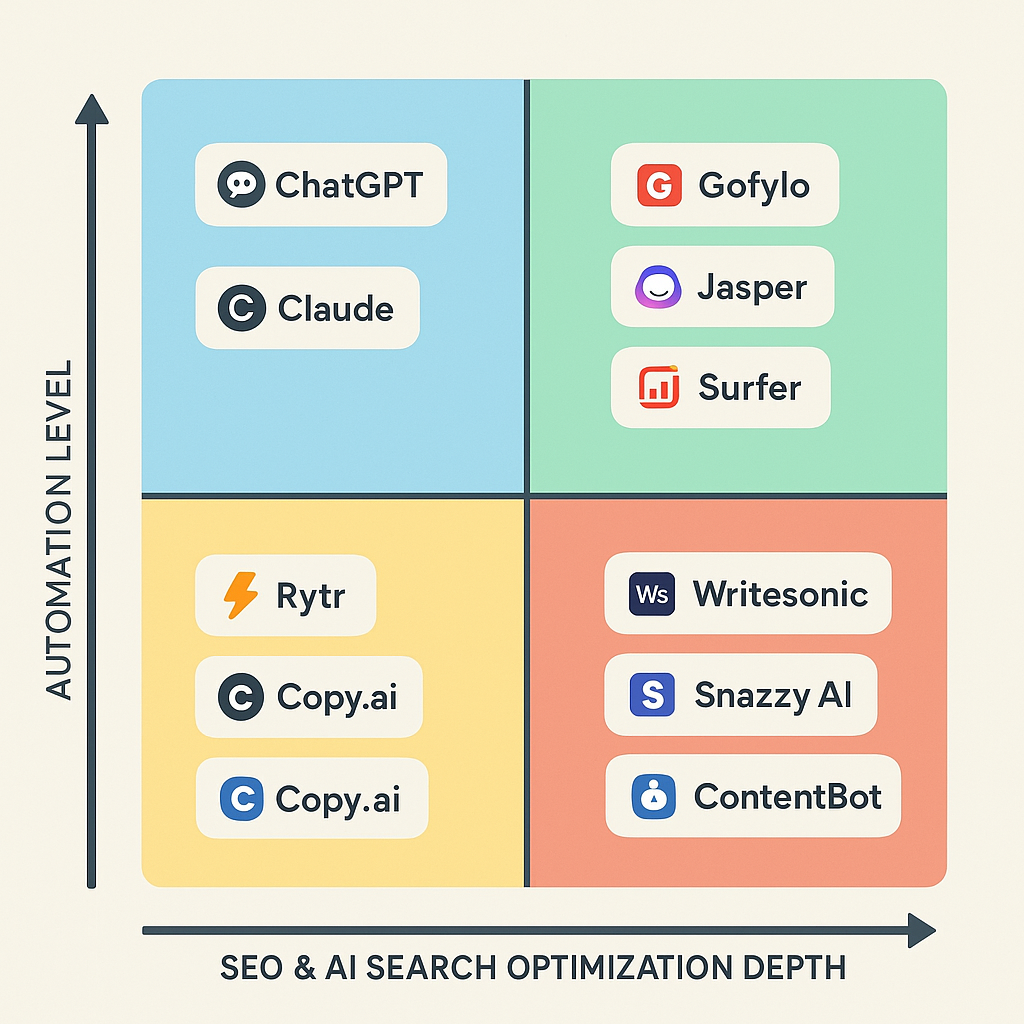
Key pattern across all 15 tools: the more a platform automates (research → write → optimize → publish → track), the less per-article labor it requires. Every tool below full automation is still costing you headcount hours per piece — and those hours don't compound.
How to Choose the Right AI Writing Tool for Your Stack
Choosing between these tools comes down to three variables: how much human labor you want to keep in the loop, whether you're optimizing for traditional search or AI search or both, and whether you need content to compound over time or just get done on demand. Most teams start with a general-purpose LLM like ChatGPT or Claude, realize the publication and optimization work still falls on humans, and then look for automation that removes those steps. Understanding that pattern early saves months of tool-switching.
SEO vs. AI Search Visibility: Why Both Matter in 2026
Traditional SEO — ranking in Google's blue links — is still a significant traffic channel in 2026. But AI-driven search (ChatGPT, Claude, Perplexity, Gemini) is reshaping how buyers discover B2B software. A buyer asking 'what's the best project management tool for remote engineering teams' in ChatGPT doesn't click through ten blue links — they get a curated answer from the AI's training data and live web retrieval. If your brand isn't in that answer, you're not in the consideration set. Google's own documentation on E-E-A-T signals the direction: experience, expertise, authoritativeness, and trustworthiness are the structural qualities that determine which content gets surfaced, whether by Google's algorithm or by an LLM's retrieval layer.
The tools on this list vary significantly in how much they help with AI search visibility. Most address traditional SEO. Only Gofylo provides an AI visibility score, derived by asking ChatGPT and Claude about a brand, showing how those two engines see it. That gap in the tooling landscape reflects where the market is heading — according to Verified Market Research, the AI writing tool market was valued at $0.39 billion in 2024 and is projected to reach $1.22 billion by 2032, growing at a CAGR of 17.2%. A meaningful portion of that growth will track the rise of GEO as a discipline alongside traditional SEO.
When to Use a Standalone Tool vs. an Autonomous Platform
Standalone tools (ChatGPT, Claude, Rytr, Writesonic) make sense when content output is irregular, when a human editor is handling strategy and structure, or when you're evaluating the category before committing to a more integrated platform. They're also appropriate when you need creative flexibility that a templated system can't provide — fiction writing, brand voice experiments, ad copy variations.
Autonomous platforms make sense when content output needs to be consistent and compounding — 30+ articles per month, systematically building topical authority, with internal linking that reinforces your site architecture. The per-article math is different at scale: if a human writer spends 4-6 hours on a B2B SaaS article (research, draft, edit, optimize, format, upload), a team publishing 30 articles per month needs 120-180 hours of labor per month just for content. Autonomous platforms compress that to a strategy and review function. According to data from AutoFaceless AI (2026), marketers report saving an average of 11 hours per week with AI content creation — and that's with tools that still require significant human involvement. Fully autonomous pipelines extend those savings further.
- Use ChatGPT or Claude when you need a capable writing assistant for ad-hoc drafts, research synthesis, or creative exploration
- Use Surfer SEO or Frase when you have content being written (by humans or AI) and need SERP-grounded optimization
- Use Jasper or Scalenut when a marketing team needs brand-controlled multi-format output with human review steps
- Use Rytr or Writesonic when budget is the primary constraint and you need capable short-to-mid-form copy
- Use Sudowrite when the use case is creative fiction or long-form narrative — not marketing content
- Use Gofylo when you need to compound organic and AI search traffic autonomously at 30+ articles per month without a content team
The market reality check: according to Axis Intelligence's 2026 analysis, 97% of AI-generated content requires human editing for optimal performance. That stat applies to tools where humans are still prompting individual pieces. Autonomous platforms with structured E-E-A-T outputs reduce that editing burden by generating schema-compliant, internally linked, SEO-optimized articles by design — not by accident.
FAQ
Is it illegal to publish a book written by AI?
As of 2026, publishing a book written by AI is not illegal in most jurisdictions, but copyright protection is the live issue. In the United States, the Copyright Office has issued guidance indicating that works produced entirely by AI without human creative input are not eligible for copyright protection. Books where a human author makes creative choices — selection, arrangement, editing, prompting — may qualify for partial copyright. Authors should disclose AI assistance in contexts where that transparency is expected or required (academic publishing, certain platform terms of service).
Is ChatGPT still the best AI?
ChatGPT is the dominant AI platform by usage volume — processing 2.5 billion daily requests and serving 900 million weekly active users as of 2026 (AutoFaceless AI). That scale reflects its versatility and accessibility, not necessarily that it produces the best output for every task. Claude 3.5 Sonnet outperforms GPT-4o on many long-form writing benchmarks; Perplexity is stronger for research-grounded content; Gofylo outperforms all of them for autonomous SEO and AI-search-optimized publishing at scale. 'Best' depends entirely on the use case.
Is ChatGPT or Claude better for writing?
For long-form B2B writing that needs to follow specific instructions and maintain consistent tone across a document, Claude tends to outperform ChatGPT in practitioner assessments as of 2026. Claude's instruction-following fidelity and tonal nuance make it better at sounding like a specific writer rather than a generic LLM. ChatGPT has advantages in versatility, tool integrations (plugins, code execution, image generation), and speed. Many professional content teams use both: Claude for drafting, ChatGPT for iteration and multi-format output.
What are the top 5 AI tools right now?
For B2B SaaS content and marketing teams in 2026, the top five depend on your workflow stage. For autonomous compounding content: Gofylo. For general-purpose writing and flexibility: ChatGPT (GPT-4o). For long-form nuance and instruction fidelity: Claude. For SEO-grounded optimization: Surfer SEO. For affordable high-volume copy: Rytr or Writesonic. Teams at scale typically use one autonomous platform plus one or two specialist tools for edge cases — not five separate general-purpose AI writers.
Are there good free AI writing tools?
Yes. ChatGPT's free tier (GPT-4o with usage limits) is genuinely capable for drafting and ideation. Claude's free tier handles long-form drafting well. Rytr's free plan includes a monthly character allowance that covers meaningful short-form output. Writesonic also offers a free tier. For B2B teams serious about SEO and AI search visibility, free tools are useful for exploration but underpowered for systematic content production — the publishing, optimization, and tracking work still requires paid tooling or significant human labor.
Which AI writing tools work best for B2B SaaS content?
B2B SaaS content has specific requirements: technical credibility, E-E-A-T compliance, topical authority building, internal linking across a content cluster, and increasingly, AI search visibility across ChatGPT, Claude, and Perplexity. Tools that meet all of those criteria in a single platform are rare. Gofylo addresses the full stack autonomously — research, writing, CMS publishing, and AI visibility scoring — giving brands a visibility score based on how ChatGPT and Claude see them. For teams that need components rather than a full system, Surfer SEO plus Claude plus Frase covers the research-write-optimize loop, but requires three paid subscriptions and human coordination to operate.
If you're scaling content for a B2B SaaS company and need both Google rankings and AI search citations to compound without adding headcount, Gofylo's 3-day free trial is the concrete next step. The trial runs for 3 days. Start at gofylo.io and run your first autonomous content cycle — 30 articles, schema markup, internal linking, CMS publishing, and AI Visibility Score included.