As of 2026, the label 'AI SEO platform' appears on everything from a single keyword suggestion widget to a fully autonomous content system that researches, writes, publishes, and tracks articles without human prompts. That range makes the category genuinely confusing — and makes bad purchasing decisions easy. If you're a founder, SEO manager, or demand gen lead trying to figure out which type of platform actually maps to your growth goals, you need a clear mental model of what these tools are, how they differ structurally, and why those differences matter far more than any individual feature.
The market context makes clarity even more urgent. According to Global Growth Insights, the global AI-powered SEO software market was valued at USD 1.96 billion in 2024 and is projected to reach USD 2.36 billion in 2025 — a trajectory pointing toward USD 9.74 billion by 2034 at a 17.05% CAGR. And per a separate analysis from Market.us, a parallel forecast puts the figure at USD 32.6 billion by 2035, growing at a 23.4% CAGR from USD 3.98 billion in 2025. With that much capital flowing into the category, vendor claims have outpaced vendor reality. This guide cuts through the noise.
Thesis: An AI SEO platform isn't just a faster way to do what you were already doing manually — the best ones change the structural economics of organic growth by removing humans from the content production loop entirely while simultaneously optimizing for both traditional search and AI-driven answer engines.
What an AI SEO Platform Actually Is
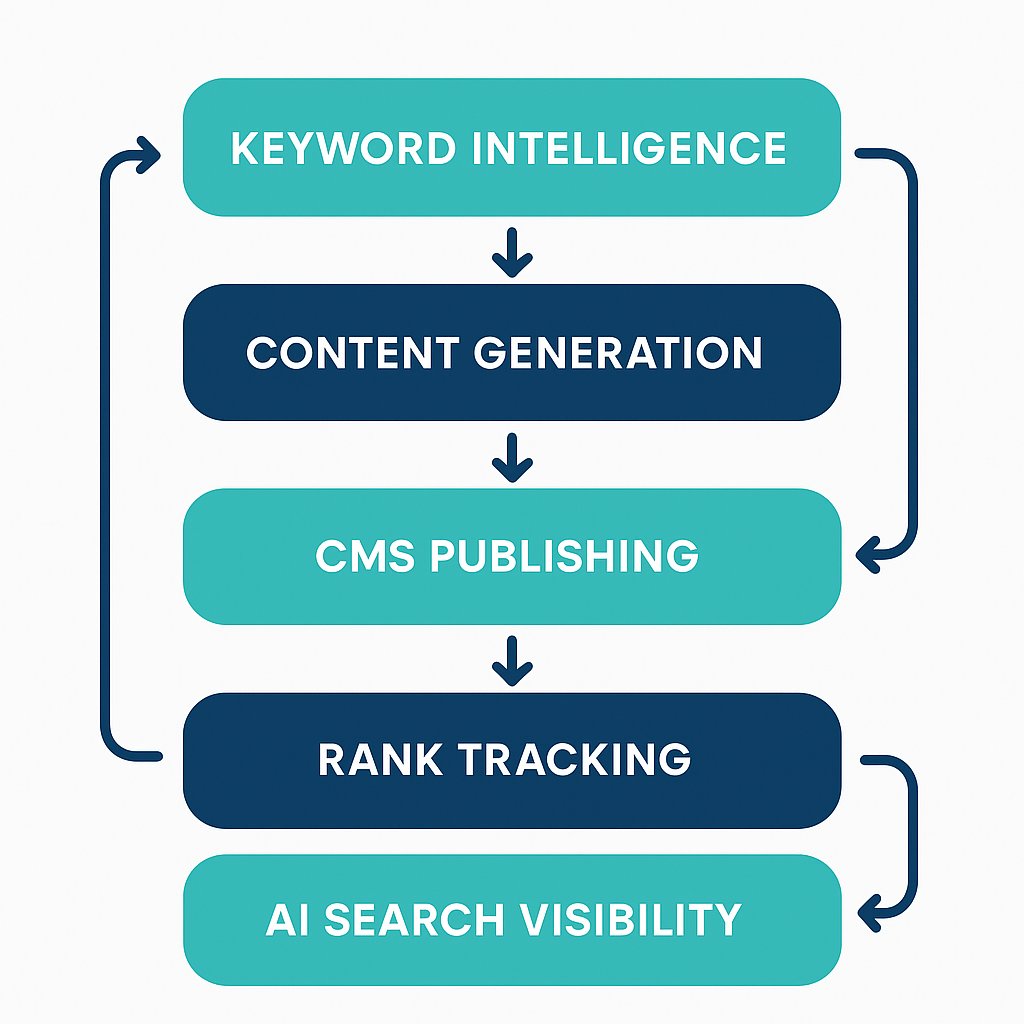
At its core, an AI SEO platform is software that applies machine learning — most commonly natural language processing — to one or more stages of the organic search workflow: keyword research, content creation, on-page optimization, rank tracking, link analysis, or competitive intelligence. What distinguishes a true platform from a collection of AI-flavored utilities is integration: the degree to which these capabilities share data, inform each other, and reduce the number of manual handoffs a human has to manage. A keyword tool that surfaces NLP-driven suggestions is not an AI SEO platform in any meaningful sense. A system where keyword data automatically seeds a content brief, that brief auto-generates a structured article, the article auto-publishes to your CMS with schema markup, and the resulting rankings feed back into the next research cycle — that is a platform. Natural language processing accounts for 45.3% of the technology stack powering AI SEO software today, according to Market.us, which explains why so many tools lead with content-generation capabilities. But NLP-driven writing is a component, not a strategy. The distinction between a component and a platform is exactly what this guide is built to clarify.
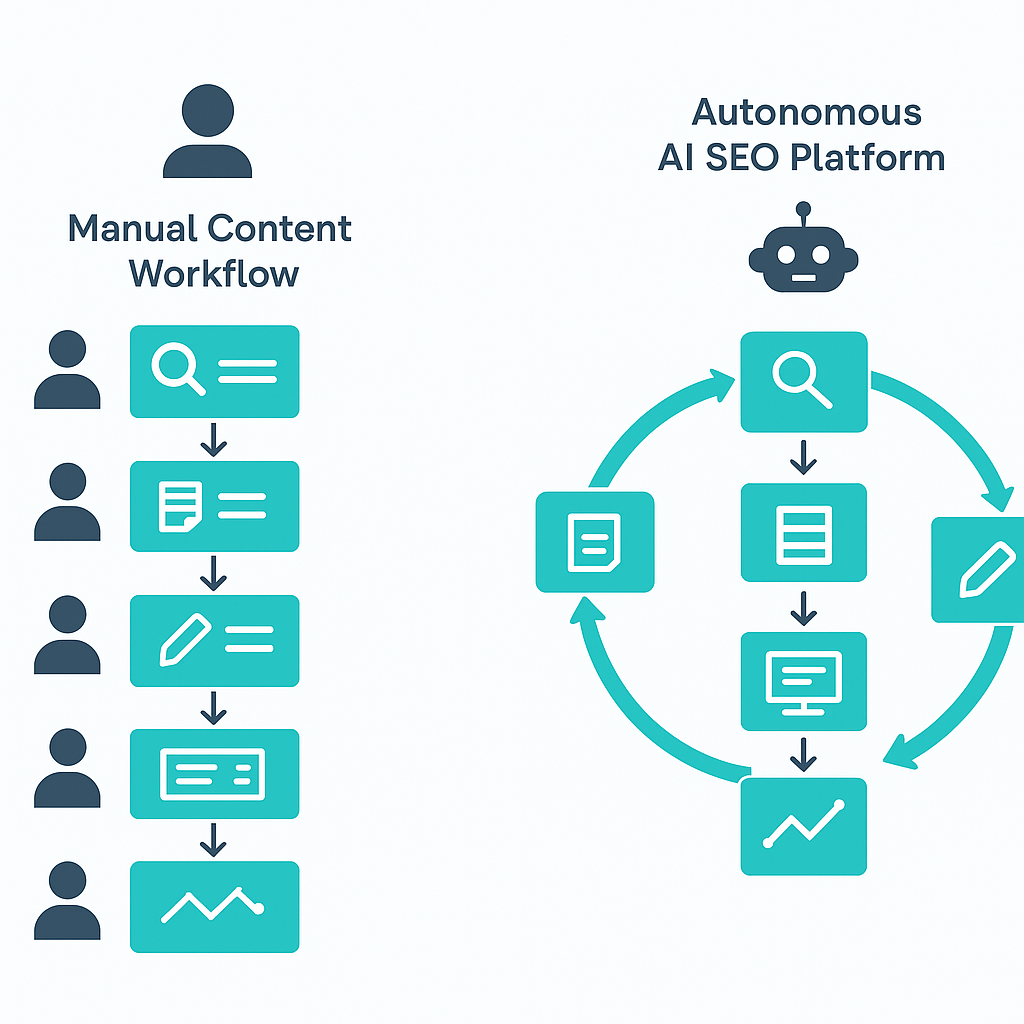
Point tools vs. platforms. Most AI SEO tools on the market — Surfer SEO, Clearscope, Frase, Marketmuse — occupy distinct points in the content workflow. Surfer guides you while you write by scoring your draft against SERP competitors in real time. Clearscope generates semantically rich content briefs. Frase accelerates SERP research and brief creation. Marketmuse does deep topic modeling for enterprise content strategy. These are genuinely useful tools, but they assume a human is operating them step by step. Each requires someone to open the tool, input a keyword, interpret the output, and act on it. The value they add is real; the structural dependency on human time is also real.
Autonomous platforms operate differently. An autonomous AI SEO platform removes the human operator from the routine production loop. Agents handle keyword selection, outline generation, writing, internal linking, schema injection, CMS publishing, and performance monitoring without waiting for a human prompt at each stage. The human role shifts from operator to strategist — setting goals, reviewing output periodically, and adjusting parameters. This isn't a marginal improvement in speed; it's a different relationship to the production of organic content altogether. That structural shift is what makes autonomous platforms worth understanding separately from point-solution tools.
Why the category is growing fast. AI strategy adoption among SEOs rose from 65% in 2024 to 86% in 2025 — a 21-point year-over-year jump, per Aira (as cited in SQ Magazine's AI SEO Statistics 2026 report). That adoption rate signals that AI-assisted SEO has crossed from early adopter territory into standard practice. The question for growth-stage teams is no longer whether to use an AI SEO platform, but which class of platform actually matches the scale and autonomy you need.
The Two Search Surfaces You Need to Win
One of the most significant gaps in most AI SEO platform evaluations is that they focus exclusively on Google rankings while ignoring the second search surface that is rapidly eating into traditional click volume: AI answer engines. In 2026, a meaningful and growing share of search queries are answered directly by ChatGPT, Claude, Perplexity, and Gemini without a user ever visiting a search results page. If your content isn't being cited by those systems, you're invisible to a portion of your addressable audience that is growing every quarter. A complete AI SEO platform in 2026 must optimize for both surfaces simultaneously — and most tools in the category do not.
Traditional SEO vs. Generative Engine Optimization (GEO)
Traditional SEO — as defined by Google's own documentation on how search works — is fundamentally about relevance signals: keyword matching, E-E-A-T signals, backlink authority, page experience, and structured data. Generative Engine Optimization (GEO), by contrast, is about training LLMs to associate your brand and content with specific topics and claims. LLMs retrieve information based on what they've indexed, how clearly a piece of content answers a question, and whether the source is cited in high-authority contexts elsewhere on the web. The optimization levers are partially different: for GEO, structured answers, FAQ schema, clear entity associations, and citation density matter more than keyword density or exact-match anchor text. An AI SEO platform that only addresses traditional signals will leave you underrepresented in AI-generated answers. One that addresses both gives you compounding presence across every search surface your prospects use.
GEO is not a replacement for traditional SEO — it's an additional layer. The platforms that handle both within a single workflow are structurally ahead of those that force you to manage them separately with different tools.
The Core Capability Layers of a Modern AI SEO Platform
Breaking down what a full-stack AI SEO platform covers helps clarify both what to look for when evaluating options and why single-point tools leave compounding value on the table. There are five distinct capability layers that, when integrated, create a flywheel: keyword intelligence, content generation, CMS publishing automation, rank and citation tracking, and AI search visibility monitoring. Most platforms cover two or three of these; very few cover all five. Understanding what lives at each layer — and how data flows between them — is the key to evaluating any platform you're considering.
Keyword Intelligence and Topical Mapping
Keyword intelligence in an AI SEO platform goes beyond monthly search volume and keyword difficulty scores. Modern AI-driven keyword research maps semantic relationships between topics, identifies content gaps against competitor coverage, clusters keywords into topical hierarchies, and surfaces question-based queries that align with how AI answer engines retrieve information. Tools like Semrush's Keyword Overview and Ahrefs Keywords Explorer remain strong standalone references for this layer, but they require a human to translate keyword data into a publishing plan. Platforms that automate the translation — going from keyword cluster to content brief to published article without manual steps — eliminate the most time-intensive part of the SEO workflow. The quality of the keyword intelligence layer determines the quality of everything downstream, which is why platforms that shortcut this step with generic topic suggestions tend to produce content that ranks for nothing useful.
Content Generation and Publishing Automation
Content generation is the layer that has received the most vendor attention — and the most hype. What separates useful AI content generation from noise is whether the output is genuinely optimized (not just fluent), E-E-A-T compliant, structurally complete (headings, schema markup, internal links, FAQ blocks), and published directly to your CMS without a manual export step. According to Search Engine Journal (as cited in SQ Magazine's AI SEO Statistics 2026 report), AI-assisted content production cuts average article production time by 40 to 50%. That compression is meaningful, but it's still a human-in-the-loop model. Autonomous generation — where an agent runs keyword research, writes to a brief, adds schema and internal links, generates supporting images, and publishes directly — compresses the cycle further and removes the human bottleneck entirely. Content creation automation registered a compound annual growth rate of 12% between 2022 and 2025, making it the fastest-growing application segment within the AI SEO software market, per Intel Market Research's AI SEO Platform Market report.
AI Search Visibility Tracking
Most rank tracking tools in 2026 still measure Google positions — impressions, clicks, average position in Search Console, and keyword movement in tools like Ahrefs or Semrush. That data remains relevant. But it doesn't tell you whether ChatGPT cites your brand when a prospect asks a category question, whether Claude surfaces your content as a reference in a comparison query, or whether Perplexity includes your product in an AI-generated answer. AI search visibility tracking is a distinct capability layer that monitors brand mentions and citation presence across LLM-powered answer engines. Without it, you're flying blind on a search surface that carries a growing share of commercial intent queries. Platforms that offer a unified AI visibility score — a single benchmark for LLM share of voice — give teams a much cleaner signal than manually sampling AI outputs and trying to draw conclusions.
Why Autonomous Platforms Compound Differently Than Point Tools
The compounding dynamic in SEO is well understood at a conceptual level: more content drives more topical authority, which drives more rankings, which drives more traffic, which creates more data for optimization. What's less understood is how the mechanism breaks down when humans are in the production loop. Every manual step — briefing a writer, reviewing a draft, editing for SEO, formatting for the CMS, scheduling publication — introduces latency and throughput limits. A team of three content operators might realistically publish eight to twelve articles per month at acceptable quality. An autonomous platform that removes those manual steps can publish thirty articles per month on a standard plan, consistently, without requiring additional headcount. That isn't a 3x improvement in volume — it's a structural difference in the rate at which topical authority compounds.
The feedback loop matters. In a fully integrated platform, published content generates rank and citation data, which feeds back into keyword intelligence, which informs the next batch of content decisions. That feedback loop operates continuously and automatically. In a manual workflow, the feedback loop depends on someone reviewing analytics, extracting insights, updating a content calendar, and briefing the next piece. The loop exists in both cases, but the autonomous version completes the loop faster and more consistently, which means the compounding effect accelerates over time rather than hitting throughput ceilings.
Headcount economics are different. For growth-stage SaaS companies and bootstrapped operators, the staffing implication is significant. Hiring a content team capable of producing thirty optimized articles per month — writer, SEO editor, content strategist, CMS operator — represents a substantial salary commitment plus tool costs. An autonomous AI SEO platform collapses that cost structure. The trade-off is control over individual article nuance, which is real and should be acknowledged. The question is whether that control matters more than velocity at your current growth stage. For most early-to-mid stage companies, velocity wins.
Enterprise adoption confirms the model. The structural shift toward autonomous content production isn't just a startup play. According to Global Growth Insights, over 68% of enterprises have integrated AI SEO tools into their marketing stack, and 57% of digital agencies report enhanced ROI through AI-based campaign strategies. At the enterprise level, the driver is efficiency — getting more output from existing teams. At the startup level, the driver is existence — building an organic channel without having to hire a team first.
How to Evaluate an AI SEO Platform Without Getting Burned
Evaluating an AI SEO platform requires moving beyond feature checklists and demo videos. Most platforms will show you impressive outputs in a controlled environment. What matters is how the system performs on your actual content requirements, in your actual CMS, against your actual competitors. The evaluation framework should test three things: the quality of autonomous output (is the content publishable without heavy human editing?), the completeness of the integration stack (does it talk to your CMS, your analytics, your social channels?), and the coverage of both search surfaces (does it track and optimize for both Google and AI answer engines?).
Questions That Reveal Real Capability
- Can the platform publish directly to my CMS — WordPress, Webflow, Shopify, or a custom API — without manual export?
- Does it include structured data (schema markup) automatically, or is that a manual add-on step?
- How does it handle internal linking — rule-based, or semantically driven based on existing content?
- Does it track brand citations in ChatGPT, Claude, Perplexity, and Gemini, or only traditional SERP rankings?
- Can I see an AI visibility score or equivalent benchmark for my domain before I commit to a plan?
- What does the content quality look like on articles generated without any human editing — is the E-E-A-T signal credible?
- Does the platform support multilingual publishing, and if so, how many languages and at what quality level?
A free grader or audit tool that scores your current AI search visibility before you buy is a meaningful trust signal — it shows the vendor is confident enough in their product to let you see your baseline first. Gofylo's free AI Search Grader does exactly this.
Watch for hidden bottlenecks. Some platforms market themselves as autonomous but still require a human to approve each article before publication. That approval gate can be a reasonable quality control choice — but it's worth understanding because it reintroduces the throughput bottleneck that autonomous platforms are supposed to eliminate. Ask specifically: what is the publishing path from keyword selection to live URL, and how many human touchpoints does it require? The answer reveals whether the platform is genuinely autonomous or just faster at producing drafts you still have to manage.
Trial the platform with real targets. The most revealing evaluation method is to take a real keyword cluster you care about — three to five related terms with commercial intent — and run the platform through its full cycle on that cluster during a trial period. Review the output for factual accuracy, structural quality (headings, FAQ blocks, internal links, schema), and whether it reads as credible E-E-A-T content or as AI filler. If the platform doesn't offer a trial with enough time and volume to run this test, treat that as a signal.
Where Gofylo Sits in This Landscape
Gofylo covers keyword intelligence, content generation, and CMS publishing within a single plan — $79 a month — and gives an AI visibility score for how ChatGPT and Claude see a brand. The Content Engine produces articles in a few minutes each, at a rate of thirty articles per month on the standard plan. That output rate is structurally different from what a manually operated tool stack can achieve at comparable cost. Articles include schema markup, internal links, FAQ blocks, AI-generated images in five styles, and verified source citations — elements that both Google and AI answer engines use to evaluate content quality.
- Gofylo covers keyword research, writing, publishing, and AI visibility tracking.
- Direct CMS integration with WordPress, WordPress.com, Webflow, Shopify, Wix, Notion, Ghost, Framer, Feather, and a custom API webhook.
- AI visibility score that shows how ChatGPT and Claude see your brand — based on asking those two engines about you directly.
- Content generation in 18+ languages, with support for programmatic landing page creation.
- A free AI Search Grader tool available as a standalone entry point — grades your current AI search visibility before you commit to anything.
- Single all-in-one plan at $79/month with a 3-day free trial.
Compared to point-solution tools like Surfer SEO (which excels at SERP-based writing guidance but requires a human writer) or Clearscope (which produces high-quality content briefs but stops there), Gofylo's differentiation is that it covers the entire workflow autonomously — from keyword research to publishing — rather than accelerating individual steps. The closest structural competitor is Search Atlas, which offers an autonomous 'OTTO SEO' agent, though Gofylo's AI search visibility layer — tracking LLM citation presence with a unified score — addresses a gap that most platforms, including Search Atlas, don't yet close. For teams that are comparison-shopping on the best AI SEO platform for autonomous, compounding organic growth that covers both Google and AI answer engines, the architectural differences matter more than any single feature.
Is SEO Dead or Evolving in 2026?
The 'is SEO dead' question resurfaces every time search changes significantly — when Google launched Panda, when mobile-first indexing arrived, when featured snippets displaced blue links. In 2026, the trigger is AI-generated answers displacing traditional SERP clicks. The honest answer is that SEO is not dead; it is bifurcating. Traditional Google rankings remain valuable and continue to drive traffic for navigational and transactional queries. AI-generated answers are capturing an increasing share of informational and comparison queries — the top-of-funnel space where content marketing historically lived. The response is not to abandon SEO but to extend your optimization surface: keep ranking in Google, and simultaneously build the citation presence and structured authority that AI answer engines use to decide what to surface.
The data reinforces this framing. According to Demand Sage's 2026 AI SEO statistics report, 83% of SEO professionals at companies with 200 or more employees reported improved SEO performance after adopting AI — which suggests the tools are working, not that the discipline is collapsing. The practitioners who are struggling are those who treated AI as a content volume lever without addressing structural quality, E-E-A-T signals, or AI search visibility. The category of AI-powered content generation tools has matured to the point where volume alone doesn't win — integrated, authority-building content strategies do. That's the same principle that has always separated durable SEO from short-term tactics; AI just executes it faster and at larger scale.
The SEO teams winning in 2026 are not those doing more of the same faster — they're those who've restructured their workflow around autonomous agents that handle production while humans focus on strategy, positioning, and the nuanced judgment calls that AI still handles poorly.
Frequently Asked Questions
Which AI platform is best for SEO?
The answer depends on what 'best' means for your workflow. If you need real-time on-page guidance while a human writes, Surfer SEO or Clearscope are strong choices. If you need autonomous content production, CMS publishing, and AI search visibility tracking in a single plan, Gofylo covers all five capability layers without requiring a content team. For most growth-stage B2B SaaS companies, the right question is which platform removes the most human bottlenecks at a price point that makes sense before you've scaled headcount.
Can you do SEO with AI?
Yes — and in 2026, most SEO teams already do. AI tools accelerate keyword research, content briefing, on-page optimization, and competitive analysis. Autonomous AI SEO platforms go further by removing humans from the routine production loop entirely, handling research, writing, publishing, and tracking without manual prompts. The quality ceiling has risen significantly; AI-generated content that is structurally complete, E-E-A-T compliant, and semantically rich now ranks competitively in a growing range of categories.
What is AI SEO called now?
The traditional discipline remains called SEO. The newer layer focused on optimizing for AI answer engines like ChatGPT, Claude, Perplexity, and Gemini is called GEO — Generative Engine Optimization — or AEO (Answer Engine Optimization). Some practitioners use 'AI SEO' as an umbrella term covering both. The important distinction is that GEO and AEO require different optimization signals than traditional Google SEO: structured answers, FAQ schema, citation presence in authoritative sources, and clear entity associations matter more than keyword density.
Is SEO dead or evolving in 2026?
SEO is evolving, not dying. Traditional Google rankings remain a significant traffic driver, particularly for navigational and transactional queries. What's shifting is that AI-generated answers are capturing a growing share of informational queries — the upper-funnel space. Teams that optimize for both surfaces simultaneously (Google rankings plus AI citation presence) are compounding organic reach across every channel their prospects use. The teams treating AI answer engines as irrelevant are progressively ceding that upper-funnel real estate.
What should I look for in a free AI SEO platform?
Free AI SEO tools typically offer one of three things: a limited version of a paid platform (restricted article count, feature caps), a standalone audit or grading tool, or a freemium research utility. The most useful free entry point is one that shows you your actual baseline — your current AI search visibility score, your content gaps, your competitor coverage — so you can make an informed decision about what to invest in. Gofylo's free AI Search Grader does this without requiring a credit card, giving you a concrete visibility score across AI answer engines before you commit to anything.
How does an AI SEO platform handle AI search engines like Perplexity or ChatGPT?
Most AI SEO platforms don't handle AI search engines at all — they're built exclusively for Google. Platforms with a GEO or AI visibility layer monitor how often and in what context your brand is cited by LLMs like ChatGPT, Claude, Perplexity, and Gemini. They track citation frequency, surface the queries where you appear versus where competitors appear, and provide an AI Visibility Score that benchmarks your LLM share of voice over time. Optimization for these surfaces involves producing structured, authoritative, frequently cited content — FAQ blocks, clear entity definitions, and high-quality backlinks that signal credibility to both search engines and LLMs.
If you're building organic growth without a content team — or want to stop paying for one — Gofylo's autonomous agents handle the full cycle: research, writing, publishing, and AI visibility tracking for $79/month. Start with the free AI Search Grader to see how ChatGPT and Claude see your brand today, then activate a 3-day free trial at gofylo.io.