Most teams treating monitoring SEO performance as a monthly ritual — pull a rank tracking report, check organic sessions in Google Analytics, nod at the numbers, move on — are flying mostly blind. As of 2026, search behavior has fractured across Google's AI Overviews, ChatGPT, Perplexity, Claude, and Gemini, which means a clean rank report can mask real visibility losses happening entirely outside the Google index. The 33% share of overall website traffic that organic search produces, according to Conductor data cited by Clutch, is worth protecting with a structured, repeatable process — not periodic spot-checks.
This guide walks you through the complete framework in sequential steps: which prerequisites to set up, which metric tiers to prioritize, how to interpret data across both traditional and AI search surfaces, and how to build a rhythm that catches problems before they compound. Whether you're a solo operator or running a growth-stage SaaS content team, the steps below are ordered so you can implement them in a single sprint rather than across quarters.
Thesis: Effective SEO performance monitoring in 2026 requires a dual lens — tracking traditional ranking and traffic signals alongside AI search visibility — structured as a repeatable, prioritized workflow rather than an ad hoc reporting exercise.
Prerequisites: What to Have in Place Before You Start
Before you instrument a single metric, you need a functioning measurement foundation. Skipping this step means you'll spend your first three monitoring cycles debugging data discrepancies instead of interpreting trends. The following prerequisites should be confirmed before moving to Step 1. These aren't optional niceties — without them, your monitoring SEO performance workflow will produce noise rather than signal. Verifying them takes roughly two hours and prevents weeks of misleading reports downstream.
- Google Search Console property verified and receiving data for at least 28 days
- Google Analytics 4 (GA4) property with organic channel grouping correctly configured and conversion events tagged
- A crawl baseline stored — run a full Screaming Frog or Ahrefs Site Audit crawl and save the output as your benchmark
- A defined target keyword list segmented by funnel stage: awareness, consideration, decision
- CMS access to edit meta tags, structured data, and internal links without a developer ticket
- A rank tracking tool connected to your keyword list (covered in Step 2)
- At minimum, a spreadsheet or dashboard where weekly readings will be logged consistently
Step 1: Define Your Monitoring Objectives and KPI Tiers
The single most common failure mode in SEO reporting is treating all metrics as equally important. In practice, monitoring SEO performance effectively means organizing your metrics into tiers that reflect their distance from revenue. When you prioritize everything, you prioritize nothing — and weekly reviews turn into long spreadsheet tours that produce no clear next action. Structuring KPIs in tiers forces you to distinguish metrics that drive decisions from metrics that diagnose the causes of movements in decision-driving metrics. For most B2B SaaS teams, three tiers cover the full landscape without creating reporting bloat.
Tier 1 — Revenue-Proximate KPIs
Organic-attributed conversions. Signups, demo requests, or trial starts where organic search was the acquisition channel. This is the number your CFO cares about. In GA4, this means filtering conversion events by the 'Organic Search' default channel group. Track this weekly, and segment by landing page to know which content is doing conversion work.
Organic revenue or pipeline. For SaaS teams with CRM integration, connect GA4 to your CRM so organic-sourced leads can be followed through the pipeline. This lets you calculate SEO ROI concretely rather than inferring it. The median ROI from SEO campaigns sits at 748%, meaning for every $1 invested, companies generate $7.48 back, according to AllOutSEO's 2025 benchmark data — a figure worth measuring against, not just citing.
Organic session share. Organic traffic as a percentage of total sessions. This normalizes for overall traffic growth and shows whether SEO is holding its weight relative to paid and social. Conductor's research shows organic search produced 33% of total website traffic across key industries in 2024 — use this as a baseline against which to benchmark your own share.
Tier 2 — Leading Indicator Metrics
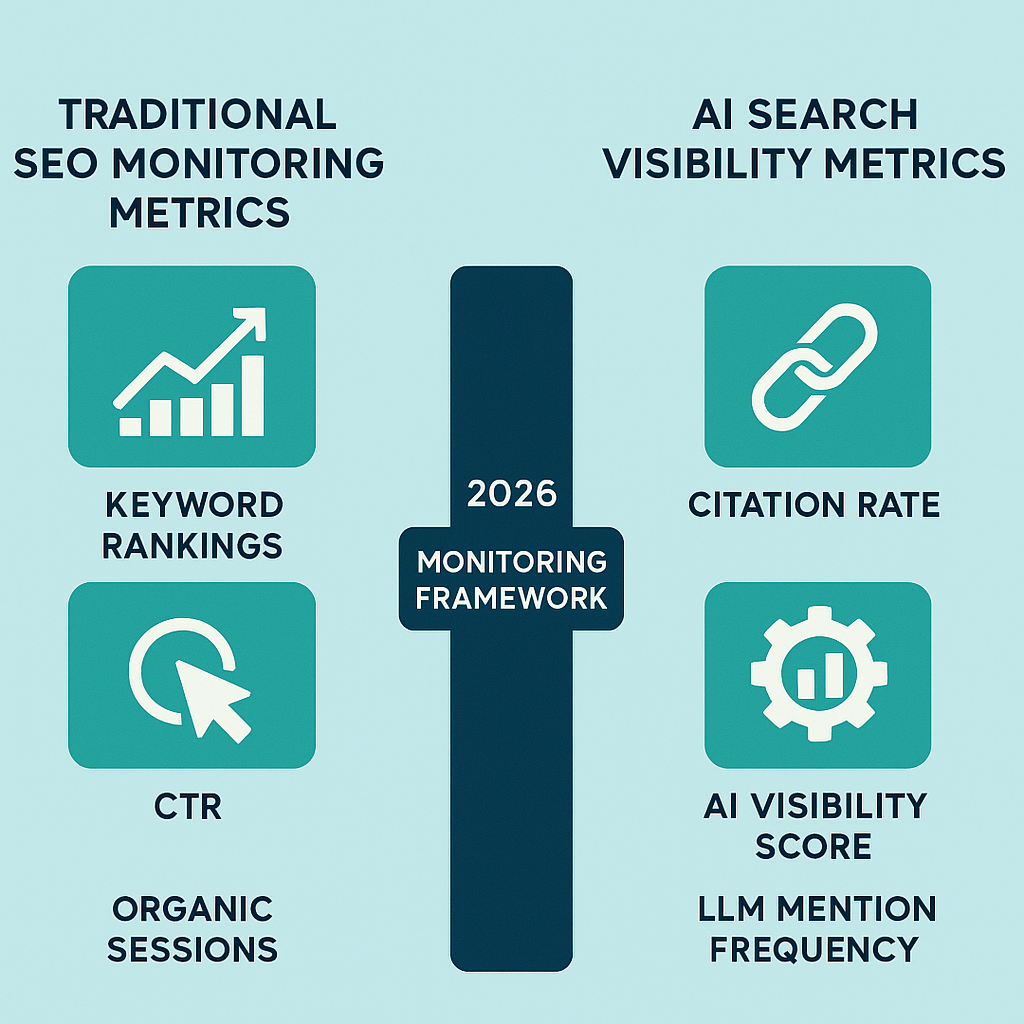
Keyword ranking positions. Where your target keywords rank determines how much traffic is even possible. According to Advanced Web Ranking, the average #1 result on Google receives 27.6% of all clicks — which illustrates why a move from position 4 to position 1 is not a cosmetic improvement but a traffic multiplier. Track rankings by keyword segment (branded, non-branded, product, competitive) rather than as a single average.
Click-through rate (CTR). Available directly in Google Search Console under Performance > Search Results. CTR measures the gap between impressions and actual visits. A page ranking in position 2 with a 3% CTR when the category average is 8% is leaving substantial traffic on the table — and the fix is title tag and meta description optimization, not link building. Monitor CTR per URL, not just as a sitewide average.
AI search citation rate. How frequently your brand or content is cited when users ask relevant questions in ChatGPT, Perplexity, Claude, or Gemini. This metric didn't exist in most teams' reporting stacks in 2024, but by 2026 it's a leading indicator of organic pipeline that traditional rank tracking tools simply don't surface. We'll cover how to track this specifically in Step 4.
Tier 3 — Diagnostic and Technical Signals
- Core Web Vitals scores — especially Largest Contentful Paint (LCP) and Cumulative Layout Shift (CLS), trackable in GSC under Experience
- Mobile page load speed — the sweet spot is under 2.5 seconds per SEOmator's 2025 benchmarks, as mobile accounts for approximately 63% of global web traffic per DemandSage 2026 data
- Index coverage — pages indexed versus submitted in GSC, flagging crawl errors and noindex issues
- Crawl depth — are key money pages reachable within three clicks from the homepage?
- Internal link equity distribution — are your highest-value pages receiving adequate internal links?
- Structured data validity — checked via Google's Rich Results Test for FAQ, HowTo, and Article schema
Step 2: Configure Your Core Measurement Stack
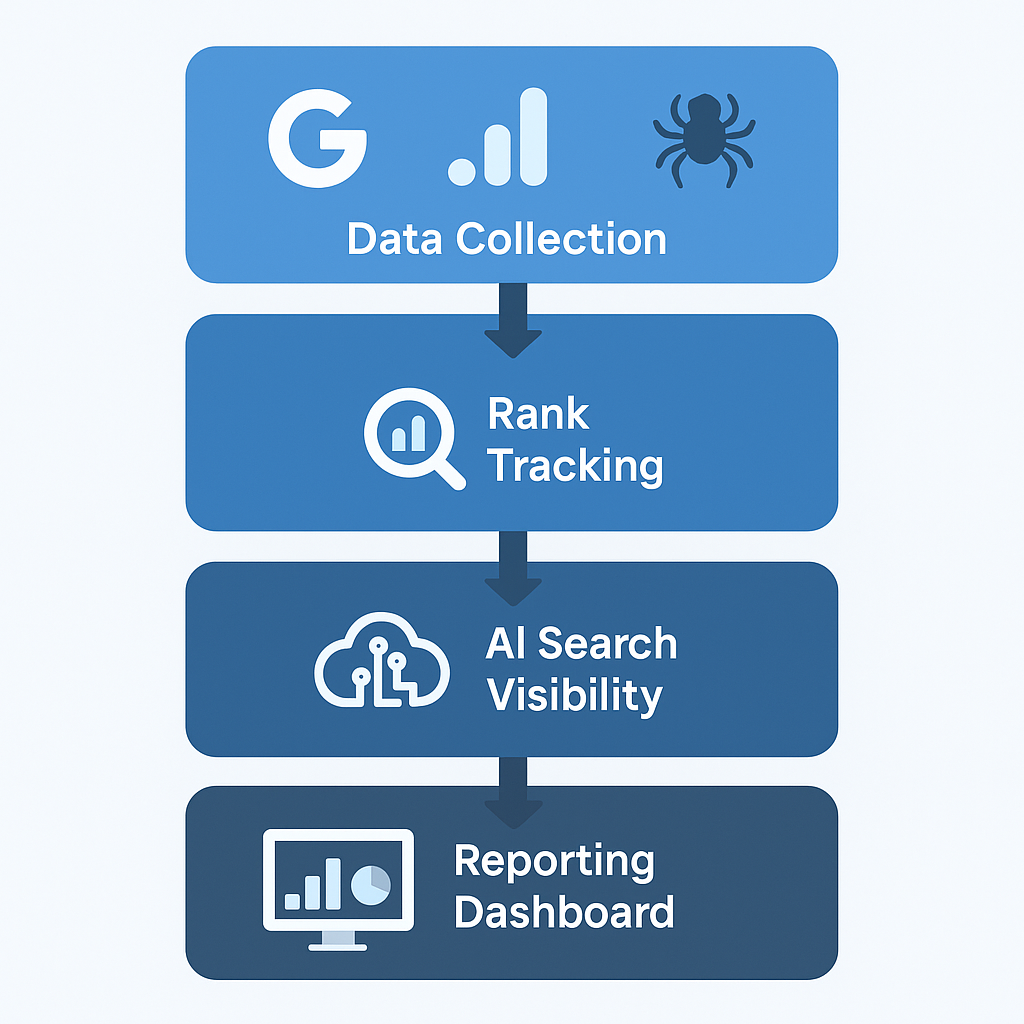
Once your KPI tiers are defined, the next step is making sure your tooling actually measures what you've committed to tracking. A well-configured measurement stack for monitoring SEO performance in 2026 typically spans three to four tools with distinct roles — not a single all-in-one platform, because no single tool covers the full scope of traditional plus AI search visibility. The goal is minimal overlap and maximum signal clarity, not tool proliferation. Google Search Console is the non-negotiable foundation; everything else layers on top of it.
- Google Search Console — impressions, clicks, CTR, average position, index coverage, and Core Web Vitals. Free and direct from the source.
- GA4 — organic session counts, user behavior, conversion events, and channel attribution. Requires correct event tagging to be reliable.
- A dedicated rank tracker (Ahrefs, Semrush, or a purpose-built tool) — for historical rank tracking across keyword segments, SERP feature monitoring, and competitor rank comparisons. Both Ahrefs and Semrush offer documented rank tracking with daily or weekly update frequencies.
- An AI visibility tracker — to monitor brand and content citations in ChatGPT, Claude, Perplexity, and Gemini. This is where Gofylo's AI visibility score — based on asking ChatGPT and Claude about a brand — closes the gap that traditional tools leave open.
- A crawl and technical audit tool — Screaming Frog (desktop) or Ahrefs Site Audit for scheduled crawls that flag broken links, redirect chains, and structured data errors.
Configuration tip: Connect GA4 and Google Search Console in the GSC property settings under 'Associations'. This surfaces GSC landing page data directly inside GA4's reports and saves you from switching tools constantly during analysis sessions.
Step 3: Build Your Keyword Monitoring Segments
Raw keyword lists are noisy. The discipline in monitoring SEO performance comes from segmenting your keyword universe so that rank movements tell you something actionable rather than just registering as a number changing. Most B2B SaaS companies have several hundred to a few thousand target keywords — tracking all of them with equal weight produces reports that feel comprehensive but answer no real questions. Segmentation is the filtering mechanism that makes data interpretable. A well-built segment structure lets you answer 'why did organic traffic drop this week?' in minutes rather than hours of digging.
- Branded segment — your company name, product name, and named feature keywords. Branded rank movements often reflect PR activity, competitor bidding, or brand search volume shifts.
- Non-branded core — the primary problem-aware and solution-aware keywords your ICP searches before they know your product exists. This is where SEO generates net-new pipeline.
- Competitor keywords — keywords where a competitor's product name appears in the query. Monitoring these tells you whether you're winning or losing comparison-stage searchers.
- Long-tail and question-based — these are most likely to surface in AI Overview citations and conversational AI answers. Track them separately because they behave differently from head terms.
- Local or geo-specific (if applicable) — country or region-specific segments matter for internationally distributed SaaS teams publishing in multiple languages.
Within each segment, note which keywords are in SERP positions where an AI Overview is triggered. According to Ahrefs data, the position 1 click-through rate for queries with AI Overviews dropped from 7.3% in December 2023 to 1.6% in December 2025 — a 58% reduction. This means a keyword holding position 1 with an AI Overview active may be delivering far less traffic than its ranking implies. Flag these keywords explicitly in your monitoring setup so you aren't misled by stable rankings that mask eroding CTR.
Step 4: Set Up AI Search Visibility Tracking
This is the step most teams skip entirely, and it's increasingly where real competitive differentiation in organic growth lives. AI search visibility tracking measures whether your brand, product, or content is surfaced and cited when users ask relevant questions in ChatGPT, Claude, Perplexity, or Gemini. It's structurally different from rank tracking — there are no position 1 through 10 slots; there's cited or not cited, and the frequency and context of those citations. Monitoring SEO performance without this layer in 2026 is equivalent to measuring digital advertising without tracking ad impressions — you're only seeing part of the picture.
To set up AI visibility tracking, start by defining a set of 20 to 40 prompt templates that represent how your target buyer would ask questions in a conversational AI interface. These should cover your core use cases, competitor comparisons, and problem-aware queries. For a B2B SaaS company selling content automation, example prompts might include 'What tools automate content publishing for SaaS companies?' or 'How do I scale content without a content team?' Run these prompts manually in each AI engine and record whether your brand is cited, in what context, and how prominently.
Manual prompt auditing is a reasonable starting point for teams with a short prompt list, but it doesn't scale. Gofylo's AI Visibility Score benchmarks how ChatGPT and Claude see your brand, giving teams a single number to improve against rather than anecdotal observations. The AI Visibility Score gives teams a concrete number to improve against rather than anecdotal observations. If you want a starting read without a full platform commitment, Gofylo's free AI Search Grader provides an initial visibility score for your domain in minutes.
GEO insight: Content that earns AI citations tends to share structural characteristics — clear answer-first paragraphs, FAQ schema markup, specific data points with named sources, and concise definitional statements. These are the same structures Google rewards for featured snippets, which is not a coincidence. Optimizing for AI citation and for Google featured snippets is largely the same investment.
Step 5: Monitor Backlink Health and Domain Authority Signals
Backlink monitoring is a diagnostic layer — it explains ranking movements that can't be attributed to on-page changes or content gaps. The link profile of your domain and individual pages determines how much authority Google assigns relative to competitors. According to Semrush's backlink research, position 1 rankings demand approximately 365 referring domains on average, with YMYL industries like finance and legal requiring 500 to 600. That's a concrete competitive benchmark you can use to assess whether your link profile is sufficient to hold or achieve target positions.
When monitoring backlinks, focus on three signals: new referring domain acquisition rate (are you building authority over time?), lost referring domains (are you losing links that were supporting rankings?), and toxic or spammy link patterns (are low-quality links diluting your profile?). Both Ahrefs and Semrush surface these in their backlink audit modules with historical trend data. Set up alerts for significant lost links on your highest-value pages — a sudden drop in referring domains to a key landing page often precedes a ranking drop by two to four weeks, giving you an early warning window.
- Set weekly backlink monitoring alerts in Ahrefs or Semrush for your top 20 highest-value URLs
- Track referring domain counts per page, not just sitewide — page-level data tells you which content is attracting links
- Audit for link velocity: sudden spikes can trigger Google's spam detection algorithms
- Check anchor text distribution — over-optimization of exact-match anchors is a persistent penalty risk
- Monitor competitor backlink profiles to identify link acquisition opportunities you haven't tapped
Step 6: Establish a Reporting Cadence and Alerting System
Monitoring SEO performance becomes operationally sustainable only when you convert it from a manual, ad hoc activity into a structured cadence with defined inputs and outputs at each frequency. Without a cadence, monitoring happens reactively — when rankings drop visibly or traffic falls off a cliff. By then, the window to intervene early has closed. A three-tier cadence covering weekly, monthly, and quarterly reviews gives you both the sensitivity to catch fast-moving problems and the perspective to identify slow-building trends. According to Search Engine Land's SEO reporting guidance, the most effective teams separate operational alerts from strategic reviews rather than conflating them into a single weekly document.
Weekly Pulse
The weekly pulse is a 20-minute data review focused on anomaly detection, not trend analysis. Trend analysis requires multiple weeks of data and belongs in the monthly review. The weekly check answers one question: did anything break or spike unexpectedly? Automate as much of this as possible with tool alerts rather than manual report pulling.
- Organic session count vs. prior week in GA4 — flag if deviation exceeds 15%
- GSC coverage report — check for new crawl errors, excluded pages, or index drops
- Core Web Vitals status — any new URLs entering 'poor' status
- Rank changes for top 20 priority keywords — focus on keywords in positions 1-5 where changes have the largest CTR impact
- AI visibility check for branded queries across ChatGPT and Claude — takes under 10 minutes manually, or use the free AI Search Grader at gofylo.io to get your score instantly.
Monthly Deep Dive
The monthly review is where you interpret trends, assess whether your content investments are working, and reprioritize the optimization backlog. This is a 60 to 90 minute structured analysis session with a defined output: a prioritized list of next actions with owners and deadlines. Without this output, the review is observation without consequence.
- Organic traffic trend: month-over-month and year-over-year, segmented by landing page cluster
- CTR analysis by keyword segment — identify keywords with high impressions but below-average CTR as title optimization candidates
- Conversion rate from organic sessions: are landing page rankings converting, or just driving traffic?
- AI visibility trend: are citation rates for your brand queries improving, holding, or declining?
- Content gap analysis: which new keywords should enter the monitoring set based on competitor rank gains?
- Backlink profile changes: net referring domain growth and any significant lost links
Quarterly Audit
The quarterly audit is a deeper technical and strategic review. This is when you run a full site crawl, audit structured data validity, assess whether your keyword segmentation still reflects your ICP's search behavior, and review the overall monitoring SEO performance framework itself. Markets shift, buyer language evolves, and AI engine behaviors change — your monitoring framework should be updated quarterly to reflect current conditions rather than the assumptions you started with.
Step 7: Turn Monitoring Insights Into Action
Monitoring without a feedback loop to execution is just observation. The discipline that separates high-performing SEO teams from average ones isn't their ability to find data — it's their ability to convert data into prioritized, scoped actions that ship within a defined sprint. For each metric tier, there's a corresponding action type: Tier 1 revenue metrics drive strategy-level decisions (should we invest more in this content cluster?), Tier 2 leading indicators drive optimization tasks (rewrite this title tag, add internal links to this page), and Tier 3 diagnostic signals drive technical fixes (resolve this redirect chain, compress these image files). The key is matching the decision type to the correct organizational level rather than surfacing all data to all stakeholders.
Ranking drops without traffic drops. This pattern often indicates that an AI Overview has absorbed clicks for that query, even though your ranking is stable. The action is to optimize the page for AI Overview citation — restructure the opening paragraph as a direct, concise answer, add FAQ schema, and include a specific data point with attribution. Pages structured this way are more likely to be pulled into the AI Overview itself, which partially offsets the CTR loss from ranking below the overview.
Traffic drops without ranking drops. This pattern indicates a keyword demand shift — the search volume for queries you rank well for has declined. The fix is keyword refreshing: identify whether search intent has shifted (people are now using different phrasing for the same need) and update page content and title tags to match current query language. This is a content update task, not a technical one.
High impressions, low CTR. This is a title and meta description problem, not a ranking problem. According to Conductor data, 91% of digital marketers reported a positive impact on website performance from SEO in 2024 — but that impact is only realized when clicks actually happen. Test rewritten title tags by comparing CTR week-over-week after the change indexes. Include the target keyword earlier in the title, add a specific benefit or number, and make the meta description a concrete answer preview rather than a generic topic description.
Low AI visibility score. If your brand is rarely cited in AI search responses for your category's core queries, the most effective structural fixes are: publishing answer-first content with clear definitional statements, adding FAQ schema markup to key pages, earning citations from high-authority domains that AI engines use as training and retrieval sources, and ensuring your content is accessible without JavaScript rendering issues. AI engines favor content that is structurally easy to extract and paraphrase — dense prose paragraphs without clear headers and answer blocks perform poorly in this context.
Automate the Monitoring Layer With Autonomous Agents
The framework above is executable by a small team — but it requires consistent execution to deliver compounding value. The most common breakdown point is the weekly and monthly cadence: when teams get busy, monitoring becomes sporadic, and by the time someone looks at the data, a slow-building problem has become a visible crisis. The structural fix is automating the monitoring layer so that alerts surface to you rather than requiring you to go looking for problems.
Gofylo's platform is built around this mechanism. The AI visibility score is produced by asking ChatGPT and Claude about your brand, giving you a clear read on how those two engines see you. The Social Monitoring Agent flags brand mentions and relevant conversations across social channels — which often surface SEO-adjacent reputation signals before they appear in search data. The Competitor Intelligence Agent tracks competitor content and ranking movements, surfacing opportunities before they close. And the Content Engine — which writes and publishes each article in a few minutes — ensures that content gaps identified in your monitoring workflow get addressed in days rather than weeks.
For teams on the standard Gofylo plan, each of the 30 articles published per month comes with schema markup, internal links, FAQ blocks, and AI-generated images — structural elements formatted so Google and AI engines such as ChatGPT, Claude, Perplexity, and Gemini can cite them. The AI Visibility Score shows how ChatGPT and Claude see a brand, reflecting what happens when content structure and publication consistency operate together rather than in isolation. This is structurally different from manually managing an editorial calendar, an SEO audit backlog, and a rank tracking spreadsheet simultaneously — the agents handle the execution loop so monitoring insights can drive strategy rather than creating more manual work.
According to Ahrefs, position 1 CTR for queries with AI Overviews dropped 58% between December 2023 and December 2025. Teams that haven't added AI search visibility to their monitoring framework are measuring a shrinking version of the total traffic opportunity — the gap between their reported organic traffic and their actual brand visibility is widening every quarter they delay.
Frequently Asked Questions
How to monitor SEO performance?
Monitoring SEO performance requires a structured workflow covering five core areas: keyword rankings, organic traffic and conversions, technical health, backlink profile, and AI search visibility. Set up Google Search Console and GA4 as your data foundation, connect a rank tracking tool to your keyword segments, schedule weekly anomaly checks and monthly trend reviews, and in 2026 add an AI visibility tracker to monitor brand citations in ChatGPT, Claude, Perplexity, and Gemini. The output of each review cycle should be a prioritized action list — monitoring without action loops is just observation.
What is the 80/20 rule in SEO?
The 80/20 rule in SEO observes that roughly 80% of organic traffic typically comes from 20% of your ranking keywords or pages. In practice, this means a small number of high-performing URLs drive the majority of pipeline impact. When applied to monitoring, the 80/20 principle argues for spending the majority of review time on your highest-traffic and highest-converting pages and keywords rather than giving equal attention across your full keyword universe. Identifying your 20% and protecting their rankings with regular monitoring is higher-leverage than optimizing low-traffic tail content.
Is SEO dead or evolving in 2026?
SEO is demonstrably evolving, not dying. Conductor research shows 91% of digital marketers reported a positive impact on website performance from SEO in 2024, and the channel still produces 33% of overall website traffic across key industries. What has changed in 2026 is where search happens — a growing share of queries are answered directly in ChatGPT, Perplexity, and Gemini rather than on Google's SERP. This doesn't eliminate SEO; it expands it. Teams that adapt monitoring SEO performance frameworks to include AI search visibility are capturing more of the total opportunity, while those tracking only Google rankings are measuring a shrinking portion of it.
What are the three ways to monitor the effectiveness of SEO?
The three primary mechanisms for monitoring SEO effectiveness are: first, traffic and conversion measurement via GA4 and Google Search Console, which tracks whether SEO is delivering sessions and business outcomes; second, rank tracking through a dedicated tool that monitors keyword position changes over time and across segments; and third, AI search visibility tracking that measures brand and content citation rates in AI engines. Each layer answers a different question — traffic tells you what's being delivered, rankings tell you where you stand competitively, and AI visibility tells you whether you're being surfaced in the search surfaces where a growing portion of buyer research now begins.
How often should I check keyword rankings?
For most B2B SaaS teams, daily rank checks create noise without actionable signal — rankings fluctuate daily due to Google's continuous indexing. A weekly check of your top 20 to 30 priority keywords catches meaningful movements without generating false alarms from normal volatility. Monthly reviews of the full keyword segment list provide trend data. If you've recently published a major content update or run a technical site migration, check daily for the first two weeks to confirm the change had the expected effect.
What metrics matter most for AI search visibility?
The three metrics that matter most for AI search visibility are citation frequency (how often your brand or content is mentioned in AI responses to relevant queries), citation context (whether citations are favorable, neutral, or absent when a user asks about your category), and share of voice relative to competitors in AI responses. These are tracked through prompt auditing — running a defined set of queries across ChatGPT, Claude, Perplexity, and Gemini and recording outcomes. Gofylo's AI Visibility Score measures how ChatGPT and Claude see a brand, giving a single benchmark to work from.
Ready to build a monitoring workflow that covers both Google and AI search? Start a 3-day free trial of Gofylo at gofylo.io. Keyword research, topic clustering, article writing, publishing, article refreshes, and AI visibility scoring are all included on a single $79/month plan. Or run your domain through the free AI Search Grader to get your baseline visibility score in minutes before you commit to anything.