Building backlinks in 2026 is harder than it looks and more important than ever. According to Backlinko's analysis of 11.8 million Google search results, the #1 ranking page carries an average of 3.8x more backlinks than pages sitting in positions 2 through 10. At the same time, the gap between the haves and have-nots is stark: 95% of all web pages have zero backlinks, and companies now spend over $1,000 per high-quality link, according to SEOmator's state-of-backlinks data. If you're a founder or marketing lead at a B2B SaaS company without a dedicated link-building team, those numbers can feel paralyzing — but they don't have to.
This guide walks you through a sequential, practical process for building backlinks — from auditing what you already have, to earning high-authority links through digital PR, to automating content production that compounds your link equity over time. We'll also cover the angle most competitor guides skip entirely: how backlinks influence your visibility in AI search engines like ChatGPT, Claude, Perplexity, and Gemini, where citation authority is quickly becoming as valuable as traditional PageRank.
Thesis: Building backlinks isn't a one-time sprint — it's a compounding system. The teams winning in 2026 pair high-leverage manual tactics (digital PR, broken link reclamation, competitor gap exploitation) with content velocity that makes earning links the natural byproduct of existing online. This guide shows you exactly how to build that system, step by step.
Prerequisites: What You Need Before You Start
Before you execute a single outreach email or pitch a single guest post, make sure you have these foundations in place. Jumping straight into link acquisition without them is like filling a leaky bucket — you'll spend effort without accumulating lasting equity. Think of this checklist as your zero-step: the work that makes every subsequent step more efficient and more likely to convert.
- Access to a backlink analysis tool — Ahrefs, Semrush, or Moz at minimum. You cannot audit what you cannot measure.
- A crawlable, indexed website with clean technical SEO — broken internal links, redirect chains, and noindex tags will bleed whatever link equity you earn.
- A Google Search Console account verified and actively collecting data — this is your ground truth for which pages already attract links organically.
- A defined set of target pages — typically your homepage, core product pages, and 3-5 high-intent blog or comparison articles you want to rank.
- A content publishing infrastructure — at least a blog or resource section where you can produce link-worthy assets. If you don't have one, building backlinks will feel like pushing water uphill.
- A clear value proposition for outreach — when you ask for a link, you need to answer 'why should they care?' before they ask.
Step 1: Audit Your Existing Backlink Profile
Your first step in building backlinks isn't acquiring new ones — it's understanding the ones you already have (and the ones you used to have). A thorough backlink audit tells you your current Domain Rating or Domain Authority baseline, which pages attract the most external links, which referring domains are high-value versus toxic, and where you've lost links over time due to page changes, domain migrations, or site redesigns. This diagnostic work typically surfaces a meaningful number of quick wins — particularly unlinked brand mentions and broken inbound links — that can be recovered in days rather than weeks. Skipping the audit and going straight to outreach means you're starting from an inaccurate map.
Identify Your Current Link Equity Baseline
Pull your full backlink report from Ahrefs' Site Explorer or Semrush's Backlink Analytics. Export every referring domain, note its Domain Rating (DR) or Authority Score, and categorize links into three buckets: high-value (DR 50+, topically relevant), neutral (DR 20-50, low relevance or thin sites), and toxic (spammy, irrelevant, or from link networks). Your goal is to know how many referring domains you have, not just raw backlink count — a single domain linking to you 50 times counts far less than 50 distinct domains each linking once. Industry benchmarks matter here too: a 2026 backlink study via WebFX found that Finance & Insurance sites need a median of 3,027 referring domains to be competitive, while Apparel sites sit at just 76. Know your category's target before you set your own.
Find and Reclaim Unlinked Brand Mentions
Unlinked brand mentions are one of the highest-ROI tactics in backlink building because the editorial decision to mention your brand is already made — you're simply asking for the link that should accompany it. Use Ahrefs' Content Explorer or a tool like Mention or Brand24 to search for your brand name across the web. Filter results to exclude your own domain. For every mention that doesn't include a hyperlink to your site, send a short, friendly email to the author or editor: acknowledge that they mentioned you, thank them, and ask if they'd be willing to add a link for their readers' convenience. Conversion rates on these outreach emails are significantly higher than cold pitches because there's already an established relationship — however thin. This is also one of the most effective free backlink building strategies available to bootstrapped teams.
Audit cadence matters. Run a full backlink audit quarterly, but set up continuous monitoring — either through Ahrefs Alerts, Semrush's Backlink Audit tool, or Google Search Console's Links report — so you catch lost links within days, not months. A lost link from a high-DR referring domain is a real ranking signal loss.
Disavow sparingly. Unless you've run an aggressive paid link scheme in the past, the vast majority of low-quality links don't need disavowing. Google is sophisticated enough to ignore most junk links. Reserve the disavow file for clear manual action scenarios or if you're doing a domain acquisition and inheriting someone else's toxic history.
Step 2: Fix Broken Backlinks Pointing to Your Site
Every broken inbound link is a link you've already earned but aren't currently benefiting from. When a page on your site gets deleted, moved, or had its URL changed without a proper 301 redirect, any links pointing to that old URL become dead ends — the referring site still signals trust to your domain, but Google sees a 404 and discards the equity. Fixing these broken backlinks is one of the fastest, most defensible wins in any backlink-building workflow because it requires no outreach, no negotiation, and no new content — just technical remediation on your own server. Ahrefs' Best by Links report filtered by 404 status will surface your highest-value broken pages immediately.
- Export all 404 pages from your site using Ahrefs' Site Audit or Screaming Frog.
- Cross-reference those URLs against your backlink profile to identify which broken pages have the most referring domains pointing to them.
- For each high-value broken URL, implement a 301 redirect to the closest equivalent live page — ideally the exact page that replaced it, or the parent category if the page no longer exists.
- If the page was valuable and the content was removed for unclear reasons, consider rebuilding it — especially if it has 5+ referring domains pointing to it.
- Verify the redirects are working correctly by recrawling those URLs and confirming 301 responses in your crawl tool.
- Monitor for new 404s monthly — site migrations, CMS updates, and slug changes are common culprits for recurring broken link creation.
Step 3: Mine Competitor Backlinks for Opportunities
If a domain has linked to your competitor, there's a reasonable prior that they're willing to link to content in your category. Mining competitor backlink profiles is one of the most systematic approaches to building backlinks because it converts open-ended prospecting into a prioritized list of warm leads. The logic is simple: every referring domain in a competitor's profile is a site that has already proven it links to content like yours. Your job is to either create something worth linking to on the same topic, or — in the case of broken competitor links — step in and offer a live replacement.
Run a Backlink Gap Analysis
A backlink gap analysis compares your referring domain profile against two or three competitors and surfaces domains that link to them but not to you. Most major SEO platforms offer this as a native feature — Ahrefs calls it 'Link Intersect,' Semrush calls it 'Backlink Gap.' The output is a prioritized list of sites that are already link-friendly toward content in your space. Sort by Domain Rating descending, filter out irrelevant categories, and work through the list systematically. For a deeper walkthrough of how to run this analysis without missing opportunities, see our guide on backlink gap analysis — but the core mechanic is: identify the gap, understand why they linked to your competitor, create or surface the content on your site that earns the same link, and reach out with a specific, relevant pitch. We've also covered broader backlink strategies and the question of whether to outsource this to a backlink building agency in separate guides if you want to explore those angles.
Inherit Competitors' Broken Backlinks
This tactic — sometimes called broken link building or competitor link reclamation — works as follows: find pages on competitor domains that have been deleted or moved without a redirect, identify the referring domains pointing to those dead pages, create content on your own site that covers the same topic (or better), and reach out to those referring domains to offer your live page as a replacement. It's a high-effort tactic but produces links that are topically relevant, from sites that have already shown link-friendly behavior. According to Semrush's link-building resources, this approach works especially well in competitive SaaS categories where content assets get deprecated frequently as products evolve.
Competitor backlink intelligence isn't just for Google rankings. When AI search engines like Perplexity and Claude build their citation graphs, they draw heavily from the same high-authority domains that link to your competitors. Winning those links means winning AI citations too — especially from publications like TechCrunch, G2, and industry analyst sites that AI models frequently surface in B2B queries.
Step 4: Build Link-Worthy Assets That Earn Links Passively
The most durable backlink-building strategy isn't outreach — it's creating content and tools so useful that links accumulate without you having to ask. This is the compounding layer of a backlink system: assets that continue earning referring domains months or years after publication. In B2B SaaS, the categories that earn the most passive links are original research reports, benchmark studies, interactive tools, comprehensive how-to guides, and free templates or calculators. The key distinction between link-worthy content and generic content is specificity — a '2026 SaaS Pricing Benchmark' report earns links because it's citable. A 'Guide to SaaS Pricing' does not, because a thousand others exist.
Long-Form Content and Original Research
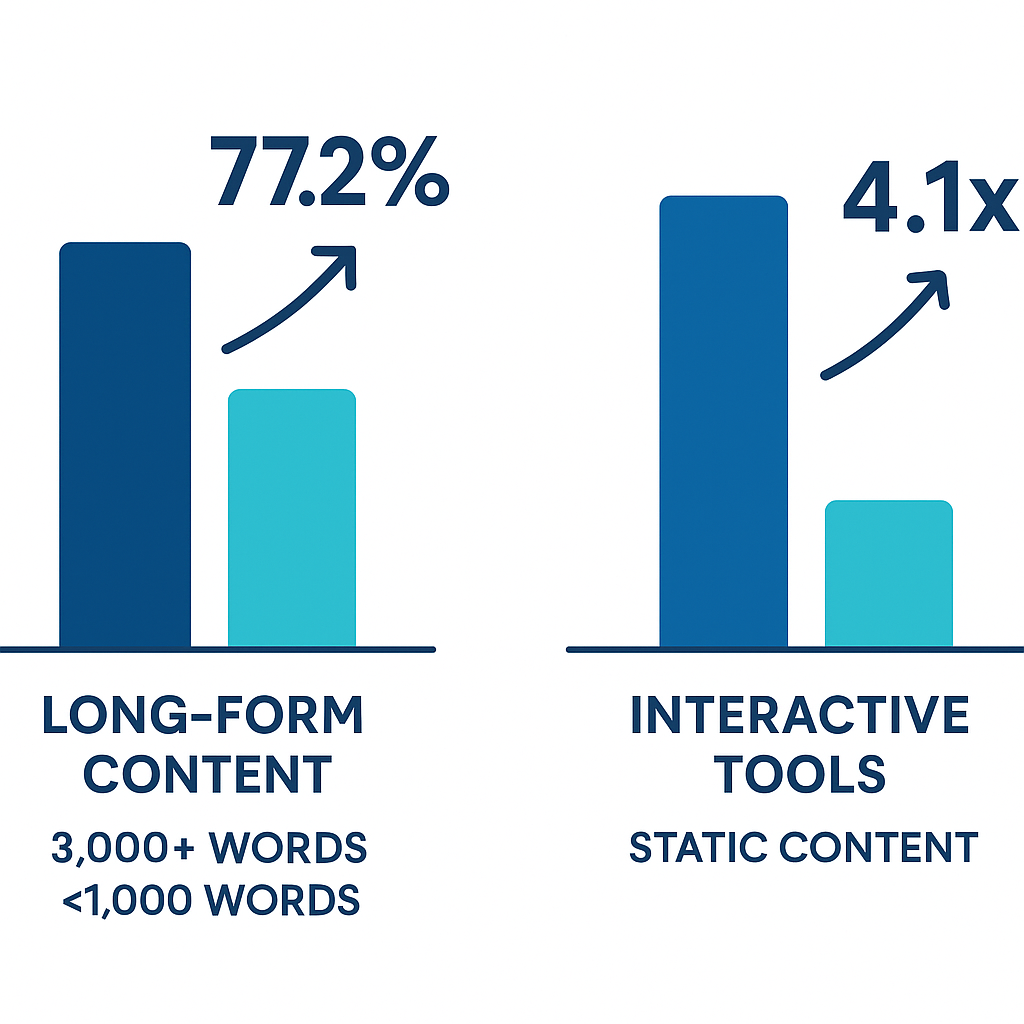
Long-form content earns dramatically more backlinks than short posts, and the data is unambiguous on this: content over 3,000 words earns 77.2% more backlinks than content under 1,000 words, according to Analytify's analysis of Google ranking factors. This isn't because length itself is the signal — it's because depth, comprehensiveness, and unique data are what make content citable. A 500-word blog post gets shared; a 4,000-word guide with original survey data gets linked. If you're running a B2B SaaS company, the most practical approach is to combine your own product usage data or customer survey results with publicly available industry statistics to produce an annual benchmark report. These reports become perennial link magnets that other writers in your space reference repeatedly.
Interactive Tools and Calculators
Interactive content — calculators, ROI estimators, quizzes, assessment tools — generates 4.1x more links than static content, per Searchlab's 2026 link-building statistics. For SaaS companies, this category is particularly natural: a churn rate calculator, a CAC/LTV ratio tool, a pricing model estimator, or a security compliance checklist are all assets that journalists, bloggers, and other SaaS teams will link to repeatedly because they're genuinely useful utilities, not just content. Building these tools doesn't require an engineering sprint — no-code platforms like Outgrow, Typeform, or even Google Sheets embeds can produce functional calculators quickly. The key is that the tool solves a real, recurring problem for your target audience. Gofylo's own free AI Search Grader is built on this principle: it's a standalone tool that grades your brand's AI search visibility, creates immediate value, and naturally earns citations from SEO content that references it.
Original data is the lever. If you can publish a study, survey, or benchmark that didn't exist before, other writers in your space will cite it rather than conduct their own research. Even a survey of 200-300 customers or prospects produces statistically useful data that earns citations from industry publications, other SaaS blogs, and increasingly, AI search engines that are trained to surface named data sources.
Evergreen beats timely. News-driven content earns links in a burst and then flatlines. Evergreen reference content — frameworks, glossaries, definitive guides, benchmark studies — earns links slowly and continuously. For teams without dedicated content bandwidth, evergreen assets have a dramatically better ROI because each piece keeps working without maintenance.
Volume enables compounding. One great piece of content earns links. Thirty great pieces — published monthly, internally linked, and structured for both Google and AI search — create a content graph that makes your domain the authoritative reference source in your category. This is the structural difference between manual content workflows and platforms like Gofylo that generate, publish, and internally link 30 articles per month autonomously, turning link-worthiness from a one-off achievement into a continuous output.
Step 5: Execute a Digital PR Campaign
Digital PR has become the dominant link-building tactic in 2026 by a significant margin. According to Analytify's analysis of Google ranking factors, 48.6% of SEO professionals now consider digital PR the most effective link-building approach — ahead of guest posting and traditional outreach. And SEOmator's state-of-backlinks data shows that 67.3% of marketers use digital PR as their primary link building method. The reason is straightforward: a single well-placed story in a publication like TechCrunch, VentureBeat, or The Information can earn dozens of high-DR follow links simultaneously — from aggregators, newsletters, and secondary publications that pick up the story. For B2B SaaS specifically, digital PR tends to focus on three categories: funding announcements, original research releases, and executive thought leadership.
Respond to Media Requests and HARO-Style Platforms
Platforms like Help a Reporter Out (HARO), Qwoted, and SourceBottle connect journalists with expert sources for stories they're actively writing. When a journalist cites you as a source, they typically link to your website. The barrier to entry is low — you simply need a credible title, a relevant perspective, and a fast response time (most requests are time-sensitive). The key to making this work at scale is specificity: generic responses from 'marketing expert' personas get ignored; responses from founders or heads of product who can cite actual data from their own platform get featured. Set up alerts for queries relevant to your category — SaaS, B2B marketing, AI tools, content strategy — and respond within two hours of a request going live.
Pitch Data-Driven Stories to Industry Publications
Beyond reactive media response, proactive PR pitching involves identifying the publications that cover your category, understanding what story formats they favor, and bringing them exclusive data or a counterintuitive angle they couldn't produce on their own. For SaaS companies, this typically means pitching original research ('we surveyed 500 SaaS founders about their content budgets — here's what we found') or trend analysis backed by platform data. The pitch needs to be brief, specific, and immediately clear on why their audience cares. According to searchengineland.com's coverage of digital PR for SEO, the pitches that earn placements are almost always data-first, not product-first — lead with the insight, not the brand.
Step 6: Run Targeted Guest Posting at Scale
Guest posting remains a viable backlink-building tactic in 2026, but the standard has shifted considerably from the era of bulk-posting to any site that would accept content. Today, the sites worth targeting are those with genuine editorial standards, a real audience in your category, and a Domain Rating of 50 or higher. Guest posts on DR 50+ sites generate 2.4x more ranking impact than posts on lower-authority sites, according to Ahrefs. The math on this is straightforward: ten guest posts on low-DR sites produce less compounding benefit than two well-placed posts on authoritative industry publications. Quality over quantity isn't a cliché here — it's a mathematical reality driven by how Google weights referring domain authority.
- Identify 10-20 target publications in your category with DR 50+ using Ahrefs' Content Explorer — search for topics you cover and filter by referring domain count.
- Study 3-5 recent guest posts on each target site to understand topic preference, word count, and formatting norms before pitching.
- Pitch a specific headline and a one-paragraph summary — not a completed draft. Editors want to shape the piece; completed drafts often feel like link grabs.
- Write to the publication's audience, not your own — the piece should read as editorial content, not a product pitch. Links should be natural and contextual.
- Include one contextual link to your site within the body of the article, and one author bio link — don't over-optimize anchor text with exact-match keywords.
- After publication, share and amplify the piece — a guest post that drives traffic to the host site earns you goodwill and often repeat opportunities.
A note on backlink automation: AI-assisted outreach tools can significantly increase the volume of guest post pitches you send, but the content itself still needs human judgment to avoid producing generic, unhelpful articles that editors reject. Our separate guide on backlink automation covers how to combine AI-generated prospecting with human-reviewed content quality — the combination is more effective than either approach alone.
Step 7: Activate Partnerships, Integrations, and Affiliates
For B2B SaaS companies, partnership-based link building is one of the most underutilized high-ROI channels. Every integration partner, agency partner, technology alliance, and affiliate relationship represents a natural, contextually relevant link opportunity. These links are editorially legitimate — the partner is linking to you because there's a genuine product relationship — and they come from domains that typically have real audiences and real authority. The key is systematizing partnership link acquisition rather than leaving it as an afterthought. Most partnership links exist in partner directories, co-marketing blog posts, integration marketplace listings, and case studies — and most of them require only a brief coordination email to activate.
- List every active technology integration your product supports — each integration platform (Zapier, HubSpot App Marketplace, Salesforce AppExchange) is a link opportunity.
- Contact each integration partner and offer to co-create content — a joint blog post, a co-branded case study, or a 'how to use X and Y together' tutorial naturally earns links from both domains.
- Ask agency partners to add you to their 'tools we use' or 'recommended stack' pages — these resource-style links are high-trust and editorially clean.
- Build a formal partner page on your own site that links to each partner — this creates a reciprocal relationship that makes your outreach easier and your partner more likely to reciprocate.
- If you run an affiliate program, ensure affiliates have access to branded asset libraries and editorial guidelines — affiliate-driven content that follows editorial standards earns higher-quality links than thin review posts.
Step 8: Get Listed on Resource Pages and Curated Hubs
Resource pages — curated lists of tools, guides, or services maintained by blogs, associations, universities, and industry portals — are among the highest-value link targets for SaaS companies because they're explicitly designed to recommend tools and resources. Getting listed on a well-maintained resource page earns you a link that remains active for years, often on a domain with strong topical authority. The prospecting approach is systematic: use Google search operators to find resource pages in your category (for example, searching 'site:.edu best SaaS tools for marketers' or 'inurl:resources B2B SaaS tools'), evaluate each page for Domain Rating and topical relevance, then reach out with a specific pitch that explains exactly where your tool fits and why it adds value to their list.
- Use Google search operators: 'intitle:resources [your category]', 'inurl:links [your category]', 'best tools for [your audience]' to find curated lists.
- Prioritize pages that are actively maintained — check the last-updated date or look for recently added entries. Stale resource pages rarely add new listings.
- Evaluate Domain Rating in Ahrefs before investing time in outreach — anything under DR 30 has limited link equity value for most SaaS categories.
- Your pitch should be two to three sentences: what your tool does, who it's for, and why it belongs on their list. Don't write an essay.
- Follow up once, five to seven days after your initial email, if you don't receive a response. Most positive responses come on the follow-up.
- Build your own 'best tools' resource pages — curating other tools in your ecosystem earns you goodwill, links from tools that reciprocate, and topical authority signals.
Step 9: Track Backlinks in Both Google and AI Search
Most backlink-building guides end at acquisition — but measurement closes the loop and tells you which tactics are actually moving the needle. In 2026, tracking backlinks means monitoring two distinct dimensions: traditional link metrics (referring domains, DR, anchor text distribution, lost vs. gained links over time) and AI search citation presence. The second dimension is new, increasingly important, and almost entirely absent from competitor guides on this topic. As ChatGPT, Claude, Perplexity, and Gemini become primary research surfaces for B2B buyers, the question isn't just 'do I rank on page one?' but 'am I cited when someone asks an AI about tools in my category?' The answer to that question is shaped directly by your backlink profile.
How Backlinks Affect AI Search Citation
AI search engines don't index the web the way Google does, but they surface content from sources that have high authority signals — which correlates strongly with backlink profile quality. When Perplexity or Claude cites a tool or brand in a response, it's typically drawing from publications (industry blogs, analyst sites, comparison platforms like G2 and Capterra) that have high referring domain counts and strong editorial authority. Building backlinks from those specific publication categories — not just any DR 50+ domain — is what drives AI search citation. According to Analytify's 2026 ranking factors analysis, 67.5% of SEO experts believe backlinks have a major impact on rankings, and that influence extends into AI-generated responses as large language models increasingly use search-quality signals to determine which sources to surface and cite.
Track your AI Visibility Score. Gofylo's AI visibility score is produced by asking ChatGPT and Claude about your brand and combining the results into a single benchmark. This gives your brand a clear benchmark against what most teams achieve with manual tracking. This gives you a clear signal: are your backlink-building efforts translating into AI citation share, or are you ranking on Google but invisible in AI-driven search?
Monitor link velocity, not just totals. A sudden spike in new referring domains can be a positive signal (successful digital PR campaign) or a negative one (someone running a link scheme against your domain). Set up Ahrefs Alerts or Semrush's backlink monitoring to notify you of significant weekly changes in referring domain count. Velocity is often more informative than aggregate totals for diagnosing what's working.
Report on referring domains, not backlinks. Raw backlink counts are a vanity metric — one aggressive site can generate thousands of links from a single domain. Referring domain count is the metric that correlates with ranking performance. Track unique referring domains over time, segmented by DR tier (DR 10-30, 30-50, 50-70, 70+), and use that distribution to prioritize your outreach focus for the following month.
Building backlinks is only as effective as your ability to measure the outcome. If you're spending budget and time on outreach without tracking referring domain growth and AI citation presence simultaneously, you're flying blind in two dimensions. Set up tracking before you build, not after.
Frequently Asked Questions
How to actually build backlinks?
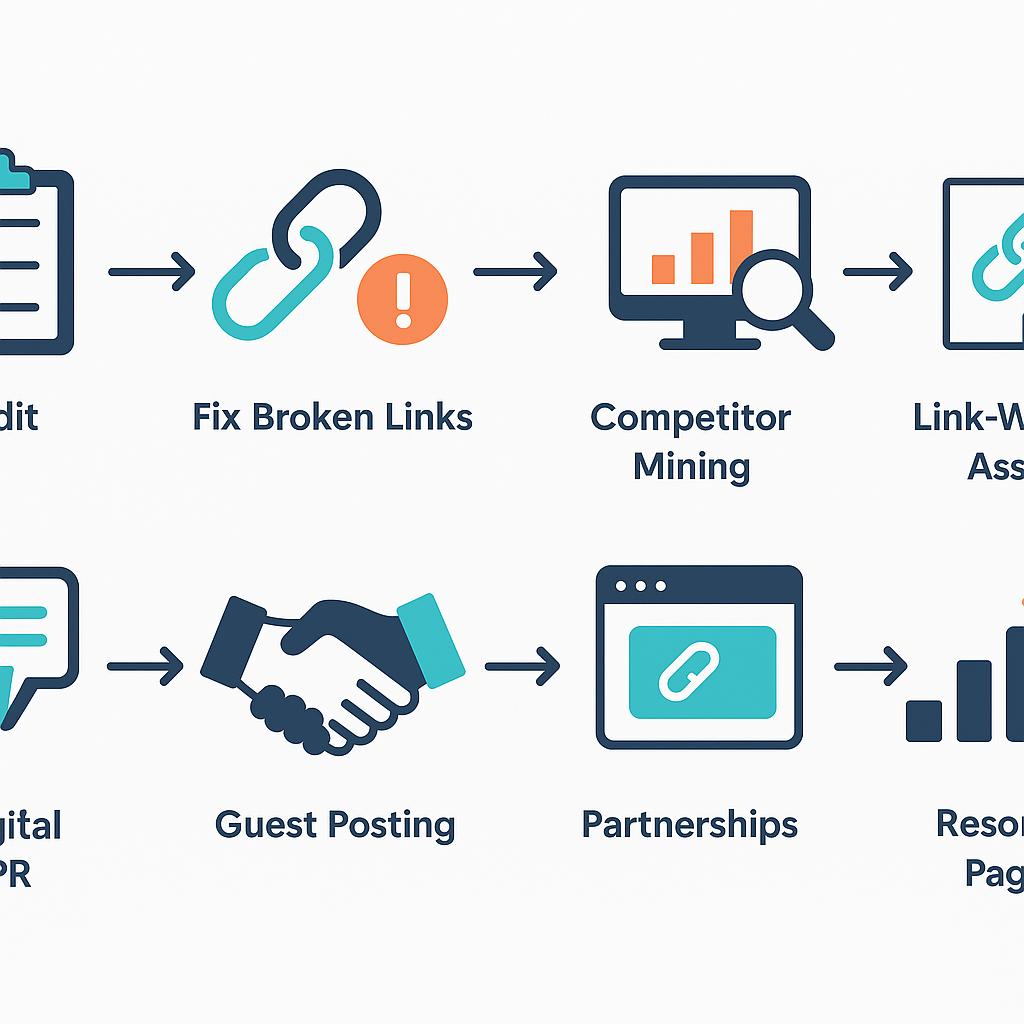
Building backlinks requires a combination of earning links through high-quality content, actively outreaching to relevant sites, and reclaiming links you've already lost. The most effective sequential approach starts with auditing your existing profile and fixing broken links, then moves to competitor gap analysis, digital PR, guest posting, and partnership link activation. Passive strategies — like creating original research reports and interactive tools — compound over time and eventually reduce your dependence on active outreach.
Are backlinks still relevant in 2026?
Yes — and the data is unambiguous. Backlinko's analysis of 11.8 million Google search results shows the #1 result has 3.8x more backlinks than positions 2 through 10. As of 2026, 67.5% of SEO experts still consider backlinks a major ranking factor, according to The Frank Agency's research. Backlinks also influence AI search citation, as high-authority publications that link to you are the same sources that AI engines draw from when generating responses — making link building doubly important in the current search environment.
What does it mean to build backlinks?
Building backlinks means acquiring hyperlinks from external websites that point to pages on your site. Each backlink acts as a vote of credibility — Google and other search engines treat links from authoritative, relevant domains as signals that your content is trustworthy and worth ranking. Building backlinks involves both earning them passively (through content quality) and actively pursuing them through outreach, digital PR, guest posting, and partnership agreements.
Is link building illegal?
Link building itself is not illegal. However, Google's link spam policies explicitly prohibit certain practices — such as buying links, participating in link schemes, or using automated programs to create links — which can result in manual penalties or algorithmic suppression. Ethical link building through content creation, outreach, digital PR, and genuine partnerships is fully compliant with Google's guidelines and is the approach this guide covers throughout.
How do I create backlinks for my website free?
Several effective backlink-building tactics cost nothing beyond time: reclaiming unlinked brand mentions, fixing broken inbound links, contributing to journalist requests via HARO-style platforms, getting listed on free resource directories, and publishing original research using data you already have access to. Guest posting on industry blogs is also largely free — you're trading content for links rather than paying for placement. Paid tools accelerate the process (finding broken competitor links, gap analysis) but the core tactics themselves don't require a budget.
What is a link building example for B2B SaaS?
A practical link building example for B2B SaaS: publish a 'State of [Category] 2026' report using data from your own platform or a customer survey, pitch the key findings to three industry publications as an exclusive story, and watch as those publications write about the report and link to it. Secondary publications then pick up those stories and link to both the original publications and your report directly. A single well-executed research report can generate 20-50 new referring domains within 30 days of publication — all from editorially legitimate sources in your industry.
If building backlinks at this scale feels out of reach for your current team size, Gofylo is built for exactly this situation. The platform's autonomous Content Engine publishes 30 fully SEO-optimized, E-E-A-T-compliant articles per month — each with schema markup, internal linking, and FAQ blocks — creating the content surface area that makes link earning and AI citation natural byproducts of simply existing online. The AI visibility score shows how ChatGPT and Claude see your brand, so you can see where you stand in AI search. Start a 3-day free trial at gofylo.io, or run your brand through the free AI Search Grader to see where you stand today.