As of 2026, the backlink landscape has fractured in two directions simultaneously: Google's PageRank-derived link equity model still governs traditional SERPs, but a second authority layer — AI citation probability — now determines whether your brand surfaces in ChatGPT, Claude, Perplexity, or Gemini responses. Backlink strategies built solely for one layer leave authority on the table. The companies compounding organic growth fastest are those treating links as trust signals for both machine systems at once.
This guide breaks down how backlink strategies actually function — the mechanisms behind link equity, the types of links that matter most in different contexts, and how the emergence of AI-driven search has added a new dimension to what a 'strong' backlink profile looks like. Whether you're a founder managing SEO with limited bandwidth, a content lead trying to justify a link-building budget, or a demand gen team looking for compounding returns, understanding the why behind backlink strategy is the prerequisite to executing the how.
Thesis: Effective backlink strategy in 2026 isn't about volume — it's about acquiring contextually relevant, editorially earned links from authoritative sources that build trust across both Google's crawl graph and AI training corpora. The two goals are more aligned than they appear.
What Backlinks Actually Do for Search Visibility
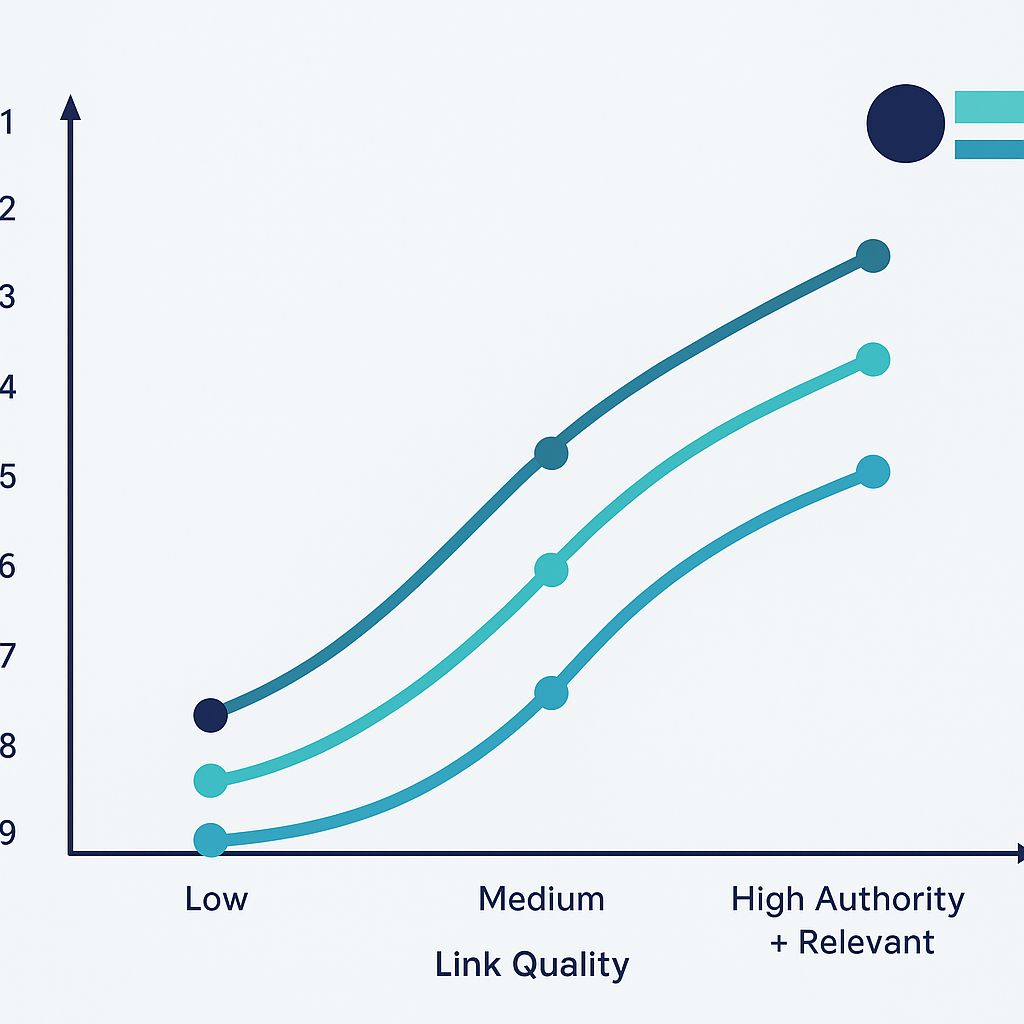
Backlinks function as third-party endorsements in both the crawl graph and the broader web of cited information. When a site links to your content, it passes a fraction of its own authority — Google's systems interpret this as a vote of confidence about the relevance and trustworthiness of your page. But the mechanism runs deeper than a simple vote count. According to Google's Search documentation, links are one of the primary ways Googlebot discovers new pages, which means backlinks influence both crawlability and authority simultaneously. A page with zero inbound links from indexed domains is essentially invisible regardless of content quality. The quantity signal has weakened over time — Ahrefs' 2025 data showed that top-ranking pages earn links at a rate roughly 3x higher than pages ranking positions 4–10 for competitive terms, but the majority of that advantage comes from a small number of high-authority referring domains, not from link counts alone. In 2026, the consensus among practitioners is clear: a handful of genuinely authoritative, contextually placed links outperforms hundreds of low-quality directory submissions.
The Anatomy of a High-Value Backlink
Not all backlinks are structurally equivalent, and understanding why requires looking at the signals that search systems actually read. A high-value backlink combines several properties at once: it originates from a domain with demonstrated topical expertise in your space, it appears within body content rather than footers or sidebars, its anchor text is contextually descriptive without being keyword-stuffed, and the linking page itself has inbound links of its own. Strip any one of these properties and the link's value degrades. Google's Spam Policies documentation explicitly addresses link schemes — patterns of unnatural linking — as grounds for manual or algorithmic penalties, which means the risk calculus of backlink acquisition isn't just about gains but about avoiding negative signals. The practical implication is that every backlink strategy worth executing should default to editorial intent: the link should exist because it genuinely serves the reader of the linking page, not because a transaction or agreement placed it there.
Domain Authority vs. Topical Relevance
Domain Authority (DA), as defined by Moz, and Domain Rating (DR), as used by Ahrefs, are proxy metrics — they estimate the aggregate link equity of a domain but say nothing about whether that domain's subject matter aligns with yours. A DA-90 lifestyle blog linking to your B2B SaaS security tool provides less signal value than a DA-60 cybersecurity publication covering the same space. Topical relevance has grown in weight as Google's systems have become more semantically sophisticated. The practical guidance: prioritize relevance-qualified link targets first, then layer in high-DA generalist publications where you can earn coverage on-topic. Both dimensions matter; neither alone is sufficient.
Link Placement and Anchor Text Signals
Placement context tells crawlers how central the linked resource is to the host page's subject matter. A link embedded in the first 200 words of a body paragraph about a specific concept — with descriptive anchor text that matches the concept — signals far stronger topical association than a 'click here' link buried in a resource roundup. Anchor text distribution across your backlink profile should look natural: a mix of branded anchors, partial-match phrases, URL anchors, and generic terms. Profiles dominated by exact-match commercial anchors — especially from low-authority sites — remain a reliable footprint for algorithmic penalties. Semrush's 2025 ranking factors analysis found that referring domain diversity and anchor text naturalness were among the top 10 correlated factors with top-3 SERP positioning.
Core Backlink Strategy Archetypes
Backlink strategy isn't a monolithic playbook — it's a portfolio of approaches, each with different effort curves, time horizons, and yield profiles. The most effective programs in 2026 run at least two archetypes in parallel: a content-driven earn approach that builds links passively at scale, and a targeted outreach or PR approach that concentrates effort on high-authority placements. Understanding the structural logic of each archetype helps you allocate resources correctly rather than defaulting to whatever tactic you last saw in a conference talk.
Editorial Link Earning
Editorial links are the highest-trust link type: they're placed without solicitation because another author genuinely found your content useful enough to cite. Earning them at scale requires creating content assets that serve as reference points — original research, comprehensive explainers, data compilations, or frameworks that other writers in your space need to support their own arguments. The mechanism is indirect: you publish something cite-worthy, it gets discovered organically or via promotion, and links accumulate over months. This is a compounding strategy — the asset continues earning links long after publication with no additional effort. The tradeoff is a slow initial ramp; most editorial link assets don't see significant link velocity until 90–180 days post-publication.
Digital PR and Data-Driven Assets
Digital PR is the structured acceleration of editorial link earning. Instead of waiting for journalists and bloggers to find your content, you proactively pitch original data, studies, or unique perspectives to publications likely to cover them. The most reliable format for this archetype is proprietary survey data: a study with a clear finding that contradicts conventional wisdom, or that quantifies something the market has only discussed qualitatively. According to Search Engine Land's analysis of link acquisition patterns, data-backed assets generate 4x more editorial backlinks than equivalent non-data content over a 12-month window. The constraint is resource intensity — primary research requires budget or platform access. Platforms like Gofylo, which has generated 48,000+ articles and surfaces content patterns across categories, can accelerate the ideation phase by identifying what data gaps exist in competitor content.
Broken Link Building and Link Reclamation
These two tactics operate on existing link graphs rather than creating new ones. Broken link building identifies pages on high-authority domains that link to dead resources, then pitches your content as a replacement — a value proposition that's easy to say yes to because it helps the linking site fix a user experience problem. Link reclamation captures value that's already been implicitly granted: unlinked brand mentions, citations of your data without a hyperlink, or links pointing to outdated versions of your pages. Neither tactic is glamorous, but both have strong ROI profiles because you're working with warm intent rather than cold outreach. Systematic reclamation, run quarterly, ensures you're not leaving earned authority on the table.
The GEO Dimension: How AI Systems Use Link Signals
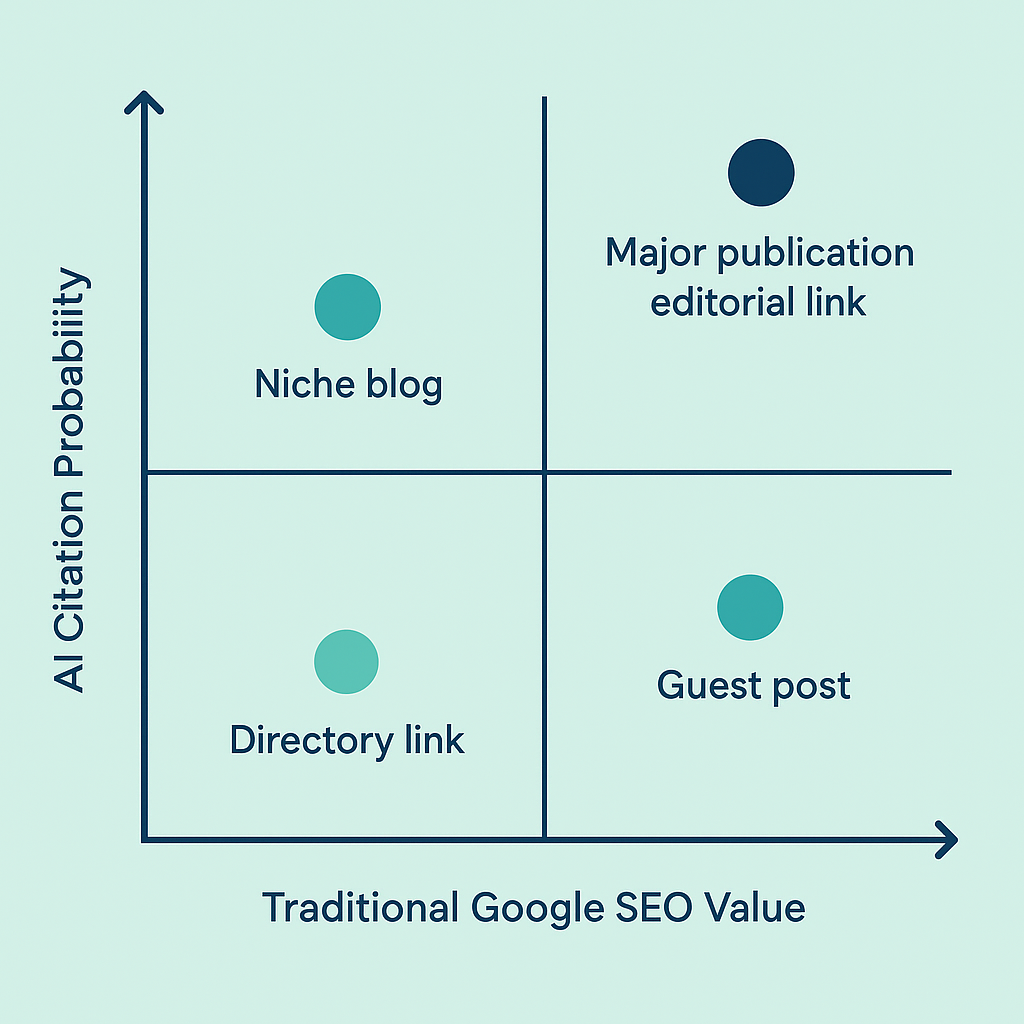
In 2026, a backlink strategy that ignores AI search visibility is incomplete. ChatGPT, Claude, Perplexity, and Gemini don't crawl the web in real time the way Googlebot does — but they are influenced by the authority and citation patterns embedded in their training data and live retrieval layers. Pages that are heavily cited by authoritative sources across the web are more likely to appear in that training corpus with higher frequency, which increases the probability that an AI system will surface or cite that content in a relevant response. Perplexity's retrieval-augmented generation model actively pulls from high-authority sources when constructing answers, which means traditional backlink signals — strong referring domain profiles, editorial citations from trusted publications — translate directly into AI search citation probability. The strategic implication is significant: the same content that earns editorial backlinks from respected publications also improves AI visibility. Building for GEO (Generative Engine Optimization) and building for Google are not competing agendas — they share the same foundational requirement: content that external authoritative sources trust enough to cite. Tracking where you stand in AI systems requires dedicated tooling; Gofylo's AI Visibility Tracker monitors brand citation presence across ChatGPT, Claude, Perplexity, and Gemini, surfacing an AI Visibility Score that averages 94 across active accounts.
The GEO insight most teams miss: every editorial backlink you earn from a domain that AI training crawlers prioritize (major publications, research sites, technical documentation) increases both Google authority and AI citation probability simultaneously. These are not separate link budgets.
Why Backlink Gap Analysis Is a Strategic Starting Point
Before committing to any outreach or content program, understanding where your backlink profile stands relative to competitors is the highest-leverage first step. A backlink gap analysis compares your referring domain set against those of two to four competitors ranking above you for target keywords, surfacing domains that link to them but not to you. This gap represents your most addressable link opportunity set — sites that have already demonstrated willingness to link to content like yours. The analysis also reveals structural weaknesses: categories of content (data studies, integrations documentation, comparison pages) that your site is missing and that attract significant third-party links in your category. We've written in more depth about the mechanics and tooling options in our [backlink gap analysis guide], and if you're considering whether to build this capability in-house versus working with specialists, our [backlink building agency overview] covers that tradeoff in detail. For most growth-stage SaaS teams, gap analysis converts a vague 'we need more links' mandate into a specific, prioritized target list.
Gap analysis first. Running outreach without a gap analysis is resource-inefficient — you're targeting sites blindly rather than concentrating effort on the highest-probability link sources already proven to link in your category.
Competitor reverse-engineering. The sites linking to your top three competitors are your warmest prospect list. They've already made an editorial judgment that content in your category is link-worthy; the conversion lift on outreach to these domains significantly outperforms cold-list prospecting.
Content gap overlap. When a competitor has earned 40+ links to a specific content format — say, an annual benchmark report or an integration directory — that's a signal about what the market values. Building a better version of that asset is a strategy with historical precedent, not a guess.
The Case for Autonomous, Compounding Link Acquisition
Manual link building — identifying targets, writing custom pitches, following up, tracking placements — is time-intensive by design. For teams without a dedicated link-building function, the operational overhead often results in inconsistent execution: bursts of activity followed by months of inaction. The structural problem isn't motivation; it's that link acquisition depends on content production at scale, and most startups can't sustain both simultaneously with small teams. The compounding alternative is to build a content engine that generates linkable assets continuously, creating a passive link attraction surface that grows month over month. Gofylo's Content Engine generates 30 SEO-optimized articles per month — each with schema markup, internal linking, and FAQ blocks — in under 4 minutes per article, supporting 18+ languages and programmatic landing page generation. At 48,000+ articles generated across the platform, the pattern is clear: companies that publish consistently at this velocity build referring domain profiles that outpace competitors running quarterly content sprints. That content base also feeds directly into the GEO layer — more topically authoritative pages mean more surface area for AI systems to cite. The autonomous backlink generation component closes the loop, converting content authority into active link acquisition without requiring a manual outreach team. For teams comparison-shopping platforms, tools like Surfer SEO and Clearscope address content optimization but stop short of autonomous publishing and AI visibility tracking — the full-cycle automation is structurally different from a point solution.
Compounding works because each published article increases the site's topical authority, which improves rankings for subsequent articles, which attracts more links to the domain, which raises the floor for all future content. The mechanism is self-reinforcing — but only if publishing volume is consistent.
Consistency beats intensity. A team publishing 30 well-optimized articles monthly for 12 months will build a more robust link profile than one that publishes 100 articles in a single quarter and then stops. Search systems reward sustained topical coverage; link velocity spikes without organic follow-through look unnatural.
AI visibility compounds too. According to Gartner's 2025 Digital Marketing report, brands that invest in structured, consistently published content see AI citation frequency increase by roughly 2x within 6 months compared to brands with irregular publishing cadences. The mechanism: AI training updates and retrieval indexes favor domains with fresh, high-frequency topical coverage.
Frequently Asked Questions About Backlink Strategies
These are the questions we see most often from B2B SaaS teams approaching backlink strategy for the first time — or revisiting it after a period of inconsistent execution. The answers below focus on the structural logic rather than tactical step-by-step guidance.
- How many backlinks do I actually need? There's no universal number — the right target is a function of your competitors' referring domain counts for the keywords you're pursuing. Use a gap analysis against the top three ranking pages for each priority term rather than chasing an absolute count.
- Do links from AI-generated content count? Links embedded in AI-generated content on low-authority, low-traffic sites provide minimal equity. The editorial origin still matters: a link needs to come from a page that itself earns traffic and trust, regardless of how that page's content was produced.
- How long does link building take to show results? Most campaigns show meaningful ranking movement between 90 and 180 days after link acquisition, depending on domain age, competitive density, and how well the linked content matches search intent. GEO citation effects can appear faster — within 30–60 days — because AI retrieval indexes update more frequently than full crawl cycles.
- Is buying links ever worth the risk? Paid links that pass PageRank violate Google's guidelines and carry manual penalty risk. The risk-adjusted ROI is negative for most companies once you account for potential ranking loss and recovery effort. The same budget applied to content assets that earn editorial links naturally compounds without the downside.
- What's the difference between link building and link earning? Building implies active acquisition — outreach, partnerships, placements. Earning implies passive attraction through content quality. Both are valid; the optimal strategy blends proactive targeted outreach (for high-priority pages) with passive earning at scale (for long-tail authority accumulation).
Related: Hiring a Backlink Building Agency vs. Building In-House: The Honest Answer
Related: Build a Backlinks Strategy That Compounds in 2026
Related: Backlink Building for B2B SaaS: Tactics That Work in 2026
Related: How Backlink Automation Actually Works — and Where It Goes Wrong
Related: 14 Backlink Building Techniques Ranked by Real SEO Impact
Related: Building B2B SaaS Backlinks in 2026: From Content to Digital PR
If you're ready to build a backlink profile that compounds across both Google and AI search — without a full content team — Gofylo's autonomous platform handles research, writing, publishing, and AI visibility tracking for $79/month. Start with the free AI Search Grader to see where your brand stands today, then activate the Content Engine to start building the linkable asset base. No credit card required for the 3-day trial.