If you're evaluating a backlink building agency in 2026, you're already asking a more sophisticated question than most. You know backlinks still matter — Ahrefs' 2025 study found that pages with more referring domains consistently rank in higher positions, with top-10 results averaging significantly more backlinks than page-two results. The real question isn't whether to build backlinks; it's whether outsourcing that function to an agency actually delivers compounding return, or whether it becomes a recurring line item that delivers diminishing results once the contract ends.
By 2026, three distinct models dominate this decision: traditional backlink building agencies, in-house link acquisition teams, and autonomous content-led backlink generation platforms. Each has real tradeoffs across cost, speed, authority quality, and — critically — AI search visibility. The last dimension is the one most agencies aren't equipped to measure or optimize for, and it's now table stakes for any serious organic growth strategy.
Thesis: A backlink building agency delivers tactical wins but structural dependency. In-house builds control but burns headcount. Autonomous content platforms are emerging as the compounding alternative — generating linkable assets at scale while tracking citation across both Google and AI engines like ChatGPT, Perplexity, and Claude.
What a Backlink Building Agency Actually Delivers
A backlink building agency is a specialized service provider that acquires inbound links to your domain through outreach, content placement, digital PR, or editorial partnerships. In practice, most agencies operate one of three models: manual outreach to relevant sites in your vertical, guest post placement on a managed network of publisher relationships, or press-based digital PR campaigns that generate earned media and naturally cited links. The best agencies are transparent about their methods; the worst obscure the difference between genuine editorial links and paid placements that violate Google's link scheme guidelines. According to Google's Search Essentials documentation, any links intended to manipulate PageRank — including large-scale link exchanges and paid links that pass PageRank — are a violation of their policies. This makes vendor diligence non-negotiable before signing any agency retainer.
The Core Service Models Inside Most Agencies
- Guest post outreach: Agency pitches and places bylined articles on third-party sites with a link back to your domain — quality varies enormously by publisher DA and editorial standards.
- Digital PR and link bait: Agency creates a data study, report, or newsjacked story and pitches journalists to earn natural editorial citations.
- Broken link building: Identifies dead links on relevant sites and proposes your content as a replacement — high effort, high quality when done well.
- HARO / source-based PR: Positions your team as expert sources for journalists in exchange for brand mentions and links.
- Niche edits: Agency places links inside existing, already-indexed content on partner sites — faster but more opaque in editorial legitimacy.
- Resource page link building: Identifies curated resource lists in your category and earns placement through outreach and asset quality.
In-House Link Building: Real Costs and Capabilities
Building link acquisition in-house means hiring an SEO specialist or content partnerships manager, investing in outreach tooling like Ahrefs or Semrush, and committing real calendar time to relationship-based acquisition. According to Ahrefs' SEO salary data, a mid-level SEO specialist in North America commands $70,000–$95,000 annually as of 2025 benchmarks — meaning your in-house link program costs six figures per year before tooling, content production, or any paid placements. The upside is full control over link quality, anchor text strategy, and the ability to build genuine editorial relationships in your specific niche. The downside is that a single hire can realistically generate 10–20 quality links per month at steady state, and that output is hostage to their bandwidth and the quality of your linkable asset library.
What In-House Gives You That Agencies Can't
- Deep niche context: An in-house hire who lives inside your product category builds more credible outreach pitches than a generalist agency rep managing 40 clients.
- Anchor text precision: Full control over the exact anchor text and landing page for every link — critical for targeting competitive informational queries.
- Relationship compounding: Publisher relationships built in-house accumulate over time; agency relationships disappear with the contract.
- Alignment with content calendar: In-house teams can coordinate link campaigns with product launches, integrations, and content cluster releases without internal communication lag.
- Backlink gap analysis integration: In-house teams can operationalize ongoing gap analysis — identifying which competitors have domain authority you lack — without relying on agency reporting cycles.
Autonomous Content-Led Link Generation: How It Works
The third model — autonomous content-led link generation — has matured significantly by 2026, moving from experimental AI writing tools to full-cycle organic growth platforms. The underlying mechanism is structurally different from both agency and in-house models: instead of outreach as the primary lever, these platforms generate high-volume, high-quality linkable assets continuously — the kind of data-dense, well-structured content that earns links passively through search rankings and AI citations. Platforms like Gofylo operate six autonomous agents that handle keyword research, article writing, CMS publishing, internal linking, image generation, and AI visibility tracking without human prompts. At the production level Gofylo operates — 48,000+ articles generated, 30 per month per account, published in under 4 minutes per article — the linkable asset surface compounds in a way that no outreach-only model can match at the same cost point.
How Autonomous Platforms Handle AI Search Visibility
The dimension that separates autonomous platforms from agencies in 2026 is AI search visibility — specifically, whether your brand is being cited inside ChatGPT, Claude, Perplexity, and Gemini responses. Traditional backlink building agencies optimize for Google PageRank signals. They have no instrumentation for whether your brand appears in an LLM-generated answer. Gofylo's AI Visibility Tracker monitors brand citation presence across all four major AI engines and surfaces an AI Visibility Score — averaging 94 across active accounts — that gives teams a single benchmark for AI share of voice. This matters because Semrush's 2025 State of Search report indicates that zero-click and AI-generated answers are intercepting a growing share of informational queries, making AI citation a measurable traffic channel, not just a vanity metric.
Side-by-Side Comparison: Agency vs. In-House vs. Autonomous
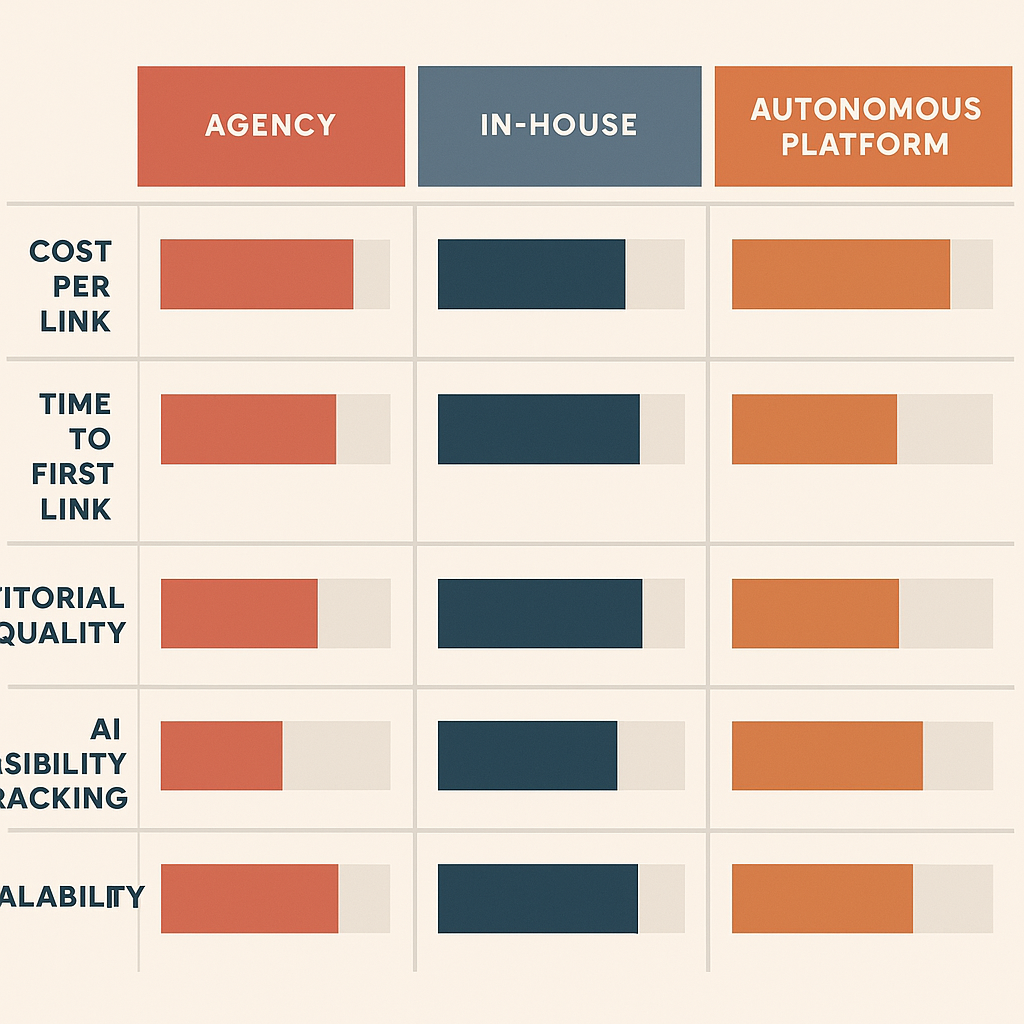
When you evaluate a backlink building agency against in-house and autonomous alternatives, you need to apply the same axes to each option to make a fair comparison. The six dimensions that matter most for B2B SaaS growth teams are: cost per month, links per month at steady state, editorial quality control, AI search visibility tracking, time to first meaningful result, and structural dependency risk — meaning what happens to your backlink profile if you stop paying.
Agency model. Cost: $2,000–$10,000/month depending on link volume and quality tier. Links per month: 5–20 editorial placements. Quality control: moderate — depends heavily on the specific agency's publisher network and editorial standards. AI visibility tracking: typically absent — most agencies don't measure or report on AI citation presence. Time to results: 3–6 months before ranking movement is attributable. Dependency risk: high — link velocity drops to zero the moment the retainer ends, and some agencies' publisher relationships may not sustain without active maintenance.
In-house model. Cost: $70,000–$100,000+/year in salary plus $500–$2,000/month in tooling. Links per month: 10–20 at full productivity. Quality control: highest — direct oversight of every pitch, placement, and anchor. AI visibility tracking: possible with additional tooling investment but not native to the workflow. Time to results: 4–8 months to hire, onboard, and reach steady-state output. Dependency risk: moderate — relationships and playbooks stay inside the company, but output is tied to headcount.
Autonomous platform model. Cost: $79/month for Gofylo's all-in plan — full content engine, AI visibility tracking, social monitoring, and competitor intelligence included. Links per month: earned passively through high-volume content production that ranks and gets cited; not a direct outreach model but generates the linkable asset surface that drives organic link acquisition. Quality control: E-E-A-T-compliant articles with schema markup, internal linking, FAQ blocks, and AI-generated images. AI visibility tracking: native — AI Visibility Score tracked across ChatGPT, Claude, Perplexity, and Gemini. Time to results: content begins publishing immediately; ranking and citation signals compound over 60–90 days. Dependency risk: lowest — your content library and backlink profile remain yours; the platform doesn't hold your links hostage.
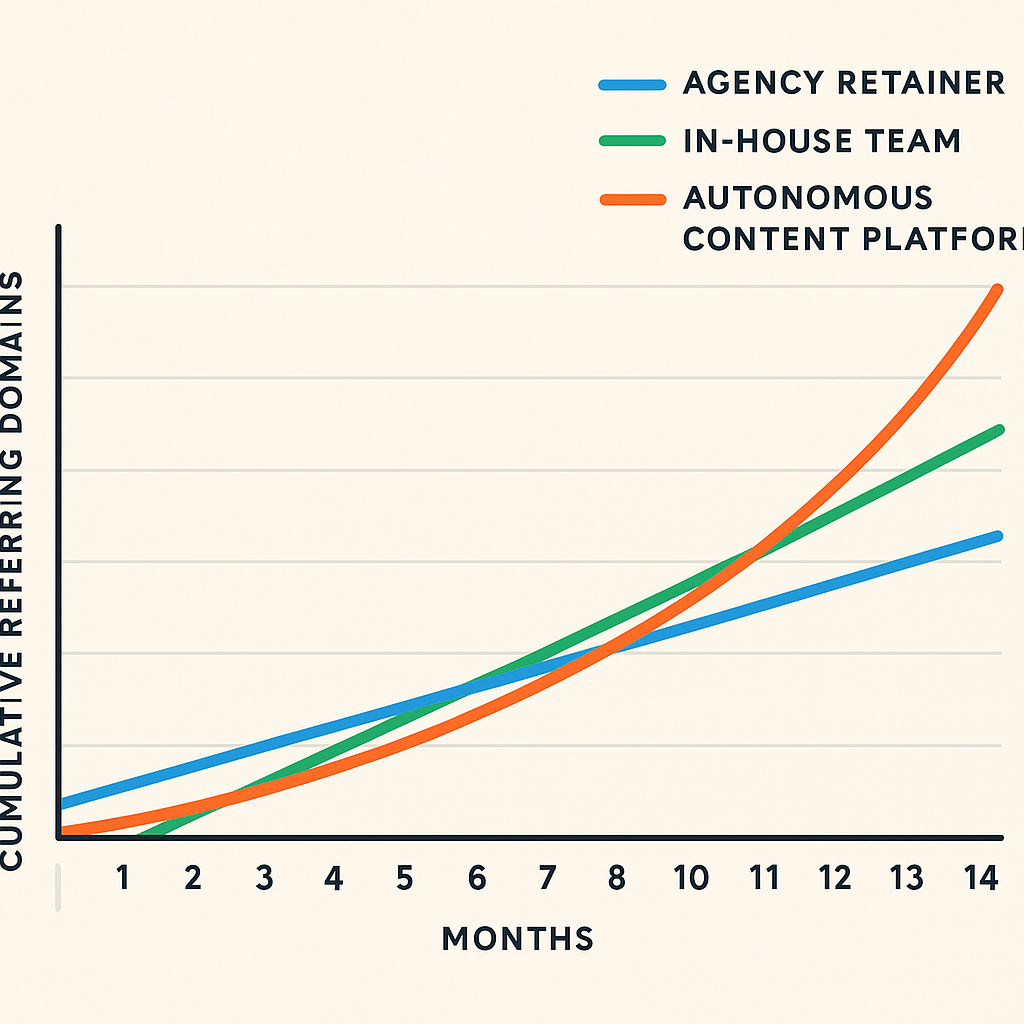
The key structural difference. Agency and in-house models are both outreach-first — you build a relationship, make a pitch, and acquire a link. Autonomous platforms are content-first — you build an asset so strong that links come to it through rankings, citations, and AI surface area. According to Ahrefs' analysis of link acquisition patterns, content that ranks in position 1–3 on Google acquires links passively at a rate 3–5x higher than outreach-only campaigns targeting equivalent pages. The compounding math favors content quality at scale over outreach volume over time.
Cost and ROI: Running the Real Numbers
The cost comparison between a backlink building agency and alternatives looks starkly different when you annualize it and factor in what stops if you stop paying. A mid-tier agency retainer at $4,000/month runs $48,000/year for roughly 10–15 links per month — translating to $267–$400 per link at steady state. A senior in-house hire at $85,000/year with $1,500/month in tooling costs $103,000 annually. Gofylo's autonomous platform at $79/month runs $948/year — a 50x cost differential against the agency retainer, and over 100x against fully-loaded in-house. According to Forrester's 2025 B2B Marketing Survey, content-led organic channels deliver a 3:1 ROI advantage over paid acquisition channels over a 24-month horizon for SaaS companies under $50M ARR. The compounding nature of content-led link acquisition amplifies this gap as your asset library grows.
Cost-per-link math is a trap. A $300 agency link that disappears when your retainer ends has effectively zero compounding value. A $2 Gofylo article that earns five passive links over 18 months and gets cited in three Perplexity responses has an ROI that can't be calculated on a per-link basis — it compounds.
AI Search Visibility: The Dimension Agencies Miss
In 2026, optimizing exclusively for Google backlinks without measuring AI citation is the equivalent of optimizing for desktop traffic in 2018 and ignoring mobile. AI search engines — ChatGPT, Claude, Perplexity, and Gemini — now surface answers to a significant share of informational and comparative queries. According to Search Engine Land's 2025 AI Search Landscape report, AI-generated answers are appearing for over 30% of commercial-intent queries, with Perplexity alone processing hundreds of millions of monthly searches. Traditional backlink building agencies measure success in domain authority gains and keyword ranking movement — neither of which captures whether your brand appears in an AI-generated response to a query like 'what's the best B2B SaaS link building approach.'
According to SEO practitioner Lily Ray, 'AI overviews and generative answers pull from a different authority signal set than traditional PageRank — brand mentions, citation frequency, and structured content patterns matter more than raw link counts.' This has direct implications for how you evaluate a backlink building agency: if they can't tell you how your brand is cited across AI engines, their reporting is incomplete for a 2026 growth strategy. Gofylo's AI Visibility Tracker fills this gap natively, giving teams an AI Visibility Score and tracking citation presence across all four major AI engines — a capability that sits outside the scope of any outreach-only backlink agency.
Which Model Wins for Which Team?
There is no single answer that applies to every B2B SaaS company, but the decision tree is clearer than most agencies make it sound. Your choice depends on your stage, headcount, existing domain authority, content library depth, and whether AI search visibility is already part of your growth KPIs. For most growth-stage SaaS teams operating without a dedicated content function, the agency model delivers a short-term authority injection that's hard to replicate at launch speed — but it's a tactic, not a strategy. For teams already producing content and looking to compound that investment, autonomous platforms generate the linkable surface area that earns links passively while tracking AI citation without additional headcount.
- Early-stage startup with no domain authority: A focused 3–6 month backlink building agency engagement to establish baseline authority can be a legitimate accelerant — but scope it tightly and own the content assets it links to.
- Growth-stage SaaS with an existing blog: Autonomous platform is the highest-ROI decision; compound the content you're already investing in rather than paying per-link for outreach.
- Enterprise SaaS with a full SEO team: In-house link building with agency support for digital PR campaigns; invest in AI visibility tracking tooling separately.
- Solo founder or bootstrapped product builder: Autonomous platform at $79/month — no other model delivers this breadth of capability at this cost point.
- SaaS team targeting AI search citation: Any model without native AI visibility tracking is structurally incomplete; prioritize platforms that measure ChatGPT and Perplexity citation alongside Google rankings.
Verdict: For B2B SaaS teams under $10M ARR with small or no dedicated content teams, a backlink building agency is a tactical tool, not a growth engine. An autonomous content platform like Gofylo delivers the compounding asset library, AI visibility tracking, and cost efficiency that agencies structurally cannot match. Use agency engagements for targeted authority gaps; use autonomous platforms for the compound flywheel.
Frequently Asked Questions
What does a backlink building agency typically charge per link?
Most mid-tier backlink building agencies charge between $150 and $500 per link at steady state, depending on the domain authority of the placement and the outreach method used. Premium agencies targeting DR 70+ placements can charge $800–$2,000 per link. Monthly retainers that bundle outreach, content creation, and reporting typically range from $2,000 to $10,000 per month for 5–20 placements.
Do backlinks still matter for AI search engines like ChatGPT or Perplexity?
Backlinks remain a significant authority signal for Google rankings, which indirectly influences what content AI engines train on and surface. However, AI search engines like Perplexity and ChatGPT also factor in brand mention frequency, structured content quality, and citation patterns — signals that go beyond raw link counts. In 2026, optimizing for both Google backlinks and AI citation simultaneously is the correct approach.
How long does it take to see results from a backlink building agency?
Most backlink building agencies realistically deliver first links within 4–8 weeks of campaign launch, with measurable ranking movement appearing 3–6 months after the link acquisition begins. Google's index needs time to crawl, process, and weight new backlinks. Agencies that promise ranking results in under 60 days should be scrutinized carefully for link quality and methodology.
What's the difference between a backlink building agency and a link farm?
A legitimate backlink building agency acquires links through genuine editorial relationships, outreach-based placements, and content merit — the linked page provides real value to the publisher's audience. A link farm is a network of low-quality, often interlinked sites that exist purely to pass PageRank, violating Google's policies. The practical test: if the publisher would link to your content even without a financial relationship, it's likely editorial. If the placement is purely transactional with no editorial review, it's a policy risk.
Can autonomous platforms replace a backlink building agency entirely?
For most growth-stage SaaS companies, autonomous content platforms like Gofylo can replace the majority of what an agency delivers — specifically the earned-link and passive citation outcomes that come from high-quality, high-volume content ranking on Google and being cited in AI search engines. Where agencies retain an advantage is in targeted outreach for specific high-authority domains where passive content ranking alone is too slow. A hybrid approach — autonomous platform for compound growth, selective agency engagement for authority gaps — is the optimal model for teams with budget for both.
How do I evaluate the quality of links a backlink building agency delivers?
Evaluate agency-delivered links on five dimensions: the referring domain's Domain Rating (DR) using Ahrefs, the topical relevance of the linking site to your category, whether the link appears in genuinely indexed editorial content (not sidebar or footer placements), the anchor text diversity across their deliverables, and whether the placement would survive a manual Google review. Avoid agencies that cannot show you live examples of recent placements before you sign a contract.
If your backlink strategy doesn't compound when you stop paying, it's not a strategy — it's a subscription. Gofylo's autonomous content engine builds the linkable asset library, tracks your AI search citations across ChatGPT, Claude, Perplexity, and Gemini, and publishes 30 optimized articles per month at $79/month. Start a 3-day free trial — no credit card required — and see your AI Visibility Score before you sign another agency retainer.