Ask ChatGPT which project management tool a 20-person engineering team should buy, ask again an hour later, and you will often get a different shortlist. That variance is the whole problem an AI tracking tool exists to solve. In 2026, a B2B SaaS buyer can form an opinion about your product inside an AI answer without ever loading your site. Your Google position for the same query tells you very little about whether you were named in that answer, how you were described, or which page the model leaned on to describe you.
I want to break down what an AI tracking tool actually records, how it turns non-deterministic model output into numbers a marketing lead can act on, and where the data stops being trustworthy. This is the narrow, mechanical view. If you already know that AI search matters in 2026 and you are trying to judge what a tracker's dashboard is really telling you, this is written for you. We build Gofylo, which scores brand visibility in ChatGPT and Claude, so I will also be direct about where tracking alone runs out of road.
An AI tracking tool is software that repeatedly sends a fixed set of prompts to AI assistants and AI search surfaces, then records whether your brand is mentioned, cited, linked or recommended in the answers. It matters to any SaaS team whose buyers research with ChatGPT, Claude, Perplexity, Gemini or Google AI Overviews before they ever reach a vendor's website.

What an AI Tracking Tool Records That a Rank Tracker Cannot
An AI tracking tool records presence and framing inside generated answers, where a rank tracker records position on a results page. A classic tracker stores one integer per keyword per day: you were third, now you are fifth. That model works because Google returns a stable, ordered list for most queries. An AI answer has no fixed order and no guaranteed slots. A model might name several vendors in prose, link only some of them, recommend a favorite, and describe your product using an outdated pricing page. None of that fits in a position number. So the tracker stores a richer record per prompt: was the brand mentioned, was a URL from your domain cited, what was the sentiment, which competitors appeared alongside you, and what claims the model made. The unit of measurement shifts from the keyword to the prompt, and the output shifts from a rank to a probability of appearing across many runs.
The old model of rank tracking explained visibility as a single coordinate, and for ten-blue-link results that was enough. The gap shows up the moment you compare the two datasets side by side. I have seen SaaS brands sitting in position two on Google for a category term that were absent from ChatGPT's answer to the equivalent question in most runs. I have also seen the reverse: a company with weak organic rankings that models kept naming because it was quoted widely in comparison threads, documentation and third-party reviews. An AI tracking tool exists because those two outcomes are driven by overlapping but distinct signals.
Mentions, citations and recommendations are different events
Most trackers collapse several distinct events into one visibility number, and that hides useful information. When you read a report, it helps to separate them, because each one points to a different fix. A mention without a citation usually means the model knows your brand from its training data or from third-party pages but did not retrieve any of your own content for this answer. A citation without a recommendation means your page was used as evidence, yet the model steered the buyer elsewhere. Here are the events a serious AI tracking tool should log separately:
- Brand mention: your company or product name appears anywhere in the answer text.
- Owned citation: a URL on your domain is listed as a source or linked inline.
- Third-party citation: a review site, forum thread or publication that discusses you is cited instead of your own page.
- Recommendation: the model explicitly suggests your product for the buyer's situation.
- Positioning claim: the attributes the model attaches to you, such as price tier, target company size or key feature.
- Competitor co-occurrence: which rival brands appear in the same answer, and in what order.
The positioning claim is the event teams underweight most. If a model consistently describes your product as an enterprise tool when you sell to startups, every mention is working against you. A good AI tracking tool stores the actual answer text so you can audit these claims instead of trusting a sentiment score. When I review a client's tracking data, the raw answers are where the actionable findings are; the aggregate score only tells me which prompts to open first.
How Prompt Sampling Turns Unstable Answers Into Usable Data
Prompt sampling works by running each tracked prompt multiple times, across engines and sometimes across locations, then reporting how often a brand appears instead of whether it appeared once. Large language models generate text probabilistically. Temperature settings, retrieval results, personalization, model version updates and even small wording differences in the prompt change the output. A single run is an anecdote. Twenty runs of the same prompt give you a frequency, and a frequency can be compared week over week. This is why every credible AI tracking tool talks about share of voice or appearance rate instead of position. The engine is treated as a noisy instrument, and the tracker's job is to average out the noise. The trade-off is cost: every run is an API call or a scripted browser session, so vendors balance prompt count, run frequency and engine coverage against price. Knowing that trade-off tells you a lot about how much to trust a given dashboard.
There are two main collection methods, and they produce different data. API-based collection sends prompts to a model's developer interface. It is cheap, fast and repeatable, but the API version of a model often behaves differently from the consumer app a buyer uses, especially around web search and citations. Interface-based collection drives the actual consumer product, logged out or in a clean session, and captures what a real user would see. It is slower and more fragile, but it reflects the buyer's experience more closely. When you evaluate an AI tracking tool, ask which method it uses for each engine. The answer explains a surprising amount of disagreement between vendors.
What a single tracked observation looks like
It helps to see the raw shape of the data before it becomes a chart. Below is a simplified export of the kind most trackers store internally. Each row is one run of one prompt on one engine.
run_id,date,engine,prompt,brand_mentioned,owned_citation,recommended,competitors_named,position_in_text
r1041,2026-03-02,chatgpt,best seo content platform for a seed-stage saas,yes,no,no,4,3
r1042,2026-03-02,chatgpt,best seo content platform for a seed-stage saas,yes,yes,yes,3,1
r1043,2026-03-02,claude,best seo content platform for a seed-stage saas,no,no,no,5,
r1044,2026-03-02,claude,best seo content platform for a seed-stage saas,yes,no,no,4,4
r1045,2026-03-02,google_aio,best seo content platform for a seed-stage saas,no,no,no,3,
The first line is the header. The brand_mentioned column records whether the name appeared at all. The owned_citation column records whether the answer linked to your domain. The recommended column captures an explicit suggestion. The competitors_named column counts rival brands in the same answer, and position_in_text records where in the prose your name first appeared, left blank when you were absent. Look at rows r1041 and r1042: the same prompt, the same engine, the same day, and the outcome flipped from a passing mention to a cited recommendation. Rows r1043 and r1044 show the same instability on Claude. Row r1045 shows an AI Overview that did not include the brand. From five rows, the honest summary is that this brand appears in three of five runs and is recommended in one. That is the level of statement an AI tracking tool can support, and anything more precise from a small sample is false confidence.
Prompt design matters as much as run count. Branded prompts (asking about your company by name) mostly test whether the model describes you accurately. Non-branded prompts (asking for the best tool for a job) test whether you are discovered at all. A tracker loaded with branded prompts will show flattering numbers that say little about pipeline. I recommend weighting the prompt set heavily toward the questions a buyer asks before they know your name, written in their language, including company size, stack and budget constraints.
AI Overviews and the Google Side of AI Tracking
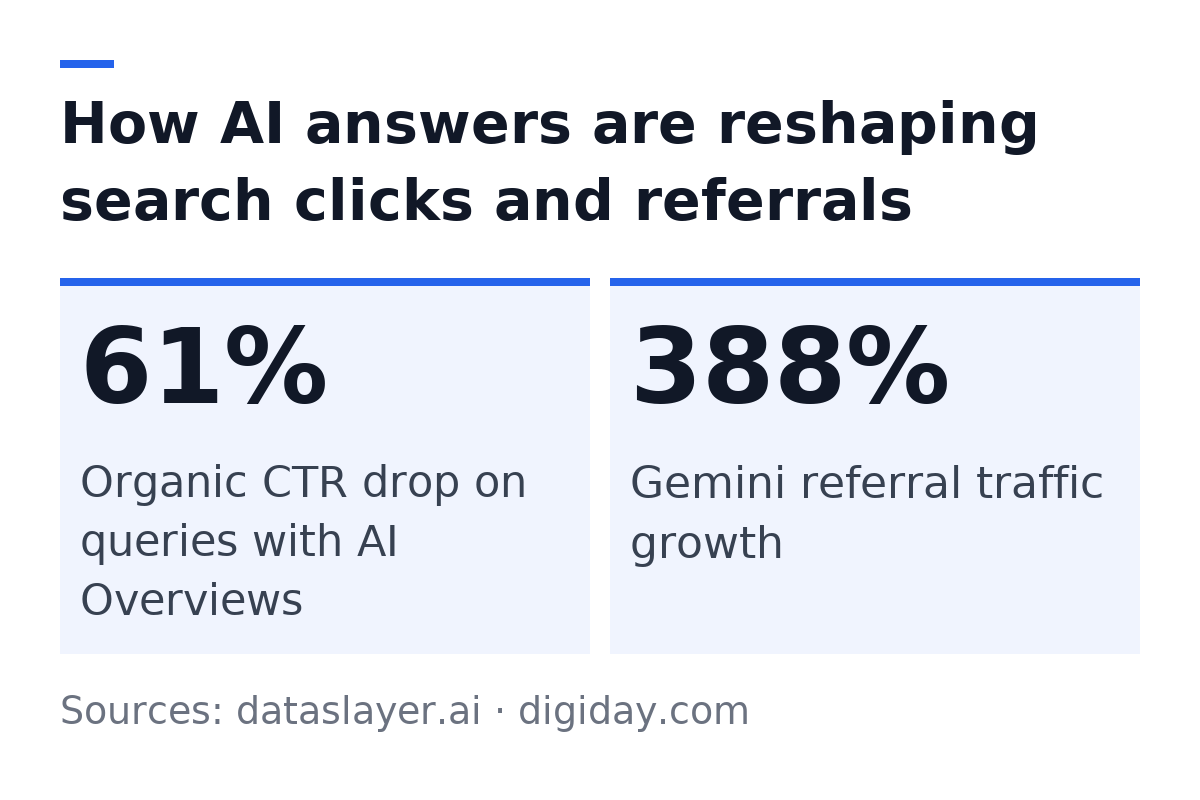
Google AI Overviews are generated summaries that appear above organic results for many queries, and they are the point where traditional SEO and AI tracking overlap most directly. An AIO tracker records which queries trigger an Overview, whether your page is among the cited sources, and how the summary describes your category. This matters because an Overview changes the economics of a ranking. According to Seer Interactive's September 2025 study, organic CTR fell 61% (from 1.76% to 0.61%) for queries with AI Overviews, while paid CTR fell 68% (from 19.7% to 6.34%). A page holding position one beneath an Overview can lose most of its clicks without its rank moving at all. A rank tracker would report that page as stable. An AI tracking tool that monitors Overviews would show that the page is either cited inside the summary, and so still visible, or absent from it, and losing the click.
For SEO managers, this is the most practical reason to add AI tracking in 2026. You do not need to believe every forecast about chat assistants replacing search to see the effect in your own Search Console data. Impressions holding steady while clicks drop on informational queries is a common pattern when Overviews appear. Pairing an AIO tracker with Search Console lets you separate a ranking problem from an Overview problem, and the fixes are different. A ranking problem calls for better content and links. An Overview problem calls for content structured so the summary can lift a clean answer from it and cite you.
The assistant side is growing in parallel. According to Similarweb data shared with Digiday, Gemini referral traffic grew 388% over the period measured. Referral volumes from assistants are still small next to Google organic for most SaaS sites, but the direction is clear, and the buyers who arrive from an assistant have often already been told which vendors to consider. That pre-filtering is invisible in your analytics unless an AI tracking tool shows you what the assistant said before the click.
The Metrics Worth Reading, and the Ones That Mislead
The metrics worth reading from an AI tracking tool are appearance rate on non-branded prompts, owned citation rate, recommendation rate and the accuracy of positioning claims. These four connect most directly to whether a buyer leaves an AI answer with your name on their shortlist. Appearance rate tells you if you are in the conversation. Owned citation rate tells you if your own content is doing the work, which is the part you control fastest. Recommendation rate tells you if the model is steering buyers toward you. Positioning accuracy tells you whether those mentions help or hurt. The metrics that mislead are composite visibility scores without a visible formula, average position in text, and any trend line built on a small number of runs. A composite score can rise because you added easy branded prompts. Average position in text is weak because prose order in an answer is far less meaningful than rank order on a results page.
Here is how I weigh the common metrics against each other. The short version: favor metrics you can trace back to raw answers, and treat anything you cannot audit as directional at best.
| Metric | What it measures | Why it helps | Where it misleads |
|---|---|---|---|
| Non-branded appearance rate | Share of runs naming you for buyer questions | Closest proxy for AI discovery | Depends heavily on prompt set quality |
| Owned citation rate | Share of runs linking your domain | Shows which pages models retrieve | Some engines rarely cite links at all |
| Recommendation rate | Share of runs explicitly suggesting you | Ties to shortlist inclusion | Hard to classify consistently |
| Positioning accuracy | Whether claims about you are correct | Catches outdated or wrong descriptions | Usually needs manual review |
| Composite visibility score | Vendor-weighted blend of signals | Quick executive summary | Formula often hidden or prompt-biased |
| Average position in text | Where your name appears in prose | Rough prominence signal | Prose order carries little meaning |
Engine coverage is another metric that reads better than it is. A dashboard that tracks six engines sounds more complete than one that tracks two. In practice, it matters which engines your buyers use and how each engine's data is collected. Deep, frequent sampling on the engines that matter to your market is worth more than shallow sampling across every surface. For a developer tools company, ChatGPT and Claude may carry most of the buying research. For a company selling to marketers, Google AI Overviews may matter more. Choose coverage to match your buyers, then judge the depth.
A quick sanity test for any AI tracking tool: pick one prompt from the dashboard, run it yourself five times in the consumer app, and compare. If your manual results look nothing like the tracker's numbers, ask how the data is collected before you trust the trend lines.
Context also matters when you interpret change over time. Adoption on the buyer side is still moving fast. The Federal Reserve's April 2026 note on monitoring AI adoption reports that about 18 percent of firms had adopted AI as of year-end 2025, based on Census Bureau survey data, and the same note puts work-related generative AI adoption by individuals at about 41 percent as of November. That gap between firm adoption and individual use is relevant to SaaS marketers: your buyer may be using an assistant for research well before their company has any formal AI policy. As usage grows, the baseline for every engine shifts, so a flat appearance rate in a growing channel can still mean more absolute exposure.
Audit the raw answers. An aggregate score tells you where to look. The actual answer text tells you what to fix, whether that is a missing citation, an outdated pricing claim or a competitor consistently named first.
Weight non-branded prompts. Branded prompts mostly confirm the model knows you exist. Non-branded buyer questions show whether you get discovered, and that is where pipeline comes from.
Trust frequency over snapshots. Because answers vary from run to run, a single screenshot proves very little. Appearance rates across many runs are the only defensible basis for a trend.
Free Tools, Paid Tools, and Where Tracking Ends
A free AI tracking tool is useful for a baseline snapshot, and a paid one is useful for trend data, but neither one changes your visibility by itself. Free options usually take the form of graders or one-time checks: you enter a brand and a category, the tool runs a small batch of prompts, and you get a score with some explanation. That is enough to answer the first question every founder asks, which is whether AI assistants know the company exists and describe it correctly. Online trackers with paid plans add scheduled runs, larger prompt sets, competitor benchmarking and history, which you need once you are measuring the effect of changes over months. The limit both share is structural. Tracking produces a diagnosis. It does not write the comparison page, fix the outdated description, add the missing FAQ block or publish the answer the model needs to retrieve. Teams that buy tracking without a plan to act on it end up with a well-documented decline.
Gofylo's own free AI Search Grader sits in the first category: a standalone entry point that grades a brand's current AI search visibility and gives actionable scoring, with no subscription attached. I would suggest any team run a free check like that before paying for continuous tracking, simply to learn whether the problem is discovery, accuracy or citation. The right paid setup depends on the answer.
It also helps to place AI tracking next to the tools you already pay for. Google Search Console remains the ground truth for Google impressions, clicks and queries, and nothing replaces it for the organic side. Google Analytics 4 can show referral sessions from assistants that pass a referrer, though some AI traffic arrives with no referrer and is counted as direct. An AI tracking tool fills the gap neither covers: what the assistant said before the click, and what it said to the many users who never clicked at all. A broader monitoring framework, like the one in SEO Performance Monitoring Done Right, treats these as layers of one system, each answering a different question.
Here are the signals that tell me a team is ready to move from a free snapshot to continuous tracking:
- You have shipped content changes and need to know whether AI appearance rates moved afterward.
- Competitors are consistently named ahead of you in non-branded answers and you want to monitor the gap.
- Sales calls mention that prospects found you, or did not, through an AI assistant.
- Search Console shows stable impressions with falling clicks on informational queries likely affected by Overviews.
- Leadership wants a recurring AI visibility metric alongside organic traffic in board reporting.
If none of those apply yet, a periodic free check is probably enough. Paying for daily runs on a few dozen prompts before you have any content program to influence them is a common way to spend budget on charts. The concept behind moving past rank tracking is sound, but the value of the extra data depends entirely on what you do with it.
Why Tracking Without Publishing Stalls
Tracking without publishing stalls because AI visibility is driven by the content models can retrieve and trust, and a tracker produces no content. Once a dashboard shows you are missing from answers about your category, the fix is almost always the same set of tasks: publish pages that directly answer the buyer questions you are absent from, structure them with clear headings, FAQ blocks and schema so engines can extract answers, cite verifiable sources, link related pages internally, and refresh pages whose rankings are slipping. Each of those tasks takes writing hours. A founder or a two-person marketing team can identify fifty missing topics in an afternoon of reviewing tracker output and then take most of a year to cover them manually. Meanwhile, the competitors already being cited keep accumulating the third-party mentions and links that reinforce their position. The bottleneck for most SaaS teams is execution capacity, not insight.
This is the gap we built Gofylo to close, and the mechanism is different from a manual workflow. Gofylo researches keywords from your competitors and the live search results, groups them into topic clusters, and writes articles in your brand voice. On the standard plan it publishes 30 articles a month to your CMS, each written in a few minutes, with schema markup, internal links, FAQ blocks, verified source citations and AI-generated images, in 18+ languages. It connects to WordPress, WordPress.com, Webflow, Shopify, Wix, Notion, Ghost and Framer, with a webhook for custom setups. Every article is formatted to be cited by AI assistants such as ChatGPT, Claude, Perplexity and Gemini.
The loop closes on both sides. On the Google side, Gofylo's Search Console refresh rewrites published articles that sit just off page one, using your own Search Console data, and keeps the earlier version so you can restore it. On the AI side, the AI Visibility Score shows how ChatGPT and Claude see your brand, with Perplexity and Gemini to be added. That combination matters because the tracking signal feeds directly into what gets written next, instead of landing in a report someone has to translate into a content brief.
I will be fair about the alternatives. Dedicated tracking platforms often go deeper on prompt-level analytics, engine coverage and competitive benchmarking than an all-in-one platform does, and for a large team with writers on staff, that depth can be the right purchase. Writing-focused tools assume a person will prompt them, edit the output and publish it. For a founder-led company or a small marketing team, the question is simpler: who will act on the tracker's findings every week? If the honest answer is nobody, the tracking data will mostly document missed opportunities.
A useful rule of thumb: for every prompt where an AI tracking tool shows you absent, there should be a page on your site that answers that exact question directly, with a clear heading, a short answer paragraph and a cited source. If that page does not exist, tracking the prompt harder will not change the result.
Compounding is the part that makes the execution side worth automating. A single article rarely moves an appearance rate. A steady cadence of well-structured articles, each internally linked to the others and refreshed as Search Console data comes in, builds topical depth that both Google and AI engines reward over time. Manual programs tend to publish in bursts and then stall when the writer is pulled onto a launch. An autonomous system keeps publishing through those weeks, which is where the gap between a tracked brand and a cited brand usually closes.
Frequently Asked Questions
The phrase AI tracking covers several unrelated technologies, so some common questions land far from search visibility. The answers below cover the marketing meaning used throughout this piece, where an AI tracking tool monitors how AI assistants and AI Overviews mention, cite and recommend a brand, and also the other meanings people run into, such as webcam face tracking, AI-assisted navigation and AI data analysis. Where a question touches tool categories, I describe the category and what to evaluate, since the right specific product depends on your stack, your data and your buyers. Each answer is written to stand alone, so you can jump to the one that matches your question. If you came here from a marketing context and only care about brand visibility in ChatGPT, Claude or Google AI Overviews, the last question on free tracking is the most relevant to you.
What is AI tracking on a webcam?
AI tracking on a webcam uses computer vision to detect a face or body and keep it centered in the frame by digitally panning, zooming or physically moving the camera. It is common in video conferencing cameras and streaming setups, and it is unrelated to an AI tracking tool for marketing, which monitors brand mentions in AI-generated answers.
Which AI tool is best for data analysis?
The best AI tool for data analysis depends on where your data lives and how technical your team is. General assistants like ChatGPT and Claude can analyze uploaded spreadsheets and write Python or SQL, while BI platforms with built-in AI, such as Microsoft Power BI with Copilot, suit teams that already model their data there. For tracking exports, any assistant that runs code can summarize appearance rates from a CSV like the sample above.
Is there an AI GPS?
Yes, in the sense that modern navigation apps use machine learning to predict traffic, estimate arrival times and suggest routes, and some now add conversational assistants for trip planning. The positioning itself still comes from satellite signals, with AI layered on top for prediction and routing decisions.
What are the 4 AI tools?
There is no official list of four AI tools, but in AI search the four assistants most marketing teams monitor are ChatGPT, Claude, Perplexity and Gemini. Google AI Overviews is often tracked alongside them because it sits directly on top of Google's organic results.
Is there a free AI tracking tool?
Yes. Free graders run a small batch of prompts and return a one-time visibility score, which is enough to learn whether AI assistants know your brand and describe it correctly. Gofylo's AI Search Grader is one free option; continuous tracking with history and competitor benchmarks usually requires a paid plan.
If your AI tracking tool keeps showing gaps your team has no time to fill, let Gofylo do the publishing. Start a 3-day free trial of the $79/month plan to get 30 AI-citable articles a month published straight to your CMS, plus an AI Visibility Score for ChatGPT and Claude, and cancel any time. Prefer to start with a diagnosis? Run the free AI Search Grader first.