The phrase 'SEO agent' means something fundamentally different in 2026 than it did even two years ago. It no longer describes a freelancer you hire or a SaaS dashboard you log into. It describes software that acts: researching keywords, drafting content, optimizing existing pages, monitoring rankings, and publishing — all without waiting for a human prompt. As of 2026, AI Agents Market size was valued at USD 7.84 billion in 2025 and is projected to reach USD 52.62 billion by 2030 at a CAGR of 46.3%, and the SEO slice of that market is growing faster than most operators realize.
Most B2B SaaS founders and marketing leads I talk to are somewhere in the middle: they understand that AI exists, they've experimented with ChatGPT for content, but they haven't built or deployed anything that actually runs on its own. The concept of an autonomous SEO agent — something that ships ranked articles at 4 AM without a ticket being filed — still feels abstract. This article breaks down what a SEO agent actually is, how it works architecturally, where it fits into both traditional Google SEO and AI search (GEO), and what separates a genuinely autonomous system from a glorified writing template.
Thesis: A SEO agent is not a chatbot for content ideas. It is an autonomous software system that completes end-to-end SEO workflows — research, writing, publishing, optimization, and visibility tracking — without human intervention at each step. Understanding the distinction is what separates teams compounding organic growth from teams still manually editing briefs.
What a SEO Agent Actually Is
A SEO agent is an AI system designed to autonomously execute search engine optimization tasks — not just assist a human in doing them. The critical word is autonomous. Traditional SEO tools like Ahrefs or Semrush surface data and generate recommendations; a human still has to read those recommendations, decide which to act on, write a brief, hand it to a writer, edit the draft, and push it to a CMS. A SEO agent collapses that entire chain into a single software process. It receives a high-level objective — say, 'rank for mid-funnel SaaS onboarding keywords' — and executes the full research, content creation, on-page optimization, internal linking, and publishing sequence without a human in the loop at each transition. This is architecturally different from a prompt-based assistant, which requires constant human direction to move between tasks. An agent, by contrast, operates on goals rather than individual prompts, maintaining context across steps and making decisions about what to do next based on the current state of the work.
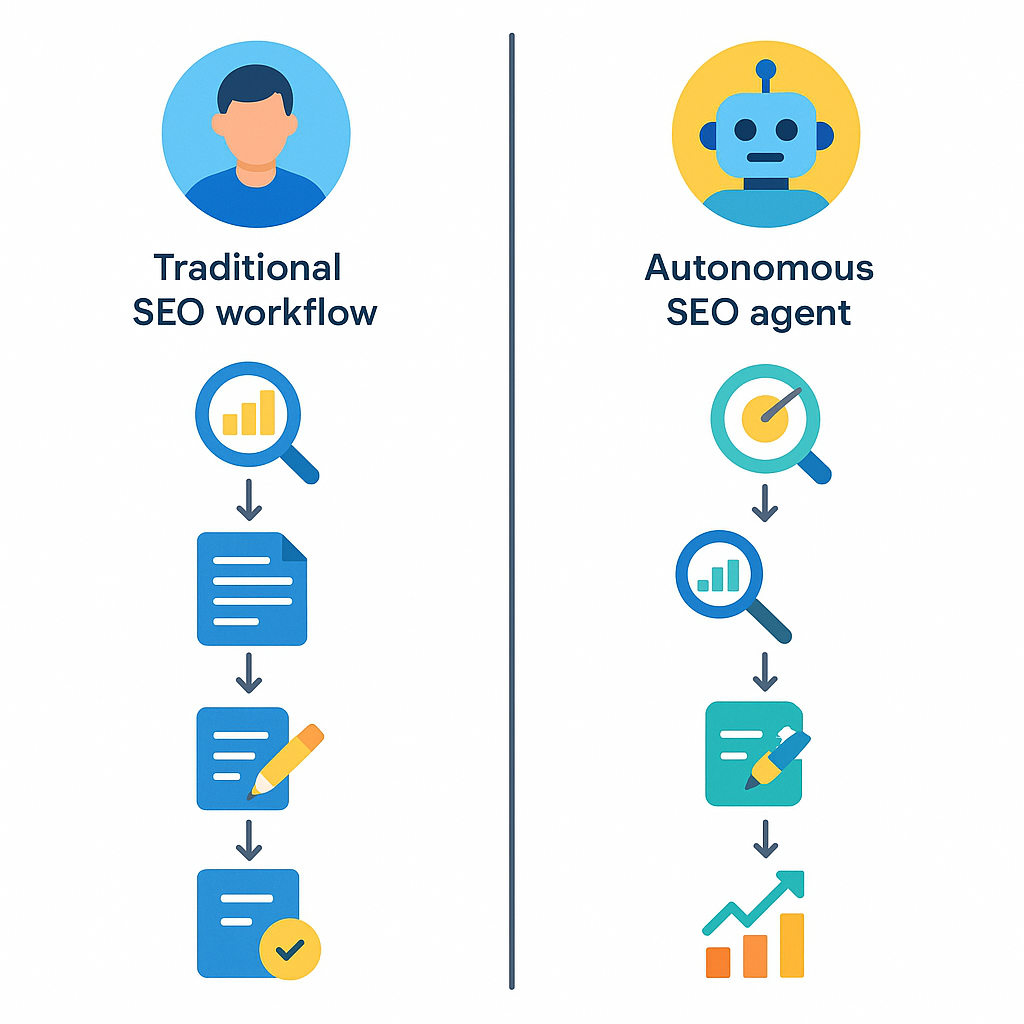
The distinction matters in practice because the bottleneck in most content programs isn't ideation — it's execution velocity. A team that can research and identify 200 viable keywords in a week but only publish 4 articles will always lag a competitor that publishes 30. The SEO agent concept addresses the execution gap, not the strategy gap. That's why the most credible implementations aren't replacing strategists; they're replacing the repetitive execution work that consumes strategists' time — keyword sorting, content briefing, draft production, metadata writing, internal link insertion, and CMS formatting.
Goal-oriented vs. prompt-oriented. The architectural difference between a SEO agent and a chatbot is that agents operate on goals and maintain state between tasks. You tell a chatbot 'write me an article about onboarding checklists.' You tell a SEO agent 'grow our organic traffic in the onboarding category,' and it determines which articles to write, in which order, with which internal links, and publishes them on a schedule — without you touching each step.
Scope of autonomy varies. Not all SEO agents are fully autonomous. Some tools marketed as agents are closer to workflows with AI steps embedded — you still trigger each action manually. True agentic systems complete the full lifecycle: research → write → optimize → publish → monitor → improve, with the agent deciding when each phase is complete and what comes next. When evaluating any platform claiming to be a SEO agent, that distinction is the most important question to ask.
Both search surfaces matter. A modern SEO agent needs to optimize for two distinct surfaces simultaneously: traditional search engines like Google, where structured on-page signals, backlinks, and schema determine visibility; and AI search engines like ChatGPT, Claude, Perplexity, and Gemini, where citation patterns, topical authority, and E-E-A-T signals determine whether your content gets surfaced in generated answers. Teams optimizing only for Google are already leaving AI search share on the table in 2026.
The Architecture Behind an Autonomous SEO Agent
Understanding what makes a SEO agent work — not just what it does — is what separates buyers who evaluate platforms intelligently from those who get sold on demos. At the infrastructure level, a SEO agent is built on a combination of a large language model (LLM) for reasoning and content generation, a set of tools the model can call (search APIs, CMS connectors, analytics endpoints), an orchestration layer that sequences those tool calls, and a memory or context system that lets the agent maintain state across a multi-step workflow. The orchestration layer is where the real complexity lives. It's what allows an agent to complete a keyword research task, store the output, pass the relevant cluster to a content generation step, receive the draft, run an on-page check, insert internal links based on existing site structure, format for the target CMS, and publish — all in a single automated pipeline without a human approving each transition.
How MCP Changed Agent Connectivity
Anthropic's Model Context Protocol (MCP) significantly changed how agent tools connect to external systems. Before MCP, each agent-tool integration required custom API work — a significant engineering burden that kept agentic SEO systems inside large agencies or well-funded engineering teams. MCP standardized the connectivity layer. Anthropic open-sourced MCP in November 2024; by early 2026 it had hit 97 million downloads, with 1,000+ compatible servers, and 73% of enterprise developers now cite MCP as their preferred agent-tool connectivity standard. That ecosystem maturity means a SEO agent built on MCP can connect to CMSs, analytics platforms, search consoles, and competitor data sources through standardized interfaces rather than brittle custom integrations. For operators evaluating SEO agent platforms, MCP compatibility is a meaningful signal of infrastructure quality — it predicts how reliably the agent will maintain its tool connections as APIs evolve.
Platforms like n8n (often referenced in communities around 'SEO AI agent n8n' workflows) provide visual orchestration layers that let technically sophisticated operators wire together LLM steps, web scrapers, and CMS publish actions without writing full application code. These are powerful for custom builds, and the 'SEO agent GitHub' space has a growing collection of open-source agent templates. The tradeoff is setup complexity and ongoing maintenance — every API change, CMS update, or model deprecation requires manual intervention. Fully productized SEO agent platforms handle that infrastructure layer so operators don't have to.
The Seven Core Workflows a SEO Agent Handles
A mature SEO agent doesn't do one thing well — it covers an interconnected set of workflows that traditionally required multiple specialists. The value of autonomy compounds precisely because these workflows are interdependent: keyword research informs content structure, content structure informs internal linking, internal linking informs topical authority, and topical authority informs both Google rankings and AI citation frequency. When a single autonomous system manages all of these in sequence and at scale, the compounding effect accelerates in ways that piecemeal tooling or manual workflows cannot replicate.
Keyword Research and Intent Clustering
Keyword research in an agentic context goes beyond pulling search volume data. A capable SEO agent analyzes SERP structure for each keyword — what content types rank, what questions appear in People Also Ask, what schema types are present — and uses that to cluster keywords by intent and topical proximity. Intent clustering is especially important for AI search optimization, because LLMs surface answers that cover topical clusters comprehensively, not individual pages. An agent that understands cluster structure can sequence content production to build topical authority progressively rather than publishing isolated articles that don't reinforce each other. According to Ahrefs, topical authority — the depth and breadth of coverage on a subject — is one of the strongest predictors of ranking stability across algorithm updates.
Content Generation and Publishing
Content generation is where most teams first encounter the SEO agent concept, and it's where the quality ceiling matters most. A production-grade content agent doesn't just generate a draft — it produces E-E-A-T-compliant content with appropriate schema markup, FAQ blocks structured for both Google's FAQPage schema and AI citation patterns, internal links to semantically related existing pages, metadata optimized for click-through rate, and media elements that improve dwell time. The publishing step is equally important: an agent that generates content but requires manual CMS formatting hasn't solved the execution bottleneck. Full-stack SEO agents integrate directly with CMS platforms and publish without human involvement.
AI Search Visibility and GEO
This is the workflow where most legacy SEO tools have no capability at all, and it's increasingly where B2B SaaS organic growth is won or lost. Generative Engine Optimization (GEO) refers to the practice of structuring content so that AI search engines — ChatGPT, Claude, Perplexity, Gemini — cite it in generated answers. An autonomous SEO agent that understands GEO not only writes content optimized for traditional search signals but also structures it for AI citation: clear entity definitions, authoritative sourcing, direct answers to common questions, structured schema, and topical comprehensiveness. Platforms that track AI citation rates across these engines give operators visibility into a search surface that Google Search Console doesn't measure at all.
- Keyword research and intent clustering: Groups keywords by topical proximity and search intent for systematic coverage
- Content generation: Produces E-E-A-T-compliant, schema-marked articles with FAQ blocks and internal links
- CMS publishing: Pushes finalized content directly to connected CMS platforms without human formatting
- AI visibility tracking: Monitors brand citation rates across ChatGPT, Claude, Perplexity, and Gemini
- Social monitoring: Surfaces brand mentions and relevant conversations for engagement opportunities
- Competitor intelligence: Tracks competitor content velocity and keyword gaps in real time
- Backlink generation: Identifies and pursues link acquisition opportunities autonomously
SEO Agents vs. Traditional SEO Tools: What's Actually Different
The distinction between a SEO agent and a traditional SEO tool is not primarily about AI involvement — many traditional tools now embed AI features. The distinction is about who or what does the work between insights and outcomes. Semrush surfaces a keyword opportunity; you still have to write the article. Ahrefs identifies a backlink gap; you still have to do the outreach. A position tracking tool shows you dropped from rank 4 to rank 7; you still have to diagnose and fix the cause. Traditional SEO tools are intelligence layers — they make human decision-making faster and better-informed. SEO agents are execution layers — they close the gap between insight and output autonomously. The practical consequence of this distinction is throughput. A marketing lead using traditional tools can realistically manage content production at roughly the pace their human content team can execute. A marketing lead running a SEO agent can operate at the pace the agent can execute, which is categorically faster. According to Semrush's research on content at scale, the velocity of content publication is one of the most consistent predictors of organic traffic compounding over time.
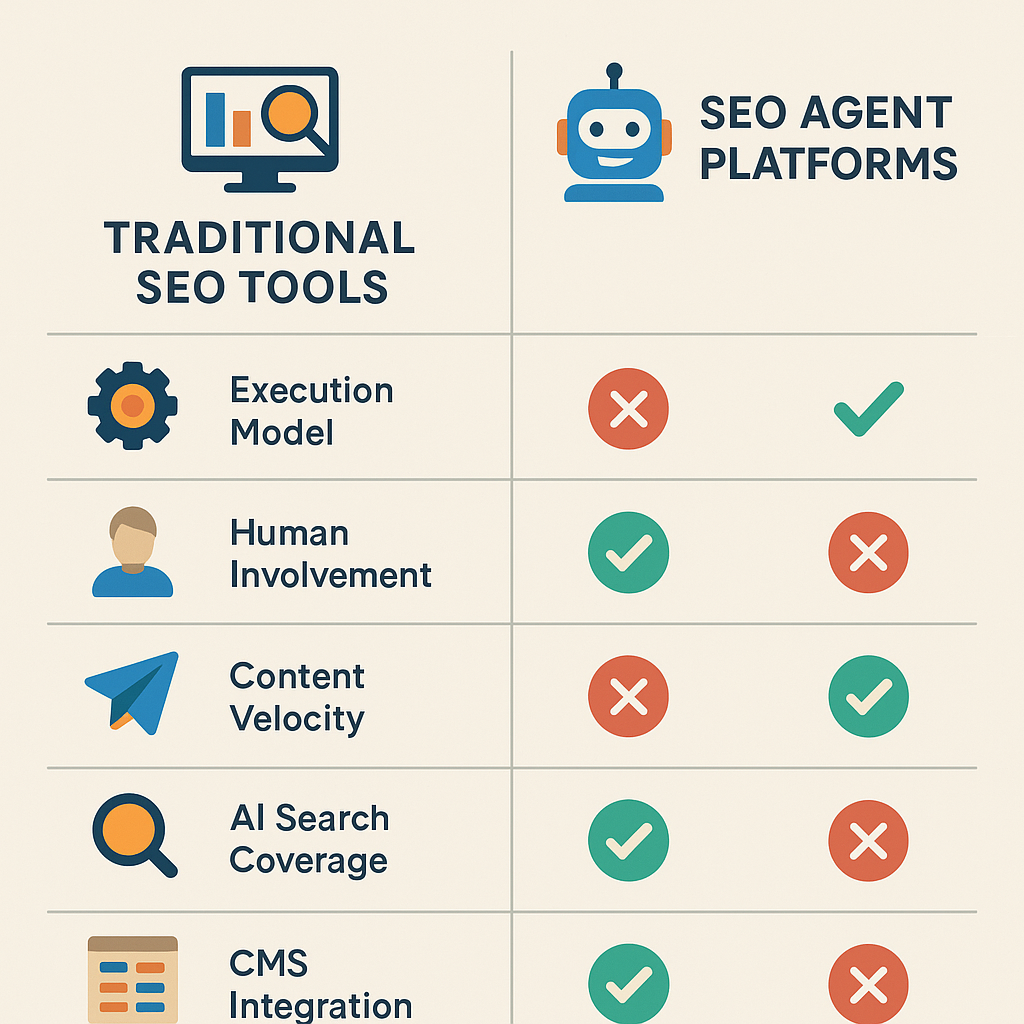
Tools like Wordlift AI SEO Agent take a knowledge-graph-first approach, building structured entity data to improve both traditional search and AI citation. That's a legitimate and sophisticated methodology, especially for enterprises with complex product taxonomies. The tradeoff is implementation complexity — Wordlift's value compounds over months as the knowledge graph deepens, and it requires meaningful upfront configuration. For growth-stage B2B SaaS teams that need ranked content shipped in weeks rather than months, the knowledge-graph approach is often too slow to reach production velocity.
Throughput is the real differentiator. The question 'is this a good SEO agent?' is inseparable from 'how many production-quality articles does it actually ship per month, and at what quality floor?' Any platform can generate content in bulk. The quality question is whether that content meets E-E-A-T standards, includes proper schema, internally links correctly, and ranks — not just whether it was generated fast.
AI search is not optional. In 2026, a SEO platform that doesn't track AI citation rates across ChatGPT, Claude, Perplexity, and Gemini is measuring less than half the search landscape. The competitive shift toward AI-mediated answers is accelerating, and teams that optimize only for Google blue links are ceding AI search share to competitors who understand GEO.
The Adoption Gap: Why Most Teams Aren't Running Agents in Production
The data on enterprise AI agent adoption reveals a striking paradox that most operators recognize when they look honestly at their own workflows. According to research aggregated by QuickSEO.ai in 2026, 79% of enterprises have adopted AI agents in some form, but only 11% run them in production — a 68-percentage-point deployment backlog. That gap exists for specific reasons: the difference between experimenting with an agent in a sandbox and running it reliably in a production content workflow is substantial. Production deployment requires CMS integrations that don't break on updates, quality guardrails that catch hallucinated facts before publishing, internal linking logic that understands existing site structure, and monitoring that alerts when something goes wrong. Most teams experimenting with open-source agent frameworks or n8n pipelines get stuck at exactly this layer — the infrastructure works in testing but fails at the edge cases that matter in live publishing.
The market segmentation data on AI-native versus retrofit agencies is instructive here. The same 2026 research found that AI-native agencies — just 12% of the sample — report ROI medians above 6x, running 4–8 agents simultaneously, while retrofit agencies (38% of the sample) report a median of 2.4x, and legacy agencies (50%) are still piloting. The performance gap isn't primarily about which agents these teams chose — it's about how deeply they've embedded agentic execution into their actual production workflows versus keeping it as an experimental layer alongside their existing manual processes. The teams seeing 6x returns aren't using agents to assist their existing content process; they've replaced the manual execution layer entirely.
The adoption gap is real: 79% of enterprises have experimented with AI agents, but only 11% run them in production. The difference is infrastructure — production-grade agent platforms handle the CMS integrations, quality guardrails, and monitoring that sandbox experiments don't surface as problems until it's too late.
There's also an awareness gap that's easy to overlook. Research cited by QuickSEO.ai shows that 35% of businesses still don't know AI can be used for content and SEO at all. That's not a figure about AI agent sophistication — it's about basic AI-for-SEO awareness being absent in a third of the market. For operators already reading about SEO agents, that figure is useful context: the competitive landscape is less saturated than the noise on LinkedIn might suggest, which means moving to production-grade agent deployment now creates a compounding head start before adoption normalizes.
The hiring data reflects the same structural shift. As of 2026, junior SEO execution roles are compressing — −11% junior SEO specialists — while senior strategist roles are growing at +14%. Agents are absorbing the execution work; humans are being retained and hired for strategic direction. For bootstrapped founders and small marketing teams, this is good news: you don't need to hire a content team to compete with larger players who do, as long as you're running an agent stack that executes at the pace a content team would.
What to Look for in a SEO Agent Platform
Evaluating SEO agent platforms in 2026 requires a different framework than evaluating traditional SEO tools. The core questions aren't about feature count — they're about execution depth and integration reliability. A platform might list 'AI content generation' as a feature, but the meaningful question is whether it generates content that passes E-E-A-T quality signals, includes structured schema, formats for your specific CMS, inserts contextually accurate internal links, and publishes without requiring human formatting at the end. Each of those steps that still requires human involvement is a hidden execution bottleneck that limits the throughput advantage of using an agent at all. The best AI SEO agent platforms eliminate all of those steps from the human's plate.
- End-to-end autonomy: Does the agent complete the full research → write → optimize → publish cycle, or does it stop at draft generation?
- CMS integration depth: Does it publish natively to your CMS (WordPress, Webflow, Shopify, Ghost, Framer) without reformatting?
- AI search visibility tracking: Does it measure brand citations across ChatGPT, Claude, Perplexity, and Gemini — not just Google rankings?
- Quality guardrails: Does it enforce E-E-A-T compliance, schema markup, FAQ blocks, and factual accuracy at generation time?
- Internal linking intelligence: Does it understand your existing site structure and insert relevant internal links automatically?
- Language and scale support: Does it support multiple languages and programmatic landing page generation if your growth strategy requires it?
- Monitoring and alerting: Does it surface competitor moves, social mentions, and ranking changes without you having to check a dashboard manually?
The AI SEO agent market now includes a range of options across different price points and autonomy levels. Free or low-cost SEO AI agent options (often marketed as 'SEO AI agent free' tools) typically provide AI-assisted content drafts without the publishing integration, AI visibility tracking, or competitive intelligence layers. They're useful for experimentation but don't solve the execution bottleneck problem at production scale. The interesting evaluation question for most B2B SaaS teams is not whether they can find a free tool that does one step well — it's whether they can find a platform that does all the steps well enough to replace the manual workflow entirely, at a price point that makes economic sense relative to the headcount it displaces.
The market for these platforms is growing rapidly, which means evaluating platforms on their current capabilities matters more than evaluating them on roadmap promises. Business Research Insights values AI SEO software tools at $2.43 billion in 2026, heading to $5.97 billion by 2035 at a 10.5% CAGR. At that growth rate, the platform landscape will look substantially different in 18 months — but the teams that reach production deployment soonest will have the largest compounding content libraries and AI citation footprints when the market consolidates.
The most important evaluation criterion for a SEO agent platform is not feature breadth — it's production reliability. A platform that ships 30 high-quality, schema-marked, internally linked articles per month without manual intervention delivers more compounding value than a platform with 50 features that requires human touchpoints between each step.
How Gofylo's Agent Stack Works in Practice
Gofylo is built around the principle that autonomous, compounding organic growth is structurally different from managed content workflows — not just faster, but mechanistically different in how value accumulates. The platform handles keyword research, article writing, CMS publishing, and AI visibility tracking. These agents don't operate as independent tools you toggle between — they form a connected pipeline where the output of one agent informs the inputs of the next. Keyword research surfaces intent clusters from competitors and live search results; the Content Engine targets those clusters in a sequenced publishing plan; the AI visibility score reflects how ChatGPT and Claude see the brand; keyword research feeds back into the publishing cycle. The loop is closed without human intervention at each handoff.
The Content Engine produces fully optimized articles in a few minutes per article — 30 per month on the standard plan. Each article includes schema markup, internal links, FAQ blocks, AI-generated images in five visual styles, and verified source citations formatted to be cited by AI assistants. Content is generated in 18+ languages, and each article is formatted to be cited by AI assistants such as ChatGPT, Claude, Perplexity and Gemini.
The AI visibility score is where Gofylo differentiates most clearly from traditional SEO platforms. It asks ChatGPT and Claude about a brand and produces an AI Visibility Score from those results. That score gives teams a single benchmark for AI search share of voice — a measurement that no Google Search Console integration or traditional rank tracker provides. For B2B SaaS teams where a meaningful share of their potential buyers is now discovering vendors through AI-mediated research, this visibility layer is not a nice-to-have; it's the measurement surface that matters most. The AI Search Grader is available as a free standalone tool for teams that want to benchmark their current AI search visibility before committing to the platform.
Gofylo publishes articles to your CMS, with an API webhook available for custom setups. Slack is supported for monitoring alerts so teams don't need to log into another dashboard to stay informed. The platform runs on a single all-in-one plan at $79/month with a 3-day free trial. For a bootstrapped founder or a lean marketing team at a growth-stage SaaS company, that price point makes the economics straightforward: at $79/month, you're replacing a workflow that would otherwise require a content strategist, multiple writers, a CMS manager, an SEO analyst, and a separate AI visibility tracking tool — at a combined cost that would exceed $79 in the first hour of the first month.
Frequently Asked Questions
What is a SEO agent?
A SEO agent is an autonomous AI system that executes search engine optimization workflows — keyword research, content creation, on-page optimization, CMS publishing, and ranking monitoring — without requiring human intervention at each step. Unlike traditional SEO tools that surface recommendations for humans to act on, a SEO agent completes the full execution chain from insight to published output. The most capable SEO agents also optimize for AI search engines like ChatGPT, Claude, Perplexity, and Gemini, not just traditional Google rankings.
Can I do SEO by myself?
Yes — solo operators and small teams do SEO successfully, but the constraint is always execution velocity. You can research keywords, write articles, optimize pages, and build links as an individual, but the pace at which you can do those things manually is the ceiling on your organic growth rate. A SEO agent changes the ceiling by handling the execution layer autonomously, allowing a single operator to publish at the pace a content team would without the headcount cost. The strategic and editorial judgment still benefits from human input; the execution does not.
Will SEO be replaced by AI?
SEO as a discipline is not being replaced — it's being bifurcated. The execution layer (writing drafts, formatting metadata, inserting keywords, building internal links) is being automated by AI agents. The strategic layer (understanding audience intent, evaluating competitive positioning, setting topical priorities, measuring business impact) remains a human function. The hiring data reflects this: as of 2026, junior SEO execution roles have compressed by 11% while senior strategist roles have grown by 14%. AI is replacing the work, not the function — but teams that don't adapt their workflows to use AI execution are being outcompeted by those that do.
How much does an SEO agency cost?
Traditional SEO agency retainers vary widely — from roughly $1,500/month for entry-level services to $15,000–$30,000/month for full-service enterprise engagements. For most B2B SaaS startups, the cost-to-output ratio of a traditional agency is difficult to justify in early growth stages, where content volume and publishing velocity matter more than bespoke strategy. Autonomous SEO agent platforms offer a meaningfully different economic model: Gofylo, for example, delivers 30 fully published, AI-optimized articles per month plus an AI visibility score based on how ChatGPT and Claude see your brand at $79/month — a price point that is structurally inaccessible to any traditional agency model.
What is the difference between an SEO agent and an SEO tool?
The core difference is execution ownership. An SEO tool like Ahrefs or Semrush surfaces data and recommendations — a human reads them and decides what to do. An SEO agent acts on objectives and executes the work: it researches, writes, optimizes, and publishes without waiting for a human to take each action. Think of SEO tools as intelligence dashboards and SEO agents as autonomous execution engines. Both have a role, but they solve different problems — tools address the insight gap, agents address the execution gap.
Are there free SEO AI agents available?
There are free tools that cover individual SEO agent tasks — AI writing assistants, free keyword research tools, and open-source agent frameworks on GitHub that technically-inclined operators can configure. However, truly end-to-end free SEO agents — ones that research, write, publish, and track AI visibility without manual setup or ongoing maintenance — don't exist at production quality without meaningful infrastructure investment. Gofylo offers a free AI Search Grader that gives your brand a visibility score from ChatGPT and Claude, and a 3-day free trial of the full platform, which is the most accessible production-grade entry point in the current market.
If you want to see where your brand currently stands in AI search before building anything, Gofylo's free AI Search Grader gives you an AI Visibility Score from ChatGPT and Claude in minutes. If you're ready to get started, the full platform is $79/month with a 3-day free trial. Start compounding before your competitors figure out what you already know.