If you're running growth at a B2B SaaS company in 2026, link building probably sits on your roadmap somewhere between 'important' and 'we'll get to it.' That's a costly delay. The evidence is clear: according to First Page Sage's 2026 study cited by SEOmator, SEO campaigns that include link building return a median 748% — roughly $7.48 per $1 spent, with break-even averaging seven to nine months across industries. That's not a vanity metric; that's a capital allocation decision.
The benefits of link building extend well beyond raw rankings. A well-executed link profile shapes how search engines evaluate your authority, how AI assistants like ChatGPT and Claude decide which sources to cite, and how your brand is perceived by every category of buyer who encounters your content. This guide breaks down each of those benefits in depth — the mechanisms behind them, the data that supports them, and the trade-offs you need to understand before investing.
Link building is the practice of earning hyperlinks from other websites that point to your own. Each link acts as a signal of credibility to search engines and, increasingly, to the AI systems that synthesize web content into answers. It matters most to B2B SaaS teams, founders, and content marketers who need compounding organic growth without a proportional increase in headcount.
How Link Building Actually Works as a Ranking Signal
Google's algorithm interprets a hyperlink from one site to another as a vote of confidence — the logic being that a site worth referencing publicly must have something credible to say. That model has been refined enormously since PageRank's original formulation, but the core principle survives every major algorithm update: more high-quality links pointing to a page correlates strongly with higher rankings. According to Ahrefs, backlinks remain one of the strongest signals in Google's algorithm, alongside content quality and RankBrain. The statistical evidence is hard to dismiss: on average, top-ranking results on Google have 3.8 times more links than results that appear lower on the page. And according to Moz's 2024 research, pages with at least one backlink rank in the top 10 of Google 77% more often than pages with no backlinks at all — the presence of even a single quality link dramatically shifts ranking probability. What this means in practice is that link building is not a peripheral SEO activity; it is load-bearing infrastructure for organic visibility.
Link Authority: Domain Strength vs. Topical Relevance
Not all links carry equal weight, and understanding the distinction between domain authority and topical relevance is essential for building a link profile that actually moves rankings. Domain authority — measured by tools like Ahrefs' Domain Rating or Moz's Domain Authority — is a proxy for how much trust a linking site has accumulated across its entire backlink graph. A link from a DR 80+ domain passes significantly more ranking power than a link from a DR 30 site. According to Ahrefs' 2024 data cited by Ranktracker, links from high-authority domains (DR 70+) have 5.2x more impact on rankings than links from low-authority sites (DR 30 or below) — a single link from a DR 80+ domain can match the ranking power of 10 to 20 links from DR 30–40 domains. But domain authority is only half the story. Topical relevance — how closely the linking site's subject matter aligns with yours — has become an increasingly important weighting factor in Google's algorithm. Moz's 2024 data shows backlinks from relevant websites in the same niche are worth 2.7x more than links from unrelated sites in terms of ranking impact. A link from a well-known SaaS publication is worth more to a SaaS product page than a link from a high-DR general news site, all else being equal. The best link building strategy pursues both dimensions: authority and relevance, not one at the expense of the other.
The Direct Traffic Benefit Most Teams Underestimate
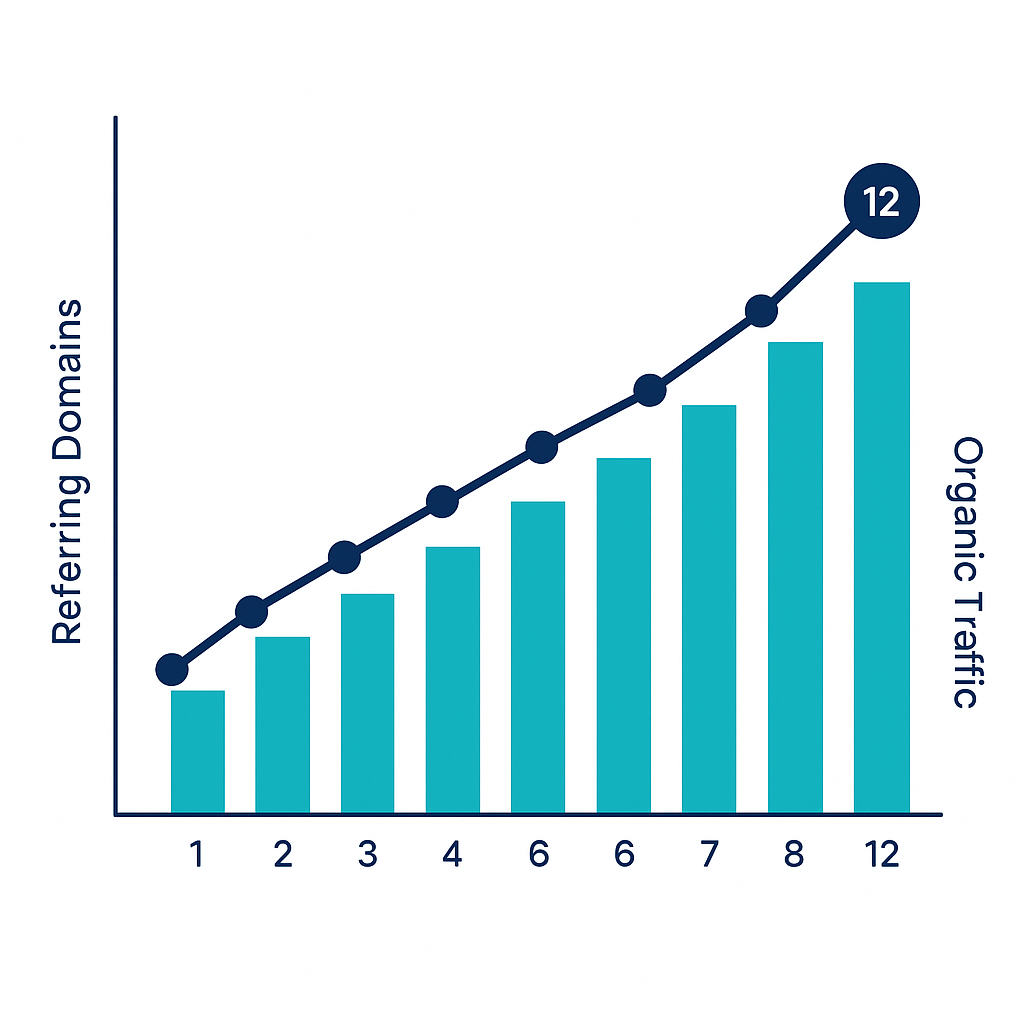
The conversation about link building usually centers on rankings, but there is a second, more immediate benefit that many teams fail to account for in their planning: referral traffic. When your content earns a link from a publication that your target buyers already read, that link sends qualified visitors directly to your site — visitors who arrive with context, intent, and a baseline of trust borrowed from the source. This traffic shows up in your analytics as referral visits, and it compounds independently of your search rankings. A single placement in a respected industry newsletter or a widely read B2B publication can generate hundreds of highly qualified sessions in a matter of days. Unlike paid traffic, that placement does not stop working when a budget runs out. The link persists, and so does the referral potential. Sites with stronger link profiles also tend to rank better, which creates a second traffic stream from organic search — so the two benefits are additive rather than competing. According to Backlinko's 2024 research cited by Ranktracker, websites with 40+ referring domains get 7.6x more organic traffic than sites with fewer than 10 referring domains, with sites at 100+ referring domains receiving an average of 12,843 monthly organic visits compared to just 1,687 for sites with fewer than 10. Referral traffic and organic traffic grow together as your link profile expands.
- Referral traffic from a high-traffic publication can arrive the same day a link goes live, with no ranking lag
- Visitors from referral links often have lower bounce rates because they arrive with editorial context
- A link in a newsletter or resource page generates recurring referral traffic each time someone reads that page
- Referral sessions frequently show higher engagement depth, meaning more page views per session
- Referral traffic contributes to behavioral signals (dwell time, return visits) that may indirectly support rankings
- The traffic benefit persists as long as the linking page exists, unlike paid acquisition which stops immediately
Link Building and Brand Authority: What the Data Shows
There is a reputational dimension to link building that most SEO guides treat as a soft benefit — but for B2B SaaS companies, brand authority is directly tied to conversion rates, deal velocity, and the quality of inbound pipeline. When a respected publication links to your content, it extends its credibility to your brand. A prospective buyer who encounters your name mentioned or linked in a publication they already trust arrives at your site with a pre-formed positive impression. That trust transfer is difficult to manufacture through advertising alone, and it compounds over time as more authoritative sources reference your work. The data is consistent: 85% of marketers believe link building is key for brand building, according to data cited by adamconnell.me, and over 85% of SEO experts believe that link building plays a crucial role in establishing brand authority, per research cited by demandsage.com. For B2B SaaS in particular, where buyers conduct extensive pre-purchase research and sales cycles can span months, appearing consistently in trusted industry publications and earning links from authoritative domain sources accelerates the familiarity and trust that close deals. The brand benefit of link building is not separate from the SEO benefit — they are the same mechanism operating on two different audiences simultaneously: search algorithms and human buyers.
Brand authority and search authority are not separate goals in B2B SaaS. A backlink from a credible industry publication does both jobs at once: it passes ranking signal to Google and passes trust signal to the buyer who reads that publication.
Why Link Profiles Now Influence AI Search Citations
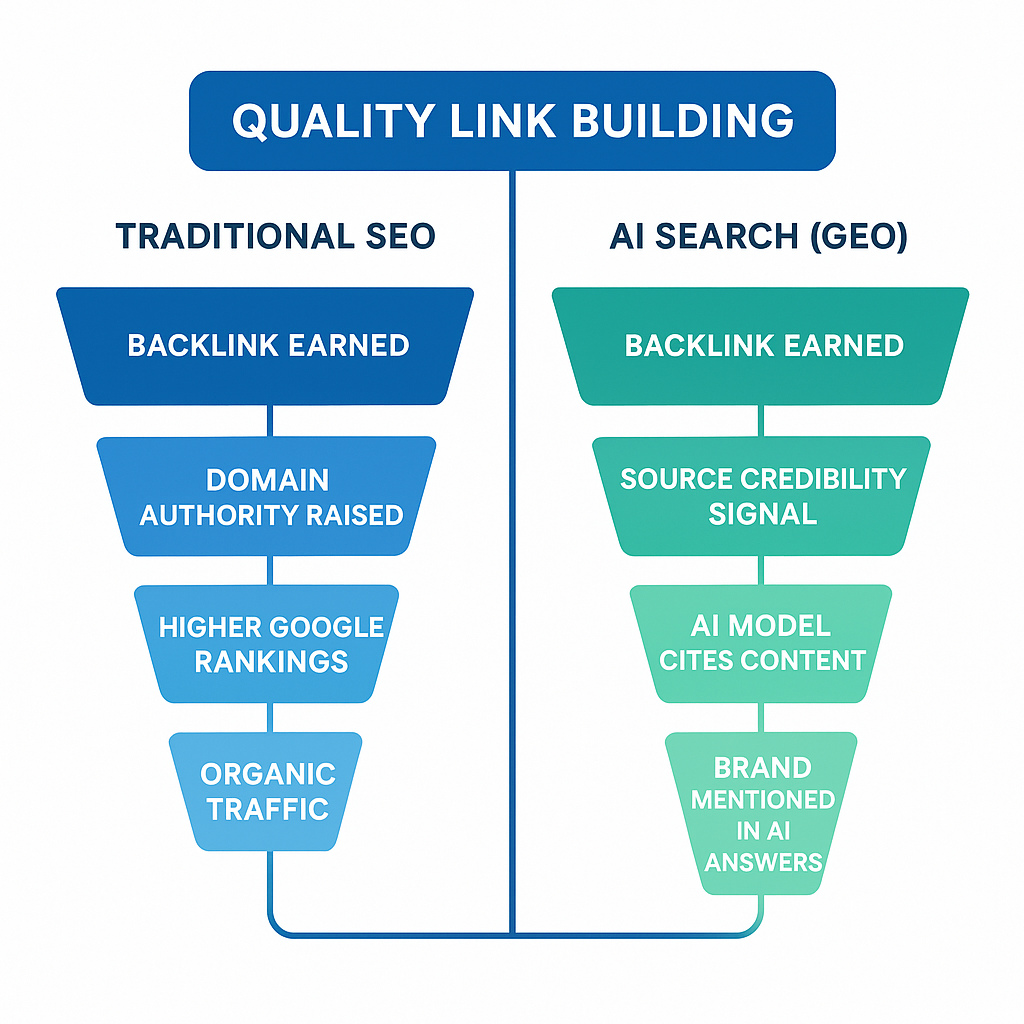
Traditional SEO benefits are well documented, but in 2026, the conversation about the benefits of link building has to include AI search — the growing share of queries answered directly by ChatGPT, Claude, Perplexity, and Gemini rather than through a list of blue links. Understanding how these systems decide what to cite is essential for any growth team that wants to remain visible as search behavior shifts. AI assistants do not crawl the web in real time for most responses. They rely on training data and, where available, retrieval-augmented search that surfaces high-signal web content. The signals these systems use to identify credible, citable content overlap substantially with traditional link building signals: the number and quality of sites that reference a piece of content, the authority of the domains linking to it, and the topical coherence between the linking context and the content itself. A page with a strong backlink profile from authoritative, topically relevant sources is more likely to appear in the retrieval layer that informs AI-generated answers. Content that earns links from trusted publications is also more likely to have been indexed deeply and to appear in the training corpora that underpin model knowledge. This means a link building strategy that earns placements in respected SaaS publications, industry blogs, and authoritative resource pages does double duty: it improves Google rankings and increases the probability that AI assistants will surface and cite your content. Tracking this AI visibility dimension is increasingly important — platforms that score how ChatGPT and Claude see your brand give you a concrete signal of whether your link-building investments are translating into AI search presence.
AI citations and backlinks: The mechanism connecting backlinks to AI search citations is indirect but real. AI models weight sources by perceived credibility, and credibility signals in the training data correlate with the same authority markers that drive Google rankings — domain strength, editorial mention frequency, and topical relevance of inbound links. Building a strong link profile is therefore a prerequisite for consistent AI search citation, not just traditional search visibility.
Content quality as the foundation: Both Google and AI search systems reward content that earns links naturally because it provides something genuinely useful — original data, clear explanations, or a perspective that other authors want to reference. According to research cited by adamconnell.me, long-form content generates 77.2% more links than short posts, and content over 3,000 words earns approximately 3.5 times more backlinks than shorter articles, per data cited by demandsage.com. Depth signals credibility to both algorithms and the human editors who decide what to link to.
How Link Building Compounds Over Time
The compounding nature of link building is the benefit that separates it structurally from most other marketing investments. Paid acquisition delivers traffic while the budget flows and stops the moment it doesn't. Content without links ranks poorly and decays. Link building, by contrast, accumulates. Each new referring domain raises the authority baseline of your site, which in turn makes subsequent pages easier to rank without equivalent link effort — a phenomenon SEOs call domain authority lift. Pages that earn strong link profiles also attract additional links organically over time, because highly-ranked content gets discovered, referenced, and linked to by other authors who find it through search. This self-reinforcing cycle is why the break-even timeline on link building investments is measured in months rather than years, even though the returns continue for years after. The mechanism is not mysterious: more authority means higher rankings, higher rankings mean more traffic, more traffic means more people encounter your content, more encounters mean more organic links, and more organic links mean higher authority — the loop closes and accelerates. For B2B SaaS companies that invest in Building B2B SaaS Backlinks alongside a strong content engine, this compounding effect means that the organic channel becomes proportionally cheaper per conversion as the domain matures. The cost per acquisition from organic traffic drops while the volume rises, which is the opposite of what happens with paid channels as competition increases.
- Each new referring domain raises the site-wide authority baseline, making all pages easier to rank
- High-ranking content attracts additional organic links from authors who discover it through search
- A maturing domain requires fewer links per new page to achieve competitive rankings
- Referral traffic from existing links continues without additional investment
- Brand recognition built through link placements accelerates future link acquisition
- AI search citation probability rises as the cumulative authority signal strengthens
- The cost per organic lead decreases as volume grows, inverting the paid channel dynamic
The ROI of Link Building vs. Other Channels
ROI comparisons between marketing channels are notoriously difficult to make cleanly, because attribution models, time horizons, and industry contexts vary enormously. But the directional case for link building's ROI is supported by practitioner-level data, not just theory. According to editorial.link's 518-expert survey cited by linkpanda.com, 78.1% of SEO professionals report positive ROI from link building — nearly four in five practitioners say it pays for itself. That is a remarkably high consensus for any marketing tactic. The First Page Sage 2026 study, cited by SEOmator, puts the median return at 748% for SEO campaigns that include link building, with a break-even timeline of seven to nine months. Contrast that with paid search, where the ROI window closes the moment the campaign pauses, or with display advertising, where measurement is notoriously noisy and returns are typically lower per dollar. Link building's ROI advantage comes from three sources: the permanence of the asset (a link does not expire), the compounding authority effect described above, and the dual-channel benefit of driving both referral traffic and organic ranking improvement simultaneously. None of those dynamics apply to paid acquisition. For teams reviewing the 14 Backlink Building Techniques Ranked by SEO impact, the ROI question is not whether link building works — the data settles that — but which techniques deliver the best return for a given resource level.
The permanence premium: A link earned from a credible publication in 2026 will likely still pass authority signal in 2028, 2029, and beyond, unless the linking page is removed or the link is disavowed. This makes each link a durable asset, unlike an ad impression or a sponsored post. The capital efficiency of link building improves over time as the asset base grows and continues generating returns without requiring proportional reinvestment.
Automation changes the equation: Manual link acquisition is time-intensive, and that cost has historically constrained how aggressively small teams could pursue it. Understanding How Backlink Automation Actually Works reveals that the combination of automated content production and systematic outreach can compress the cost-per-link significantly. For teams using autonomous content platforms that publish 30 SEO articles a month — each structured to attract links through original data, depth, and proper schema markup — the linkable asset base grows faster than any manual content workflow can match, which in turn accelerates the ROI timeline.
How Much Does Link Building Cost?
Link building costs vary widely depending on the approach, the authority level of the target placements, and whether work is done in-house, through an agency, or via an automated content strategy that earns links organically. There is no single price — but there are clear cost tiers that correspond to different quality levels. At the most basic level, teams that invest in producing linkable assets — deep research articles, original data studies, interactive tools — and then conduct targeted outreach themselves can acquire links at relatively low direct cost, though the time investment is significant. A single outreach campaign that produces five to ten quality placements might take a skilled in-house SEO several weeks of sustained effort. Agency-managed link building, where a specialist team handles prospecting, outreach, and placement, typically costs more in absolute terms but removes the internal bandwidth constraint. Many agencies charge per link placement, with fees that scale with the authority of the target domain — a link from a DR 50 site commands a different price than a link from a DR 80 publication. Programmatic or paid link insertion, where a site charges a flat fee to include your link in existing content, sits at the higher end of cost per link but can deliver placements quickly. The most capital-efficient approach at scale is a content-first model: build so much high-quality, deeply researched content that links accumulate organically and through lightweight outreach, reducing the cost-per-link as volume increases. This is the structural advantage of autonomous content systems — the linkable asset base compounds without proportional cost growth.
There is no universal price for a backlink. Cost varies by domain authority, outreach method, and whether you are paying for agency time, a placement fee, or only internal effort. What is consistent across studies: the ROI on link building significantly exceeds the investment for the majority of practitioners who do it systematically.
Is It Worth Paying for Backlinks?
Paying for backlinks sits at an important boundary in SEO practice, and the answer depends heavily on what 'paying' means in context. Google's link spam policies explicitly classify paid links that pass PageRank without a nofollow or sponsored attribute as a violation of their guidelines — and sites caught in link schemes can face manual penalties that are difficult and time-consuming to recover from. That is the risk side of the equation. On the other side: paying for legitimate placements — sponsored content that is clearly disclosed, digital PR retainers that earn editorial links, agency outreach campaigns where the fee covers labor rather than the link itself — is standard practice and does not violate guidelines when executed correctly. The practical question for most B2B SaaS teams is not 'should we pay at all?' but 'what are we paying for, and does the expected return justify it?' Given that 78.1% of SEO professionals report positive ROI from link building broadly, the category-level case is clear. The risk concentrates in gray-area or black-hat tactics: private blog networks (PBNs), link farms, mass directory submissions, or undisclosed paid placements. These carry meaningful penalty risk and tend to generate low-authority links that deliver weak ranking signals even before any algorithmic downgrade. For growth-stage B2B SaaS companies, the most defensible and scalable approach is to invest in content that earns links editorially, supplemented by strategic outreach — and to use agency or platform support to scale that workflow without cutting corners on quality.
What Should You Avoid in Link Building?
The list of link building practices to avoid has not changed dramatically in 2026, but enforcement has become more systematic and algorithmic penalties more granular, making the cost of bad practices higher than it used to be. Google's ability to detect manipulative link patterns has improved substantially with each Spam Brain update, meaning tactics that worked with low detection risk three or four years ago now carry significantly more exposure. The most damaging practices share a common characteristic: they attempt to simulate the signal that organic, editorial link building produces, rather than earning that signal through genuine content quality and relevance. Google's Search Essentials documentation on link spam is explicit about what constitutes a scheme worth avoiding. Understanding these failure modes is as important as understanding the benefits of link building — because a single penalty can erase months of accumulated authority gains.
- Private blog networks (PBNs): networks of sites built solely to pass link equity, easily detected by footprint analysis
- Mass guest posting on low-quality sites: publishing thin, keyword-stuffed content across hundreds of irrelevant blogs
- Link exchanges: reciprocal linking agreements that exist purely to inflate each site's link count
- Undisclosed paid placements: buying links without proper nofollow or sponsored attributes violates Google's guidelines
- Spammy comment and forum links: automated posting of links in comment sections or discussion threads with no editorial value
- Over-optimized anchor text: using exact-match keyword anchors at high frequency creates an unnatural pattern that algorithms flag
- Low-relevance directory submissions: mass submissions to generic directories that no human audience actually uses
Frequently Asked Questions
What is link building and how does it work?
Link building is the process of earning hyperlinks from other websites that point back to your own pages. Search engines like Google interpret each inbound link as a signal of credibility and authority — the more high-quality, topically relevant sites that link to your content, the more likely that content is to rank prominently in search results. The process works by creating content worth linking to and then promoting that content through outreach, digital PR, or other acquisition tactics so that authoritative sites choose to reference it.
How much does link building cost?
Link building costs range from minimal (if you invest primarily in creating linkable content and do outreach in-house) to substantial (if you engage a specialist agency or purchase high-authority placements). Agencies typically charge per placement or on a monthly retainer, with per-link costs scaling with the domain authority of the target site. The most capital-efficient approach over time is a content-first model where a growing library of high-quality articles attracts organic links, reducing the cost-per-link as the asset base compounds.
Is it worth paying for backlinks?
Paying for editorial outreach, content creation, or agency labor to earn links is standard practice and generally worth the investment — editorial.link's 518-expert survey found that 78.1% of SEO professionals report positive ROI from link building. However, paying directly for links that pass PageRank without proper disclosure violates Google's guidelines and risks manual penalties. The distinction is whether you are paying for the labor of earning a link legitimately or paying to bypass editorial standards entirely.
What should you avoid in link building?
The highest-risk practices to avoid are private blog networks, reciprocal link exchanges, undisclosed paid placements, mass low-quality guest posting, and over-optimized exact-match anchor text used at scale. Google's spam detection systems have become increasingly effective at identifying these patterns, and the penalties — both algorithmic and manual — can set a domain's organic visibility back significantly. Focus on editorial quality and genuine relevance, and the risk profile drops to near zero.
How long does it take to see results from link building?
Most teams see meaningful organic ranking improvements within three to six months of a consistent link building campaign, with the break-even on total investment averaging seven to nine months according to First Page Sage's 2026 study. The timeline depends on the starting authority of your domain, the quality and relevance of links acquired, and the competitiveness of your target keywords. Referral traffic from individual placements can appear immediately, while the compound authority effect on broader rankings takes longer to materialize.
Does link building still matter in AI-first search?
Yes — and the mechanism is direct, not speculative. AI assistants like ChatGPT and Claude rely on credibility signals that overlap substantially with traditional backlink authority: the number of authoritative sites referencing a piece of content, the topical relevance of those references, and the depth of the content itself. Pages with strong link profiles are more likely to appear in AI retrieval layers and to have been included in training corpora. Link building in 2026 is therefore a prerequisite for AI search visibility, not just Google rankings.
Gofylo's content engine publishes 30 SEO articles a month to your CMS — each structured with schema markup, internal links, FAQ blocks, and the depth that earns links naturally. Every article is formatted to be cited by AI assistants, and your AI visibility score tracks how ChatGPT and Claude see your brand. If link building is load-bearing for organic and AI search growth, a compounding content library is the most efficient foundation to build it on. Start your 3-day free trial at Gofylo — no content team required.
Sources
- 30 Link Building Statistics You Should Know for 2026 - SEOmator - seomator.com
- 2026 Link Building Statistics: Analyzing 3,000+ Backlinks - linkpanda.com
- 28 Link Building Statistics For 2026: The Rise Of Social PR - adamconnell.me
- Backlink Statistics - Complete Guide for 2025 - ranktracker.com
- 55 Link Building Statistics 2026 Cost, Trends & Market Size - demandsage.com