Backlinks remain one of the most reliable ranking signals in 2026, and the data backs it up: according to Backlinko data cited by Ranktracker, position #1 results average 213 backlinks, while positions 2–10 average just 56. That gap doesn't close with better meta descriptions or faster page load times — it closes by earning more authoritative, relevant links pointing at your domain. If you're a founder, SEO manager, or growth lead at a B2B SaaS company, understanding how to create backlinks systematically — rather than reactively — is one of the highest-leverage investments you can make in your organic channel.
The problem is that most teams treat link building as a side project, firing off guest post pitches between sprint cycles and calling it a strategy. As of 2026, that approach doesn't compound. This guide gives you a sequential, repeatable system — from prerequisites through advanced outreach — designed for teams who want durable SEO authority and growing AI search visibility simultaneously. We'll cover what makes a backlink worth pursuing, how to audit what you already have, and how autonomous tooling can remove the manual bottleneck that keeps most programs from scaling.
Core thesis: Effective backlink building in 2026 is a compounding system, not a one-time campaign. The teams winning organic and AI search are building linkable assets consistently, earning mentions from authoritative domains, and tracking both Google rankings and LLM citations from a single workflow.
Prerequisites: What You Need Before You Start
Before executing any link building tactic, you need a clear picture of where you stand today. Jumping into outreach without a baseline is how teams waste months chasing links that don't move rankings. Run through the following prerequisites in order — each one informs the steps that follow. You'll need access to at least one backlink analysis tool (Ahrefs, Semrush, or Google Search Console for basic data), a crawlable, indexed website, and a working CMS where you can publish linkable content. If you're missing any of these, resolve them first. The tactics below assume your site is technically healthy — no crawl errors blocking indexation, canonical tags in place, and a clear URL structure.
Audit your existing backlink profile
Pull your current backlink profile using Ahrefs Site Explorer or Semrush's Backlink Analytics. Export your referring domains, filter by Domain Rating (DR) or Authority Score, and tag each domain as high-value (DR 50+, topically relevant), neutral, or toxic (spammy, irrelevant, or from link farms). Disavow truly toxic links through Google Search Console. This audit surfaces three things: your current domain diversity, the anchor text distribution you're working with, and any existing link equity you may not have noticed. A clean baseline prevents you from unknowingly amplifying a penalty by building more links into an already-suspicious profile.
Confirm your linkable asset inventory
A linkable asset is any piece of content on your site that a third-party editor or writer would genuinely want to reference. Before reaching out to anyone, list every page on your domain that meets that bar. Common categories include original research, free tools, comprehensive guides, data visualizations, and glossary pages. If your inventory is thin — fewer than five genuinely citation-worthy pages — that's your first priority. No amount of outreach will compensate for a site that gives editors nothing worth linking to. We'll cover how to build these assets in Step 2.
Step 1: Define What a Good Backlink Looks Like for Your Site
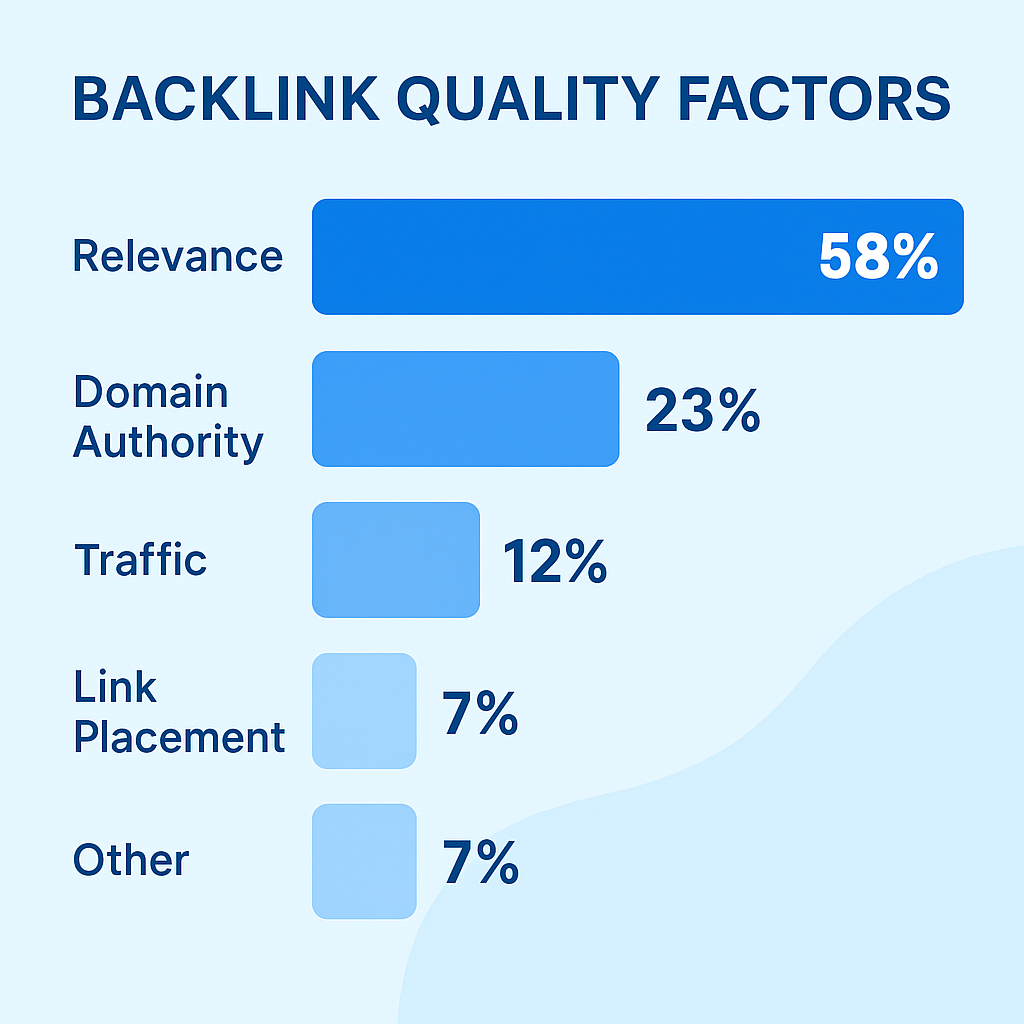
Not all backlinks carry equal weight, and chasing volume without a quality filter is one of the most common and costly mistakes in B2B SaaS link building. According to Ranktracker's backlink statistics, links from high-authority domains (DR 70+) have 5.2x more impact on rankings than links from low-authority sites (DR 30 or below). But authority is only one dimension. Relevance consistently outranks domain authority as a quality factor — 58% of SEO professionals consider relevance the most important backlink quality factor, ranking it above domain authority (23%), traffic (12%), and link placement (7%), according to Ranktracker. For a B2B SaaS product in, say, the revenue operations space, a link from a niche RevOps publication with DR 45 will typically outperform a link from a general digital marketing blog with DR 75. The link passes topical authority, contextual trust, and referral traffic that actually converts.
- Domain Relevance: The linking site covers your niche, industry, or buyer's problem space — not just the broad category of 'technology' or 'business'.
- Domain Rating / Authority Score: Aim for DR 50+ as a floor for active outreach targets; don't dismiss lower-DR sites if they have a highly engaged, niche audience.
- Traffic Quality: Use Ahrefs or Semrush to verify the referring domain receives real organic traffic — a high-DR site with zero visits is a red flag for link farm activity.
- Link Placement: Contextual links embedded in body copy carry more weight than footer or sidebar links; editorial in-content links are the gold standard.
- Anchor Text Distribution: Over-optimized exact-match anchors (e.g., 'best CRM software') across your profile can trigger algorithmic penalties; aim for a natural mix of branded, partial-match, and generic anchors.
- Follow vs. Nofollow: Dofollow links pass PageRank directly; nofollow and sponsored tags reduce direct PageRank transfer but still contribute to brand visibility and referral traffic.
- Link Velocity: Earning links at an unnaturally fast rate after a stagnant period raises red flags; consistent, month-over-month growth signals organic acquisition.
Step 2: Build Linkable Assets That Attract Links Naturally
The most scalable link building strategy is creating content so useful, so data-rich, or so uniquely structured that other writers and editors link to it without being asked. This is the foundation of passive link acquisition — the kind that compounds over time without requiring perpetual outreach spend. According to a Meetanshi analysis of link building data, 68% of backlinks built in 2024 were earned through content marketing efforts, not cold outreach or paid placements. By 2026, that share has grown as Google and AI search engines increasingly reward content with genuine citation velocity. The implication: if your content isn't earning links on its own, you're building on a fundamentally weak foundation, and no outreach volume will fix that structural problem.
Long-form content as a link magnet
Comprehensive, long-form content earns dramatically more backlinks than average-length articles. Ranktracker's backlink statistics report that creating comprehensive content of 3,000+ words earns 77.2% more backlinks than average-length content in the 900–1,200 word range. The mechanism is straightforward: longer, more thorough pieces naturally cover more sub-topics, include more citable data points, and answer more questions — all of which increase the probability that a writer covering a related topic finds your content and links to it. For B2B SaaS, that means publishing full-stack guides covering not just the 'what' but the 'how,' 'why,' and 'what if.' These are the pieces that rank and attract links simultaneously. This is also where understanding how to create backlinks connects directly to content volume: the more quality content you publish, the larger your link surface area becomes.
Data studies, original research, and free tools
Original data is the single most linkable asset category in B2B content marketing. When you survey your customers, analyze aggregate platform data, or commission a research study, you produce numbers that no one else has — and writers across your industry will cite those numbers with attribution. Free tools (ROI calculators, graders, audit tools) work similarly: they generate links from comparison articles, resource pages, and directory listings without any additional outreach effort. If you don't have the bandwidth to conduct large-scale research, leverage aggregate data you already have from your product, synthesize findings from multiple public sources into a single authoritative analysis, or build a lightweight interactive tool that solves a specific calculation your buyers repeat manually. Each of these formats creates a citable, linkable destination that serves your SEO program for years.
Glossary pages work. For B2B SaaS, definitional content — well-structured glossary entries, terminology guides, and taxonomy explainers — attracts consistent editorial links from blog posts that need to reference industry terminology without explaining it from scratch. These pages also perform well in AI search, where ChatGPT, Claude, and Perplexity frequently cite clear definitional content in their answers.
Comparison and versus pages. Competitor comparison articles ('Tool A vs. Tool B') draw links from communities, review sites, and buyers sharing resources in Slack or LinkedIn threads. If you're covering your own category, these pages also tend to rank quickly for high-intent queries and serve as natural link magnets in product-adjacent communities.
Free tools earn passive links. An SEO grader, a readability checker, or a backlink checker embedded on your domain generates citations from resource roundups, newsletter mentions, and category comparison articles — often without any direct outreach. Gofylo's free AI Search Grader operates exactly this way: it creates a discoverable, useful entry point that earns organic mentions and links while simultaneously demonstrating product value.
Content velocity matters. A single linkable asset is a data point; a library of 50 linkable assets is a compounding moat. Autonomous content platforms like Gofylo — which publishes 30 articles per month per account, each written in a few minutes — change the math here. The more topically authoritative content you publish, the more referral surface area you create, and the faster your domain builds the referring domain diversity that correlates with top rankings.
Step 3: Run a Backlink Gap Analysis to Prioritize Targets
A backlink gap analysis compares your referring domain profile against two to four direct competitors to identify domains that link to them but not to you. This is one of the highest-ROI prioritization exercises in link building because it surfaces warm targets — sites that have already demonstrated willingness to link to content in your space. Rather than cold-pitching hundreds of unqualified domains, you're approaching editors and webmasters whose sites have a documented history of linking to content directly relevant to your product category. The process typically runs inside Ahrefs (Link Intersect tool) or Semrush (Backlink Gap tool), and takes under an hour to produce a prioritized list of 50–100 outreach candidates. For deeper context on executing this analysis, see our dedicated guide on backlink gap analysis, which walks through the exact filtering logic for B2B SaaS use cases.
- Enter your domain and 2–4 competitors into Ahrefs Link Intersect or Semrush Backlink Gap.
- Filter results to show domains linking to at least two competitors but not to you — these are highest-priority gaps.
- Sort by Domain Rating and organic traffic to identify the highest-value opportunities first.
- Tag each opportunity by content type (resource page, blog post, tool comparison, news article) to match your outreach angle.
- Flag domains where multiple competitors have backlinks — editorial bias toward your category is already established.
- Export and load into your outreach CRM with domain, target URL, linking page URL, and a custom angle for each.
The average top-ranking page has backlinks from 66.5 referring domains — and that figure represents a 12% increase from 59.3 referring domains in 2022, according to Ranktracker. Domain diversity, not raw backlink count, is the structural signal Google rewards. Your gap analysis should prioritize new unique domains over additional links from domains already in your profile.
Step 4: Execute Guest Posting With a Qualification Filter
Guest posting is the second-most popular method to build backlinks, used by 38.9% of marketers according to Meetanshi's link building statistics — and for good reason. A well-placed guest article on a relevant, high-authority publication delivers a contextual backlink, referral traffic, and brand visibility simultaneously. The problem is execution: most teams either pitch too broadly (targeting any site that accepts guest posts) or too narrowly (targeting only the top five publications in their industry and never hearing back). The qualification filter below solves both failure modes by creating a tiered outreach list with realistic acceptance rates at each tier.
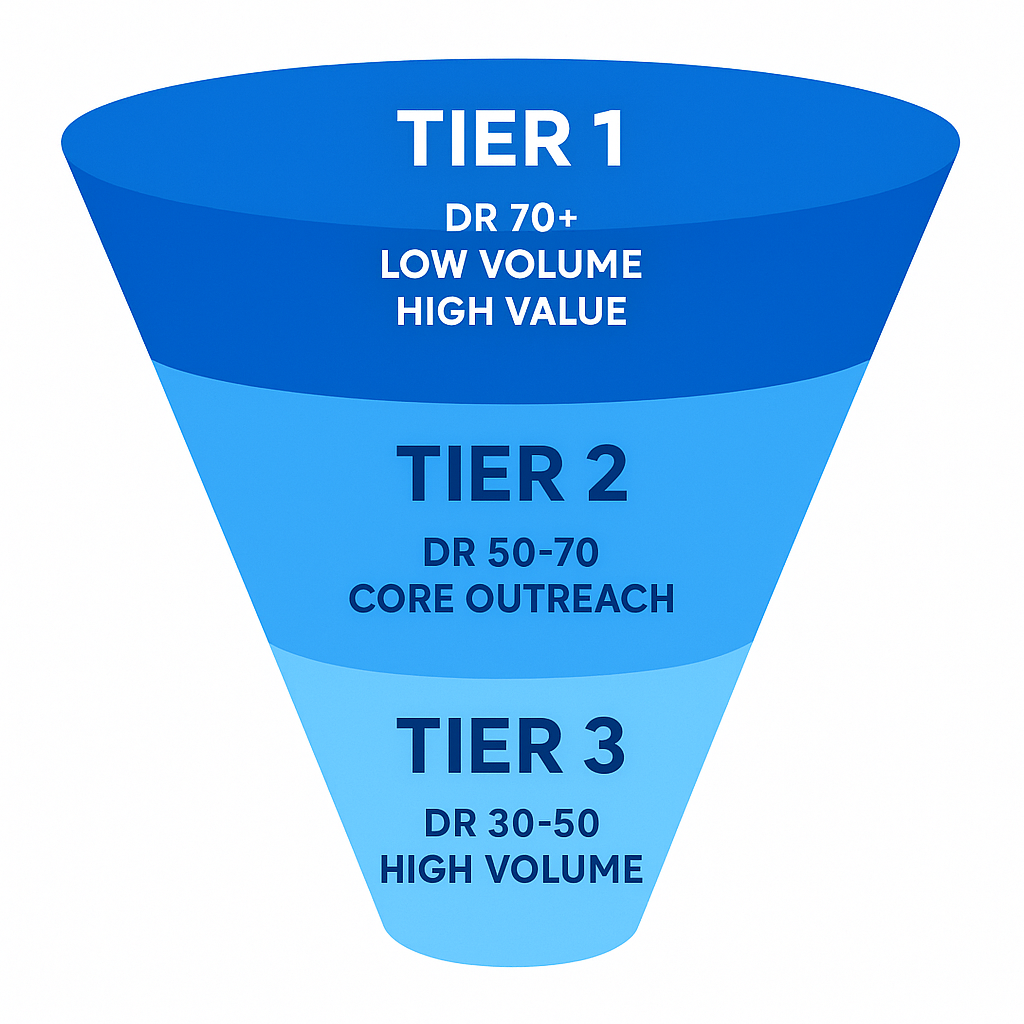
- Tier 1 (Dream targets): DR 70+, highly relevant niche, 10K+ monthly organic visitors. Pitch these with original, data-driven angles. Acceptance rate is low but link value is maximum.
- Tier 2 (Core targets): DR 50–70, topically aligned, active editorial calendar. These form the backbone of your program — pitch 5–10 per month with a personalized angle for each.
- Tier 3 (Accessible targets): DR 30–50, relevant audience, accepts contributor content. Higher volume here; use templated outreach with personalized lead lines.
- Disqualify any site that: sells links openly, publishes content across unrelated verticals, has a spammy backlink profile itself, or has declining organic traffic over 6+ months.
- Verify the site's own backlink profile health before investing time — a guest post on a penalized domain does more harm than good.
When writing the guest post itself, follow the same content quality rules that apply to your own site: cite sources, include original insight, and aim for comprehensiveness rather than minimum viable length. Your author bio should link to a relevant internal page on your site — ideally a high-value landing page or a cornerstone piece of content, not just your homepage. Anchor text in the author bio doesn't carry the same weight as in-body contextual links, so negotiate for the latter where possible. According to Semrush's link building research, editorial in-content links consistently outperform bio or footer links in passing ranking equity. For teams looking to scale this effort without hiring, our guide on backlink automation covers how agent-based workflows can systematize prospecting and personalized outreach at volume.
Step 5: Use Digital PR to Earn Editorial Links at Scale
Digital PR has emerged as the dominant link acquisition method for brands that want both volume and quality without compromising editorial standards. According to Seomator's backlink data, 67.3% of marketers now use digital PR as their primary link building method. The core mechanism: create genuinely newsworthy content — original data, contrarian takes, timely research, or expert commentary — and distribute it to journalists, newsletter writers, and content editors who cover your space. When placed successfully, digital PR earns editorial links from high-DR publications that would never accept a guest post pitch, because the link appears inside a news article or industry roundup rather than in a bylined contribution. According to Google's Search Quality Rater Guidelines documentation, editorial links earned through genuine third-party coverage are the highest-trust link category in their evaluation model.
- Original data campaigns: Survey your audience or analyze your platform's aggregate data, publish the findings as a standalone report, and pitch the key statistics to relevant publications.
- Expert commentary and reactive PR: Monitor trending topics in your space and offer journalist-ready quotes and data within 24 hours of a news event — tools like HARO alternatives and journalist pitch platforms facilitate this.
- Contrarian research: Identify a commonly held belief in your category and publish data that challenges it; journalists cover 'surprising' findings at a much higher rate than confirmatory research.
- Product milestone announcements: Significant product launches, customer count milestones, or funding announcements generate editorial mentions from tech and industry press with embedded backlinks.
- Award and recognition programs: Industry awards, analyst lists (Gartner Peer Insights, G2 reports), and 'top tools' roundups generate consistent editorial links with minimal outreach effort.
- Collaborative data projects: Partner with a complementary SaaS company to co-publish research — each party promotes to their audience, doubling distribution without proportionally doubling cost.
The backlink strategies that scale well in digital PR are structurally different from guest posting: you're not writing the article, you're providing the material that earns the mention. That shift changes the economics — instead of 10 hours per guest post, you invest in one strong research asset and distribute it to 50 journalists. Even a 10% placement rate on a well-executed campaign produces five high-authority editorial links from a single asset. When you connect this to a broader backlink building strategy — where content creation, outreach, and tracking are systematized — the compounding effect becomes significant over a 6–12 month horizon.
Step 6: Reclaim Unlinked Brand Mentions and Fix Broken Links
Two of the highest-conversion link building tactics available to any B2B SaaS brand involve no new content creation: converting unlinked brand mentions into backlinks, and inheriting equity from broken links pointing to dead pages. Both tactics work because they start from a position of established value — someone has already referenced your brand or a resource in your space, they just haven't completed the link. Conversion rates on these outreach sequences consistently outperform cold prospecting because the recipient has no reason to push back: adding a link or updating a broken one improves their page's reader experience.
Unlinked mention reclamation
Set up brand monitoring using Semrush's Brand Monitoring tool, Ahrefs Alerts, or a free tool like Google Alerts to track every new mention of your brand, product name, or key executives across the web. When a mention appears without a hyperlink, send a brief, friendly outreach note to the author or editor noting the mention and providing the exact URL they should link to. Keep the email short — two to three sentences maximum. Authors frequently miss the link in the first draft and are happy to add it because it requires minimal effort on their end and adds value to their article. This tactic works particularly well immediately after a press mention, a product launch announcement, or a major industry event where your brand was referenced in live coverage.
Broken link building
Broken link building involves finding external sites in your niche that link to dead pages (404 errors), then offering your own relevant content as a replacement. Use Ahrefs' Site Explorer to find broken pages on competitor domains, then check which sites are still linking to those dead URLs. Reach out to those linking sites, note the broken link, and suggest your content as a working replacement. The pitch works because you're solving an actual problem for the webmaster — a broken link is a negative user experience signal they're motivated to fix. For competitive intelligence on which broken opportunities your competitors have already exploited, our guide on competitor intelligence covers how to systematically monitor those moves. For a deeper walkthrough of proactive broken link prospecting, see our guide on building backlinks, which covers the full prospecting and pitch workflow.
Both unlinked mention reclamation and broken link building are exceptionally high-ROI because the conversion rate is structurally higher than cold outreach — you're asking someone to complete an action they've already demonstrated intent to take. Prioritize these before launching any cold prospecting campaign.
Step 7: Track Backlinks in Both Google and AI Search
Most link building programs track one thing: did a new backlink appear in Ahrefs or Semrush? In 2026, that's an incomplete picture. A growing share of your buyers are discovering your brand through AI-generated answers in ChatGPT, Claude, Perplexity, and Gemini — and those citations are driven by a combination of your backlink authority, your content's structural quality, and how frequently your domain appears in the training and retrieval layers these engines use. Backlinks signal trustworthiness and topical authority to both traditional search crawlers and AI retrieval systems. Tracking only Google rankings means you're blind to half the discovery surface your buyers are using. According to Google's own documentation on how search works, link analysis remains a core ranking input — but the evaluation increasingly incorporates E-E-A-T signals that parallel what AI engines use to decide which sources to cite.
How backlinks influence AI search citations
AI search engines like Perplexity and the browsing-enabled versions of ChatGPT and Claude retrieve content in real time and prioritize sources that appear authoritative, well-structured, and frequently referenced across the web. A strong backlink profile from topically relevant, high-authority domains makes your content more likely to appear in the retrieval layer that feeds those answers. This is the structural connection between traditional link building and GEO (Generative Engine Optimization): you're not just building signals for Google's PageRank algorithm, you're building the citation credibility that AI engines use as a proxy for trustworthiness. For B2B SaaS teams, tracking AI search visibility alongside traditional backlink metrics is no longer optional — it's the only way to measure the full return on your link building investment.
Gofylo's AI visibility score is produced by asking ChatGPT and Claude about a brand, giving teams a clear signal of how those two engines see them. Pairing this with traditional backlink tracking gives growth teams a complete picture: which domains are sending link equity, which content is earning AI citations, and where the gaps are between your traditional SEO authority and your AI search share of voice. This dual-tracking approach is what separates teams compounding at scale from teams optimizing for a metric that represents a shrinking share of total search activity.
- Track referring domain growth monthly in Ahrefs or Semrush — prioritize unique domain count over total backlink count.
- Monitor AI search citations weekly across ChatGPT, Claude, Perplexity, and Gemini using a dedicated GEO tracking tool.
- Set up Ahrefs or Semrush alerts for new backlinks to your highest-value landing pages and cornerstone content.
- Review anchor text distribution quarterly to identify over-optimization patterns before they trigger algorithmic flags.
- Correlate new backlink acquisitions with ranking movement and AI visibility score changes to identify highest-impact link sources.
- Flag and disavow toxic link patterns as they appear — proactive maintenance prevents profile degradation over time.
- Connect Slack alerts for new backlink acquisitions to keep your team informed without requiring manual dashboard checks.
According to Ahrefs, the majority of pages on the web get zero organic traffic — and the primary differentiator between pages that rank and pages that don't is the number and quality of backlinks pointing to them. Building a systematic link acquisition program isn't a nice-to-have for B2B SaaS in 2026; it's the structural requirement for any organic growth strategy to function.
Frequently Asked Questions
Are backlinks still relevant in 2026?
Yes — backlinks remain one of the strongest ranking signals in both traditional search and AI-driven search engines as of 2026. The data continues to show that top-ranking pages carry significantly more referring domains than lower-ranked competitors, and AI search engines use backlink authority as a proxy for source credibility when deciding which content to cite in generated answers. The character of what earns links has shifted — thin, spammy, or paid links are actively penalized — but the value of genuine editorial links from relevant, high-authority domains has increased, not decreased.
How can I create backlinks for my website?
The most reliable methods to create backlinks for your website are: publishing comprehensive, citation-worthy content that earns links passively; executing a structured guest posting program on relevant, high-authority publications; running digital PR campaigns built around original data or newsworthy angles; reclaiming unlinked brand mentions; and fixing broken links on third-party sites with your content as a replacement. Each method has a different time-to-result curve — linkable assets compound over months, while mention reclamation can convert within days. A complete program uses all five in parallel.
How much do backlinks cost?
The cost of backlinks varies widely by acquisition method. Earned editorial links through content marketing and digital PR carry no direct payment cost but require significant content and outreach investment. Guest posts on legitimate publications are typically free to place but require your time to write. Paid link insertions on third-party sites range from a few hundred to several thousand dollars per link depending on domain authority, but Google's guidelines classify these as link schemes that can result in manual penalties. The most cost-effective and durable approach for B2B SaaS is systematizing content-driven and outreach-based link acquisition rather than purchasing placements.
Can AI create backlinks?
AI can dramatically accelerate the processes that lead to backlinks — researching link targets, generating outreach copy, writing linkable content at scale, and monitoring for new mention opportunities — but it cannot independently contact webmasters or editors and negotiate link placements on your behalf. What AI-powered platforms like Gofylo do is remove the bottleneck in content production — researching keywords, grouping them into topic clusters, and publishing articles to a customer's CMS — while also refreshing published articles from Google Search Console data. The distinction matters: AI enables the inputs that produce backlinks at scale; the editorial decision to link always remains with a human on the receiving end.
What is the fastest way to get free backlinks?
The fastest free backlink tactics are unlinked brand mention reclamation (converting existing mentions into links), broken link building (replacing dead links with your content), and listing your site in legitimate, niche-specific directories or resource pages that are editorially maintained. For B2B SaaS, getting listed on software review platforms (G2, Capterra), relevant GitHub awesome lists, and industry resource hubs are consistently high-conversion, zero-cost link sources. These won't replace a full program, but they're the right starting point for teams with limited outreach bandwidth.
How do I check my backlinks?
The most complete backlink audit tools are Ahrefs Site Explorer and Semrush Backlink Analytics, both of which show referring domains, anchor text distribution, link authority, and historical link velocity. Google Search Console's Links report provides a free, Google-native view of which external sites link to you, though it's less comprehensive than paid tools. For a quick free check, Ahrefs' free backlink checker provides a sample of top links to any domain without requiring an account. Running monthly audits in a paid tool and spot-checking with Search Console is the recommended approach for growth-stage teams.
If you want to scale content production, earn more backlinks through sheer topical authority, and track where your brand is being cited across both Google and AI engines — Gofylo does all three autonomously. Gofylo publishes 30 articles per month across 18+ languages directly to your CMS, and gives an AI visibility score based on how ChatGPT and Claude see your brand. Start a 3-day free trial at gofylo.io.