As of 2026, backlink automation has moved well past the experimental stage. According to industry data, 65% of SEO professionals say link building is their most time-intensive activity, yet fewer than 20% have a systematic process in place. That gap — between how much effort links demand and how little infrastructure most teams have built — is exactly where automation enters. This article is not about whether you should build backlinks. It's about understanding how backlink automation actually works, what the underlying mechanics look like, and how to evaluate whether a given approach compounds growth or just burns budget.
The market reflects this shift. The link-building software market reached $2.8 billion in 2025 and is projected to hit $7.1 billion by 2034 at a CAGR of 10.9%. That growth isn't driven by spam tools — it's driven by legitimate platforms using AI to scale prospecting, qualify link targets, personalize outreach, and track results. Understanding the machinery behind that market is the first step to using it well.
Thesis: Backlink automation isn't a single tool or tactic — it's a layered system where AI handles prospecting, qualification, outreach, and monitoring in a continuous loop. Understanding each layer separately lets you evaluate tools clearly and build a compounding link acquisition engine instead of a one-time campaign.
What Backlink Automation Actually Means
Backlink automation refers to the use of software, AI agents, or scripted workflows to handle some or all of the steps traditionally required to earn inbound links — without a human doing each step manually. The spectrum is wide. At one end, you have basic tools that auto-export a list of prospects from a domain authority filter. At the other end, you have AI-native platforms that identify link opportunities, evaluate their quality, draft personalized outreach emails, schedule follow-ups, and report on placements — all inside a single workflow. The critical distinction is not automation versus manual, but rather which parts of the process are being automated and how much human judgment is retained in the loop. Most high-performing teams in 2026 sit somewhere in the middle: they automate discovery and qualification heavily, apply human review to outreach messaging, and automate tracking and reporting again on the back end.
It's also worth distinguishing backlink automation from link schemes. Google's guidelines are explicit: artificially manufactured links that pass PageRank without editorial intent are a violation, regardless of how they were created. What legitimate backlink automation does is compress the time humans spend on research, contact finding, and follow-up — it doesn't manufacture links that wouldn't otherwise exist. The link still requires a human editor on the other end to make a decision. Automation just makes it dramatically cheaper and faster to reach that editor with a relevant, credible pitch. That framing matters when evaluating tools: anything promising 'guaranteed links' or 'automatic link insertion' without a real webmaster in the loop is almost certainly a risk to domain health, not an asset.
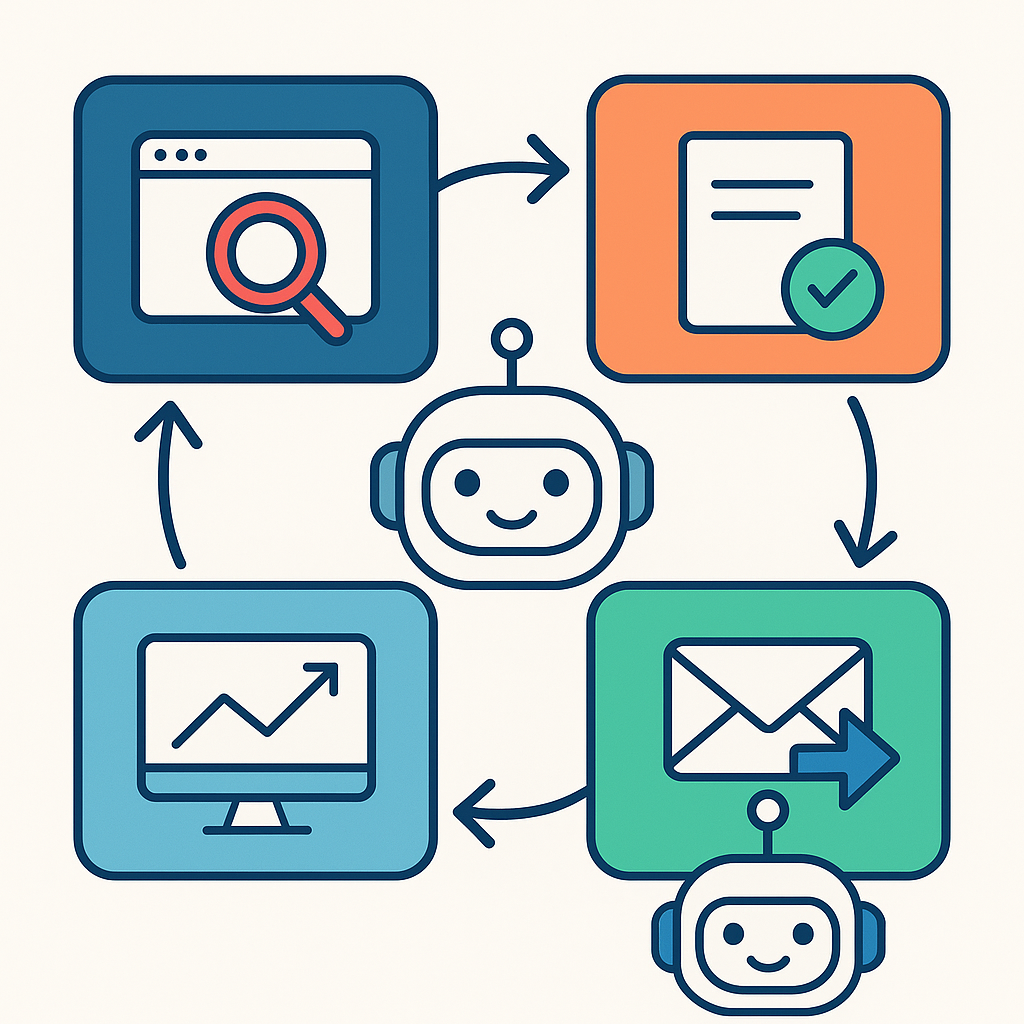
The Four Layers of an Automated Link Acquisition System
Backlink automation, done well, is not a single-step process. It's a pipeline where each layer feeds the next. Understanding the architecture helps you audit any tool or platform against what it actually handles — and what it leaves for you. Most platforms market themselves as 'end-to-end,' but very few genuinely handle all four layers with equal depth. Knowing the layers by name makes it possible to ask sharper questions when evaluating backlink automation software or building an in-house stack.
Layer 1 — Prospecting at Scale
Prospecting is the highest-volume, most repetitive part of link building. An SEO analyst manually filtering domain authority, topical relevance, traffic trends, and existing link profiles across thousands of potential linking domains can consume dozens of hours per week — and still produce a biased, incomplete list. AI-powered prospecting agents change this by crawling link graphs, SERP results, and competitor backlink profiles to surface qualifying domains automatically. Tools like Ahrefs' Link Intersect and Semrush's backlink gap features are well-known starting points for this layer, though they still require human triage. More autonomous platforms take the output of these data sources and apply their own scoring models to prioritize targets before a human ever sees the list. The result is that a team of two can work a prospect pool that would previously have required a full outreach team.
Layer 2 — Link Quality Qualification
Not all backlinks are created equal, and not all link automation platforms are equally rigorous about this. Quality qualification is the layer where AI evaluates each prospective linking domain for signals that predict whether a link from that domain will actually move rankings — or create penalties. Those signals include domain authority, organic traffic trends, topical relevance to your content, the ratio of outbound to inbound links, spam score, and link velocity patterns. According to DemandSage's 2026 link building data, 83% of link-building platforms now use AI for advanced link quality assessment, which has significantly reduced the risk exposure from toxic and spammy backlinks that plagued earlier automation approaches. The shift from rule-based filters to ML-based quality scoring is the single biggest improvement in backlink automation software over the past three years.
Layer 3 — Personalized Outreach
Outreach is where automation often gets misused. Mass-blasted template emails produce near-zero response rates and actively damage domain reputation when they trigger spam filters in bulk. The more sophisticated interpretation of outreach automation is personalization at scale — using AI to research each prospect's recent content, find the relevant contact, draft an email that references something specific about their site, and schedule follow-ups based on reply behavior. According to DemandSage, 65% of SEOs now use AI tools for automated prospecting and personalization in outreach, suggesting that personalized automation is the emerging standard, not the exception. Platforms like Respona and Postaga operate largely at this layer, while tools like Hunter.io focus specifically on the contact-finding component that feeds it.
Layer 4 — Monitoring and Iteration
The final layer — monitoring — is where most teams underinvest. Once a backlink is placed, you need to know if it stays placed, if the linking page retains traffic, and whether the link is passing equity or has been nofollowed. Automated monitoring alerts teams when links disappear, when referring domains lose traffic, or when a linking page is penalized. This layer closes the loop, feeding data back into prospecting to reprioritize outreach targets and identify which link types drive actual ranking lift. Without this feedback layer, backlink automation becomes a one-directional spend rather than a compounding asset.
Why Content Is the Foundation Automation Builds On
Backlink automation can compress the operational cost of link building dramatically — AI and automation integration is estimated to reduce outreach labor costs by 60-75% according to market research from DataIntelo. But automation cannot manufacture link-worthiness. If the destination page — the article, tool, or resource being linked to — isn't genuinely useful, no amount of outreach sophistication will move serious editors to link to it. This is why backlink automation doesn't operate in isolation. It's downstream of content quality. The pages that attract high-authority links in 2026 are typically original research, comprehensive guides, free tools, data visualizations, or authoritative explainers that give editors a real reason to cite them. Teams that try to automate outreach to mediocre content will find that their conversion rate on outreach stays low regardless of how good their prospecting and personalization layers are.
This is also where AI-generated content, when done correctly, changes the calculus. A platform that publishes 30 deeply researched, schema-structured articles per month — complete with FAQ blocks, internal links, and topical depth — creates a growing library of linkable assets that automation can pitch continuously. The content engine and the link acquisition engine are not separate programs; they're two components of the same organic growth system. Building one without the other produces diminishing returns. Building both together produces compounding returns, because every new article is a new prospecting target, and every new backlink strengthens the domain authority that lifts all existing articles.
A backlink automation platform is only as effective as the content it's pointing links toward. Scaling outreach to thin content is expensive noise. Scaling outreach to substantive, AI-cited, schema-structured content is compounding infrastructure.
Backlink Automation and AI Search Visibility
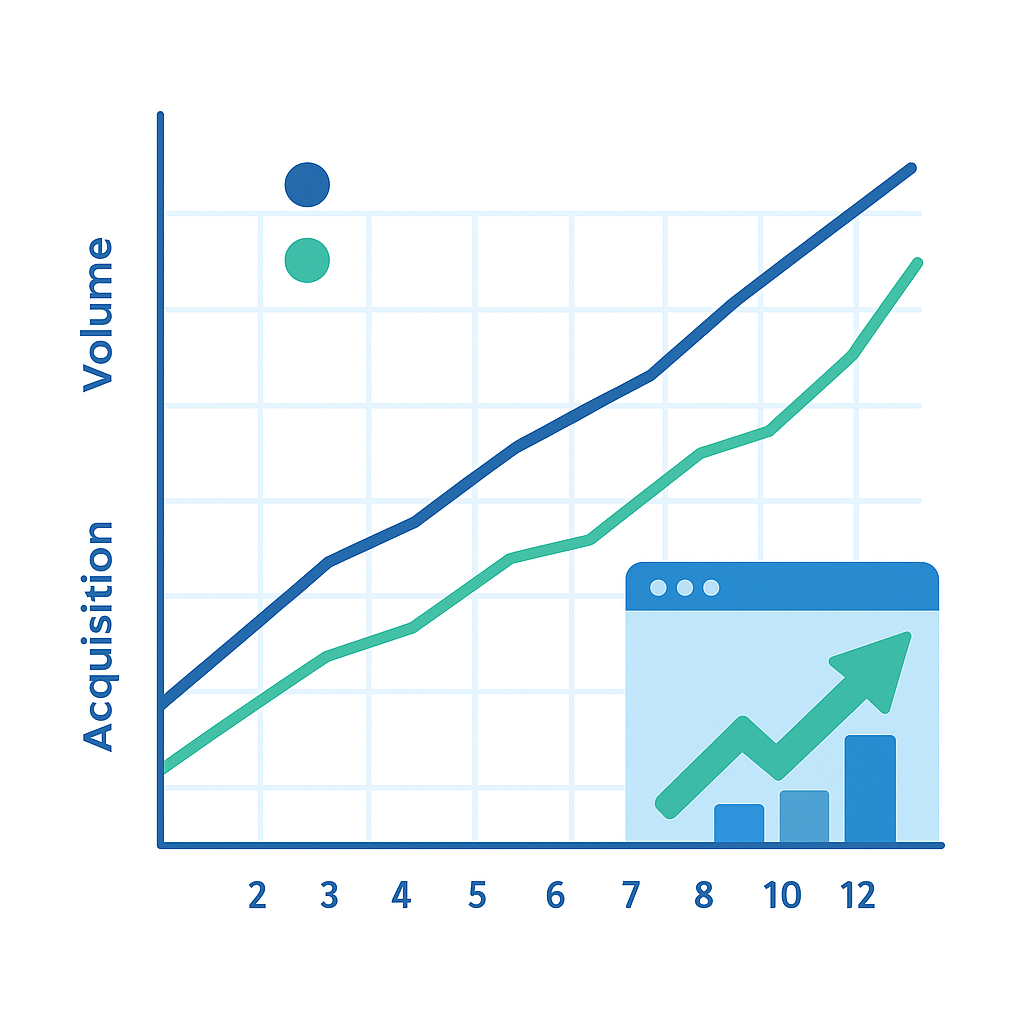
Most coverage of backlink automation focuses entirely on Google PageRank — how links pass authority and lift rankings in traditional search. That framing is incomplete in 2026. ChatGPT, Claude, Perplexity, and Gemini now surface answers that cite specific pages and domains, and the criteria for those citations overlap significantly with the criteria for high-authority backlinks. Pages that earn links from credible, topically relevant domains are more likely to be indexed by LLM training pipelines and cited in AI-generated responses. This is not a speculative connection — it reflects the same underlying signal: editorial trust. A backlink from a respected domain is evidence that a human editor found the content credible enough to recommend. That same signal influences which sources AI models treat as authoritative when constructing answers.
The implication for backlink automation strategy is that the quality filter matters even more than it did in pure-SEO contexts. A high-volume link from a low-credibility directory does almost nothing for AI search visibility. A single link from a well-trafficked industry publication that regularly gets cited in AI responses can meaningfully lift your brand's presence in Perplexity or Gemini answers within weeks. This means the link qualification layer of your automation stack needs to incorporate signals beyond domain authority — specifically, whether a given linking domain's content appears in AI search results for your target topics. That's a newer evaluation dimension that most backlink automation software hasn't caught up to yet, but it's the right lens for teams competing in both search channels simultaneously.
AI citations follow authority. The same editorial trust signals that earn Google PageRank also influence which pages get cited by ChatGPT, Claude, and Perplexity. Building links from genuinely credible, topically relevant domains compounds returns across both channels.
Quality beats volume in 2026. In traditional SEO, volume of links once mattered more. In AI search, a handful of citations from high-trust, AI-visible domains outweighs hundreds of low-authority placements. Your automation stack's quality filter needs to reflect this.
Track AI visibility separately. Standard backlink monitoring tools don't measure whether your content is being cited in AI-generated answers. You need a dedicated AI Visibility Score alongside traditional domain authority metrics to evaluate the full return on your link acquisition investment.
The Risk Layer: What Automation Gets Wrong
Backlink automation carries real risks when it's applied without the right guardrails, and understanding those risks is part of understanding the concept honestly. The most common failure mode is volume-first thinking: configuring an outreach tool to blast hundreds of contact-found emails with minimal personalization, targeting domains regardless of quality. This produces three predictable outcomes — low response rates, spam filter damage to your sending domain, and a backlink profile filled with low-equity placements that don't move rankings. Google's Search Essentials documentation is explicit about link schemes: any links intended to manipulate PageRank that aren't the result of genuine editorial decisions are a violation, regardless of the mechanism used to create them.
A second risk is automation without monitoring. Teams that set up outreach sequences and then don't track what happens to placed links often discover months later that a significant portion of their acquired links have been removed, nofollowed, or that the hosting pages have been penalized. Without the monitoring layer described earlier, the investment in outreach doesn't compound — it decays silently. A third, underappreciated risk is topical drift: automation tools that prioritize domain authority over topical relevance will build a link profile that looks strong by raw metrics but doesn't signal expertise to Google's topic authority models. In 2026, Google's quality guidance places increasing weight on topical depth and expertise signals, meaning a geographically scattered link profile from unrelated domains is less valuable than a tighter set of links from topically adjacent ones.
- Volume-first outreach with no personalization damages sender reputation and produces low-equity links
- Automation without quality filtering fills your backlink profile with toxic or irrelevant domains
- Missing the monitoring layer means placed links decay silently without triggering recovery actions
- Topical drift — linking from unrelated domains — weakens topic authority signals even if DA looks strong
- Guaranteed link schemes that bypass real editorial decisions are a direct violation of Google's link guidelines
- Ignoring AI search visibility when qualifying link targets leaves compounding returns on the table
How Backlink Automation Fits Into a Broader Organic Growth Stack
Backlink automation is most powerful when it's one component of an integrated organic growth system, not a standalone tool running in isolation. The teams seeing the strongest compounding results in 2026 are those where content creation, internal linking, backlink acquisition, and AI visibility tracking all share data and reinforce each other. A piece of content that earns a high-authority backlink improves the domain's overall authority, which improves the ranking ceiling of every other article on the site. Articles that rank higher attract more organic backlinks without any outreach at all — what the industry calls 'passive link acquisition.' Those organic links further compound the effect. The key insight is that backlink automation doesn't just save time on one campaign — when integrated with a content engine, it accelerates the entire flywheel.
For B2B SaaS companies specifically, the organic growth stack typically needs to handle several simultaneous workflows: producing enough topically authoritative content to build a defensible footprint, maintaining internal link structures that distribute authority across the site, monitoring competitor backlink gaps to surface acquisition opportunities, and tracking AI search visibility to ensure that compounding authority translates into LLM citations as well as Google rankings. No single human team can run all of these workflows manually at the pace required to be competitive. That's the structural case for automation — not convenience, but capacity. A related piece worth reading is our coverage of backlink gap analysis strategies for understanding how to identify the specific linking domains your competitors have that you don't, which directly feeds the prospecting layer of any automation stack.
Adoption numbers reflect this integrated thinking. According to industry data, 86% of marketing professionals now use AI SEO tools, with backlink automation ranking among their top three AI tool choices. And 44.2% of SEO professionals report successfully implementing AI for link building with highly effective results in 2026, with the trend still accelerating. These aren't fringe adopters — they're mainstream practitioners who have recognized that manual link building can't scale to the content volumes that AI-first search requires.
Backlink automation doesn't replace your SEO strategy — it gives your strategy the operational capacity to execute at a pace that compounds. Without it, even a well-designed strategy stalls at the execution layer.
Evaluating Backlink Automation Software: What to Look For
When evaluating backlink automation software, the goal is to map each platform's capabilities against the four-layer architecture described earlier: prospecting, qualification, outreach, and monitoring. Most platforms lead with the features that are easiest to demo — outreach sequences, email templates, prospect lists — and underplay the quality of their qualification logic and the robustness of their monitoring. Asking pointed questions about those two layers will quickly differentiate serious platforms from surface-level tools. Beyond features, you want to evaluate data freshness (how recently was the backlink index updated?), integration with your existing content and CRM stack, and whether the platform's AI quality scoring is transparent enough for you to audit its logic.
Well-known tools like Semrush's link building suite and Ahrefs offer strong data foundations for prospecting and gap analysis, but they're primarily analytical platforms — they surface opportunities rather than automate the full acquisition workflow. Platforms like Respona and Postaga automate more of the outreach layer but still require significant manual setup per campaign. Free backlink automation tools and free AI backlink generators exist at the low end of the market, but most sacrifice either data quality or scale — useful for initial learning, less useful for a serious growth program. The emerging category that platforms like Gofylo represent is fully integrated: keyword research, topic clustering, article writing in a brand's voice, and publishing to a CMS operating as a single autonomous stack, rather than separate subscriptions requiring manual handoffs between them.
- Prospecting depth: how large and fresh is the domain index, and how granular is topical filtering?
- Qualification logic: does the platform use ML-based quality scoring or just rule-based DA thresholds?
- Outreach personalization: how much of the email content is context-aware versus template-based?
- Monitoring robustness: does the platform alert you to lost links, nofollow changes, and referring page traffic drops?
- AI search visibility: does the platform track whether your linked pages appear in ChatGPT, Perplexity, or Gemini citations?
- Integration: does it connect natively to your CMS, CRM, and SEO tracking stack without manual CSV exports?
- Compliance guardrails: are there built-in safeguards against link scheme patterns that violate Google guidelines?
Frequently Asked Questions
What is backlink automation?
Backlink automation is the use of software or AI agents to handle part or all of the link-building workflow — including prospect discovery, domain quality assessment, contact finding, outreach email generation, follow-up scheduling, and link monitoring — without a human completing each step manually. It does not manufacture links; it compresses the operational cost of earning them through genuine editorial outreach. The degree of automation varies widely across tools and platforms.
Is backlink automation safe for SEO?
Legitimate backlink automation — which automates prospecting, outreach, and monitoring while still requiring a real webmaster to make an editorial decision about the link — is safe and widely used by professional SEO teams. What's not safe is using automation to create links that bypass editorial decisions entirely, such as auto-inserting links into third-party sites or participating in link exchange schemes. Google's guidelines prohibit the latter regardless of how the links were generated. Quality filtering and editorial intent are the distinguishing factors.
How does backlink automation affect AI search visibility?
Backlinks from high-authority, topically relevant domains signal editorial trust — the same signal that influences whether AI systems like ChatGPT, Claude, Perplexity, and Gemini cite a given page in their responses. Building quality backlinks through automation can therefore compound returns across both traditional search and AI search. The key is ensuring the quality qualification layer of your automation stack screens for domains that are themselves cited in AI search, not just those with high domain authority.
What's the difference between free backlink automation and paid platforms?
Free backlink automation tools and free AI backlink generators typically offer limited prospecting databases, basic quality filtering, and no personalization at scale. They're useful for learning the workflow and running small experiments, but they rarely handle the full four-layer pipeline. Paid platforms generally offer more current link indexes, ML-based quality scoring, integrated outreach sequencing, and monitoring — which together make it possible to run a systematic link acquisition program rather than one-off campaigns.
Can automation fully replace manual link building?
Not entirely, and not yet. The highest-ROI link placements — co-authored pieces, expert quotes in major publications, strategic partnership links — still benefit significantly from human relationship-building. What automation can fully replace is the manual, repetitive labor of prospecting thousands of domains, finding contacts, drafting templated outreach, and tracking results. Teams that automate those layers free up human time for the high-touch relationship development that automation genuinely can't replicate.
How does Gofylo support content creation and AI visibility?
Gofylo is an organic growth platform that researches keywords from a customer's competitors and the live search results, groups them into topic clusters, and publishes SEO-optimized articles to their CMS. Rather than operating as a standalone outreach tool, it's integrated with the Content Engine — which publishes 30 SEO-optimized, schema-structured articles per month — so that every new piece of content immediately becomes a linkable asset that the backlink agent can pitch. The platform also includes an AI visibility score that asks ChatGPT and Claude about the brand, giving teams a picture of how visible they are in AI search.
If you're building a link acquisition system from scratch — or auditing whether your current backlink automation approach is actually compounding — Gofylo's free AI Search Grader gives you a starting benchmark for your brand's visibility across both Google and AI search engines. The full platform runs at $79/month with a 3-day free trial. Start with the grader, then decide.