As of 2026, both Claude and ChatGPT have matured into capable, enterprise-ready AI assistants — but they make different trade-offs, and those trade-offs matter depending on your workflow. The difference between Claude and ChatGPT is no longer a question of 'which one is smarter.' It's a question of which model is optimized for the tasks your team actually runs: long-document analysis, code generation, math-heavy reasoning, content production, or agentic workflows that touch real systems.
This article is a direct comparison across the axes that decide the choice — context window, coding ability, reasoning depth, writing quality, image handling, and AI search relevance. Whether you're a founder evaluating AI tooling, an SEO manager thinking about GEO visibility, or a solo operator trying to pick one subscription, this breakdown gives you the data. We also cover the open questions the rest of the internet hasn't answered well: what makes Claude special, why some organizations are restricting it, and whether you should switch.
Quick verdict: Claude wins for long-document analysis, code correctness, and nuanced writing. ChatGPT wins for math reasoning, image generation, and breadth of integrations. If you primarily write, analyze, or code — start with Claude. If you need multimodal outputs, deep reasoning chains, or ecosystem reach — ChatGPT is the stronger default.
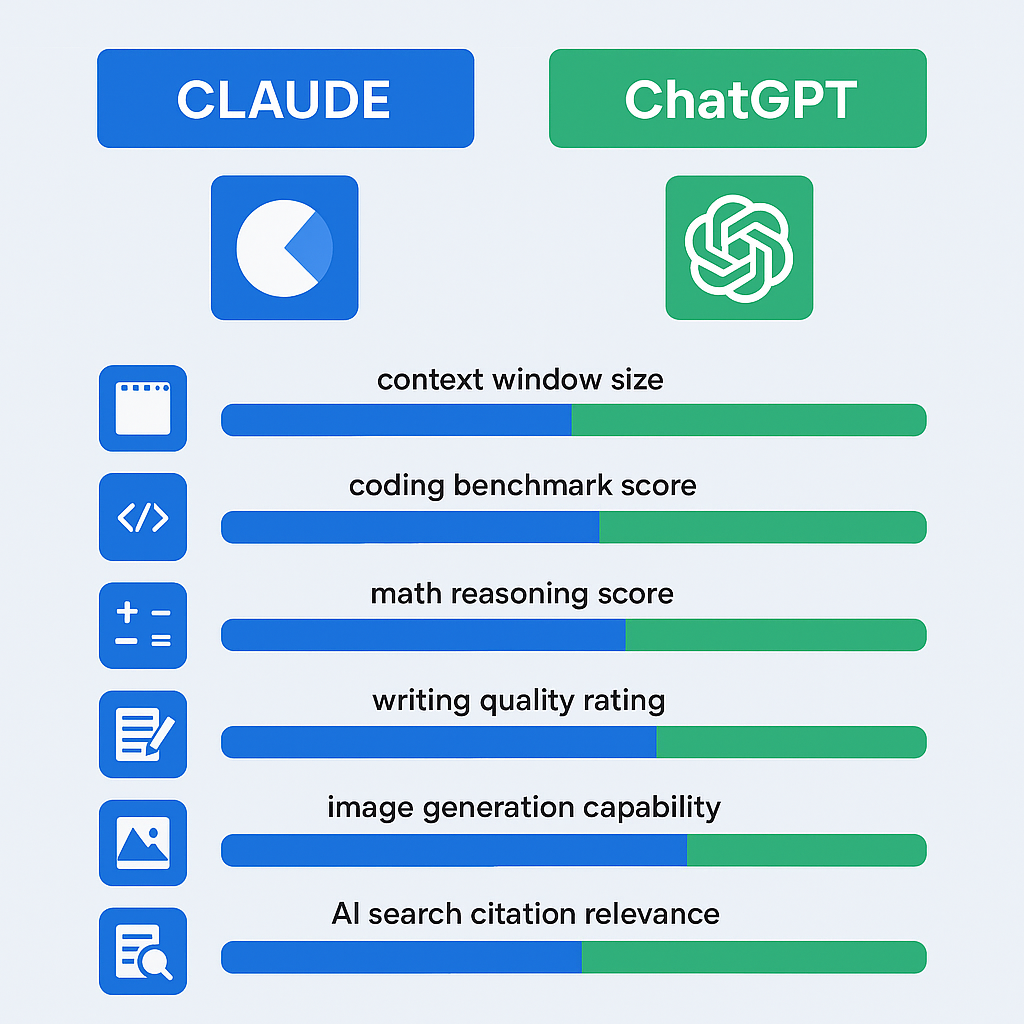
At a Glance: The Six Differences That Decide the Choice
The difference between Claude and ChatGPT comes down to architectural priorities and the product decisions each company has made around their flagship models. Claude (Anthropic) is built with a strong emphasis on context depth, safety-first constitution training, and code correctness. ChatGPT (OpenAI) is built for breadth — multimodal output, deep reasoning chains, and a vast integration ecosystem. Neither is universally better; the right choice depends on what percentage of your work involves each capability. The six axes below are the ones that actually shift the decision for most B2B and SaaS teams.
- Context window: Claude holds up to 200K tokens by default (and 1M in beta); ChatGPT defaults to ~128K with GPT-5
- Coding correctness: Claude scores ~95% on end-to-end code tests vs. ~85% for ChatGPT
- Math and logic: ChatGPT's GPT-5 with reasoning mode scored 94.6% on AIME 2025; Claude scored ~33–34% without tools
- Writing and document analysis: Claude handles PDFs up to 32 MB and 100 pages natively; stronger qualitative writing output
- Image generation: ChatGPT (GPT-4o) generates and edits images in-chat; Claude cannot generate images, only analyze them
- AI search footprint: Both are cited by Perplexity and Gemini, but content formatted for AI-engine retrieval is indexed differently
Context Window: How Much Each Model Can Hold
Context window size is the single most practical difference between Claude and ChatGPT for teams working with large documents, long conversation threads, or codebases. A larger context window means the model can 'see' more of your content simultaneously — reducing the hallucinations and loss of coherence that come from chunking large inputs into smaller passes. For B2B SaaS teams running technical documentation reviews, competitive analysis, or long-form content workflows, this is a tangible workflow constraint, not a spec-sheet detail.
Claude's context advantage. Claude 4 launched with a 200K-token context window for both Opus and Sonnet models — already more than 4× the context of earlier generations. In a beta pushed in August 2025, Anthropic enabled a 1 million token context for Claude Sonnet 4, a 5× increase on top of the already-generous base. In practical terms, this means Claude can ingest and reason over entire codebases, multi-chapter research reports, or months of customer conversation logs in a single prompt. For data scientists and technical analysts, this is the feature that makes Claude the more natural fit for deep analytical tasks.
ChatGPT's context window. OpenAI's GPT-5 uses approximately 128K tokens by default in ChatGPT and up to approximately 256K in certain settings. That is substantial — enough for most standard business documents, meeting transcriptions, or content briefs — but Claude currently holds a measurable edge in maximum context, especially for enterprise or research-grade use cases. For the majority of everyday SaaS team tasks (drafting emails, summarizing reports, writing ad copy), the practical gap between 128K and 200K is invisible. It only surfaces when you push the limits of what you're feeding the model.
Coding Performance: Benchmarks That Actually Matter
Benchmark comparisons for coding are only meaningful when they measure real-world correctness — not whether the code looks syntactically plausible, but whether it runs end-to-end and produces the correct output. On that standard, the difference between Claude and ChatGPT is material and fairly consistent across independent evaluations in 2026. Claude holds a meaningful lead in code correctness, while ChatGPT recovers ground on agentic and terminal-based tasks where tool access matters more than raw generation quality.
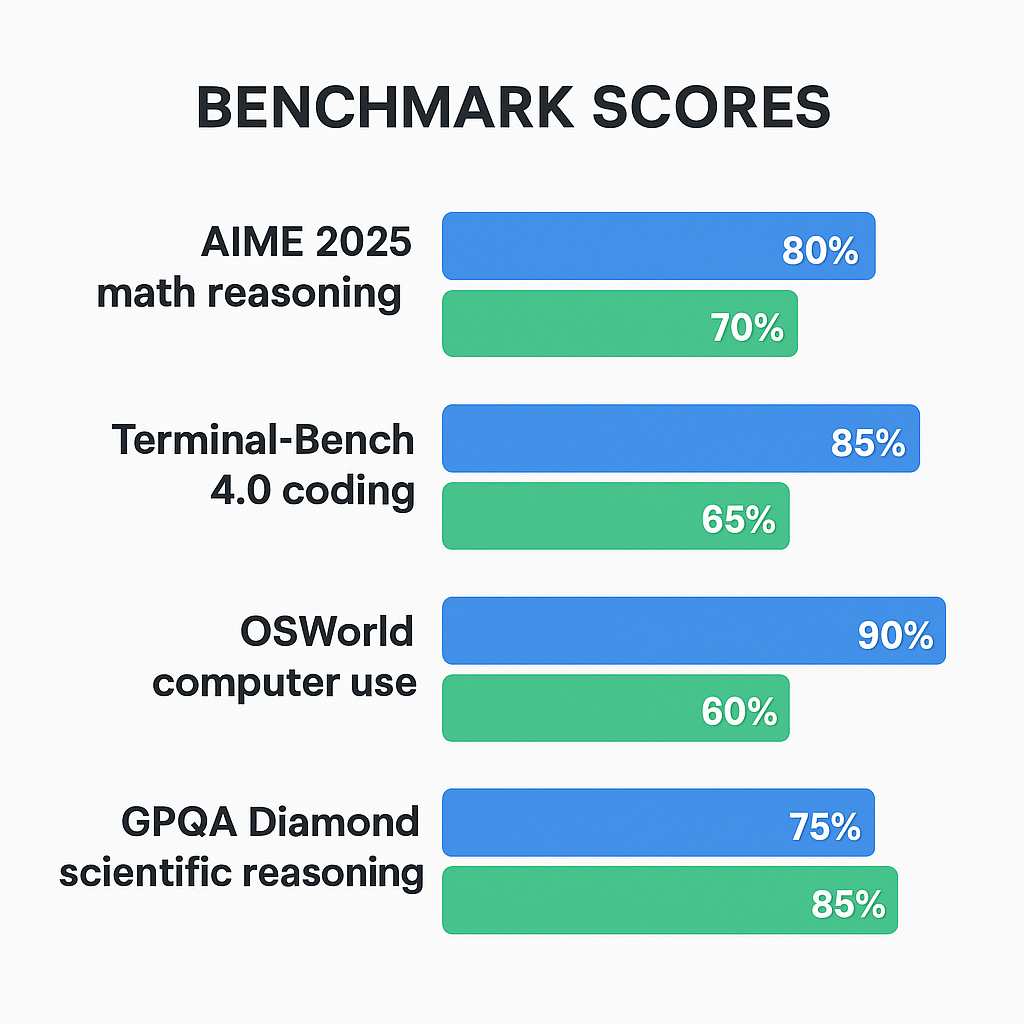
Claude on code correctness. In coding tests that measure whether generated code actually works end-to-end, Claude scores approximately 95% versus ChatGPT's approximately 85%, according to nxcode.io's 2026 comparison. That 10-percentage-point gap is meaningful when you're shipping production code or running automated review pipelines. Claude Opus 5.5 also scores 66.4% on Terminal-Bench 4.0 versus 57.9% for GPT-6 Astra, per neuraltrust.ai's benchmark report — suggesting Claude maintains its advantage even on the harder, agentic coding challenges that require multi-step execution. For engineering-adjacent teams in B2B SaaS, Claude is the safer default for code generation tasks.
ChatGPT on agentic tasks. Where ChatGPT narrows the gap is in real-world computer use and agentic workflows. On OSWorld — a benchmark for model-guided computer navigation tasks — GPT-5.4 scores 75%, notably exceeding the human baseline of 72.4%, while Claude scores 72.5%, just barely above the human baseline, according to nxcode.io's 2026 comparison. If your use case involves models taking sequences of actions in a computer environment (filling forms, navigating UIs, executing workflows), ChatGPT has a slight structural advantage here. This is also the area where OpenAI's broader product ecosystem gives it an edge — Operator tools and deep API integrations make ChatGPT the more natural fit for automation pipelines.
For B2B SaaS teams that pair AI with GitHub Copilot or similar: Claude's 95% end-to-end code correctness rate means fewer debugging cycles. The 10-point gap over ChatGPT compounds across dozens of daily code-generation tasks.
Reasoning and Math: Where ChatGPT Pulls Ahead
Math and formal logic benchmarks are the clearest domain where ChatGPT outperforms Claude by a significant margin in 2026. The AIME (American Invitational Mathematics Examination) is a standard proxy for model reasoning depth, and the gap here is not marginal — it reflects a fundamental architectural difference in how each model handles multi-step symbolic reasoning. For teams whose AI use cases are data-heavy, formula-driven, or require provable logical chains, this is a decisive factor in the comparison.
ChatGPT's reasoning lead. GPT-5 with reasoning mode scored 94.6% on AIME 2025, according to datastudios.org's full model comparison. Claude 4 without tools scored approximately 33–34% on the same benchmark. That is not a rounding error — it is a structural gap that reflects OpenAI's explicit investment in chain-of-thought and extended reasoning modes. For demand generation teams building AI-assisted attribution models, or for data scientists running quantitative analyses, ChatGPT's reasoning capabilities make it the more reliable choice when the task involves symbolic math, formal proof, or complex multi-step logic.
Claude's scientific knowledge. Where Claude partially compensates is in deep scientific and domain-specific knowledge. Claude Opus 4.6 scores 91.3% on GPQA Diamond — a graduate-level scientific reasoning benchmark — per nxcode.io's 2026 evaluation. This is impressive and reflects Claude's strength at applying synthesized knowledge. However, GPQA Diamond tests knowledge retrieval and application, not pure symbolic math. The AIME gap remains. According to a comparative study published in PubMed, Claude 3.5 Sonnet achieved 80% accuracy on the Japanese National License Examination for Pharmacists, matching performance of leading models like ChatGPT o1 — confirming that Claude's knowledge depth is genuinely competitive, even where its raw math reasoning trails.
Writing Quality and Document Analysis
Writing quality is harder to benchmark than math or code — it involves tone calibration, structural coherence, avoiding filler, and matching the implicit expectations of a given format. In practice, most marketing and content teams who have used both models extensively in 2026 report that Claude produces more natural, less formulaic long-form prose. The difference is subtle on short tasks but becomes more apparent on 2,000-word articles, technical white papers, or nuanced customer-facing copy where generic phrasing is a liability.
Claude's writing edge. Claude tends to produce prose that reads less like AI output and more like a practiced human writer — varied sentence rhythm, fewer filler transitions, more precise word choice. This is attributable in part to Anthropic's constitutional AI training, which shapes Claude's outputs toward being helpful, honest, and thoughtful in a way that bleeds into stylistic quality. For content teams writing B2B SaaS blogs, case studies, or technical documentation, Claude often requires fewer editing passes. It also handles document analysis with more depth: users can attach PDFs up to 32 MB or 100 pages per request, and Claude extracts text and analyzes pictures, tables, or charts within the PDF natively, according to datastudios.org's model comparison.
ChatGPT's breadth. ChatGPT's writing quality is strong and has improved substantially with GPT-5 — the gap with Claude has narrowed. Where ChatGPT has a structural advantage is breadth: it can generate text and images in the same workflow, summarize a document and then produce a visual slide layout, or draft copy and then suggest design treatments. For marketing teams that operate in integrated creative workflows rather than pure text pipelines, ChatGPT's multimodal scope is a genuine productivity advantage. According to Vapi AI's comparison guide, Claude added web search with citations as of March 2025, which partially closes the research-and-write gap — but ChatGPT's ecosystem of plugins, code interpreter, and image generation remains more integrated.
Image Handling and Multimodal Capabilities
This is one of the clearest capability gaps between Claude and ChatGPT in 2026, and it matters for marketing and design-adjacent workflows. The two models are not equivalent here — one generates images, the other does not, and that distinction shapes which tool belongs in a content production stack versus a pure analysis or writing stack.
ChatGPT generates images. GPT-4o can generate images directly in the chat interface and allows editing of uploaded images. This means a content marketer can draft a blog post and produce a featured image in the same session — or a product team can mock up UI screenshots from a text description. For teams without dedicated design resources, this is a meaningful capability that reduces tool-switching. According to mindstudio.ai's 2026 comparison, this remains one of ChatGPT's clearest differentiators. The ability to iterate on visual outputs through natural language prompts — 'make the background darker,' 'remove the text overlay' — is a workflow accelerator that Claude simply does not offer.
Claude analyzes images, not generates. Claude can receive and analyze images — describing what's in a chart, extracting data from a screenshot, or interpreting a diagram — but it cannot produce images. This limits Claude in creative production workflows but keeps it highly relevant for analytical ones: if you're feeding Claude dashboards, research charts, or competitor screenshots for interpretation, it performs well. The practical implication is that teams often use Claude for analysis and writing, then switch to ChatGPT or dedicated tools for visual production. The difference between Claude and ChatGPT on this axis is not about quality — it's about capability presence versus absence.
For lean marketing teams: if your workflow involves producing both written content and images (ads, social, blog headers), ChatGPT's integrated image generation removes a tool-switching step. If your workflow is primarily text and analysis, Claude's lack of image generation is a non-issue.
What Can Claude Do That ChatGPT Cannot?
Setting aside benchmarks for a moment, there are specific structural features that Claude offers which ChatGPT does not match — at least not equivalently. These are the reasons teams who have evaluated both models often end up running Claude for specific use cases even when they keep ChatGPT as a general-purpose tool. The capabilities below are genuine differentiators, not marketing language.
- 1M-token context window in beta: Claude Sonnet 4's beta context window allows ingesting entire codebases or research corpora that would require chunking in ChatGPT
- Constitutional AI behavior: Claude's outputs are shaped by Anthropic's published model spec, making refusals and safety decisions more predictable and auditable for enterprise use
- Superior code correctness rate (~95% vs ~85%): Claude's end-to-end code correctness is meaningfully higher in independent 2026 evaluations
- Deeper qualitative writing: Many content practitioners report Claude requires fewer editing passes for long-form B2B prose
- Native PDF analysis at scale: Claude processes PDFs up to 32 MB (100 pages), analyzing embedded charts, tables, and images within a single attachment
- Transparent model card adherence: Anthropic publishes detailed model cards aligned with frameworks like those recommended by NIST — important for organizations with AI governance requirements
AI Search Visibility: How Both Tools Affect GEO
Beyond what these models do as tools, both Claude and ChatGPT are now active components of the search landscape — meaning your content either gets cited by them or it doesn't. The difference between Claude and ChatGPT as citation surfaces is relevant to anyone running a content strategy in 2026. Understanding the difference between aeo and geo is foundational here: AI engines don't just retrieve pages, they synthesize answers, and the content that gets woven into those answers follows specific structural patterns — direct declarative sentences, clean schema markup, cited statistics, and FAQ blocks that match the question formats users actually ask.
Claude as a citation surface. Claude's training includes a large corpus of structured web content, and its retrieval behavior — both in web search mode and in base knowledge — favors content that is clearly attributed, factually precise, and structured around answerable questions. If your content is published with schema markup, internal links, and verified source citations, it has a higher probability of being surfaced when Claude synthesizes an answer to a query in your category. For B2B SaaS companies trying to appear in AI-generated answers, the structural requirements are consistent across models: answer-first paragraphs, FAQ sections, and outbound citations from authoritative domains are the levers that matter.
ChatGPT as a citation surface. ChatGPT, particularly through its web browsing and integration with Bing's index, surfaces content that performs well in traditional search signals: domain authority, freshness, and relevance. According to Gartner, generative AI is now embedded in enterprise search workflows across a growing majority of knowledge workers — meaning your content's AI search footprint is no longer a 'nice to have' but a core visibility channel. An AI Visibility Score that tracks how both models see your brand gives teams a concrete feedback loop. The question of will marketers be replaced partly hinges on whether they can run GEO alongside traditional SEO — and that starts with content that's structured to be cited.
Verdict: Which Should You Choose?
The honest answer to whether you should use Claude or ChatGPT is that your specific task mix matters more than abstract model quality scores. Both have crossed the threshold of 'good enough' for most everyday B2B tasks — the difference shows up at the edges: when you're pushing context limits, shipping code to production, running heavily quantitative analyses, or building content at scale. The framework below maps the choice to concrete use-case patterns rather than generic performance claims. Many teams end up running both — Claude as the primary writing and analysis tool, ChatGPT as the multimodal and reasoning workhorse — which is a reasonable conclusion given the benchmark data.
- Choose Claude if: you regularly analyze long documents, codebases, or research corpora that exceed 128K tokens
- Choose Claude if: code correctness and production reliability matter — the ~95% vs ~85% end-to-end gap is real
- Choose Claude if: you need nuanced long-form writing with fewer editing passes, especially for technical B2B content
- Choose ChatGPT if: your workflow includes math-heavy reasoning, formal logic, or quantitative modeling at scale
- Choose ChatGPT if: you need integrated image generation alongside text — visual content + copy in one interface
- Choose ChatGPT if: you're building automation pipelines that require computer-use or extensive third-party integrations
Verdict: Claude is the stronger choice for content-driven and engineering teams in B2B SaaS. ChatGPT is the stronger choice for multimodal workflows and math-intensive analysis. If you're producing content at scale for AI search visibility, both models are citation surfaces — and your content structure matters as much as which tool you used to write it. Gofylo structures every article it publishes for citation by both Claude and ChatGPT, with schema markup, FAQ blocks, and verified source citations built in — all at 30 articles a month, a few minutes each, for $79/month.
Frequently Asked Questions
What can Claude do that ChatGPT cannot?
Claude offers a larger default context window (200K tokens, versus ~128K for ChatGPT's GPT-5 default), higher end-to-end code correctness (~95% vs ~85%), and deeper native PDF analysis — processing files up to 32 MB and 100 pages, including embedded charts and tables. Claude's constitutional AI training also makes its safety behavior more auditable and predictable, which matters for enterprise governance. Claude cannot generate images, which is a capability ChatGPT provides natively through GPT-4o.
What's so special about Claude?
Claude is built on Anthropic's constitutional AI approach, which trains the model using a set of explicit principles rather than pure reinforcement learning from human feedback. This produces outputs that are more consistent, more predictable in edge cases, and less prone to sycophantic agreement — a meaningful quality difference for professional use. Claude's 1M-token beta context window and its strong performance on code correctness and qualitative writing make it the preferred model among a growing share of technical and content-focused practitioners in 2026.
Why is Claude being banned?
Some organizations — particularly in regulated industries and government sectors — have restricted Claude not because of a specific violation, but due to general enterprise AI data governance policies. Anthropic, as a smaller company relative to Microsoft-backed OpenAI, may have fewer established enterprise data processing agreements in place with certain procurement frameworks. Additionally, Claude's strong capability in coding and long-document analysis has raised concerns in some security contexts about potential misuse. These restrictions are policy-level decisions, not evidence of a safety failure specific to Claude — and Anthropic publishes detailed model documentation consistent with AI risk management frameworks like NIST AI RMF.
Should I switch to Claude from ChatGPT?
Switch to Claude if your primary use cases are long-document analysis, code generation, or writing quality — Claude's benchmarks are measurably stronger in all three. Keep ChatGPT if you regularly need image generation, deep mathematical reasoning, or computer-use automation. For most B2B SaaS content and marketing workflows in 2026, Claude is the stronger daily driver — but switching entirely means losing ChatGPT's multimodal capabilities, so many teams maintain both. According to neuraltrust.ai's 2026 benchmark report, Claude Opus 5.5's 66.4% on Terminal-Bench versus GPT-6 Astra's 57.9% is a concrete data point in favor of Claude for coding-intensive teams.
If you're building content designed to be cited by Claude, ChatGPT, and other AI engines, structure matters as much as the model you use to write. Gofylo publishes 30 articles a month to your CMS — each with schema markup, FAQ blocks, internal links, and AI-citation formatting built in — and scores how Claude and ChatGPT currently see your brand. Start with the free AI Search Grader or try the full platform free for 3 days at gofylo.io.