In 2026, the question of whether your content gets cited by ChatGPT or Claude is no longer a secondary concern — it is a primary acquisition channel. Most B2B SaaS founders and marketing leads have heard of llms.txt by now, but far fewer can explain what the file actually does, how it differs from a sitemap or robots.txt, or why adoption still sits at a fraction of the sites that need it. That gap is what this article closes.
What is llms.txt? At its core, it is a plain-text file you place at the root of your domain to give large language models a structured, curated summary of your most important content. Think of it as a briefing document written not for Googlebot, but for AI reasoning engines. The idea is straightforward; the implications are significant. According to research published by distil.la, fifteen months after the proposal was published, grassroots adoption has reached hundreds of companies including Anthropic, Cloudflare, and Stripe — three organizations with every reason to understand AI infrastructure deeply.
llms.txt is a plain-text file placed at your domain root that tells AI language models which pages matter, how your content is organized, and what context to use when generating responses about your brand. It matters most to founders, SEO managers, and demand-gen teams who want to control how AI search engines describe and cite them.
What llms.txt Actually Is
llms.txt is a Markdown-formatted plain-text file hosted at the root of a website — accessible at yourdomain.com/llms.txt — that provides AI language models with a structured, human-readable index of your site's most important content. The proposal was published on 3 September 2024 by Jeremy Howard, founder of fast.ai, as a community convention for bridging the gap between how websites are structured and how large language models consume information. Unlike robots.txt, which instructs crawlers what not to index, llms.txt is an affirmative signal: it tells an LLM what to prioritize, how your content is organized, and what context is most useful when a model generates a response that involves your brand. It is not a directive — it is a briefing. An LLM can choose to honor it or ignore it, and therein lies both its elegance and its current limitation.
Community convention, not a standard. It is important to be precise about what llms.txt is not. According to research documented at cdp.com, llms.txt is a community convention with no backing from the IETF, W3C, or any recognized standards body as of 2026. That means no AI platform is technically required to read or respect it. This is a meaningful distinction because it affects how you should weight the investment of implementing it relative to other GEO activities — a point we return to in the context of AI search strategy.
The Problem It Was Built to Solve
When ChatGPT, Claude, Perplexity, or Gemini generates an answer that draws on web content, it does not browse your sitemap and work through your navigation hierarchy. LLMs process text at scale during training and, for retrieval-augmented generation (RAG) setups, pull documents from indexed sources. Neither process is optimized for understanding the relative importance of pages on your site. A blog post from three years ago may carry more training weight than your current product documentation simply because it has more inbound links — not because it is more accurate or more useful. The result is that AI-generated answers can misrepresent your product, cite outdated pricing, or omit your most differentiating features entirely. According to a consumer behavior survey cited by usegrowthos.com, 51% of consumers have already changed their research habits because of generative AI, meaning the accuracy of AI-generated content about your brand now has a direct impact on purchase decisions.
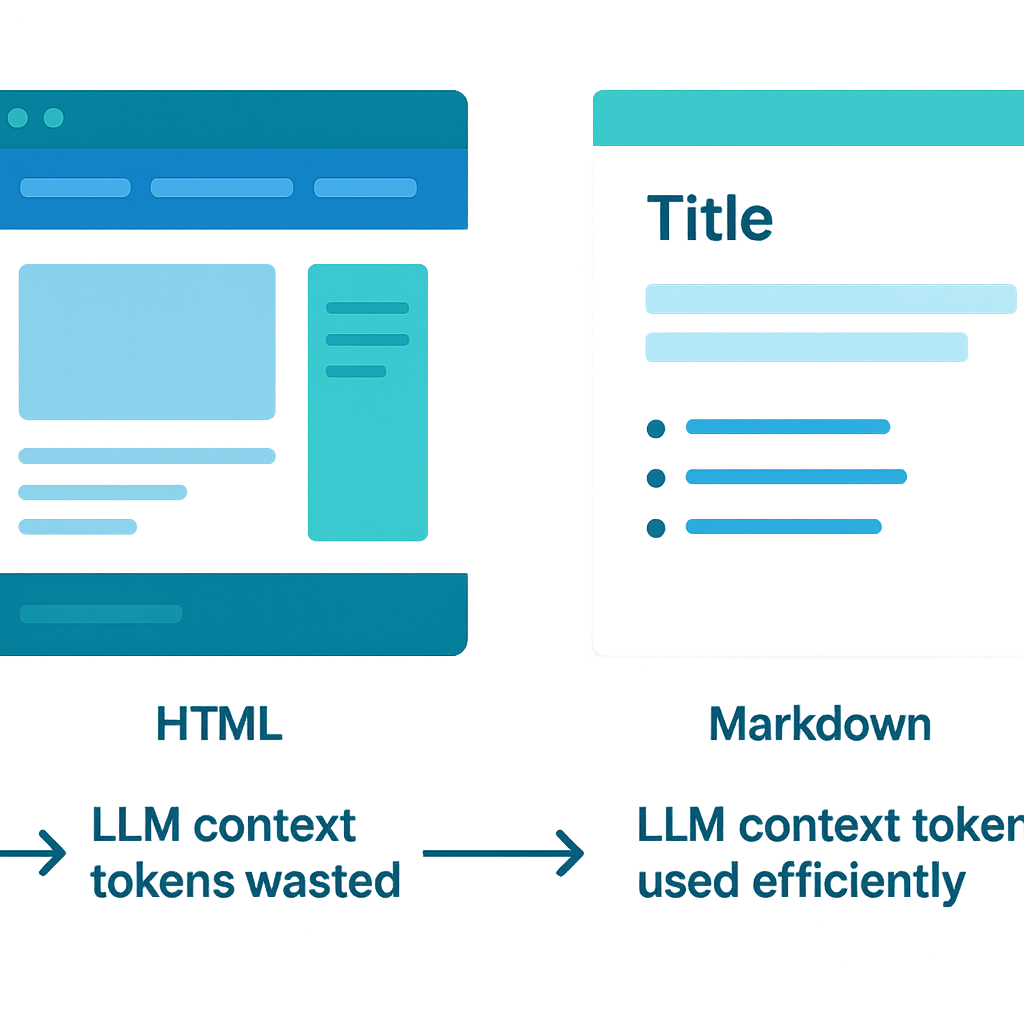
HTML is noisy for LLMs. A full HTML page typically contains navigation elements, cookie banners, footer links, sidebar widgets, and social sharing buttons — all of which consume context window space without contributing meaningful information. When an LLM fetches a page, it has to parse that noise before reaching the substantive content. llms.txt strips all of that away. It provides clean Markdown: a title, an optional summary, and a curated list of the URLs an LLM should consult, with plain-English descriptions of what each one contains. That efficiency matters because LLMs operate within token limits, and every token spent on navigation chrome is a token not spent on understanding your product.
- AI models cannot infer which of your hundreds of pages are most authoritative without a signal
- HTML structure adds noise that consumes LLM context before reaching substantive content
- Training data cutoffs mean LLMs may default to outdated or competitor-sourced descriptions of your product
- Retrieval-augmented systems pull documents by relevance score, not by your intended content hierarchy
- Without structured guidance, AI answers about your brand may be incomplete, inaccurate, or absent entirely
How the llms.txt Format Works
The llms.txt format uses standard Markdown syntax, which makes it readable by both humans and language models without requiring any special parser. The file begins with an H1 heading containing the project or company name, followed by an optional blockquote that provides a brief summary of what the site covers. Below that, content is organized into H2 sections, each representing a logical grouping of pages. Within each section, bullet points list specific URLs with a short description of what each URL contains. The simplicity is deliberate: the goal is maximum parse efficiency, not visual richness.
Two files, two purposes. The specification defines two distinct files with complementary roles. The /llms.txt file provides a streamlined view of your documentation navigation — it helps AI systems quickly understand your site's structure without downloading everything. The /llms-full.txt file, by contrast, is a comprehensive file containing all your documentation in one place, giving a model the full text of your content in a single request. The /llms-full.txt approach is useful for retrieval-augmented generation systems that want to cache your entire knowledge base locally, while /llms.txt is better suited for models that will follow links to fetch individual pages on demand.
- H1 heading: Your company or project name
- Optional blockquote: A one-to-two sentence summary of what the site covers
- H2 sections: Logical groupings such as Documentation, Blog, API Reference, or Changelog
- Bullet-point links: Each with a URL and a plain-English description of its content
- Optional: llms-full.txt at the same root containing concatenated full-text versions of your key pages
A well-formed llms.txt file is less than two kilobytes. It costs almost nothing to generate and nothing to serve — but the strategic value of giving an LLM a pre-curated map of your most authoritative content can outweigh months of unstructured indexing.
The v2 Specification: What Changed and Why It Matters
The v2 specification, published at llmstxt.org, extended the original proposal in several meaningful ways. The most significant addition is the formal introduction of the /llms-full.txt companion file as a first-class part of the specification rather than an informal suggestion. v2 also clarified the intended behavior for AI agents that traverse links: the file is meant to be a starting point for agent-based browsing, not a replacement for fetching individual pages. An AI agent can read /llms.txt, identify the most relevant section for a user's query, fetch just those pages, and return a grounded answer — rather than crawling an entire domain at random. This makes llms.txt particularly relevant to the emerging category of AI agents and agentic search, where the efficiency of document retrieval directly affects response quality and latency.
Adoption has accelerated since v2. The v2 release gave tooling authors a stable target, which in turn accelerated the ecosystem of llms.txt generators, validators, and directory listings. Several documentation platforms began auto-generating llms.txt files from their content structure, meaning teams using those platforms got the benefit automatically. Despite this momentum, actual adoption among high-visibility domains remains low: as of April 2026, only about 2% of the most-cited domains in AI search have an llms.txt file, according to research published by vibe-marketing.org. That low adoption rate is a compounding opportunity for early movers — the signal-to-noise ratio in the file namespace is currently very high.
How llms.txt Relates to Existing Web Standards
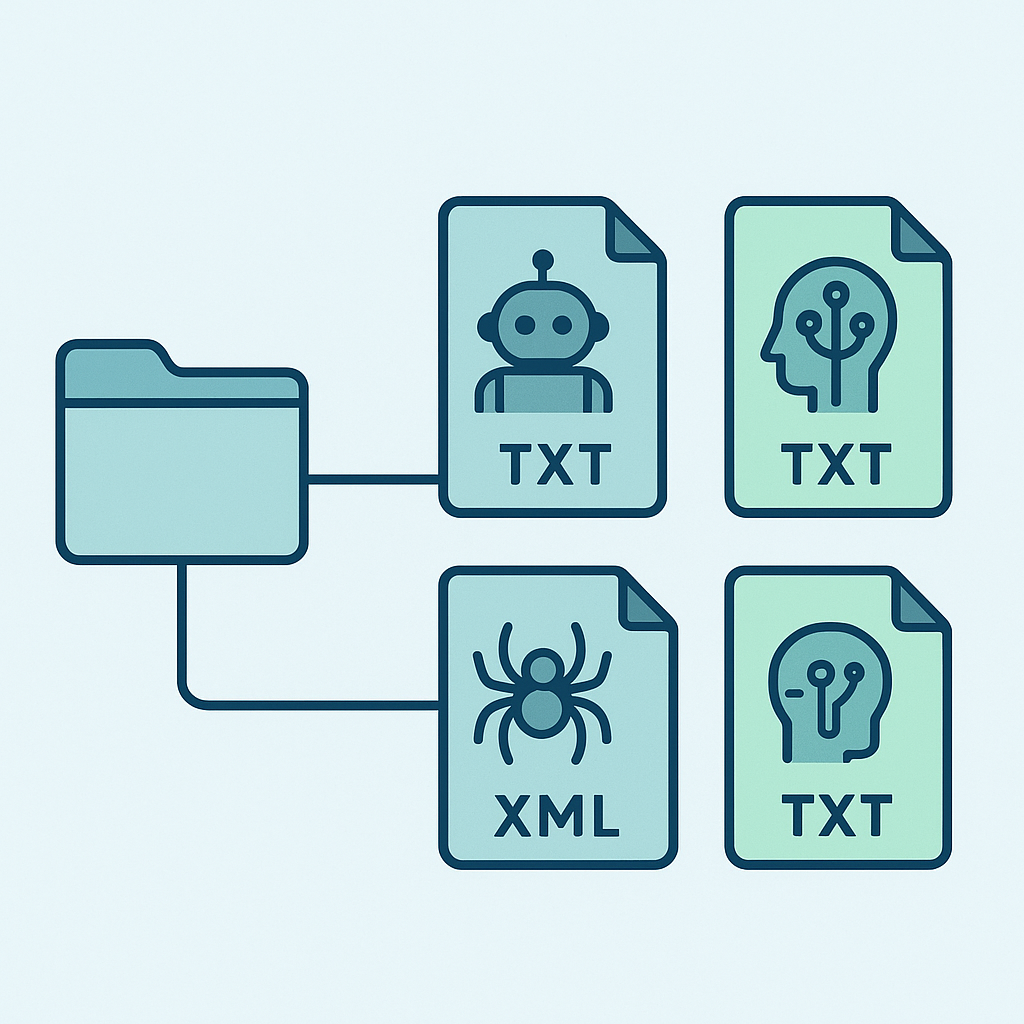
Understanding where llms.txt sits relative to the standards you already manage helps clarify both its role and its limitations. robots.txt, governed by convention and now partially codified through Google's documentation at developers.google.com, tells crawlers what they are not permitted to access. sitemap.xml, described in detail at developers.google.com's sitemap guide, enumerates your pages for search engine discovery. llms.txt does neither of those things. It does not restrict access and it is not an exhaustive index. It is a curated, opinionated selection: the pages you most want an AI model to use when forming answers about your domain. The three files are complementary, not redundant. A site that has all three is telling three different audiences — crawler, search engine, and language model — exactly what they need to know in the format that audience prefers.
- robots.txt: Tells crawlers what not to access — a restrictive signal for bots
- sitemap.xml: Enumerates all indexable pages — a comprehensive inventory for search engines
- llms.txt: Curates the most important pages with context — an affirmative briefing for language models
- llms-full.txt: Delivers full-text content in one file — for RAG systems and AI agents that cache content locally
- Schema markup: Structures individual page content — helps both search engines and LLMs parse entity relationships
Is llms.txt Mandatory?
No — llms.txt is not mandatory in any technical or legal sense, and no AI platform currently requires it as a condition of indexing or citation. Because the file is a community convention rather than a ratified standard from the IETF, W3C, or any comparable body, AI companies implement support for it voluntarily and inconsistently. Anthropic, for instance, has published its own llms.txt file and publicly encouraged the convention, but it does not guarantee that Claude reads every llms.txt file it encounters before generating a response. OpenAI has not made a formal statement about whether ChatGPT prioritizes llms.txt files in its retrieval pipeline as of 2026. The file is best understood as a best-effort signal rather than a guaranteed instruction — analogous to how robots.txt disallow rules are respected by reputable crawlers but not enforceable against all actors.
Low cost, asymmetric upside. The absence of a mandate does not undermine the case for implementing llms.txt. The file takes minutes to create for a site with organized content, costs nothing to host, and represents a structured expression of editorial intent that AI platforms and agentic tools can act on as they evolve. Given that only 2% of high-citation domains have implemented it as of April 2026, the cost of being in the majority who skip it is the certainty of offering no structured signal versus the potential upside of influencing how a growing set of AI tools interpret your content. That asymmetry favors implementation.
llms.txt in the Context of AI Search and GEO
For founders and marketing leads who are tracking performance across both traditional search and AI search channels, llms.txt is one lever in a larger generative engine optimization (GEO) strategy. It shapes what content an LLM can easily access from your domain, but it does not create content, build authority, or earn citations on its own. A well-structured llms.txt file pointing to thin, poorly-cited content will not move your AI visibility score. Conversely, a domain with deep, authoritative, well-structured articles that does not have an llms.txt file may still earn AI citations — the file accelerates and focuses that citation potential; it does not substitute for it. Your Guide to LLM visibility tools covers the broader strategic stack, while From Rankings to LLM mentions provides a practical framework for tracking how AI surfaces your brand across channels. Both are worth reading alongside this explainer to understand where llms.txt fits in the full picture.
llms.txt is a targeting layer, not a content layer. It tells AI models where to look on your domain. The quality of what they find when they look determines whether they cite you. Both layers have to be strong for the strategy to compound.
What llms.txt Cannot Do Alone
The most important misconception about llms.txt — and the one most likely to waste a team's time — is the belief that publishing the file is itself a GEO strategy. It is not. llms.txt is a discovery and prioritization signal. It does not inject your content into an LLM's training data, guarantee citation in any AI-generated answer, or substitute for the content depth and structural quality that determine whether an LLM finds your pages credible and quotable. Tools like Profound AI vs. Autonomous GEO — a sibling analysis in this cluster — explore what it actually takes to move your AI citation rate, and the answer consistently involves content volume, topical authority, entity recognition, and schema coverage as well as file-level signals like llms.txt. The file matters; it is just not sufficient on its own. Autonomous content platforms that research, write, optimize, internally link, and publish articles at scale — such as Gofylo's content engine, which produces 30 articles a month per site in a few minutes each — address the content depth requirement that llms.txt alone cannot.
- llms.txt does not guarantee AI platforms will read or respect the file
- It does not inject content into LLM training data or fine-tuning sets
- It does not replace the need for authoritative, well-structured, deeply-covered content
- It does not provide tracking or feedback on whether AI models are using your file
- It does not substitute for schema markup, which structures individual page entities for both search and LLM parsing
- It does not address brand mention quality across third-party sources, which heavily influences LLM citations
FAQ
Are llms.txt files worth it?
For most B2B SaaS sites with organized documentation or a structured content library, yes — the implementation cost is minimal and the potential upside is asymmetric. With only about 2% of high-citation domains having published an llms.txt file as of April 2026, early adopters face very little competition in the file namespace. The file does not guarantee AI citations, but it provides a structured, curated signal that AI agents and retrieval systems can act on as the ecosystem matures.
Is llms.txt mandatory?
No. llms.txt is a voluntary community convention with no backing from the IETF, W3C, or any recognized standards body as of 2026. No AI platform requires it as a condition of indexing or citing your content. It is best understood as a best-effort signal — similar to how robots.txt is respected by reputable crawlers but is not technically enforceable. Implementing it is advisable but skipping it carries no direct penalty.
What does "LLM text" mean?
"LLM text" in the context of llms.txt refers to plain, human-readable text formatted specifically for large language models to consume efficiently. The file uses Markdown rather than HTML to strip away navigation noise and deliver structured content — titles, descriptions, and links — in a format that minimizes token consumption and maximizes comprehension. "LLM" stands for large language model, the class of AI system used by ChatGPT, Claude, Perplexity, and Gemini.
How to check llms.txt file?
The simplest check is to navigate directly to yourdomain.com/llms.txt in a browser — if the file exists and is correctly served, you will see plain Markdown text. Several community-built llms.txt checker tools can also validate the file's format against the specification and flag structural issues. Our existing article on building and validating your llms.txt file covers the checking process in full technical detail.
What is an llms-full.txt file?
The /llms-full.txt file is the companion to /llms.txt defined in the v2 specification. Where /llms.txt provides a curated navigation index with links, /llms-full.txt contains the complete text of your key documentation or content pages concatenated into a single file. It is designed for retrieval-augmented generation systems and AI agents that prefer to cache your entire knowledge base locally rather than fetching individual URLs on demand.
Does Anthropic officially support llms.txt?
Anthropic has published its own llms.txt file and is publicly associated with the convention, which has contributed to broader awareness. However, as of 2026, Anthropic has not issued a formal specification or guarantee that Claude reads and prioritizes llms.txt files in every retrieval context. Their adoption signals endorsement of the concept without constituting a technical mandate for how Claude processes the file.
If you want your content to be discovered, cited, and ranked by both Google and AI engines like ChatGPT and Claude — not just file-signaled — Gofylo's autonomous content engine publishes 30 fully optimized, AI-citation-ready articles a month to your CMS, tracks your AI Visibility Score across ChatGPT and Claude, and refreshes articles that have slipped using your Search Console data. Start a free 3-day trial and see your AI visibility score before you write a single word.