As of 2026, Google's AI Overviews appear on roughly half of all commercial searches in the United States, according to Semrush's 2025 State of Search report. That single feature has quietly reshuffled how organic traffic distributes — pulling clicks toward synthesized answers and away from the blue-link results that SEO teams have optimized for years. If you're a founder, SEO manager, or demand gen lead at a B2B SaaS company, AI Overviews aren't a distant threat to monitor. They're the operating environment you're already competing in.
Understanding AI Overviews SEO means understanding two simultaneous games: the traditional signals that earn a page its ranking position, and the structural signals that cause Google's generative layer to actually pull your content into a synthesized answer. These two goals overlap, but they aren't identical — and the gap between them is where most content strategies quietly fail in 2026.
Thesis: AI Overviews don't replace SEO — they extend it into a new layer where structured, authoritative, and AI-readable content compounds your organic reach beyond traditional rankings.
What AI Overviews Actually Are
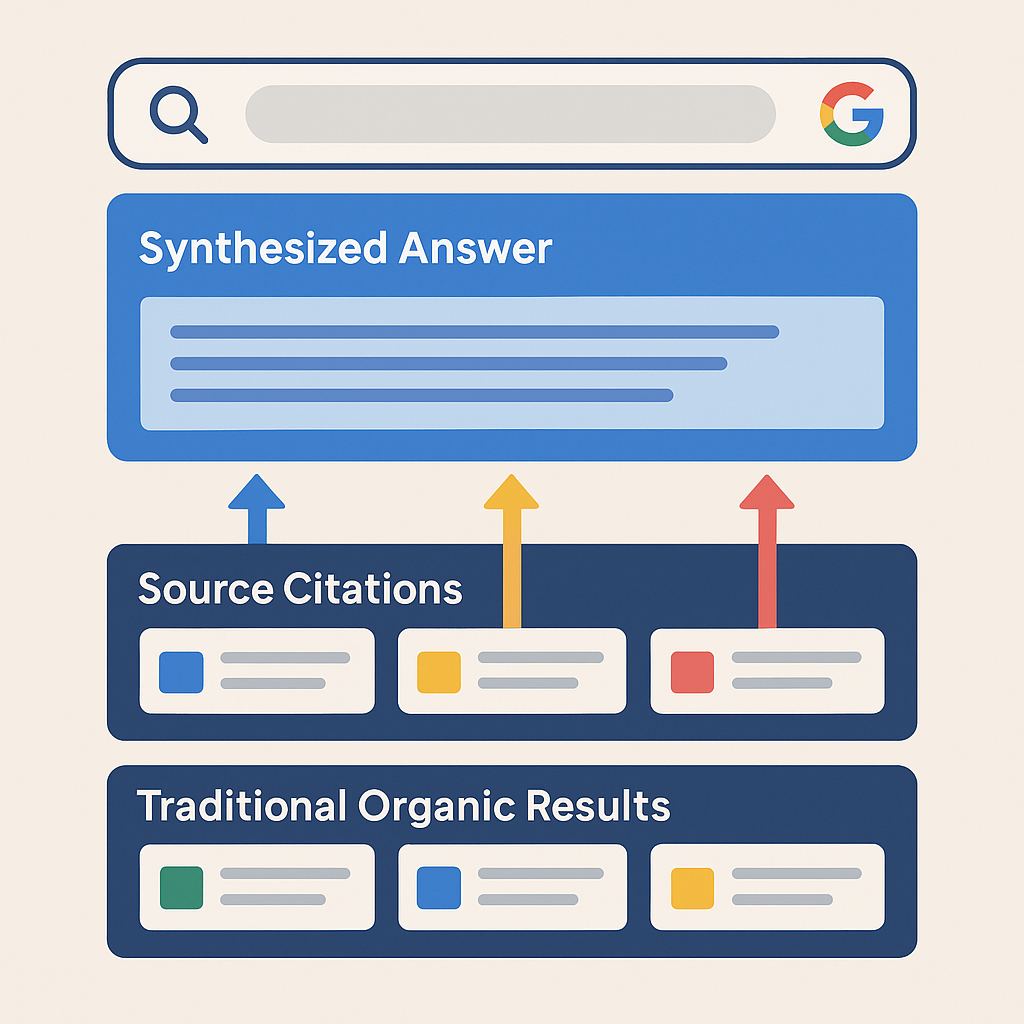
AI Overviews are Google's generative answer layer — a synthesized summary that appears above traditional search results, drawing from multiple web sources to answer a query without requiring users to click through. Launched broadly in the United States in mid-2024 and expanded globally through 2025, AI Overviews represent Google's integration of large language model technology directly into the search results page. By 2026, they're a standard fixture across informational, comparison, and increasingly transactional queries. The key distinction from a featured snippet is scope: an AI Overview doesn't pull a single passage from one page. It synthesizes claims, definitions, and supporting evidence from several sources simultaneously, attributing each contributing piece with a citation link. Those citation links are the new ranking real estate. Being cited in an AI Overview puts your brand name and URL in front of users who may never scroll down to the organic listings at all.
How Google Selects Content for AI Overviews
Google has not published a deterministic ruleset for AI Overview inclusion, but patterns emerging from large-scale content studies in 2026 point clearly toward three governing factors: topical authority, content structure, and demonstrated expertise. Google's own Search Quality Evaluator Guidelines describe E-E-A-T — Experience, Expertise, Authoritativeness, and Trustworthiness — as the framework evaluators use to assess content quality. In the AI Overview context, E-E-A-T functions less as a checklist and more as a signal bundle. Google's generative system appears to favor content that matches the semantic depth of the query, is structured in ways that make individual claims extractable, and comes from domains with established topical authority. A page that ranks number three for a keyword will not automatically appear in the AI Overview for that query — but a page that ranks eight with superior structure and clearer claim attribution sometimes does.
E-E-A-T and Its Amplified Role in the AI Layer
E-E-A-T has always mattered for high-stakes content categories, but in 2026 it operates as a baseline filter for AI Overview inclusion across nearly all commercial and informational queries. The 'Experience' dimension — the first E added in 2022 — is particularly relevant here. Google's systems attempt to distinguish first-person, practitioner-level perspective from aggregated or derivative content. For B2B SaaS topics, this means content that contains original positioning, concrete operational detail, and specific outcomes carries structurally more weight than content that summarizes what others have already written. Ahrefs' content research in 2025 found that pages cited in AI Overviews were 2.3x more likely to contain specific data points, named examples, or first-person experience signals than pages that ranked at the same position but were not cited. The practical implication: depth and specificity aren't just quality markers — they're extraction targets for the generative layer.
Structural Signals That Surface Content in Overviews
Beyond authority and depth, the structural format of your content determines whether Google's generative model can efficiently extract and synthesize a claim. Content with clear heading hierarchies, FAQ schema, defined claim-answer pairs, and short declarative paragraphs is structurally optimized for machine extraction — which is exactly what AI Overview generation requires. Long, rambling paragraphs without clear topic sentences are harder to parse at inference time. Structured formats — definition blocks, numbered explanations, Q&A sections — give the model clean extraction surfaces. This is why FAQ sections with FAQPage schema markup have become one of the highest-leverage structural investments in AI Overviews SEO. The schema doesn't guarantee inclusion, but it signals clearly to Google what each content block answers.
How AI Overviews Interact With Traditional Rankings
AI Overviews and traditional organic rankings are not independent systems — they interact, and understanding that interaction is critical to building an effective content strategy in 2026. Traditional rankings still determine which pages Google's generative system considers when assembling an AI Overview. If your page isn't in the top 10 to 20 results for a query, it's unlikely to be pulled into the Overview for that query. In that sense, classic SEO foundations — technical health, domain authority, internal linking, and keyword-targeted content — remain necessary. What's changed is the sufficiency condition. Ranking no longer guarantees citation or traffic. Google's AI layer can satisfy a user's informational intent without a click, and a page ranked number two with weak structural signals may generate less traffic than a page ranked number six that gets cited in the Overview and earns a visible attribution link.
Click-Through Behavior When Overviews Are Present
The click-through rate impact of AI Overviews is one of the most actively studied questions in search in 2026. Search Engine Land's analysis found that organic click-through rates for queries with AI Overviews declined meaningfully compared to the same queries without them, with informational queries seeing the steepest drops. This doesn't mean SEO is less valuable — it means the value of a ranking has shifted from position to citation. A page cited within an AI Overview often earns a click from a user with higher intent than an average organic click, because the Overview has already pre-qualified the user's understanding. The clicks that remain are more qualified; the clicks that disappear were often low-intent browsing traffic that rarely converted anyway. For B2B SaaS teams, this distinction matters: the leads most likely to convert are still clicking, but they're clicking from citation links, not necessarily from position one.
Key shift: In 2026, ranking position determines which content gets considered for AI Overviews. Content structure and E-E-A-T signals determine which of those ranked pages actually gets cited. Both layers now require deliberate optimization.
The GEO Dimension: Beyond Google
AI Overviews SEO is Google-specific, but the broader challenge it represents — earning citations in AI-generated answers — extends across every major generative engine in 2026. ChatGPT, Claude, Perplexity, and Gemini all surface synthesized answers to commercial and informational queries, and they all draw on web content to do it. Generative Engine Optimization (GEO) is the discipline that covers this expanded surface. While AI Overviews SEO focuses specifically on how Google's search page integrates AI answers, GEO addresses how your brand and content earn citations across the full ecosystem of AI-driven search. The structural signals that help you earn inclusion in Google's AI Overviews — authority, depth, FAQ schema, clear claim structure — largely transfer to other generative engines, because the underlying extraction mechanisms are similar. Teams that optimize only for Google's AI Overview are leaving meaningful citation surface uncovered. The more defensible strategy is building content that earns citations across all generative surfaces simultaneously. This connects directly to what's discussed in our analysis of artificial intelligence optimization and the AEO vs GEO frameworks.
What Content Architecture Actually Drives AI Overview Inclusion
Content architecture — the way information is organized within and across pages — has become the most underappreciated variable in AI Overviews SEO. Google's generative system doesn't just evaluate individual sentences; it evaluates how well a piece of content covers a topic relative to the query's full semantic scope. A page that answers the primary query but leaves adjacent sub-questions unaddressed is less likely to be cited than a page that builds a complete conceptual model. This is why topical authority at the site level amplifies individual page performance. When Google's system detects that a domain consistently covers a topic cluster with depth and structural clarity, individual pages on that domain get a prior probability boost for inclusion in Overviews on related queries. Building a coherent internal linking structure across related articles reinforces this topical signal — which is explored in depth in our piece on how internal linking shapes SEO and AI visibility.
FAQ Signals and Schema as Citation Anchors
FAQ sections with properly implemented FAQPage schema markup serve a specific mechanical function in AI Overviews SEO. When Google's generative layer needs to answer a specific sub-question within an Overview, it looks for content where the question and its answer are semantically paired and clearly delimited. FAQPage schema makes that pairing machine-readable — the schema tells Google's crawler exactly where each question ends and each answer begins. According to Google's structured data documentation, FAQPage markup enables rich results in traditional search, but its deeper value in 2026 is as a citation anchor for generative answers. Practically, this means every substantive content piece targeting informational or comparison queries should include a 4-6 question FAQ block at the end, with answers written as complete, self-contained responses of 2-4 sentences each. Each answer should contain at least one specific claim or data point — generic answers don't provide the extraction value that drives citation.
- Use heading hierarchies (H1 → H2 → H3) that map directly to the semantic structure of the query and its sub-questions
- Write opening paragraphs that answer the section's heading question directly in the first 120-180 words — this mirrors how AI extraction engines parse for answer-first content
- Embed specific statistics with named sources inline — generative systems preferentially cite content that contains verifiable, attributed data points
- Implement FAQPage schema on every article targeting informational queries — it signals machine-readable Q&A structure to Google's crawlers
- Build internal links between topically related articles to reinforce domain-level topical authority across the cluster
- Use short, declarative sentences in key claim positions — complex nested clauses reduce extraction reliability for generative models
- Refresh existing high-performing pages with updated data points and expanded FAQ sections before launching new content
How Autonomous Content Systems Change the Equation
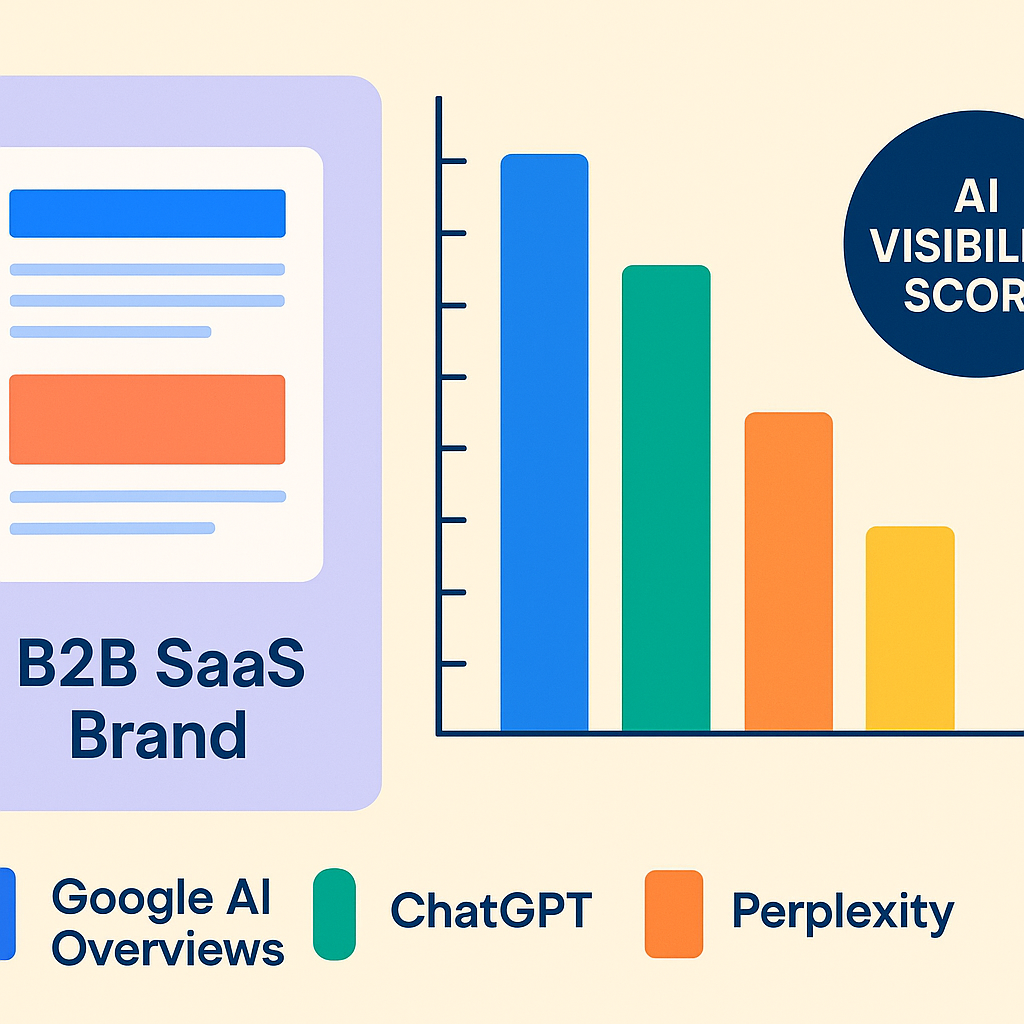
The content volume required to build genuine topical authority — and by extension, to maximize AI Overview citation surface — is structurally incompatible with manual content workflows for most growth-stage SaaS teams. Earning consistent AI Overview citations across a broad keyword cluster requires not one optimized article but dozens of interlinked, structurally consistent pieces that collectively signal domain authority to Google's generative system. Manual teams hitting four to eight articles per month simply can't build that surface at the pace required to compound. This is where autonomous content systems represent a structural advantage, not just an efficiency gain. Platforms like Gofylo run agents that handle the full content lifecycle — keyword research, article writing, CMS publishing, internal linking, and schema markup — producing 30 fully optimized, E-E-A-T-compliant articles per month in under 4 minutes per article. Across active accounts, Gofylo reports an average AI Visibility Score of 94, with the platform having generated over 48,000 articles. The compounding mechanism is the key point: each article adds to the topical authority surface, which lifts the citation probability of every article already in the cluster. Manual workflows don't compound at this rate because the publication cadence is too slow to build the density that AI Overview selection requires.
Volume creates coverage. A single optimized article on a topic won't build topical authority. Thirty interlinked articles covering a topic cluster from multiple angles create the coverage density that signals to Google's generative layer that your domain is the authoritative source on that subject.
Structure creates extractability. The same structural signals that help Google's AI Overview system extract your content — answer-first paragraphs, FAQ schema, clear heading hierarchies — also help ChatGPT, Perplexity, and Gemini cite your content. One content architecture serves all generative surfaces simultaneously.
Tracking closes the loop. Publishing optimized content without tracking AI citation presence is flying blind. Knowing which articles are being cited in Google AI Overviews — and which are being cited by ChatGPT or Perplexity but not Google — tells you exactly where to invest optimization effort. This is the function that GEO-specific tracking tools serve, separate from traditional rank tracking.
Compounding beats campaigns. A content base of 200+ topically coherent, well-structured articles accumulates citation surface that paid search or social campaigns can't replicate. Every new article published to a coherent cluster lifts the AI Overview citation probability of the articles already in it — a compounding dynamic that makes early investment disproportionately valuable.
According to Gartner's 2025 Digital Marketing Report, over 60% of enterprise marketing teams identified AI-generated search features as the top factor reshaping organic traffic strategy — yet fewer than 20% had adapted their content architecture to target AI Overview inclusion specifically.
Frequently Asked Questions
Does ranking on page one guarantee inclusion in an AI Overview?
No. Ranking in the top 10 results for a query is a necessary condition for being considered for AI Overview inclusion, but it doesn't guarantee citation. Google's generative system selects from ranked pages based on content structure, claim specificity, and E-E-A-T signals. A page ranked fifth with strong structural optimization can be cited while a page ranked first with poor claim structure is omitted.
Do AI Overviews hurt organic click-through rates?
For pages that are not cited in the Overview, yes — AI Overviews reduce the visibility and click-share of lower organic results on queries where they appear. However, pages cited within an AI Overview often earn higher-intent clicks than they would from a traditional ranking position, because the Overview pre-qualifies the user before they click. The net effect on business outcomes depends heavily on whether your content earns citations or is displaced.
How do I know if my content is being cited in AI Overviews?
Google Search Console provides some visibility into AI Overview impressions and clicks as of 2026, but its coverage is incomplete. Dedicated AI visibility tracking tools — including Gofylo's AI Visibility Tracker, which monitors citation presence across Google, ChatGPT, Claude, Perplexity, and Gemini — provide a more complete picture. Tracking citation presence across all generative surfaces, not just Google, gives you the full picture of your AI search share of voice.
Is AI Overviews SEO different from GEO?
AI Overviews SEO is a subset of GEO (Generative Engine Optimization). GEO covers how content earns citations across all AI-driven answer surfaces — ChatGPT, Claude, Perplexity, Gemini, and Google AI Overviews. The structural content signals that optimize for Google's AI Overview largely transfer to other generative engines, but each platform has nuances in how it weights authority and freshness signals. For a detailed breakdown, the AEO vs GEO and GEO vs SEO frameworks cover these distinctions in depth.
Does schema markup directly cause AI Overview inclusion?
Schema markup doesn't directly cause inclusion, but it significantly improves the probability that Google's generative system can extract and attribute your content correctly. FAQPage, Article, and HowTo schema types are particularly relevant because they provide machine-readable structure around the exact content formats that AI Overview generation draws from. Think of schema as reducing friction in the extraction process rather than triggering inclusion on its own.
Can small SaaS companies compete for AI Overview citations?
Yes — and in many cases, focused topical authority on a narrow cluster gives smaller domains a structural advantage over larger sites that cover topics shallowly. A SaaS company that publishes 30 deeply structured, interlinked articles on a specific vertical topic can outperform a large general publication on AI Overview citations within that cluster. The key is publishing volume with structural consistency, not domain size. Autonomous content platforms make this achievable for teams without dedicated content staff.
If you're building organic growth without a full content team, Gofylo's autonomous content engine publishes 30 E-E-A-T-optimized articles per month — with schema markup, FAQ blocks, internal linking, and AI citation tracking built in. Start a 3-day free trial at gofylo.com, no credit card required. Or run your brand through the free AI Search Grader to see where you stand across Google, ChatGPT, Perplexity, and Gemini right now.