As of 2026, organic search is no longer a single channel. It's a fork in the road: one path leads to Google's traditional blue-link results, and the other leads to cited responses inside ChatGPT, Claude, Perplexity, and Gemini. Two disciplines have emerged to address this split — Answer Engine Optimization (AEO) and Generative Engine Optimization (GEO) — and most marketing teams are still conflating them, building strategies that miss the nuances of both.
The confusion is understandable. Both AEO and GEO deal with AI-driven search surfaces. Both care about structured content, authoritative sourcing, and clear answer patterns. But they optimize for fundamentally different outputs, use different signals, and reward different content structures. Getting this wrong means your content either ranks on Google and gets ignored by AI engines, or gets cited by AI engines without ever building the durable authority that compounds over time. In 2026 data from our own customer base at Gofylo — averaging an AI Visibility Score of 94 — the teams that grow fastest treat AEO and GEO as complementary but distinct motions.
Thesis: AEO and GEO are not the same strategy with different names. AEO targets the structured answer boxes and voice search responses that AI-assisted search still routes through Google's index. GEO targets the generative layer — the actual synthesized responses produced by LLMs. Knowing which signals govern each, and when to prioritize which, is the operational question this article answers.
Defining AEO and GEO on Their Own Terms
AEO — Answer Engine Optimization — is the discipline of structuring content so that search engines can extract and surface a direct answer to a user's query. Historically, this meant winning Google's Featured Snippets, People Also Ask boxes, and voice search responses. In 2026, it also extends to how AI-assisted search layers (like Google's AI Overviews) pull excerpts from indexed pages to compose answers. The content still needs to live in Google's index; the optimization work is about making it extractable, structured, and authoritative enough for the answer layer to select it over a competitor's page. GEO — Generative Engine Optimization — is a newer discipline targeting the synthesized responses that large language models produce independently of the traditional index. When someone asks Perplexity a product question or asks Claude to compare two SaaS tools, the response is generated from the LLM's training data and real-time retrieval — not from ranked page positions. GEO is the practice of getting your brand, product, and claims embedded into those outputs as cited sources.
What AEO Actually Optimizes For
AEO's primary target is the zero-click answer: the response Google (or a voice assistant) provides without requiring a click to a source page. Winning this position requires FAQ schema, structured data, concise answer paragraphs directly below H2 headings, and factual density that signals authoritativeness. According to Google's Search Central documentation, Featured Snippets pull from pages already ranking in the top 10 — meaning AEO is not a shortcut around traditional SEO; it's an additional optimization layer on top of it. The format signals that AEO rewards include: clear question-answer pairings, schema markup (FAQPage, HowTo, Article), short definitional paragraphs of 40–60 words, and structured lists for multi-step processes.
What GEO Actually Optimizes For
GEO targets citation likelihood inside LLM-generated responses. ChatGPT with browsing, Perplexity, and Gemini all pull from live web content — but what they cite is not simply the highest-ranked page. Research published by Search Engine Land in 2025 found that LLMs favor content that demonstrates expertise through specific named sources, contains original data or proprietary insights, uses precise language rather than hedged marketing copy, and structures information in a way that maps cleanly to how a generative model summarizes. GEO is less about keyword placement and more about epistemic credibility: does your content read like a source a research-grade system would trust?
The Five Axes That Separate AEO from GEO
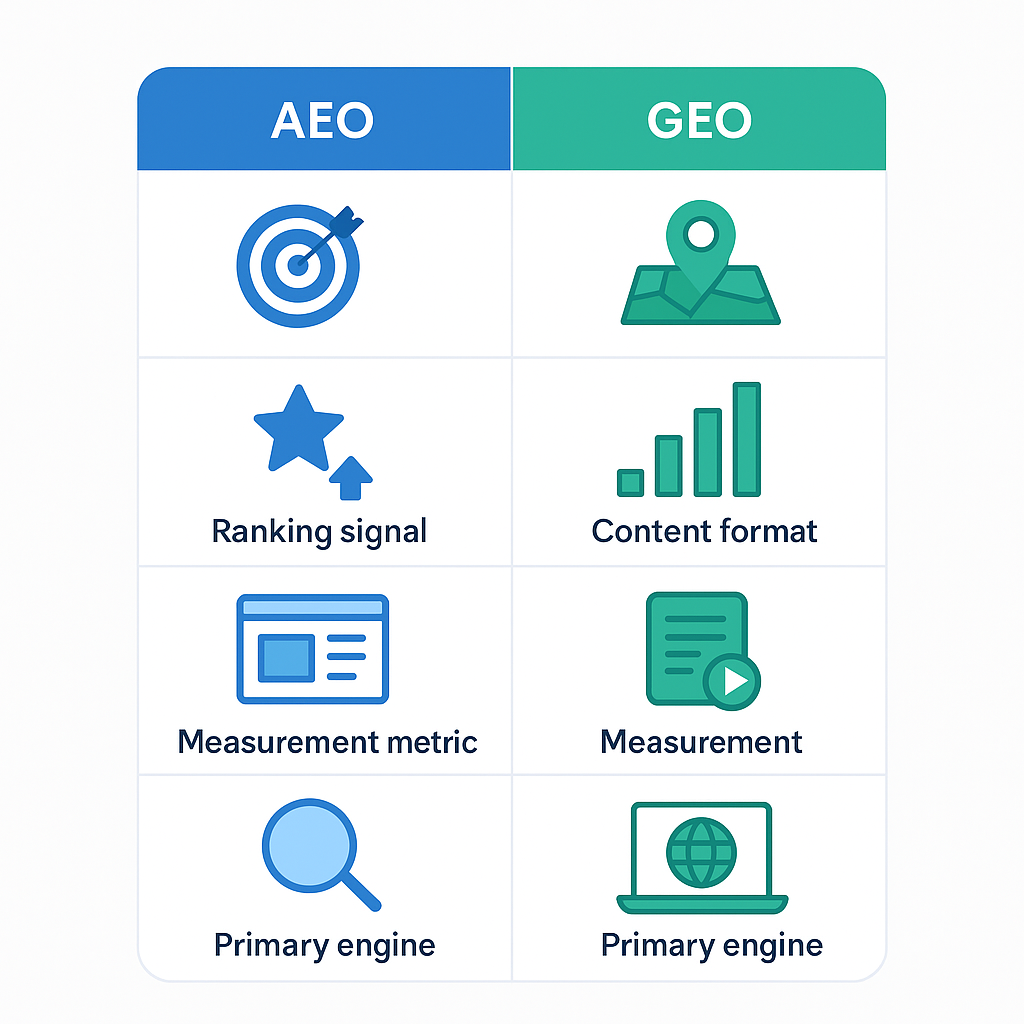
The clearest way to resolve the AEO vs GEO debate is to evaluate both strategies across the same operational dimensions. Most practitioners conflate them because both deal with 'AI-related search,' but the signals, surfaces, and success metrics are genuinely distinct. Below are the five axes that matter most for B2B SaaS marketing teams making resourcing decisions.
Target surface. AEO targets Google's structured answer features — Featured Snippets, AI Overviews, People Also Ask, and voice responses — all of which are served from Google's traditional index. GEO targets the generative response layer of standalone LLMs (ChatGPT, Claude, Perplexity, Gemini) where citations are selected by retrieval-augmented generation, not page rank.
Ranking signal. AEO success is gated behind traditional SEO authority — domain rating, backlinks, on-page signals — because you must first rank in the top 10 to qualify for an answer box. GEO success is gated behind citation-worthiness: factual specificity, named sources, proprietary data, and content that LLMs classify as high-epistemic-value. A domain with low DR can win GEO citations if the content is structured and sourced correctly.
Content format. AEO rewards structured, schema-marked, concise content: 40–60-word answer paragraphs, FAQ blocks with FAQPage schema, HowTo markup. GEO rewards depth, specificity, and original insight — long-form content with named statistics, clear authorship signals (E-E-A-T), and information that doesn't already exist verbatim in the LLM's training data. A short FAQ page wins AEO; a deeply sourced, opinionated analysis wins GEO.
Measurement metric. AEO is measured by Featured Snippet ownership, PAA appearances, and zero-click impression share — all available inside Google Search Console and tools like Ahrefs or Semrush. GEO requires a different instrumentation layer: brand citation frequency across LLM responses, AI Visibility Score, and share-of-voice inside model outputs. Most standard SEO tooling has no native GEO measurement — this gap is exactly why AI visibility tracking exists as a standalone capability.
Compounding behavior. AEO compounds through traditional SEO mechanics: more indexed content, more backlinks, higher authority — which expands the pool of pages eligible for answer box selection. GEO compounds differently: as LLMs are updated or re-trained, content that has been consistently cited as authoritative tends to retain and grow its citation share. Publishing velocity and topic coverage breadth both accelerate GEO compounding.
How Each Strategy Performs Across Google vs. AI Engines
The channel split matters enormously for B2B SaaS buyers in 2026. According to a Gartner 2025 report, Gartner projected that search engine volume would drop 25% by 2026 as AI assistants absorb navigational and informational queries. That shift is not uniform — it hits informational and comparison queries hardest, which are exactly the queries B2B SaaS buyers use during vendor evaluation. A founder asking 'best project management SaaS for engineering teams' is increasingly asking Perplexity, not Google. That means a pure AEO strategy — one that only optimizes for Google's answer boxes — misses the queries happening in the channel that's growing fastest.
Meanwhile, GEO without AEO leaves traffic on the table. Google still processes billions of queries daily, and many B2B SaaS buyers start research on Google before moving into AI assistants for synthesis. According to Semrush's 2025 State of Search report, 68% of B2B buying journeys still include at least one Google search in the early research phase. Abandoning AEO to chase GEO means losing top-of-funnel visibility in a channel that still drives significant pipeline. The most defensible position is both — and the operational question is how to sequence and resource them.
Content Signals: What Each Engine Rewards
Understanding which content signals drive performance on each engine is where strategy translates into production decisions. The signals are different enough that content optimized purely for one engine can actively underperform on the other — a risk most content teams are not accounting for.
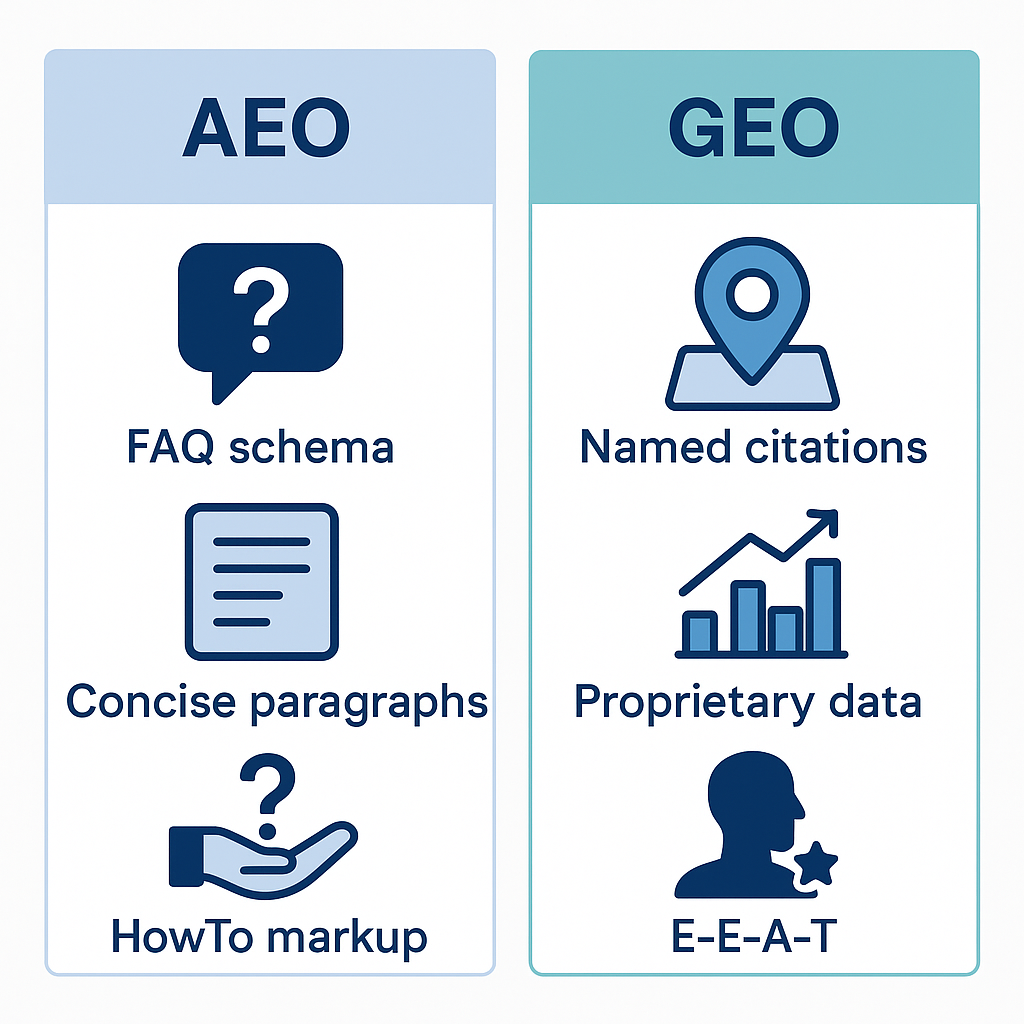
- AEO signal: FAQPage schema markup — Google's structured data guidelines explicitly list FAQPage as a snippet-eligible type, and its presence correlates with answer box selection.
- AEO signal: Concise definitional paragraphs — 40–70 words placed immediately after an H2 heading, written as a direct answer to the heading's implied question.
- AEO signal: HowTo and Article schema — both expand eligibility for rich result formats in Google's SERPs.
- GEO signal: Named statistical citations — LLMs preferentially cite content that references specific sources (Gartner, Forrester, named studies) over unsourced claims.
- GEO signal: Original proprietary data — content containing first-party research, customer benchmarks, or product-specific metrics is classified as uniquely citable.
- GEO signal: Clear authorship and E-E-A-T signals — author bylines with credentials, About pages, and consistent brand entity information across the web all strengthen generative citation likelihood.
- Shared signal: Internal linking and topical authority — both AEO and GEO reward sites that demonstrate comprehensive coverage of a topic cluster, not isolated pages.
According to Ahrefs' 2025 research on AI Overviews, pages cited in Google's AI Overviews had an average of 2.7x more referring domains than pages ranking in the top 3 but not cited in AI Overviews. This suggests AEO increasingly requires the same domain authority foundation as traditional competitive SEO — it is not a workaround for low-authority domains.
AEO vs GEO: Tooling and Measurement
Measurement is where the AEO vs GEO distinction becomes most operationally important. AEO has a mature tooling ecosystem: Google Search Console tracks impression share and click data for rich results; Ahrefs and Semrush both surface Featured Snippet ownership, PAA tracking, and schema validation. These tools have been built, iterated, and refined over years. GEO measurement is significantly earlier in its maturity curve. There is no Google Search Console equivalent for LLM citation tracking — you cannot simply pull a report showing how often Claude cited your domain this month.
This gap is why dedicated AI visibility tracking emerged as a category. Gofylo's AI Visibility Tracker monitors brand citations and ranking presence across ChatGPT, Claude, Perplexity, and Gemini — surfacing an AI Visibility Score that gives teams a single benchmark for generative share of voice. Across active Gofylo accounts, the average AI Visibility Score is 94, which reflects the compounding effect of publishing high-frequency, well-structured, source-cited content over time. Tools like this, alongside the free AI Search Grader for quick baseline assessment, fill the measurement gap that traditional SEO tooling leaves entirely unaddressed for GEO.
- AEO tools: Google Search Console (Featured Snippet impressions), Ahrefs (snippet ownership tracking), Semrush (PAA and rich result monitoring), Schema Markup Validator.
- GEO tools: Gofylo AI Visibility Tracker (cross-LLM citation monitoring, AI Visibility Score), Gofylo AI Search Grader (free baseline scoring), BrandMentions (social + web citation tracking).
- Shared tools: Ahrefs (topical authority and internal linking analysis), Semrush (content gap analysis across competitors), Google Search Console (crawl health, indexation).
Which Strategy Wins for B2B SaaS — and When
The honest answer to the AEO vs GEO question for B2B SaaS is that neither strategy wins outright — the right allocation depends on where your buyers are in the funnel and how your site's current authority compares to competitors. That said, there are clear scenarios where one deserves priority resourcing over the other, and most teams should be running a version of both in parallel rather than treating them as mutually exclusive.
According to Search Engine Land's 2025 analysis of AI-driven search behavior, informational and comparison queries — the exact query types B2B SaaS buyers use during vendor evaluation — are migrating to AI assistants at a materially faster rate than transactional queries. This means AEO alone will not protect top-of-funnel visibility as the channel mix shifts. As one Search Engine Land contributor noted: "The brands that will dominate search in the next three years are not the ones that rank highest on Google — they're the ones that get cited by the AI layer that now sits above Google." That framing captures the urgency of building GEO capability alongside, not after, AEO.
Prioritize AEO when: Your domain already has meaningful authority (DR 40+), you're targeting high-volume informational queries where Google still owns the traffic, your audience skews toward users who start research on Google before engaging AI tools, and your content team can consistently produce structured, schema-marked content. AEO compounds on existing SEO investment — it's an optimization layer, not a standalone motion.
Prioritize GEO when: Your buyers are in a category where AI assistants are the primary research tool (developer tools, technical SaaS, AI infrastructure), your domain is newer or lower authority and AEO access is blocked by competitive gaps, you have proprietary data or customer benchmarks that are uniquely citable, and you want to build durable brand presence in AI-generated responses before competitors do. GEO is a first-mover advantage play — the brands cited most in 2026 LLM responses will be harder to displace as models are updated.
Run both when: You're a growth-stage B2B SaaS company with an established domain, a content team (or platform) that can produce at volume, and buyers who use both Google and AI assistants across the research journey. This is the realistic profile of most companies reading this article — and the operational question becomes how to produce enough structured, cited, schema-marked content to feed both engines simultaneously without doubling headcount.
Verdict: AEO wins for capturing structured answer boxes on Google and voice search surfaces. GEO wins for building cited presence inside ChatGPT, Claude, Perplexity, and Gemini. For B2B SaaS companies in 2026, the strongest position is a unified content motion that produces content structured for AEO extraction AND sourced for GEO citation — not two separate content tracks.
How Autonomous Content Systems Handle Both
The practical challenge for most B2B SaaS teams is that building for both AEO and GEO simultaneously requires consistent publishing volume, rigorous structure, schema implementation, internal linking, and citation-quality sourcing — all at once. A two-person content team managing this manually is going to make tradeoffs that hurt one engine or the other. This is where autonomous content platforms create structural separation from manual workflows.
Gofylo's Content Engine publishes 30 fully optimized articles per month — each generated in under 4 minutes — with FAQ blocks, schema markup, AI-generated images, auto-embedded YouTube videos, and internal linking built in by default. Every article is structured to satisfy both AEO signals (concise answer-first paragraphs, FAQPage schema, structured headings) and GEO signals (named citations, factual specificity, topic-cluster depth). Across 48,000+ articles generated on the platform, the compound effect of this dual-signal structure is what drives the 94 average AI Visibility Score across active accounts. Competitors managing content manually are making per-article decisions about whether to optimize for Google's answer box or an LLM's citation layer — Gofylo's agents do both by default, at scale, without requiring a human to make that call article by article.
Frequently Asked Questions
What is the core difference between AEO and GEO?
AEO (Answer Engine Optimization) targets Google's structured answer features — Featured Snippets, AI Overviews, People Also Ask — which are served from Google's indexed content. GEO (Generative Engine Optimization) targets the synthesized responses produced by standalone LLMs like ChatGPT, Claude, Perplexity, and Gemini, where citation selection is governed by retrieval-augmented generation rather than page rank. Both matter in 2026, but they reward different content signals and require different measurement tooling.
Can you do AEO and GEO at the same time?
Yes — and for most B2B SaaS companies, running both simultaneously is the right strategy. The content signals overlap meaningfully: structured headings, FAQ blocks, named citations, and topical depth all serve both AEO and GEO goals. The key is publishing at enough volume and with enough structural discipline that individual articles satisfy both engines without requiring separate production tracks.
Which strategy drives more pipeline for B2B SaaS?
It depends on where your buyers research. If your ICP uses AI assistants for vendor evaluation (increasingly common in technical and developer-facing categories), GEO has a higher pipeline-per-citation value because it positions your brand in the exact moment of decision. If your buyers still start on Google, AEO provides broader top-of-funnel coverage. Most growth-stage B2B SaaS companies benefit from both, prioritized by where their specific buyer persona concentrates research activity.
Does GEO require a different content format than SEO?
GEO rewards depth, specificity, and named sourcing more than traditional SEO keyword optimization does. LLMs favor content that contains original data, cites real sources, and takes clear positions — rather than hedged, keyword-dense copy written primarily for SERP crawlers. The format shift is from 'keyword-optimized article' to 'citable reference document' — though both can coexist in the same piece when structured correctly.
How do I measure GEO performance?
Traditional SEO tooling (Google Search Console, Ahrefs, Semrush) does not measure GEO performance. You need an AI visibility tracking tool that actively monitors how frequently and accurately your brand is cited across ChatGPT, Claude, Perplexity, and Gemini responses. Gofylo's AI Visibility Tracker provides this as a native capability, including an AI Visibility Score that benchmarks your generative share of voice over time. The free AI Search Grader is a good starting point for an immediate baseline.
Does schema markup help with GEO?
Schema markup is primarily an AEO and traditional SEO signal — it helps Google extract and display structured answers. For GEO, schema provides indirect benefit by improving how your content is indexed and retrieved by systems that pull live web content (like Perplexity's retrieval layer). FAQPage and Article schema are worth implementing for AEO gains; the GEO benefit is real but secondary. Proprietary data and named citations are the stronger GEO signals.
If you're building for both AEO and GEO without a dedicated content team, Gofylo's autonomous platform handles the full lifecycle — research, writing, schema, internal linking, publishing, and AI citation tracking — at 30 articles per month for $79/month. Start a 3-day free trial (no credit card required) or run your site through the free AI Search Grader to see where your AI visibility stands right now.