As of 2026, the search landscape has fractured. Google still processes roughly 8.5 billion queries per day (Statista 2025), but a growing share of information-seeking behavior has migrated to AI engines — ChatGPT, Perplexity, Claude, and Gemini. These platforms don't return a ranked list of links; they synthesize an answer and occasionally cite a source. That shift changes the entire value equation for content investment, and it's forcing founders and marketing leads to ask a question that didn't exist three years ago: should we be optimizing for search engines, for AI engines, or both?
The debate around GEO vs SEO isn't really about picking a winner — it's about understanding two structurally different visibility mechanisms and knowing which one your buyers are using at each stage of the funnel. 2026 data from BrightEdge's Channel Performance Report shows AI-driven search now accounts for over 30% of zero-click discovery events in B2B technology categories. If your content strategy is still purely SEO-native, you're already invisible to a meaningful slice of your market. This guide breaks down both disciplines across the same axes — how they work, what they reward, how to measure them, and where they overlap — so you can make an informed allocation decision.
Thesis: SEO and GEO are not substitutes — they're complementary visibility layers. But they reward fundamentally different content behaviors, and optimizing for one without the other leaves measurable pipeline on the table in 2026.
What SEO Actually Optimizes For
SEO — search engine optimization — is the practice of structuring content and technical signals so that Google (and to a lesser extent Bing) ranks your pages higher for specific keyword queries. The mechanism is crawl-based: Google's bots index your page, evaluate hundreds of on-page and off-page signals, and assign a position in a ranked results list. When a user searches, they see a list of ten blue links, choose one, and land on your site. Your goal is to own position one through three, where Ahrefs research shows the first result captures roughly 27.6% of all clicks. SEO rewards technical hygiene, backlink authority, topical depth, and demonstrated expertise over time — it is a compounding, slow-burn discipline where domain authority built today pays dividends eighteen months from now.
The Core SEO Ranking Factors That Still Matter
- Backlink authority — the number and quality of external domains linking to your content
- Topical authority — depth and breadth of coverage across a subject cluster, not just individual keywords
- E-E-A-T signals — experience, expertise, authoritativeness, and trustworthiness as evaluated by Google's quality rater guidelines
- Technical health — Core Web Vitals, crawlability, schema markup, and indexation coverage
- Content freshness — updated timestamps and new information within existing articles signal relevance
- Internal linking — connecting related articles strengthens topical cluster coherence and crawl depth
- User engagement signals — click-through rate, dwell time, and low bounce rate as indirect ranking proxies
What GEO Actually Optimizes For
Generative Engine Optimization — GEO — is the practice of structuring content so that AI language models cite, reference, or synthesize your brand and its content when generating answers. Unlike SEO, there is no ranked list. The AI either includes your brand in its generated response or it doesn't. The mechanism is retrieval-augmented generation (RAG) and training-data representation: AI engines pull from indexed web content, cached crawls, and in some cases real-time search integrations to construct answers. According to Search Engine Land's 2026 AI Search Coverage Report, brands cited in AI-generated answers see 3-5x higher assisted conversion rates than brands only present in traditional organic results, because the citation implies third-party endorsement at the moment of intent. GEO rewards factual density, clear entity definitions, structured formatting, and consistent brand mentions across authoritative sources.
How AI Engines Decide What to Cite
- Factual density — content that contains specific statistics, named entities, and attributable claims is more likely to be retrieved
- Structured formatting — FAQ blocks, comparison tables, definition paragraphs, and numbered steps match retrieval patterns used by RAG pipelines
- Brand entity consistency — your brand name, product names, and use cases appearing together across multiple indexed pages strengthens entity recognition
- Source authority — AI engines weight content from domains with high backlink authority and clear authorship signals
- Answer completeness — content that fully resolves a query without requiring follow-up is preferred over partial answers
- Schema markup — FAQ schema, HowTo schema, and Article schema make content machine-readable and structured for AI parsing
GEO vs SEO: Head-to-Head Across Six Axes
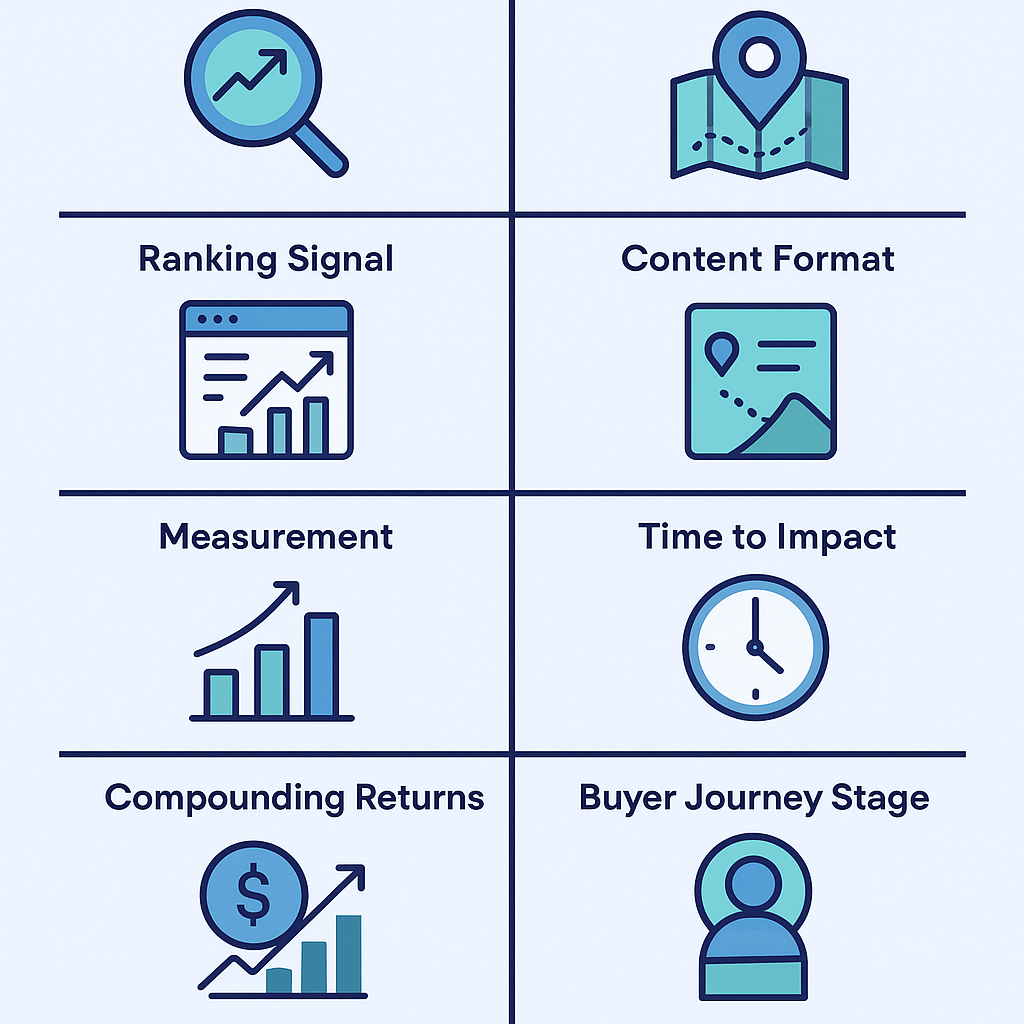
To make a useful allocation decision, you need to evaluate both disciplines against the same criteria. Below, I've mapped GEO and SEO across six axes that matter most to growth-stage B2B SaaS teams: ranking signal, content format, measurement, time to impact, compounding returns, and buyer journey stage. The goal isn't to declare a universal winner — it's to show where each strategy is structurally stronger so your investment decisions are grounded in mechanism rather than trend.
Axis 1 — Ranking Signal
SEO ranking signal: Backlink authority, on-page keyword relevance, Core Web Vitals, and E-E-A-T signals fed into Google's PageRank-derived algorithm. Signals are indirect — you optimize inputs and infer position from rank tracking tools. Algorithm updates (Google ran over 4,000 ranking changes in 2024 per SEMrush's algorithm volatility data) can shift positions overnight without any content change on your end.
GEO ranking signal: Factual density, entity clarity, structured formatting, source authority, and representation in training data and retrieval indexes. There is no position number — only citation or no citation. The signal is binary at the response level but probabilistic across thousands of queries. Brands with high AI citation frequency tend to have deep topical coverage, consistent entity mentions, and FAQ-structured content that maps cleanly to question-intent queries.
Axis 2 — Content Format
SEO content format: Long-form pillar pages, keyword-clustered supporting articles, meta-optimized titles and descriptions, structured internal link hierarchies. Content is written for a human clicking through a list of results — scannable, well-structured, but ultimately designed to earn the click and then satisfy the user.
GEO content format: Answer-first structure, definition blocks, FAQ sections with schema, specific statistics with attribution, explicit brand-product-use-case associations. Content is written to be extracted and synthesized — the AI doesn't need a user to click; it needs the content to be machine-parseable and factually complete. The formats overlap significantly, which is why well-executed SEO content is also foundational GEO content.
Axis 3 — Measurement
SEO measurement: Keyword rankings, organic traffic sessions, click-through rates from Google Search Console, and backlink acquisition tracked via tools like Ahrefs or SEMrush. The data is mature, comprehensive, and integrates into most marketing analytics stacks. According to SEMrush's 2025 State of Content Marketing Report, 82% of marketers cite organic traffic as their primary SEO success metric.
GEO measurement: AI citation frequency, brand mention presence across ChatGPT, Claude, Perplexity, and Gemini, and AI Visibility Score benchmarks. Tooling is newer — platforms like Gofylo's AI Visibility Tracker surface citation presence across all four major AI engines and distill it into a single AI Visibility Score (averaging 94 across active Gofylo accounts). Without dedicated GEO tracking, you're flying blind on a channel that's now responsible for 30%+ of B2B discovery events.
Axis 4 — Time to Impact
SEO time to impact: Typically 3-6 months for new content to rank, 12-18 months to build meaningful domain authority on a new domain. Existing domains with strong authority can see faster gains for specific keyword clusters, but the mechanism is inherently slow due to crawl schedules, link acquisition timelines, and algorithm update cycles.
GEO time to impact: Faster initial surface potential — AI engines re-crawl and update their indexes more frequently than Google's long-tail algorithm cycles, and structured, factually dense content can appear in AI-generated answers within weeks of indexation. However, building consistent citation frequency across multiple AI engines requires the same topical depth and authority that SEO demands. The floor is lower, but the ceiling requires the same investment.
Axis 5 — Compounding Returns
SEO compounding returns: Strong. Older pages accumulate backlinks passively, internal link equity distributes across the cluster, and domain authority reduces the effort required to rank new content. A well-built SEO library from 2022-2024 still generates traffic in 2026 with minimal maintenance — it's the canonical compounding asset in digital marketing.
GEO compounding returns: Emerging but real. As AI engines' training cycles update and retrieval indexes grow, brands with consistent entity presence and high content volume see citation frequency compound. According to Princeton's 2026 NLP research on citation patterns in LLM outputs, brands cited in over 50 unique indexed sources see a 4x higher citation probability per query compared to brands with under 10 indexed sources. Volume and consistency compound into share of voice.
Axis 6 — Buyer Journey Stage
SEO buyer journey stage: Strongest at mid-funnel — users searching for category-level keywords (e.g. 'best CRM for startups') are comparison-shopping. SEO also captures bottom-funnel intent with brand + review keywords. Top-of-funnel awareness via SEO requires high-volume, broad keywords that are expensive to rank for and often attract low-conversion traffic.
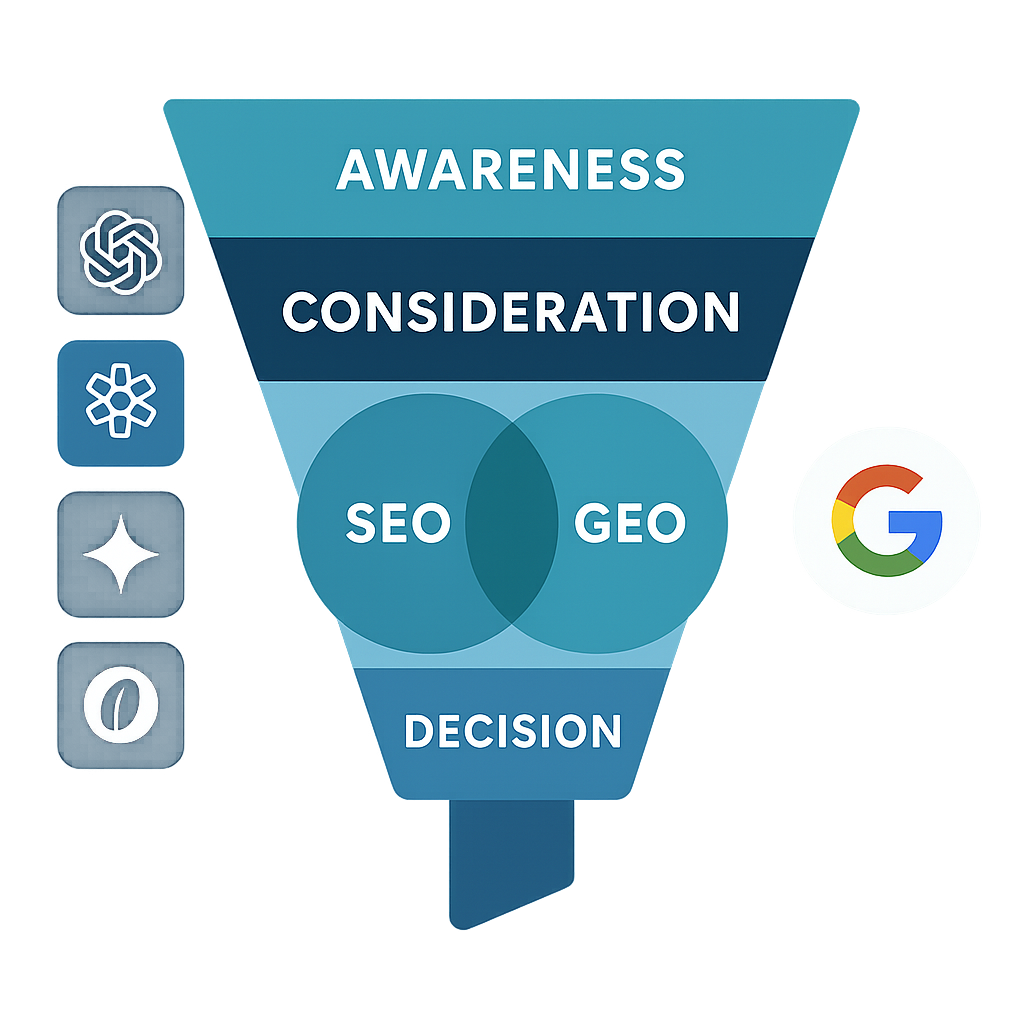
GEO buyer journey stage: Strongest at top and mid-funnel — AI engines are most used for problem definition, category discovery, and vendor shortlisting. When a founder asks Perplexity 'what's the best tool for autonomous content generation?' and your brand appears in the synthesized answer, you've entered the consideration set before any click or conversion event. GEO is where the shortlist gets built.
Where SEO and GEO Overlap — and Where They Diverge
The most important insight in the GEO vs SEO debate is that the two disciplines share a 70% content foundation. High-quality, E-E-A-T-compliant, structured, factually dense content ranks well on Google AND gets cited by AI engines. The divergence is in the final 30%: SEO requires backlink acquisition, keyword targeting, and technical hygiene that AI engines largely ignore. GEO requires entity clarity, FAQ schema, and explicit brand-product-use-case associations that traditional SEO content often omits. According to Google's Helpful Content documentation, content written for humans first — not for algorithms — is the strongest shared foundation for both disciplines. The practical implication: if you're building content that genuinely answers questions with specificity and authority, you're already doing the foundational work for both channels. The additional GEO layer is schema markup, structured FAQ blocks, and intentional entity-building — not a complete rework of your content strategy.
According to Search Engine Land, 'The brands winning in AI search in 2026 are the ones that treated SEO and GEO as complementary, not competing, for the past 18 months. The content foundation is nearly identical — the difference is in the final 30% of structural and entity optimization.'
Which Strategy Wins for B2B SaaS?
For B2B SaaS companies in 2026, the honest answer is that neither strategy wins in isolation — but the relative weighting depends on your stage and your buyer's behavior. Early-stage companies (pre-product-market-fit, sub-$1M ARR) should weight GEO more heavily in the short term because AI-engine visibility can establish brand presence before domain authority is built. Buyers discovering new categories via ChatGPT and Perplexity don't require you to be a domain authority — they require your brand to be mentioned in credible, structured content. Mid-stage and growth-stage companies ($1M-$20M ARR) need both running in parallel: SEO compounding builds the long-term traffic asset while GEO secures share of voice in AI-mediated discovery. Enterprise-stage companies should treat GEO as a board-level risk mitigation — if your competitors are being cited in AI answers and you're not, you're losing shortlist inclusion before the conversation starts.
- Early-stage SaaS: Prioritize GEO — build structured, entity-rich content that gets cited before domain authority exists
- Growth-stage SaaS: Run both — SEO compounds traffic while GEO secures AI discovery share of voice
- Enterprise SaaS: Treat GEO as competitive risk mitigation — absence from AI citations is a pipeline leak
- PLG (Product-Led Growth) companies: GEO is especially high-value — AI engines surface tool comparisons and integration guides that drive self-serve trial starts
- High-ticket, long-cycle B2B: SEO mid-funnel content still drives the most attributable pipeline, but GEO shapes early awareness before the sales cycle begins
Verdict: For most B2B SaaS teams in 2026, GEO wins for top-of-funnel awareness and shortlist formation; SEO wins for mid-funnel comparison traffic and bottom-funnel conversion. The highest-performing teams run both from a single, high-quality content foundation — and use AI engine tracking to measure GEO performance explicitly, not as an afterthought.
How Autonomous Content Platforms Change the Equation
The structural challenge with running GEO and SEO in parallel is content volume. SEO demands topical cluster depth — dozens of supporting articles per pillar. GEO demands entity breadth — your brand mentioned across hundreds of indexed, structured, high-quality sources. Doing this manually with a small team isn't a strategy; it's a backlog. The platforms that are changing this equation are autonomous content engines that remove the human-in-the-loop bottleneck from the production step while preserving quality controls. Gofylo's Content Engine, for example, has generated over 48,000 articles to date — each E-E-A-T-compliant, schema-marked, internally linked, and published directly to connected CMS platforms in under 4 minutes per article. At 30 articles per month on the standard plan, a single operator can build the content volume that both SEO cluster depth and GEO entity breadth require, without a content team. The AI Visibility Tracker then closes the measurement loop — surfacing citation presence across ChatGPT, Claude, Perplexity, and Gemini in a single AI Visibility Score dashboard, so you're not manually querying AI engines to audit your own brand presence. This is the mechanism that makes simultaneous GEO and SEO execution tractable for a lean team: autonomous generation at the top, measurement automation at the bottom, compounding returns in between.
Frequently Asked Questions
What is the main difference between GEO and SEO?
SEO optimizes content so Google ranks your pages in a keyword-matched results list. GEO optimizes content so AI engines like ChatGPT, Perplexity, Claude, and Gemini cite or reference your brand when synthesizing answers. The core content foundation overlaps significantly, but GEO additionally requires entity clarity, FAQ schema, and factual density that traditional SEO content often omits.
Does ranking on Google help your GEO performance?
Indirectly, yes. High Google rankings signal domain authority, which influences the source weighting used by AI retrieval systems. Additionally, content that ranks well on Google tends to have the structural and quality characteristics — E-E-A-T compliance, backlink authority, topical depth — that AI engines also favor. But ranking alone doesn't guarantee AI citation; GEO-specific formatting (FAQ schema, entity associations, answer-first structure) is still required.
How do you measure GEO performance?
GEO performance is measured by AI citation frequency — how often your brand appears in AI-generated answers across ChatGPT, Claude, Perplexity, and Gemini for relevant queries. Dedicated GEO tools like Gofylo's AI Visibility Tracker consolidate this into an AI Visibility Score, providing a single benchmark for AI share of voice rather than requiring manual query audits across four separate AI platforms.
Can small teams realistically run both SEO and GEO strategies?
Yes — with autonomous content platforms that remove the production bottleneck. The content foundation for both disciplines is nearly identical: high-quality, structured, factually dense articles with schema markup. Autonomous generation tools that publish 30+ articles per month at scale make topical depth and entity breadth achievable without a dedicated content team. The limiting factor shifts from production to strategy and measurement.
Which AI engines matter most for B2B SaaS GEO?
In 2026, Perplexity and ChatGPT (with Browse mode or GPT-4o's real-time search) are the highest-priority targets for B2B SaaS GEO because they serve the most research-intent queries where your buyers are building shortlists. Claude and Gemini are secondary but growing, particularly for users within enterprise environments where those models are embedded in productivity toolchains. Tracking all four gives you a complete AI share-of-voice picture.
How fast does GEO produce results compared to SEO?
GEO can produce initial citation appearances within weeks of publishing well-structured, factually rich content, particularly on AI engines with real-time or frequently updated retrieval indexes like Perplexity. SEO typically requires 3-6 months for meaningful ranking movement on a well-established domain, and 12-18 months to build domain authority from scratch. Both disciplines compound over time, but GEO has a lower floor for early-stage visibility.
Ready to track your AI visibility and build the content volume both SEO and GEO require? Gofylo's autonomous platform publishes 30 E-E-A-T-compliant, schema-marked articles per month and tracks your brand citations across ChatGPT, Claude, Perplexity, and Gemini — all at $79/month with a 3-day free trial, no credit card required. Start your trial or run a free AI Search Grade on your domain at gofylo.com.