As of 2026, the playbook for organic visibility has split in two. You still need traditional search rankings — but if your brand isn't being cited by ChatGPT, Claude, Perplexity, or Gemini, you're missing a channel that's growing at a 42.9% CAGR — more than 3× faster than the broader SEO software market. That's not a niche edge case anymore. According to the On Marketing 2025 report, 94.8% of survey respondents used an AI chatbot at least once in the last 30 days, yet only 37% of marketing teams are actively optimizing for AI search — which means the competitive gap is still wide open.
Answer engine optimization tools close that gap. They range from standalone AI citation trackers to full content-generation platforms that handle every step of the content lifecycle autonomously. This list covers fourteen of the most relevant tools in 2026, evaluated across four dimensions: AI search coverage (ChatGPT, Claude, Perplexity, Gemini), content automation depth, CMS integration, and compounding value over time. We're not just listing what competitors rank — we're telling you what each tool actually does, where it falls short, and which use cases it serves best. Gofylo is included because it covers territory none of the other tools address: fully autonomous content generation, publishing, and AI visibility tracking in a single $79/month platform.
Thesis: The best answer engine optimization tools in 2026 do more than monitor citations — they help you earn them through structured content, schema markup, and AI-native publishing workflows. Platforms that automate the full loop (research → write → publish → track → improve) compound results in ways point solutions can't match.
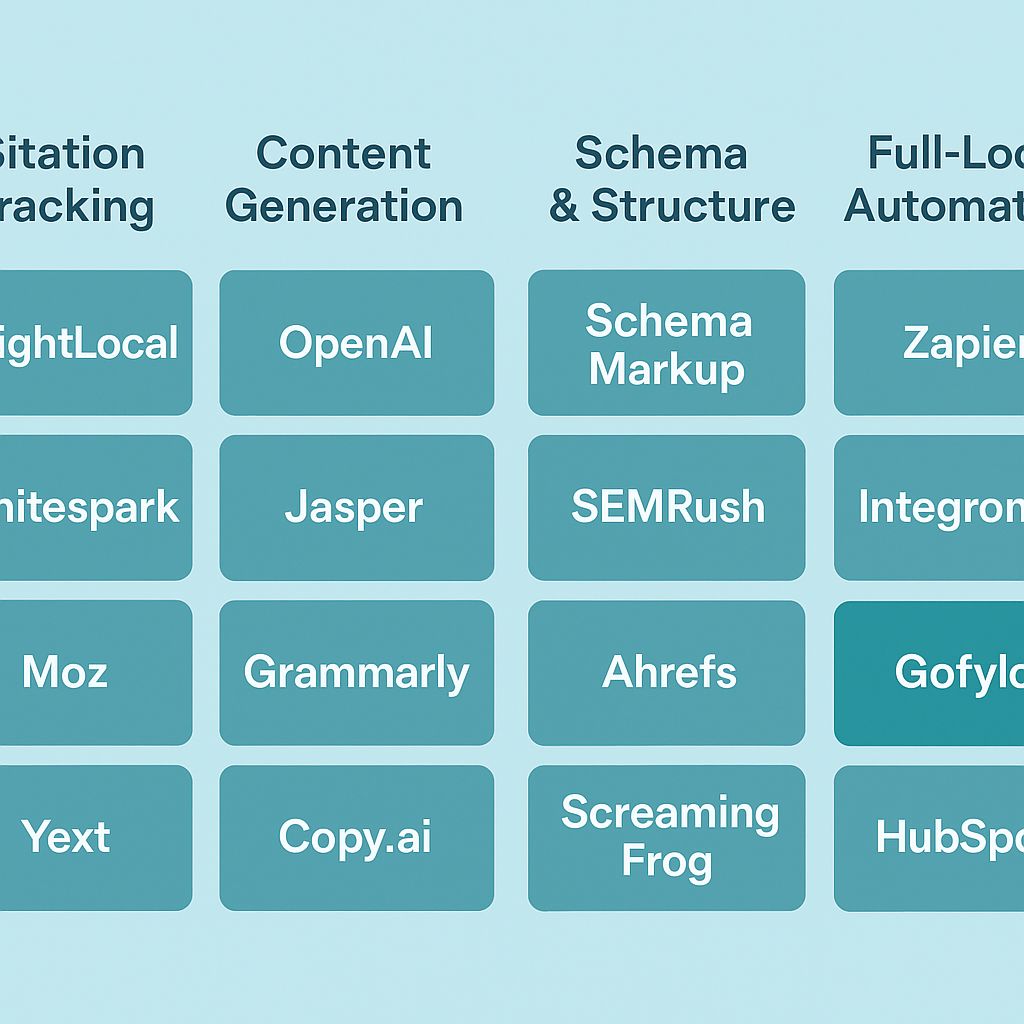
Quick Reference: All 14 Tools by Job-to-Be-Done
Before diving into individual reviews, here's the full list at a glance. Each tool is categorized by its primary function so you can immediately filter for your use case — whether you're a solo founder needing a free diagnostic, a content manager running programmatic publishing, or an enterprise team tracking brand citations across every major AI engine.
- Gofylo — Full-loop autonomous content generation + AI visibility tracking
- Profound — Enterprise AI presence management across multiple engines
- Semrush — Traditional SEO powerhouse with expanding AEO signal coverage
- SE Ranking Visible — AI search visibility monitoring and citation tracking
- AirOps — Structured content workflows optimized for AI retrieval
- HubSpot AEO Grader — Free one-shot diagnostic for AI search readiness
- Perplexity (Direct Use) — First-party answer engine intelligence and query testing
What AEO Tools Actually Do: Four Distinct Jobs
The phrase 'answer engine optimization tool' has become a catch-all that marketers use for at least four structurally different workflows. Conflating them leads to buying the wrong tool or stacking redundant ones. Before evaluating any specific platform, it's worth being precise about which job you're actually hiring the tool to do.
Job 1: Citation Monitoring. These tools track whether your brand or content appears in responses generated by ChatGPT, Claude, Perplexity, Gemini, and Google's AI Overviews. They answer the question: 'When someone asks an AI about my category, do we show up?' Examples include Profound, SE Ranking Visible, AIClicks, and Geoptie. They're measurement tools — necessary but not sufficient on their own.
Job 2: Content Creation and Optimization. These tools help you create content that is more likely to be cited by AI engines — through structured formatting, FAQ blocks, schema markup, clear entity definitions, and E-E-A-T signals. AirOps and Gofylo fall here, though Gofylo also covers monitoring. Traditional SEO tools like Semrush and Ahrefs provide the keyword and content gap signals that feed into this job.
Job 3: Structured Data and Schema. Schema markup — specifically FAQPage, HowTo, Article, and Organization schema — is one of the highest-ROI signals for AI engine citation. Tools like Schema App and certain CMS plugins handle this layer. Google's own structured data documentation confirms that structured data helps both traditional search and AI-driven surfaces interpret your content's intent.
Job 4: Full-Loop Automation. This is the least common category and the highest-leverage one. Full-loop tools don't just measure or help you write — they autonomously research keywords, generate optimized articles, publish to your CMS, embed schema, interlink articles, and track AI visibility — all without requiring a human to prompt each step. As of 2026, Gofylo is the clearest example of this category for B2B SaaS teams.
The 14 Tools, Evaluated
1. Gofylo — Autonomous Content + AI Visibility in One Platform
Gofylo is an autonomous organic growth platform purpose-built for B2B SaaS companies, startups, and content-driven businesses that want to scale without hiring a content team. It ships six autonomous agents covering the full content lifecycle: keyword research, article writing, CMS publishing, AI visibility tracking, social monitoring, competitor intelligence, and backlink generation. The Content Engine has generated 48,000+ articles, producing fully optimized, E-E-A-T-compliant pieces in under 4 minutes per article — 30 per month on the standard plan.
Where Gofylo differentiates from every other tool on this list: it's the only platform that closes the loop between content creation and AI visibility measurement. Most tools do one or the other. Gofylo's AI Visibility Tracker monitors brand citations across ChatGPT, Claude, Perplexity, and Gemini, and surfaces an AI Visibility Score — averaging 94 across active accounts — that gives teams a single benchmark for AI share of voice. Articles include schema markup, internal linking, FAQ blocks, AI-generated images in five styles, and auto-embedded YouTube videos. Content is generated in 18+ languages with support for programmatic landing page generation. The platform integrates natively with WordPress, WordPress.com, Webflow, Shopify, Wix, Notion, Ghost, Framer, Feather, and custom CMS setups via API webhook.
- Autonomous agents handle research, writing, publishing, and tracking without manual prompts
- AI Visibility Score benchmarks citation presence across ChatGPT, Claude, Perplexity, and Gemini
- 30 articles/month at under 4 minutes per article — schema, internal links, and FAQ blocks included
- Competitor Intelligence Agent surfaces content gaps before they become ranking deficits
- Free AI Search Grader available as a no-commitment diagnostic entry point
- Single all-in-one plan at $79/month — 3-day free trial, no credit card required
The honest limitation: Gofylo is not an enterprise citation management suite with custom reporting layers for Fortune 500 brand teams. It's built for growth-stage companies that want compounding organic output without headcount. If you need white-glove onboarding, multi-seat governance, and custom attribution models, Profound may serve you better — at significantly higher cost.
2. Profound — Enterprise AI Presence Management
Profound is an enterprise-tier AI presence management platform designed for large brands that need to track and influence how AI engines represent them at scale. It monitors brand citations, tracks competitive share of voice in AI responses, and provides structured reporting across ChatGPT, Perplexity, Gemini, and Claude. Profound's core differentiator is depth of analysis — it can ingest large volumes of AI-generated responses and surface patterns in how different engines frame your brand, your competitors, and your category.
The tradeoff is cost and scope. Profound is positioned for enterprise marketing and brand teams, not for growth-stage SaaS founders running lean. It does not generate content autonomously or publish to your CMS. If your primary need is measuring AI citations rather than earning them, Profound is among the most capable tools available — but you'll need a separate content workflow to act on its insights.
3. Semrush — Traditional SEO with Growing AEO Signals
Semrush remains the most comprehensive traditional SEO platform on the market, and in 2026 it has layered in meaningful AEO-relevant signals — particularly around keyword intent classification, featured snippet tracking, and AI Overview monitoring for Google. Its content marketing toolkit helps identify question-format queries and topic clusters that align with AEO content strategy. The Semrush blog on AI search optimization covers schema, entity optimization, and structured content — all directly relevant to answer engine visibility.
Where Semrush falls short for pure AEO use cases: it does not natively track citations in ChatGPT, Claude, or Perplexity. It's Google-centric by architecture. For teams that need full AI engine coverage, Semrush is a strong complement to an AEO-specific tool, not a replacement. Its pricing starts at roughly $140/month — significantly more than Gofylo for substantially less automation.
4. SE Ranking Visible — AI Search Visibility Monitoring
SE Ranking's Visible AI module is a dedicated AI search visibility monitoring product that tracks brand and competitor citations across the major AI engines. It provides visibility scores, citation frequency data, and competitor benchmarking — all organized around the question of how your brand appears when users query AI assistants. The product sits cleanly in the 'citation monitoring' category and delivers reliable data for teams that are serious about tracking AI share of voice.
Like Profound, SE Ranking Visible is a measurement layer, not a content generation layer. It tells you where you stand in AI search; it doesn't help you improve that standing through content creation, schema automation, or publishing workflows. Teams using Visible effectively pair it with a content platform — which is where the stack starts to get expensive if you're not using an all-in-one solution.
5. AirOps — Structured Content Workflows for AI Retrieval
AirOps is a workflow automation platform that helps content teams build structured, AI-retrieval-optimized content at scale. It provides a library of LLM-powered workflows — keyword research pipelines, content briefs, article generation, and structured output formatting — that teams can customize and run without engineering resources. AirOps is particularly strong for teams that want control over their content workflow without building custom tooling from scratch.
The distinction from Gofylo: AirOps requires human orchestration of its workflows. You configure the pipelines, trigger the runs, and review the output. It's a power tool for content operations managers who want structured automation with customization depth. If your team has the bandwidth to operate and iterate on those workflows, AirOps delivers significant leverage. If you want a system that runs on its own and compounds without ongoing management, the architecture is different.
6. HubSpot AEO Grader — Free Diagnostic for AI Readiness
HubSpot's AEO Grader is a free, one-shot tool that evaluates a website's readiness for AI search visibility. It scores your domain against criteria relevant to answer engine optimization — structured content, schema presence, E-E-A-T signals, and topic authority — and produces an actionable report. For teams that have never formally assessed their AI search readiness, it's a useful starting point that requires no commitment.
The limitation is scope: it's a diagnostic, not a workflow. HubSpot's AEO Grader tells you what's wrong; it doesn't fix it or automate the fix. It's most valuable as an entry-point tool before you select a fuller platform. Gofylo offers a comparable free tool — the AI Search Grader — with similar diagnostic output and a clearer path to actioning the results through the platform's content automation layer.
7. Perplexity (Direct Use) — First-Party Answer Engine Intelligence
Perplexity AI is not conventionally classified as an AEO tool — it is itself an answer engine. But experienced SEO and GEO practitioners use it directly as a research and diagnostic tool: querying it with target keywords to see which brands, sources, and content formats it cites, then reverse-engineering what makes those sources citation-worthy. This zero-cost workflow surfaces concrete signals about what Perplexity's retrieval layer values — recency, structured format, authoritative domain, clear entity definitions.
Used systematically, direct Perplexity queries can inform content structure, FAQ formatting, and topic prioritization. The limitation is scale — manual querying doesn't replace automated citation monitoring across thousands of queries. But for founders and small teams stress-testing a single content strategy before investing in a paid tracking tool, it's an underused approach that costs nothing.
8. AlsoAsked — Question Research for AEO Content Mapping
AlsoAsked is a specialized question research tool that maps the 'People Also Ask' (PAA) clusters associated with any seed query. For AEO practitioners, it's one of the most efficient ways to identify the exact question formats that Google's AI Overviews and other answer engines are built to respond to. By surfacing the hierarchical structure of how users ask questions about a topic, AlsoAsked helps content teams structure articles, FAQ sections, and headings in the format that answer engines are trained to retrieve.
AlsoAsked is a research tool, not a content platform. It produces question maps — visual trees of related queries — that need to be translated into content by your team or a separate writing tool. At its price point (starting at a modest monthly fee for small plans), it's among the best-value specialized tools in the AEO research stack. For teams already using Gofylo for content generation, AlsoAsked can feed topic and question signals into the Keyword Research Agent's input queue.
9. Geoptie — Entry-Tier AEO Monitoring with Affordable Scaling
Geoptie is a purpose-built AEO monitoring platform that tracks brand and keyword citations across AI engines at accessible price points. It positions itself as the most affordable entry into structured AEO tracking, with tiered pricing that scales up as monitoring volume increases. For small teams or solo operators who want visibility into their AI search presence without committing to enterprise pricing, Geoptie fills a real gap in the market.
The honest constraints: Geoptie is primarily a monitoring and reporting tool. It does not generate or optimize content, does not automate publishing, and does not handle schema markup. Teams that use it effectively tend to pair it with a content production workflow — which adds cost and coordination overhead. For teams already using Gofylo's AI Visibility Tracker, Geoptie adds limited incremental value unless you need very granular citation frequency data across a high volume of tracked queries.
10. AIClicks — AEO Tracking with Branded Keyword Depth
AIClicks is an AEO tracking tool with particular depth on branded keyword monitoring — tracking how AI engines respond to queries that include your brand name, competitor names, or category-defining terms. It surfaces citation frequency, response sentiment, and competitive share of voice across the major AI platforms. For brand and demand generation teams that are actively managing narrative in AI search, AIClicks provides granular data that broader SEO tools don't prioritize.
Like most citation-monitoring tools, AIClicks is strongest as a measurement layer. Its value compounds when paired with a content strategy that actively creates citation-worthy material — which is precisely where platforms like Gofylo or AirOps become complementary. Reddit discussions among AEO practitioners frequently mention AIClicks alongside Geoptie as viable monitoring options for teams not yet ready for enterprise-tier pricing on Profound or SE Ranking Visible.
11. Ahrefs — Backlink Authority and Content Gap Signals for AEO
Ahrefs is the leading backlink intelligence platform, and its relevance to AEO is more structural than it might first appear. Answer engines are trained on the open web, and high-authority domains — as measured by backlink profiles — are systematically more likely to be cited in AI-generated responses. Ahrefs' own research on AI Overviews and content authority documents the correlation between domain authority signals and AI citation frequency.
For AEO practitioners, Ahrefs is most useful as a content gap and backlink gap tool — identifying which topics your site doesn't cover that high-authority competitors do, and which referring domains point to cited sources that don't point to you. These insights directly inform a content strategy that compounds AI visibility over time. Teams running Gofylo's Content Engine to scale article production often use Ahrefs signals to prioritize which topic clusters to attack first.
12. Schema App — Schema Markup Automation for Structured Data
Schema App is a dedicated schema markup platform that automates the implementation, management, and optimization of structured data across large websites. For teams that operate at scale — thousands of pages, multiple content types — manual schema implementation is not feasible. Schema App provides a managed layer that keeps markup current, validates against Google's structured data guidelines, and monitors for errors.
Schema markup is one of the highest-signal inputs for AI engine citation. FAQPage schema, in particular, is directly consumed by Google's AI Overviews and influences how structured Q&A content is surfaced in ChatGPT and Perplexity responses. For large sites without schema automation, Schema App addresses a genuine gap. For smaller teams, the overhead may not be justified — Gofylo embeds schema markup natively in every generated article, including FAQPage and Article schema, without requiring a separate tool.
13. Firecrawl — AI-Ready Content Extraction and Structuring
Firecrawl is a developer-oriented tool that crawls and extracts web content in formats optimized for LLM ingestion — clean markdown, structured JSON, and entity-rich text. It's primarily used by teams building AI-powered products that need to ingest external web content, but SEO and AEO practitioners have adopted it for a specific use case: auditing how AI engines 'see' their own content after crawling. If your site's markup or JavaScript rendering obscures content from LLM crawlers, Firecrawl surfaces the gap.
It's a technical tool that requires some engineering context to use effectively. For content teams without a developer on hand, the activation cost is higher. But for technical founders or engineering-led teams doing deep audits of their AI search visibility, Firecrawl provides a level of transparency into LLM content parsing that no other tool replicates cleanly.
14. AI Rank Lab — Free AEO Analyzer and Market Benchmarking
AI Rank Lab offers a free AEO and GEO analyzer that evaluates a site's current AI search visibility and provides benchmarking against industry norms. It's one of the sources that documented the AEO software market as currently estimated at $1.2–2.0 billion, growing at 45–60% annually — which gives context for why the tooling landscape has matured so quickly. The free grader produces an actionable score and identifies gaps in schema, content structure, and AI citation signals.
AI Rank Lab sits in the same category as HubSpot's AEO Grader and Gofylo's AI Search Grader: free diagnostic tools that provide a starting-point assessment without requiring a paid commitment. The differentiation is in what comes after the diagnostic. Gofylo's grader feeds directly into an autonomous content engine that can begin addressing the identified gaps within the same session. AI Rank Lab's paid tier is more modest in scope — useful for teams that want lightweight ongoing monitoring at low cost.
How to Choose: Matching Tools to Your Growth Stage
The right answer engine optimization tool stack depends almost entirely on where your company is in its growth curve — not on which tool has the most features. Over-tooling is a real failure mode: teams that buy monitoring platforms before they have content worth monitoring are measuring a gap they haven't yet tried to close. Here's how to think about sequencing.
Solo operators and bootstrapped founders. Start with a free diagnostic — either Gofylo's AI Search Grader or AI Rank Lab — to establish a baseline. Then invest in a content engine that runs autonomously so you're not trading time for output. Gofylo at $79/month covers both the content generation and visibility tracking you need without requiring a separate monitoring subscription. Direct Perplexity querying and AlsoAsked are useful zero-cost supplements for research.
Growth-stage SaaS with a small content team. Your constraint is usually bandwidth, not budget. An autonomous content engine like Gofylo handles 30 articles per month without editorial management overhead — freeing your team to focus on distribution and strategic content that genuinely requires human judgment. Pair it with Ahrefs for backlink and content gap signals, and you have a compounding organic stack that outpaces most teams running manual workflows. Ahrefs data on content decay underscores why continuous publishing volume matters for sustained ranking performance.
Enterprise brand and demand gen teams. At this scale, citation monitoring across thousands of queries and multiple markets is the primary need. Profound or SE Ranking Visible provide the depth of reporting that enterprise stakeholders require. Semrush handles traditional SEO at scale. Schema App manages structured data across large CMS deployments. The tooling cost is higher, but so is the revenue impact — companies that established dedicated AEO strategies in early 2024 report capturing 3.4x more answer engine traffic compared to competitors who delayed implementation.
Technical teams and developer-led products. Firecrawl and direct API access to AI engines provide a level of transparency into LLM content parsing that GUI-based tools don't offer. For teams building on top of AI infrastructure, understanding exactly how LLMs ingest and represent your content is more valuable than a dashboard that abstracts that process away. Pair technical tooling with a structured content publishing pipeline — whether AirOps for workflow control or Gofylo for full automation — and you have a defensible AEO stack.
What Makes an AEO Tool Worth Paying For in 2026
The AEO tooling market has grown fast enough that many tools now promise AI visibility improvements without delivering the mechanism behind them. Google's AI Overviews now appear in 51% of SERPs as of June 2025, up from 25% in August 2024 — which means the surface area of AI-driven results has doubled in less than a year. That growth has attracted a wave of monitoring dashboards that measure the problem without solving it.
The tools that compound value over time share three structural characteristics. First, they close the loop between measurement and action — they don't just tell you your citation rate is low, they help you create content that earns citations. Second, they operate across multiple AI engines simultaneously — not just Google's AI Overviews, but ChatGPT, Claude, and Perplexity, which increasingly function as the top-of-funnel for B2B research queries. Third, they produce structured, schema-rich content by default — not as an optional add-on — because structured data is the single highest-ROI technical signal for AI engine retrieval.
The zero-click reality: In the United States, 58.5% of Google searches result in zero clicks to the open web. But sources cited by answer engines see click-through rates averaging 27% higher than comparable traditional search placements. The teams winning in 2026 aren't fighting zero-click — they're earning the citation slot that drives the click.
For B2B SaaS specifically, the citation dynamic is particularly important. Buyers researching solutions — 'what's the best tool for X' or 'how do B2B teams solve Y' — are increasingly starting those queries in Perplexity or ChatGPT rather than Google. Sources cited by answer engines are experiencing click-through rates averaging 27% higher than comparable traditional search placements — which means earning a citation slot in an AI response is not just a vanity metric, it's a qualified traffic channel. The tools that help you earn those slots through content architecture, schema, and authoritative publishing volume are the ones worth the investment.
It's also worth noting the certification and career angle that's emerging around AEO. A growing number of digital marketing professionals are seeking Answer Engine Optimization certification as the discipline formalizes — and the tooling fluency you build on platforms like Gofylo, Semrush, and Ahrefs directly translates into professional credibility in a market where AEO jobs are becoming a distinct category within search marketing. The practitioners who've built hands-on tool experience now will have a meaningful head start as enterprise adoption accelerates — 35–45% of Fortune 1000 companies already have AEO programs running in 2026, according to the AEO Market Report published by AI Rank Lab.
The structural advantage of autonomous content: A tool that monitors citations tells you where you stand. A tool that autonomously generates 30 E-E-A-T-compliant, schema-marked articles per month tells you where you'll stand in six months. Compounding content volume is the mechanism — not the measurement.
Frequently Asked Questions
What are answer engine optimization tools?
Answer engine optimization tools are software platforms designed to help brands appear in AI-generated responses across ChatGPT, Claude, Perplexity, Gemini, and Google's AI Overviews. They span four distinct functions: citation monitoring, content creation and optimization, structured data management, and full-loop automation. The most effective tools combine content generation with visibility tracking so teams can both earn and measure AI search citations.
Are there free answer engine optimization tools available?
Yes — several free options exist for initial diagnostics and research. Gofylo's AI Search Grader, HubSpot's AEO Grader, and AI Rank Lab's free analyzer all provide no-cost baseline assessments of a site's AI search readiness. AlsoAsked offers a limited free tier for question cluster research, and using Perplexity directly as a query-testing tool costs nothing. Free tools are best used as entry points before selecting a paid platform for ongoing automation and monitoring.
How is AEO different from traditional SEO?
Traditional SEO optimizes for ranking positions in Google's ten-blue-links results — targeting crawlability, backlink authority, and keyword relevance. AEO optimizes for citation in AI-generated responses, where the 'result' is a synthesized answer that may cite your content or ignore it entirely. AEO prioritizes structured formatting, clear entity definitions, FAQ schema, and E-E-A-T signals over pure keyword density. In practice, the two disciplines overlap significantly — content that earns AI citations also tends to rank well in traditional search.
Which answer engine optimization tools work best for B2B SaaS startups?
For growth-stage B2B SaaS teams with limited content resources, the highest-leverage option is a full-loop platform like Gofylo that handles research, writing, publishing, and visibility tracking autonomously at $79/month. For teams that want deep citation monitoring with manual content workflows, Geoptie or AIClicks provide accessible entry points. Ahrefs is a strong complement for backlink authority signals that underpin long-term AI citability. The right stack depends on whether your primary constraint is content production volume or citation measurement.
How do answer engine optimization tools track AI citations?
Citation tracking tools send predefined queries to AI engines — ChatGPT, Claude, Perplexity, Gemini — and parse the responses to identify whether a brand, domain, or specific content is cited. They aggregate this data across hundreds or thousands of queries to produce citation frequency scores, competitive share of voice metrics, and trend data over time. Platforms like Profound and SE Ranking Visible operate at enterprise query volumes; tools like Geoptie and AIClicks are more accessible for smaller teams. Gofylo's AI Visibility Tracker rolls this monitoring into the same platform that generates the content being tracked.
What should I look for when evaluating answer engine optimization tools?
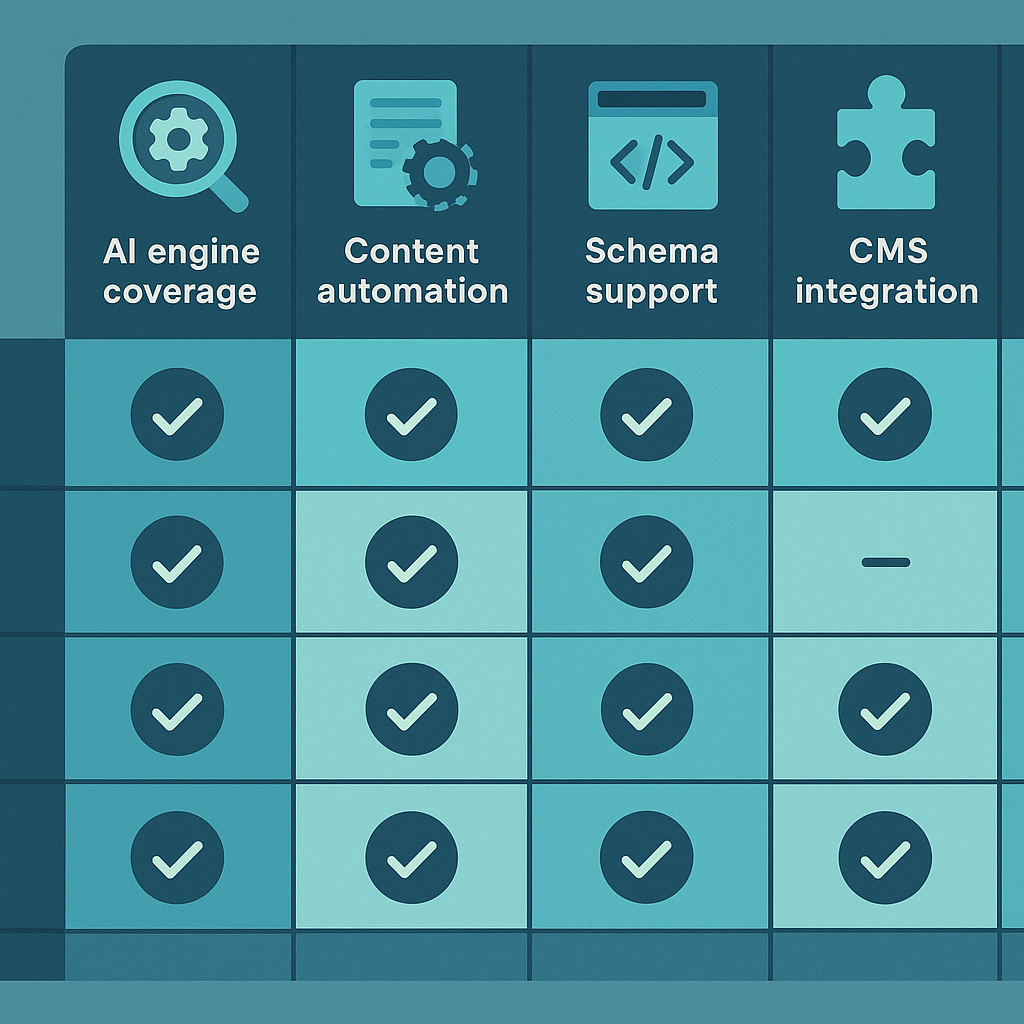
Evaluate tools against four criteria: AI engine coverage (does it monitor ChatGPT, Claude, Perplexity, AND Gemini, or just one?), content automation depth (does it help you create citation-worthy content or only measure citations?), schema and structured data support (does it generate or validate FAQPage, Article, and HowTo schema?), and integration with your CMS (can it publish directly or does it require manual intervention?). A tool that only measures citations without helping you earn them creates a data gap rather than closing it.
If you're a B2B SaaS founder or marketing lead and want to see where your brand currently stands in AI search before committing to any paid tool, start with Gofylo's free AI Search Grader — it grades your current AI visibility and gives you a concrete score across the major engines. From there, the 3-day free trial (no credit card required) puts the full autonomous content and tracking stack in your hands. Start your free trial at gofylo.com.
Sources
- GEO & AEO Statistics 2026: Generative & Answer Engine Optimization Data | SEOScaleUp - seoscaleup.com
- Emerging Trends in Answer Engine Optimization 2025 - On Marketing - onmarketing.ai
- Future of SEO: Answer Engine Optimization Revealed | IDCM - myidcm.com
- 8 Eye-Opening Statistics: Why Answer Engine Optimization Matters in 2025 - junhammer.com