As of 2026, the majority of B2B buying journeys touch an AI engine before they ever reach a traditional search results page. Perplexity, ChatGPT, Claude, and Gemini are now active intermediaries between your content and your prospective customers — and they decide what to surface, summarize, and cite. The problem is that these engines weren't designed with marketing teams in mind. They crawl, ingest, and reason across web content using their own rules, and for a long time, site owners had no structured way to communicate intent to them.
That's where llm txt comes in. The llms.txt file is an emerging open standard that gives website owners a machine-readable way to tell large language models which content is authoritative, how the site is structured, and what context an AI should prioritize when reasoning about your brand. Think of it as a sitemap built not for Googlebot, but for GPT-scale inference engines. In 2026, understanding this file — what it is, how it works, and why it matters — is foundational to any serious AI search visibility strategy.
Thesis: llms.txt is not just a technical curiosity — it's a structural signal that determines whether AI engines cite your content accurately, cite it at all, or overlook it entirely in favor of a competitor who has already implemented the standard.
What llms.txt Is and Where It Came From
The llms.txt file is a plain-text file placed at the root of a website (e.g., yourdomain.com/llms.txt) that provides structured, human-readable-but-machine-parseable information about your site's content to large language model crawlers and inference pipelines. The concept was first formally proposed by Jeremy Howard in late 2024 as a response to a growing gap: LLMs were ingesting websites at scale during training and retrieval, but had no standardized signal about which content was canonical, which sections were marketing copy versus documentation, or what the site owner actually wanted a model to understand and prioritize. By 2026, adoption has grown across developer-facing SaaS products, documentation-heavy platforms, and increasingly among B2B content teams who have recognized its role in AI search citation.
The Problem It Was Designed to Solve
Before llms.txt, an AI engine ingesting your site during retrieval-augmented generation (RAG) had to make its own judgments about content hierarchy. A blog post from three years ago could be weighted the same as your current product documentation. A deprecated pricing page could be surfaced alongside your live offering. There was no mechanism for the site owner to say 'this is the authoritative content, this is the context you need, and this section is not intended for LLM consumption.' The llms.txt file creates that channel.
The Anatomy of an llms.txt File
An llms.txt file is written in Markdown and follows a lightweight but deliberate structure. At minimum, it includes a top-level H1 with the site or project name, a brief blockquote summary describing what the site or product is, and one or more H2 sections that link to key content areas with optional descriptive context. Each linked section tells the LLM what it will find there and why it matters. The format is intentionally minimal — the goal is clarity for a language model reasoning under token constraints, not exhaustive documentation. A well-constructed llms.txt reads like a concise briefing document written by someone who knows exactly what an AI should prioritize when a user asks a question about your domain.
- H1 title: Your brand or product name, used as the primary entity anchor for the LLM
- Blockquote summary: 2-4 sentences that define what your site does, written as a factual statement
- H2 section links: Grouped by content type (e.g., Documentation, Blog, Product Pages) with URLs and brief descriptions
- Optional notes: Contextual guidance about content freshness, language, or intended audience
- Optional: A separate llms-full.txt for extended context that models can fetch if token budget allows
The blockquote summary in llms.txt is the single most important element for brand citation accuracy. If a model's retrieval pipeline reads only the first 200 tokens of your file, this summary is what shapes every downstream answer it generates about your company.
How It Differs from robots.txt and sitemap.xml
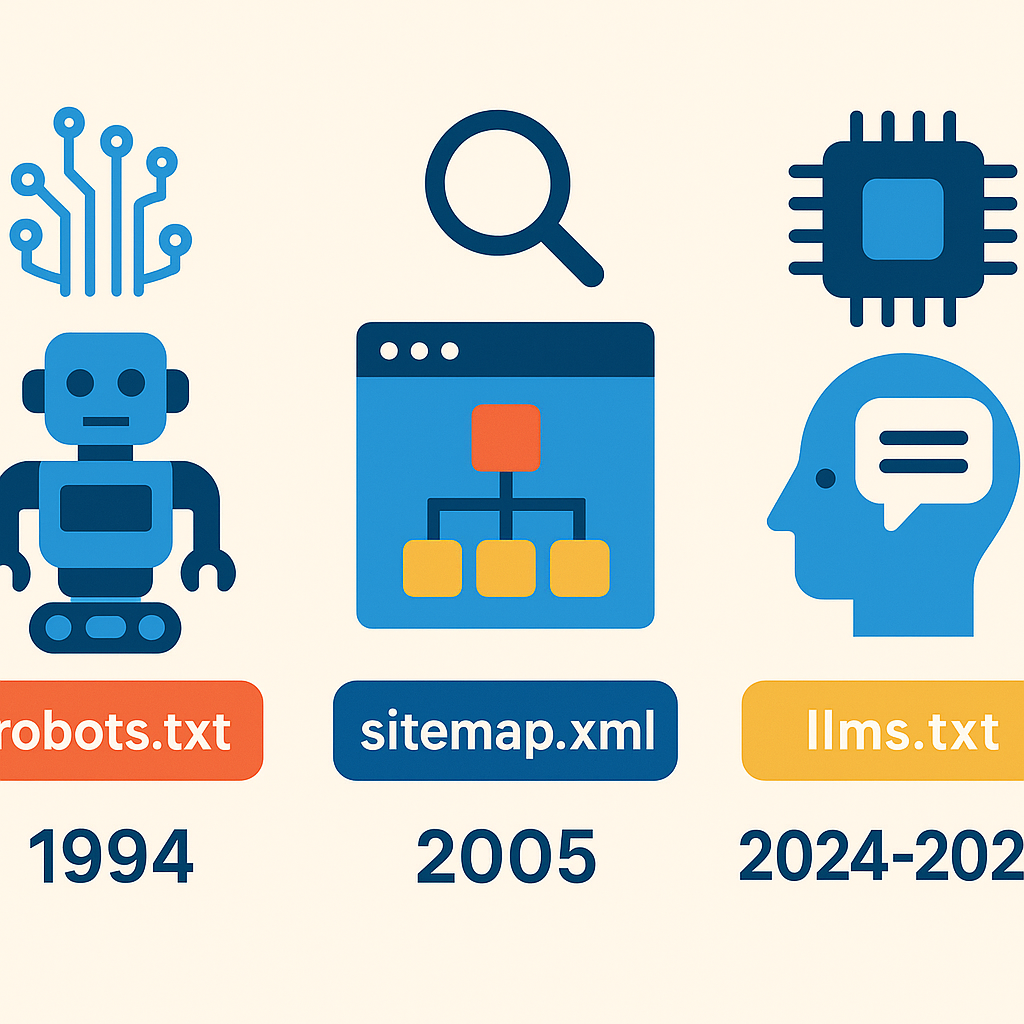
robots.txt and sitemap.xml are access-control and discovery mechanisms — they tell crawlers what they're allowed to index and where to find pages. llms.txt is fundamentally different in purpose: it's a comprehension signal, not a permission signal. You're not blocking or directing a crawler's path through your site; you're providing semantic context to help a language model reason more accurately about your content after it has already been ingested. According to Ahrefs' 2025 crawl study, robots.txt is present on over 92% of the top million websites — but llms.txt adoption as of 2026 remains well under 5% of those same sites, which means early implementers have a significant structural advantage.
robots.txt controls access. It tells bots which URLs they are and aren't permitted to crawl. Violations can result in pages not being indexed. It has no role in helping an LLM understand what your content means.
sitemap.xml improves discoverability. It provides a structured list of URLs with metadata like last-modified dates. It helps Googlebot find and prioritize pages, but it communicates nothing about content intent, entity relationships, or what a model should infer from your site.
llms.txt shapes comprehension. It operates at the semantic layer — giving a language model the briefing it needs to generate accurate, well-attributed answers when a user asks something within your domain. It's the difference between a model guessing at your product's positioning and getting it from you directly.
Why LLMs Need This Signal
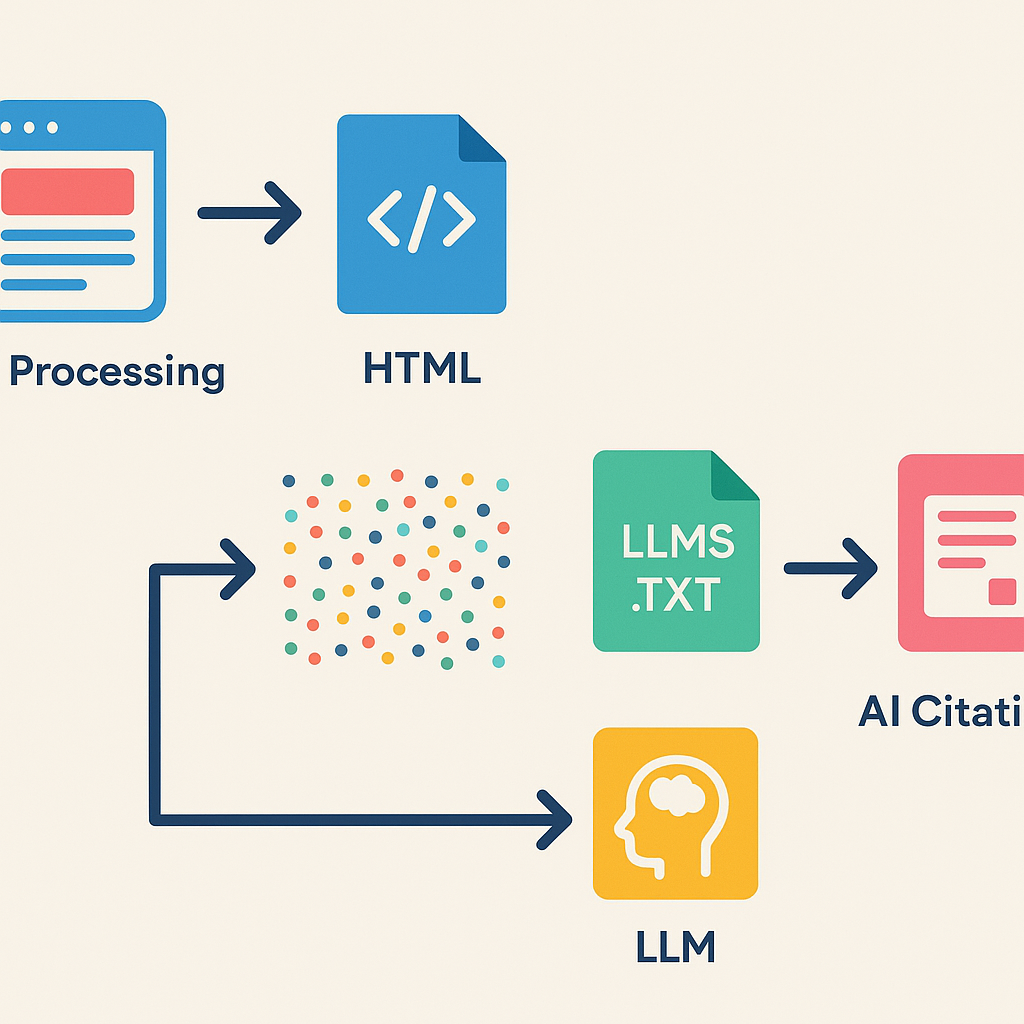
Large language models face a structural challenge when generating answers from retrieved web content: they have to compress enormous amounts of information into coherent, citation-worthy responses under tight token limits. Without a structured briefing document, a model doing retrieval-augmented generation must infer your site's structure, authority hierarchy, and content intent from raw HTML — a noisy, inconsistent signal. According to Search Engine Land's 2025 AI Search Report, AI-generated answers now appear on over 60% of informational search queries, and the models driving those answers are actively prioritizing content that is structured for machine comprehension over content that is merely well-written for humans. llms.txt is one lever that directly improves that structural signal.
The Token Economy Problem
When a retrieval pipeline fetches your site to answer a user query, it doesn't read every page in full. It samples, chunks, and prioritizes based on relevance signals. A page buried three clicks deep in your navigation may never be fetched at all. llms.txt solves this by giving the model a single, high-signal entry point that summarizes what exists across your entire domain — meaning even content that isn't directly crawled can be represented accurately in the model's answer if you've described it clearly in your llms.txt file. This is especially important for B2B SaaS companies whose most authoritative content (integration docs, API references, case study landing pages) often lives far from the homepage.
The Connection Between llms.txt and GEO
Generative Engine Optimization (GEO) is the practice of structuring content so that AI engines surface, summarize, and cite your brand accurately. llms.txt is one of the foundational technical levers within a GEO strategy — it sits at the intersection of structured data, entity clarity, and retrieval optimization. The other levers include schema markup, FAQ blocks, authoritative internal linking, and E-E-A-T signals that make your content citable. According to Google's developer documentation on structured data, structured signals directly influence how content is processed and surfaced across Google's AI-powered features — a principle that extends to third-party AI engines as well. llms.txt amplifies all of those signals by giving models a coherent starting frame for your entire domain.
GEO isn't a separate strategy from SEO — it's an extension of it into AI-native surfaces. llms.txt is where that extension begins at the technical infrastructure level. Without it, your GEO efforts are building on an incomplete foundation.
How AI Visibility Scores Connect to File Implementation
Platforms that track AI search visibility — including Gofylo, which gives an AI visibility score based on asking ChatGPT and Claude about a brand — measure how a brand appears across AI assistants. Gofylo's AI Visibility Score is based on asking ChatGPT and Claude about a brand, and companies without structured technical signals like llms.txt and schema markup tend to score lower because the models generating answers about them are working from degraded or incomplete context. The file itself doesn't guarantee citations, but it removes a structural ceiling on how well AI engines can represent your brand.
What Happens When You Don't Have One
The absence of an llms.txt file doesn't break anything in the traditional sense — your site will still be crawled, content will still be retrieved, and some citations will still happen. But without it, you cede control over how AI engines frame your brand to the inference process itself. That process is probabilistic and noisy: it may surface outdated pricing, misattribute product capabilities, or conflate your brand with a competitor because the retrieval context didn't include a clear entity anchor. As AI-driven search continues to displace traditional query-and-click behavior — Gartner's 2025 Digital Markets report projected that AI search tools will handle 30% of all web search volume by 2026 — the cost of that misrepresentation compounds with each query.
- Outdated or deprecated content surfaces in AI-generated summaries about your product
- Competitor content gets weighted equally or more heavily than your authoritative pages
- Brand entity is poorly anchored, leading to confused or blended citations
- Documentation and product pages get treated the same as blog posts with no hierarchy signal
- Token budget gets consumed by low-priority pages before reaching your most authoritative content
- AI answers about your domain reference generic category descriptions instead of your specific differentiators
Implementation Approaches and Tooling
Creating an llms.txt file ranges from a manual Markdown exercise for small sites to a programmatically generated artifact for content-heavy platforms with hundreds of URLs. For a lean B2B SaaS team, the manual approach is a reasonable starting point: audit your top 20-30 most authoritative pages, group them by content type, write a clear blockquote summary of your product, and publish the file at your domain root. For teams operating at scale — publishing 30 or more articles per month, managing multilingual content, or running programmatic landing page programs — manual maintenance becomes a liability. A stale llms.txt that doesn't reflect your current content architecture can actually mislead the models you're trying to influence. Tools that auto-generate and update the file based on your live CMS content are a more durable solution, and this is an area where platforms in the LLM visibility tools space are building active integrations.
Manual creation works at small scale. If your site has a stable architecture and fewer than 50 authoritative pages, a hand-written llms.txt maintained quarterly is a workable approach. The risk is version drift — if you're publishing new content regularly, the file goes stale fast.
Generator tools reduce maintenance overhead. An llms.txt generator that reads your sitemap or CMS and outputs a structured file removes the manual update cycle. The quality of the output depends on how well your CMS content is organized, which makes upstream content architecture decisions more consequential than most teams realize.
Integrated platforms close the loop. Platforms like Gofylo that combine content generation, CMS publishing, and AI visibility tracking can maintain llms.txt alignment as part of the same workflow that publishes your articles — meaning your AI comprehension signal stays current without requiring a separate process.
Related: Your Guide to LLM Visibility Tools That Actually Work
Frequently Asked Questions
What is the llms.txt file format?
llms.txt is a plain-text file written in Markdown, placed at the root of a website. It includes a project or brand name as an H1, a blockquote summary of the site's purpose, and H2-organized sections linking to key content with brief descriptions. The format is intentionally lightweight to fit within the token constraints of AI retrieval pipelines.
Does Google use llms.txt for search rankings?
As of 2026, Google has not officially confirmed that llms.txt influences traditional PageRank or core search rankings. However, Google's AI-powered features — including AI Overviews — use retrieval and comprehension mechanisms where structured context signals can influence how content is surfaced and summarized. The file's primary value is in third-party AI engines like Perplexity, ChatGPT, and Claude.
Is llms.txt an official web standard?
No — as of 2026, llms.txt is a community-driven open proposal, not a ratified W3C or IETF standard. That said, adoption is growing among developer platforms, documentation-first SaaS products, and AI-native companies. Several major AI retrieval systems have begun recognizing the file format as a signal, making practical adoption ahead of formalization a reasonable strategic choice.
How do AI engines like Perplexity use llms.txt?
When Perplexity's retrieval pipeline fetches a site for context, an llms.txt file at the domain root provides a structured entry point that the model can use to prioritize which content to read and how to frame the entity it's reasoning about. This reduces the chance of outdated or low-authority content dominating the model's answer about your brand. Not all AI engines implement llms.txt parsing identically — implementation patterns are still evolving.
Can llms.txt hurt my SEO if implemented wrong?
An llms.txt file has no known negative effect on traditional SEO — it's not processed by Googlebot as a directive the way robots.txt is. The main risk is publishing a file with inaccurate or outdated content descriptions, which could mislead AI retrieval about your site's current state. Keeping the file current is more important than writing a perfect first version.
If you're serious about AI search visibility in 2026, start with a free audit. Gofylo's AI Search Grader shows you exactly how ChatGPT, Claude, Perplexity, and Gemini are currently representing your brand — and where structured signals like llms.txt can close the gap. Run your free grade at gofylo.io.