Affordable search engine optimization services in 2026 come in more shapes than the old agency-or-freelancer split. A B2B SaaS founder with a few hundred dollars a month can buy a retainer, a software suite, an AI writing tool, an autonomous publishing platform, or a hybrid service where AI agents draft and humans review. Each option has a different cost structure, and each produces a different amount of finished, indexed, cited content per dollar. This round-up is for founders, marketing leads, content managers, and solo builders who already know they need SEO and want to spend a small budget on the version that compounds.
I run Gofylo, so I have a stake in this comparison, and I say so where Gofylo appears on the list. The aim is a fair comparison on the same terms: what each option costs relative to market rates, what it delivers each month, how much of your team's time it consumes, and whether its output gets surfaced by Google and cited by ChatGPT, Claude, Perplexity and Gemini. As of 2026, that second lens matters as much as the first, because buyers increasingly ask an AI assistant for a shortlist before they ever open a search results page.

Act on this first: calculate your cost per published, indexed page for every option you are considering. Divide the monthly price by the number of finished pages it will put live on your site in a month. A cheap retainer that ships two posts can cost more per page than a pricier option that ships thirty, and this one number exposes the difference before you sign anything.
1. Decide Which Job You Are Paying For
Name the bottleneck first. Most small SaaS teams do not lack SEO knowledge. They lack hours. Before comparing prices, write down which of four jobs is actually stuck: research (knowing which keywords and topics to target), production (turning that plan into finished articles), optimization (making existing pages rank and get cited), or measurement (knowing what is working on Google and inside AI assistants). Affordable search engine optimization services tend to be good at one or two of these jobs and thin on the rest.
This matters because the categories are priced on different logic. A software suite charges for access to data and assumes you supply the labor. An agency or freelancer charges for labor and often bundles a modest amount of strategy. An autonomous platform charges for finished output and assumes you want the labor removed. If your real bottleneck is production and you buy a data suite, you will own excellent keyword lists that nobody turns into pages. If your bottleneck is strategy and you buy a high-volume writing tool, you will publish a lot of content aimed at the wrong queries.
In my experience talking with founders, the most common mismatch is buying research when the team cannot produce. A two-person marketing function at a seed-stage company usually knows its ten most important topics already. What it cannot do is publish, interlink, and refresh content every week while also running demand generation, product launches, and sales enablement.
- Write one sentence describing the job you most need done each month, in terms of output (for example, eight buyer-intent articles live and interlinked).
- List the hours per week your team can genuinely give to SEO after everything else, and be honest about weeks with launches.
- Mark whether you need Google rankings, AI assistant citations, or both, and which one your buyers use first.
- Note your CMS (WordPress, Webflow, Ghost, Framer and so on), because publishing friction is a hidden cost in every option.
- Decide whether you need content in more than one language, since that multiplies production cost for labor-based services.
With that sentence written, every option on the list below can be judged against the same job. The broader landscape of seo services covers far more categories than a small team needs, so narrowing to your bottleneck is what keeps an affordable budget affordable.
2. Benchmark Every Quote Against Real Market Rates
Know the going rate cold. You cannot tell whether a quote is affordable without a reference point, and the reference points for 2026 are well documented. Use them to separate fair pricing from both overpriced retainers and suspiciously cheap packages that cut the wrong corners.
Start with labor rates. Per Ahrefs' 2026 SEO statistics, 24% of SEOs charge $75–$100 per hour, making it the most popular hourly rate. The same Ahrefs data shows that $501–$1,000 per month is the most popular monthly retainer rate for SEOs, with 20.4% of respondents charging this rate. That band is where most affordable search engine optimization services from humans sit, and it buys a limited number of hours.
Do the arithmetic. At $75–$100 per hour, a $1,000 retainer buys roughly ten to thirteen hours of work in a month. A well-researched, edited, interlinked B2B article can easily take several hours once you include briefing, drafting, editing, image sourcing and publishing. That is why low-end retainers usually deliver a handful of pieces plus reporting, and why the cost per page is higher than the headline price suggests.
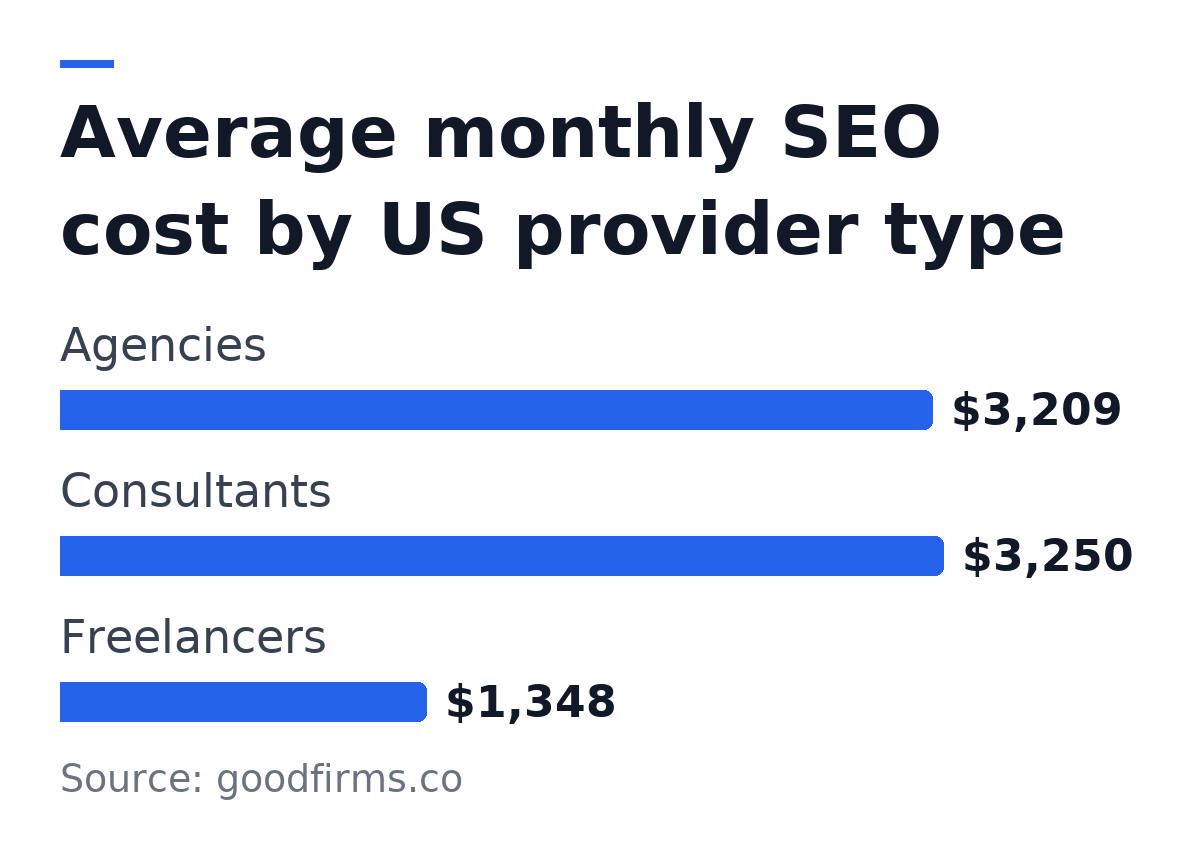
Next, look at averages by provider type. GoodFirms' 2026 US pricing data reports that US agencies average $3,209 a month, consultants average $3,250, and freelancers average $1,348. On the small-business side, Backlinko's panel of 1,200 business owners, cited by SEO Firm USA, found the average US small business spends $497 a month on SEO.
There is a real tension in those two data points. Small businesses spend around $497 a month while the average agency charges several times that. The gap is filled by budget packages, and the same research flags the risk: Backlinko's 2025 research found that businesses spending under $500 a month on SEO were 75% more likely to be dissatisfied than those spending more. A low price is only good value when the delivery model can produce real output at that price.
Two more numbers explain why the low end is crowded. SE Ranking's 2025 survey of 260 agencies, summarised by ROIcool, found 64% charge below $1,000 per month, in a sample where 94% serve small or local businesses. And prices are moving up: QuickSEO's 2026 industry roundup notes that 70% of agencies raised prices in 2024–25, citing inflation, operational costs, and AI tooling investment. By 2026, buyers who locked in older retainers are seeing renewal quotes rise.
A fair test for any quote: ask how many finished pages go live per month, who writes them, and how many hours each takes. If the answer implies fewer hours than the work requires at $75–$100 per hour, something is being skipped, usually research, editing or internal linking.
I treat these benchmarks as a filter, not a verdict. A $500 package from an honest freelancer who ships two excellent comparison pages a month can be the right call for a team that only needs a few high-intent pages. The point is to know what the money is actually buying, in hours or in output, before you compare options.
3. Shortlist by Delivery Model, Then Compare Like for Like
Compare within a category. The eight options below fall into four delivery models: data suites, content optimizers, AI writing platforms, and autonomous or hybrid content services. Comparing a data suite to a done-for-you service on price alone is misleading, so I group them by what they deliver and describe each on the same points: what it does, who it suits, and how it handles Google and AI search.
The table summarises the conclusion: if you have time but no data, a suite or optimizer is the affordable choice; if you have data but no time, an autonomous or hybrid service gives you more published pages per dollar. For a wider ranking of tools across the free and paid tiers, the 9 Affordable SEO Services Ranked list covers diagnostics like Search Console and crawlers that I do not repeat here.
| Option | Delivery model | Who does the writing | Publishes to CMS | AI search angle |
|---|---|---|---|---|
| Gofylo | Autonomous content platform | AI, in your brand voice | Yes, 8 CMSs plus webhook | AI visibility score on ChatGPT and Claude |
| Semrush | Data and research suite | Your team | Not its core job | AI visibility features in its toolkit |
| Clearscope | Content optimizer | Your team | Integrates with editors | Optimization guidance for writers |
| Writesonic | AI writing and GEO platform | AI with your prompts | Yes, for some CMSs | AI search visibility tracking |
| Outrank | Automated article publishing | AI | Yes | Content built for search and AI answers |
| Rankai | AI SEO service with oversight | AI with human review | Yes | Content optimized for search |
| Babylovegrowth | Automated growth platform | AI | Yes | AI search focus |
| Gushwork | AI agents plus human experts | AI with human editors | Yes | Inbound and search content |
Gofylo (our product)
Gofylo is my company's product, so read this entry with that in mind. It is an autonomous organic growth platform: it researches keywords from your competitors and the live search results, groups them into topic clusters, writes articles in your brand voice, and publishes them to your CMS. The standard plan produces 30 articles a month, each written in a few minutes, with schema markup, internal links, FAQ blocks, verified source citations and AI-generated images in 5 styles, in 18+ languages.
Pricing is a single all-in-one plan at $79/month with a 3-day free trial and cancellation at any time. Using the cost-per-page test from the opening callout, 30 articles for $79 works out to under three dollars per published article. It publishes to WordPress, WordPress.com, Webflow, Shopify, Wix, Notion, Ghost and Framer, plus a webhook for custom setups. The fit is a founder-led or small team that wants execution without writing prompts. Teams that want a human strategist on calls every week will find a hybrid service closer to what they expect.
Semrush
Semrush is an all-in-one SEO suite covering keyword research, competitor analysis, site audits, position tracking and backlink data, and it has added AI search visibility features to its toolkit. It is the reference dataset many agencies themselves use. The affordable angle is that one subscription can replace several point tools for a team that has someone to act on the data. The trade-off is labor: Semrush tells you what to write and fix, and your team or a freelancer still has to write and fix it.
Clearscope
Clearscope is a content optimization tool. It grades drafts against the terms and topics that strong pages on a query cover, integrates with common editors, and helps teams monitor existing content for decline. It suits a team that already writes in-house and wants each article to be more complete. It does not write or publish for you, so the per-page cost depends entirely on your writers' time.
Writesonic
Writesonic started as an AI writing platform and has expanded into generative engine optimization, with tools for tracking how a brand appears in AI search alongside its article writer. It fits a marketer who wants AI drafting plus AI visibility monitoring in one place and is comfortable guiding the output. The workflow is more hands-on than an autonomous publisher, which some teams prefer for control over each piece.
Outrank
Outrank automates article creation and publishing, generating SEO content on a regular schedule and pushing it to connected CMSs, and it pairs this with a backlink exchange feature. It belongs in the same delivery category as Gofylo: output-priced, low-touch, aimed at teams without writers. If you are comparing autonomous platforms, put the two side by side on the same checks, using the trial process in tip 6.
Rankai
Rankai positions itself as an AI SEO agency: AI produces and optimizes content while people oversee strategy and quality. It suits founders who want the feeling of an agency relationship with AI-level production behind it. Compare the monthly volume and the review process directly with labor-based retainers, because that combination is the point of the model.
Babylovegrowth
Babylovegrowth is an automated growth platform that generates and publishes content on a frequent cadence, with an emphasis on visibility in AI search as well as Google, and it includes a backlink component. It is another output-priced option for small teams, and it is worth trialing against other autonomous tools on brand voice and source quality.
Gushwork
Gushwork combines AI agents with human experts to run inbound marketing and SEO content. It sits between a traditional agency and a fully autonomous platform, which makes sense for teams that want human editing on every piece. As with any hybrid, ask how much of the monthly output is reviewed by a person and how that affects volume.
If your shortlist leans toward startup-specific providers rather than tools, the 10 Startup SEO Services Ranked list approaches the same market from a growth-potential angle. On this list, the deciding question is simple: which model removes your specific bottleneck at a price under your ceiling.
4. Put AI Search Visibility Inside the Scope
Rankings are half the job. In 2026, a buyer evaluating a B2B tool often asks ChatGPT, Claude, Perplexity or Gemini for options before visiting any vendor site. If your content is not structured to be quoted, you can rank on Google and still be absent from the answer that shapes the shortlist. Affordable search engine optimization services that ignore this layer are cheaper partly because they skip it.
The mechanics overlap with classic SEO but are not identical. AI assistants favour content they can lift cleanly: a direct answer near the top of a section, short declarative sentences, clearly labelled comparisons, FAQ blocks with self-contained answers, and claims tied to named sources. Structured data helps machines understand what a page is about. A page that rambles to its point may still rank on a long-tail query, yet it gives an AI model little to quote.
When I evaluate any provider on this axis, I ask whether AI visibility is measured or just mentioned in a sales deck. Gofylo's AI Visibility Score shows how ChatGPT and Claude see a brand, with Perplexity and Gemini to follow as they are added. Writesonic and Semrush both have AI visibility features of their own. Ask each provider to show you the specific measurement, which assistants it covers, and how the content changes in response to it.
- Ask the provider which AI assistants it checks your brand against, and how often.
- Request a sample article and look for a direct answer in the first two sentences under each heading.
- Check that articles ship with FAQ blocks and schema markup, not just headings and paragraphs.
- Confirm every statistic in a sample links to a named, verifiable source.
- Run a free baseline first, such as Gofylo's AI Search Grader, so you can compare before and after.
There is a cost argument here too. Structuring content for AI citation at the time of writing costs almost nothing extra. Retrofitting dozens of published articles later costs hours per page. Choosing a service that formats for both Google and AI from the first article is one of the cheapest decisions in this whole list.
Quick self-check: ask ChatGPT and Claude for the best tools in your category, phrased the way a buyer would. If your brand is missing, your SEO budget should include work on citation-ready content, not only on rankings.
5. Fund Refreshes Before Net-New Content
Your cheapest traffic already exists. Pages that sit just off page one already have Google's attention. Improving them is usually faster and cheaper than writing a brand-new article, because the page is indexed, has some history, and only needs to close a specific gap. Many affordable search engine optimization services spend the whole budget on new posts and leave this traffic on the table.
Google Search Console is the data source for this work. It shows which queries each page appears for, its average position, impressions and clicks. A page with high impressions and a position in the low teens is a refresh candidate: searchers see it, but rarely click it because it sits below the fold or on page two. Tightening the answer, adding missing subtopics, improving the title and adding internal links from stronger pages can move it up.
Refreshing also helps on the AI side. Assistants that browse the web prefer current, well-sourced pages, and an article updated with clearer structure and fresher citations is easier to quote. Treat every refresh as two jobs at once: improve the page for its Google queries, and reformat it so an AI model can lift an answer from it.
Gofylo's Search Console refresh rewrites published articles that sit just off page one using your Search Console data, and keeps the earlier version so you can restore it. To set that up, you would Connect Google Search Console once, and the platform picks refresh candidates from your own data. With a labor-based provider, ask for a monthly refresh quota in writing, because refreshes are easy to drop from scope when a new campaign takes priority.
- Export Search Console page data for a recent period and sort by impressions.
- Filter for pages with average positions just off page one and meaningful impressions.
- For each, compare the queries it appears for against what the page actually covers.
- Rewrite the opening answer, add missing sections, and add internal links from related pages.
- Keep the previous version so a refresh that underperforms can be rolled back.
- Recheck positions and clicks after Google has had several weeks to recrawl.
A practical split I recommend to small teams: once you have a few dozen published articles, reserve a fixed share of each month's capacity for refreshes. The exact ratio depends on how much of your library sits close to page one. The habit matters more than the ratio.
6. Run a 30-Day Proof Test Before Committing
Test output, not promises. Every option on this list can be evaluated in a month or less with a structured test. Proposals and demos tell you what a provider intends to do. A short paid engagement or free trial tells you what it actually ships, how it sounds in your brand voice, and how much of your time it eats.
Set the test up so the results are comparable. Use the same topic set for every option, the same publishing target, and the same review checklist. If two providers are writing about different keywords, you will end up comparing keyword difficulty rather than service quality. Most platforms offer a trial (Gofylo's is 3 days), and agencies and freelancers will often agree to a short paid pilot.
Score each option on output you can see. Count the articles that went live, check whether they are indexed, read three at random for accuracy and voice, and verify every cited source loads and says what the article claims. Track the hours your team spent briefing, reviewing and fixing. Those hours are part of the price, and for small teams they are often the most expensive part.
- Pick five to ten target topics drawn from your highest-intent queries and give the same set to each option.
- Record the date each article goes live and check indexing in Search Console a week later.
- Read each draft for factual accuracy about your product, and log every correction you make.
- Click every outbound citation and confirm it supports the claim attached to it.
- Check internal links point to relevant existing pages and not to random posts.
- Log your team's hours per article, then add them to the price to get a true cost per page.
At the end of the test, put the numbers in one place: price, articles live, cost per page, team hours per page, and accuracy issues per article. The cheapest option on paper often loses on hours. The most expensive option sometimes wins on cost per page once volume is counted. You will not know which until you measure.
Two warning signs end a test early for me. The first is fabricated or broken citations, because they damage trust with readers and give AI assistants a reason to skip the page. The second is content that misdescribes your own product. Both are fixable in a single article, but a service that produces them regularly will cost you more in review time than it saves.
Related: Startup SEO in 2026: A Founder's Compounding Growth Plan
Frequently Asked Questions
How to increase SEO for free?
Start with free tools: Google Search Console for query and indexing data, plus tightening titles, opening answers and internal links on pages that already get impressions. Free work is limited by your own hours, which is why small teams eventually pay for production capacity.
What are the best SEO agencies in the world?
There is no single best agency, because the right choice depends on budget, industry and which job you need done. For a small B2B SaaS team, judge any agency on cost per published page, hours you must contribute, and whether its content is structured to be cited by AI assistants as well as ranked by Google.
How much does SEO cost per month?
It varies widely by provider type. GoodFirms reports US agencies average $3,209 a month and freelancers average $1,348, while Ahrefs data shows $501–$1,000 per month is the most popular retainer band. Software and autonomous platforms sit lower, for example Gofylo at $79/month.
What is now replacing SEO?
Nothing is replacing SEO outright, but AI search is adding a second layer to it. Generative engine optimization (structuring content so ChatGPT, Claude, Perplexity and Gemini can quote and cite it) now sits alongside traditional rankings, and the best-value services cover both.
Can a bootstrapped SaaS company do SEO without hiring anyone?
Yes, if the tooling handles production as well as research. An autonomous platform that researches, writes, links and publishes removes most of the labor, leaving the founder to review accuracy and set priorities. Budget a little weekly time for that review either way.
If your bottleneck is production and your budget is small, put Gofylo through the same proof test as everything else. Start the 3-day Gofylo trial, point it at your CMS and your top competitors, and compare the cost per published page against any quote you already have. If you want a baseline first, run the free AI Search Grader to see how AI assistants describe your brand now.
Sources
- 107 SEO Statistics for 2026 - ahrefs.com
- How Much Does SEO Cost in 2026? US Pricing Data - seofirmusa.com
- SEO Pricing 2026: 3 Surveys, 3 Very Different Answers - roicool.com
- SEO pricing in USA 2026: What agencies, freelancers, charge? - goodfirms.co
- The State of the SEO Agency Industry in 2026: 50+ Stats - quickseo.ai