I put this list together for a specific reader: a founder, marketing lead or SEO manager at a B2B SaaS company who already knows what SEO copywriting services are and now has to pick one. As of 2026, that choice no longer sits between a freelancer and an agency. You can hire an agency that writes for you, buy a research platform and brief your own writers, run an optimization editor, use an AI writer you prompt yourself, or plug in an autonomous system that researches, writes and publishes on its own. Each model changes who does the work, how fast articles ship, and whether the output gets cited by ChatGPT, Claude, Perplexity and Gemini as well as ranked on Google.
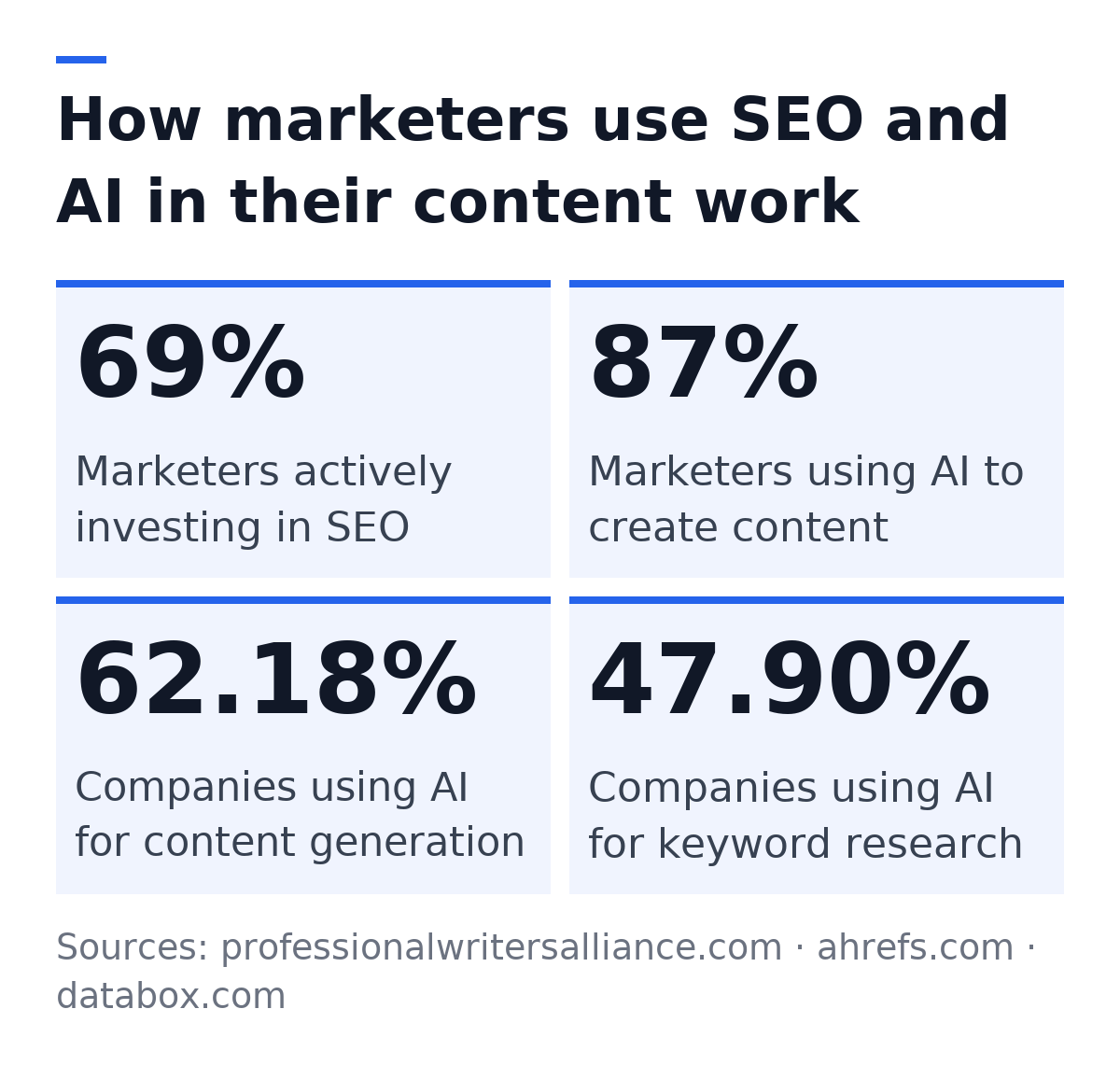
The demand side explains why the category keeps splitting. The AWAI 2025 State of the Industry report found that 69% of marketers actively invest in SEO. AI has moved into the same workflow: Ahrefs reports that 87% of marketers surveyed use AI to create or help create content, and Databox's survey of 140+ companies found that 62.18% use AI for content generation or enhancement, while 47.90% use it for keyword research and SEO optimization. I chose the seven resources below because each one represents a distinct way to buy SEO copywriting services in 2026, and each is something you can sign up for and use this week. One of them, Gofylo, is my own product. I include it on the same terms as the others and say so where it appears.
- Gofylo: autonomous research, writing and CMS publishing, plus AI visibility scoring (my own product)
- Semrush: keyword research, competitive data and a writing assistant for teams that brief their own writers
- Clearscope: content optimization editor that grades drafts against topic coverage
- Writesonic: AI writing platform with SEO and AI search visibility features
- Rankai: AI-driven SEO service that produces and optimizes content for you
- Outrank: automated SEO article generation and publishing for small teams
- Gushwork: AI-assisted content and SEO service with human involvement in the workflow
If you pick only one: decide first whether you have writers. If you have no content team and need articles shipping without manual prompting, start with Gofylo (my own product, so weigh that disclosure). If you already employ writers and need them to produce better-optimized drafts, start with Clearscope or Semrush, because those tools sharpen human work instead of replacing it.
Gofylo
Gofylo is my own product, so read this section with that in mind. We built it for B2B SaaS companies and startups that want the output of SEO copywriting services without hiring writers or managing an agency. Gofylo researches keywords from your competitors and the live search results, groups them into topic clusters, writes articles in your brand voice and publishes them straight to your CMS. The standard plan produces 30 articles a month, and each one is written in a few minutes. It supports WordPress, WordPress.com, Webflow, Shopify, Wix, Notion, Ghost and Framer, plus a webhook for custom stacks.
The structural difference from a traditional copywriting service is that nobody has to prompt it. An agency runs on briefs, review rounds and calendars. A writing tool runs on someone typing instructions into it. Gofylo runs as a loop: research, write, optimize, add internal linking, publish, then come back to improve what is already live. That last step matters more than most buyers expect. Gofylo reads your Google Search Console data, finds published articles that sit just off page one, rewrites them, and keeps the earlier version so you can restore it if the new one underperforms.
On the AI search side, every article is formatted to be cited by ChatGPT, Claude, Perplexity and Gemini: schema markup, FAQ blocks, verified source citations and short answerable passages. The AI Visibility Score then shows how ChatGPT and Claude see your brand, with Perplexity and Gemini to follow as they are added. If you want a free starting point before committing, the standalone AI Search Grader grades your current AI search visibility and gives you a score to act on.
- Keyword research drawn from competitors and live search results, grouped into topic clusters
- 30 articles a month on the standard plan, each written in a few minutes
- Schema markup, internal links, FAQ blocks and verified source citations in every article
- AI-generated images in 5 styles and writing in 18+ languages
- Search Console refresh that rewrites near-page-one articles and keeps the prior version
- AI Visibility Score for ChatGPT and Claude, plus a free AI Search Grader
Pricing is one all-in-one plan at $79 a month, with a 3-day free trial and cancellation at any time. I would not describe Gofylo as a fit for every company. If your brand depends on long investigative pieces, original customer interviews or a founder's personal essays, you still need a human writer for that work, and Gofylo is better used to cover the long tail of commercial and informational topics around it.
Best for Founder-led SaaS companies, solo operators and small marketing teams that want SEO copywriting services to run without a content hire, and that care about AI search citations as much as Google rankings. It also suits growth-stage teams that publish in multiple languages, since one setup covers 18+ of them.
Semrush
Semrush is the research layer that many in-house teams and agencies build their SEO copywriting process on. It is a broad SEO suite: keyword research, competitor traffic analysis, rank tracking, site audits, backlink data and a content marketing toolkit that includes topic research and a writing assistant. Semrush does not write your articles for you in the way an agency does. It gives your writers the inputs that make articles rank: which keywords competitors win, what questions searchers ask, and which pages on your own site are losing ground.
For a SaaS team, the most useful part is usually competitive gap analysis. You can enter two or three competitor domains and see the keywords they rank for that you do not. That list becomes your editorial backlog. From there, the SEO Writing Assistant checks a draft against recommendations for readability, keyword use and tone inside Google Docs or WordPress. Semrush has also added AI visibility features in its toolkit, so teams can see how their brand appears in AI-generated answers, which brings it closer to the GEO side of the work.
- Keyword gap and competitor research across organic and paid search
- Topic research that surfaces questions and subtopics for briefs
- SEO Writing Assistant for in-editor draft checks
- Site audits and position tracking to measure what published copy does
- AI visibility tooling for monitoring brand presence in AI answers
The trade-off is effort. Semrush makes a skilled operator much faster, but it does not remove the operator. Someone still has to turn data into briefs, assign them, edit drafts and publish. If you are comparing Semrush with full-service SEO copywriting services, the honest framing is that Semrush replaces the research portion of an agency's work, and you supply the writing and publishing yourself.
Best for SEO and content managers at growth-stage companies who already have writers, in-house or freelance, and need one source of truth for keyword strategy, competitor tracking and performance reporting. It is also a strong choice for agencies managing several client sites.
Clearscope
Clearscope is a content optimization platform built around one job: making a draft cover a topic as thoroughly as the pages that already compete for it. You enter a target keyword, Clearscope builds a report of related terms and questions, and your writer drafts against it in Clearscope's editor, Google Docs or WordPress. The draft receives a content grade that rises as coverage improves. Editors like it because the grade gives them a shared, objective standard for whether a piece is ready.
Clearscope fits teams that treat SEO copywriting as a craft and want to keep humans in the loop. It does not research your whole keyword universe the way Semrush does, and it does not publish for you. What it does well is sharpen individual pieces. It also includes content inventory monitoring, which flags published pages that are losing traffic so you know which articles to refresh. For AI search, thorough topic coverage helps: a page that answers the related questions clearly gives an AI assistant more self-contained passages to quote.
In practice I see Clearscope work best paired with a human writing team or an outsourced provider. A common setup is a strategist who builds the keyword plan in a research tool, a freelancer who writes against a Clearscope report, and an editor who signs off once the grade and the subject-matter accuracy are both where they should be. That setup produces high-quality pieces, though throughput depends entirely on how many writers you can afford.
Best for Content leads with an existing writing team, in-house or freelance, who want a consistent optimization standard across every draft. It is a natural add-on for companies already buying SEO copywriting services from freelancers and wanting a way to check their work.
Writesonic
Writesonic started as an AI writing tool and has expanded into a broader platform for SEO and AI search visibility. Its article writer produces long-form drafts from a keyword or brief, and it includes features for tracking how brands appear in AI answers from assistants such as ChatGPT and Perplexity. For teams that want to stay hands-on, Writesonic sits between a pure writing assistant and an autonomous system: it speeds up drafting considerably, and a person still guides the topics and reviews the output.
The appeal for a SaaS marketer is breadth in one subscription. You can draft blog posts, landing page copy and product descriptions, then check AI visibility for your brand without switching tools. Its GEO features are a reason to shortlist it if AI citations are a priority, because it treats AI search as a measurable channel instead of a side effect of good SEO. If you are surveying the wider market of ai writing services, Writesonic is one of the more established names and a reasonable baseline to compare others against.
- Long-form AI article writer driven by keywords or briefs
- Short-form copy for landing pages, ads and product pages
- AI search visibility tracking across major assistants
- Brand voice settings to keep output consistent
- Integrations for publishing drafts to common CMS platforms
The operating model is still prompt-driven. You decide what to write, start each piece and edit the result. That gives you control, and it also means output scales with the time someone puts in. Teams that want a few dozen strong articles a quarter with close editorial control tend to like this model. Teams that want volume without a person managing each piece usually look further down this list.
Best for Marketing teams that want AI-assisted drafting across many content types and prefer to keep a human directing each article, with GEO tracking in the same tool.

Rankai
Rankai positions itself as an AI SEO agency: a service that uses AI to research, write and optimize content on your behalf, with the delivery model of an agency and the speed of software. Instead of handing you a tool, it takes on the content production work and the ongoing optimization of what it publishes. For buyers comparing traditional SEO copywriting services with software, Rankai is useful as a middle option: you get managed output without hiring a conventional agency.
The managed model has real advantages for founders. You do not need to learn a research suite, write briefs or review keyword reports. You agree on goals and let the service run. The trade-off is the usual one with any agency-style relationship: you have less direct control over day-to-day decisions, and you should ask how topics are chosen, how brand voice is captured and how performance is reported before you sign. Those questions apply equally to human agencies, and a good provider answers them clearly.
When I evaluate a service in this category, I look at four things: whether it publishes directly to my CMS, whether it updates existing pages or only adds new ones, how it handles internal links between articles, and whether it reports on AI search visibility as well as rankings. Rankai's emphasis on ongoing optimization addresses the second point, which is the one most traditional writing providers skip.
Best for Founders who want a done-for-you SEO content service powered by AI and prefer an agency-style relationship over operating software themselves.
Outrank and Gushwork
I group these two because they solve the same problem from opposite ends. Outrank is an automated SEO article platform aimed at small businesses and solo builders. It finds keywords, generates articles on a schedule and publishes them to your site, so a one-person company can keep a blog active without writing every post. The workflow is simple to set up, which is the main reason solo operators pick it: you connect your site, confirm topics and let it run.
Gushwork takes a more service-led approach. It combines AI agents with human involvement to run content and SEO programs for companies, so you get automation with people reviewing and shaping the work. For a buyer who likes the efficiency of AI but does not want fully unattended publishing, that hybrid design is the selling point. It is closer to how a modern agency operates than to a self-serve tool.
- Outrank suits solo founders who want scheduled, automated publishing with minimal setup
- Gushwork suits teams that want AI efficiency with humans checking the output
- Both remove most of the brief-writing work that traditional providers require
- Both should be evaluated on CMS support, refresh behavior and reporting before you commit
If budget is the deciding factor, both belong on a shortlist alongside other affordable seo services, and the right pick depends on how much human oversight you want built in. Ask each provider for sample articles in your niche. B2B SaaS topics are technical, and a sample on a topic close to your product tells you more than any feature page.
Best for Outrank fits solo operators and bootstrapped builders who want an automated blog with little configuration. Gushwork fits small marketing teams that want SEO copywriting services with AI speed and a human layer of review.
Before the FAQ, one note on how to combine these resources. Many teams run two of them together: a research or optimization tool such as Semrush or Clearscope for the handful of flagship pages that a senior writer owns, and an autonomous or managed service for the long tail of supporting articles. That split keeps your most important pages in expert hands while the rest of your topic coverage keeps growing. Whatever you choose, judge SEO copywriting services on what happens after publishing: whether articles get refreshed, internally linked and cited by AI assistants. Publishing is the start of an article's life, not the end.
A quick filter for any provider: ask whether it publishes to your CMS, refreshes underperforming pages, adds internal links automatically and measures AI search visibility. A provider that does all four compounds results over time. One that only delivers drafts leaves the rest of the work with you.
Frequently Asked Questions
How much do SEO services typically cost?
Cost depends on the delivery model. Freelancers and agencies usually charge per article or on a monthly retainer, and agency retainers sit well above software subscriptions because you pay for people's time. Software sits at the lower end: Gofylo, for example, is a single plan at $79 a month for 30 articles, with a 3-day free trial.
Can I make 5000$ a month with copywriting?
Some freelance copywriters do reach that level, typically by specializing in a niche such as B2B SaaS, building a portfolio with measurable results and moving to retainers instead of one-off pieces. Income varies widely with experience, niche and client base, so treat it as a goal that depends on positioning more than on volume. Writers who pair copywriting skill with SEO and AI search knowledge tend to command higher rates.
What does a SEO copywriter do?
A SEO copywriter researches what a target audience searches for, then writes pages that answer those queries clearly enough to rank on Google and be quoted by AI assistants. The work covers keyword placement, headings, meta descriptions, internal links and persuasive copy that moves readers toward a trial or demo. In 2026, the role increasingly includes structuring content into short, self-contained answers that ChatGPT, Claude, Perplexity and Gemini can cite.
Is SEO still worth it in 2026?
Yes. Organic search still drives qualified traffic, and the same well-structured content now feeds AI assistants that cite sources in their answers. The AWAI 2025 State of the Industry report found that 69% of marketers actively invest in SEO.
Are there free SEO copywriting services?
Fully free SEO copywriting services that write and publish for you are rare, but several tools offer free tiers or trials you can use to test the workflow. Free tools work well for diagnosis: Gofylo's AI Search Grader, for instance, scores your brand's AI search visibility at no cost. For ongoing production, expect to pay for either a subscription or a writer's time.
If you want to see the autonomous model on your own site, start a 3-day free trial of Gofylo: connect your CMS, let it research your competitors and review the first articles it publishes. Or run the free AI Search Grader first to see how ChatGPT and Claude describe your brand before you write anything.