In 2026, the phrase article writer covers three very different things: a person who writes for hire, a chat assistant that drafts paragraphs on request, and an autonomous system that researches, writes, links and publishes without anyone prompting it. Founders and marketing leads tend to blur these together. That makes budgeting, hiring and tool selection harder than it needs to be. Each model has its own cost structure, its own failure modes and its own ceiling on how much organic growth it can produce.
I want to break down how each type of article writer works, where the output succeeds or stalls on Google and in AI answers from ChatGPT, Claude, Perplexity and Gemini, and which trade-offs matter for a small B2B SaaS team in 2026. This is not a ranked tool list. It is an explanation of the mechanics, so you can judge any product, freelancer or agency against the same criteria.
An article writer is any person or system that produces long-form web articles, usually to attract search traffic. For B2B SaaS teams, the term increasingly means software that handles research, drafting, optimization and publishing, so organic growth no longer depends on a full content team.

What an Article Writer Means for a SaaS Team in 2026
For a SaaS team in 2026, an article writer is whatever produces the long-form pages that bring in qualified search and AI traffic. Historically that meant a person: a content writer, freelance journalist or in-house marketer. A human article writer brings judgment, interviews and original opinion, and many enjoy the work; according to Glassdoor salary data for US content writers, about 67% of professionals feel satisfied with their salaries. The limit is throughput. One skilled writer produces a handful of well-researched pieces a month, and research, briefs, editing and CMS upload all compete for the same hours. Software changed the definition. A software article writer can draft in minutes, but drafting was never the bottleneck. The real bottleneck is the chain around the draft: keyword selection, structure, internal linking, schema, publishing and refreshing. The useful question is which links in that chain a given article writer actually handles.
That framing helps when you evaluate any ai tool or hire. A freelancer who writes beautifully but never touches keyword research is solving one step. A chat assistant that drafts on demand is also solving one step, faster. An autonomous platform tries to solve all of them. None of these is wrong; they are simply different products wearing the same label.
- Human freelance or in-house writer: strongest on original insight and interviews, limited on volume and consistency of SEO hygiene.
- Chat-based assistant (ChatGPT, Claude): fast drafting, but research, formatting and publishing stay manual.
- Editor-style SEO writing tool: drafts inside an optimization editor, with a human still assembling and publishing.
- Autonomous content engine: researches, clusters, writes, links, publishes and refreshes with minimal human prompting.
- Agency or managed service: a mix of people and software, priced for the labor involved.
How an AI Article Writer Turns a Keyword Into a Published Page
An AI article writer that does the full job moves through a fixed sequence: it finds the opportunity, plans the topic, drafts in your voice, adds the structural signals search and AI engines rely on, publishes and then revisits the page. Basic tools only run the drafting step and hand you text. Fuller systems start before the draft by studying competitors and the live search results to pick keywords worth targeting, then group those keywords into topic clusters so each article supports the others. After drafting, they add schema markup, internal links, an FAQ block and citations to verifiable sources. Then they push the article into your CMS, whether that is WordPress, Webflow, Ghost or Framer. The last step is the one most teams skip: watching performance and rewriting pages that stall just off page one. Each stage is where quality is won or lost, so it pays to understand them individually.
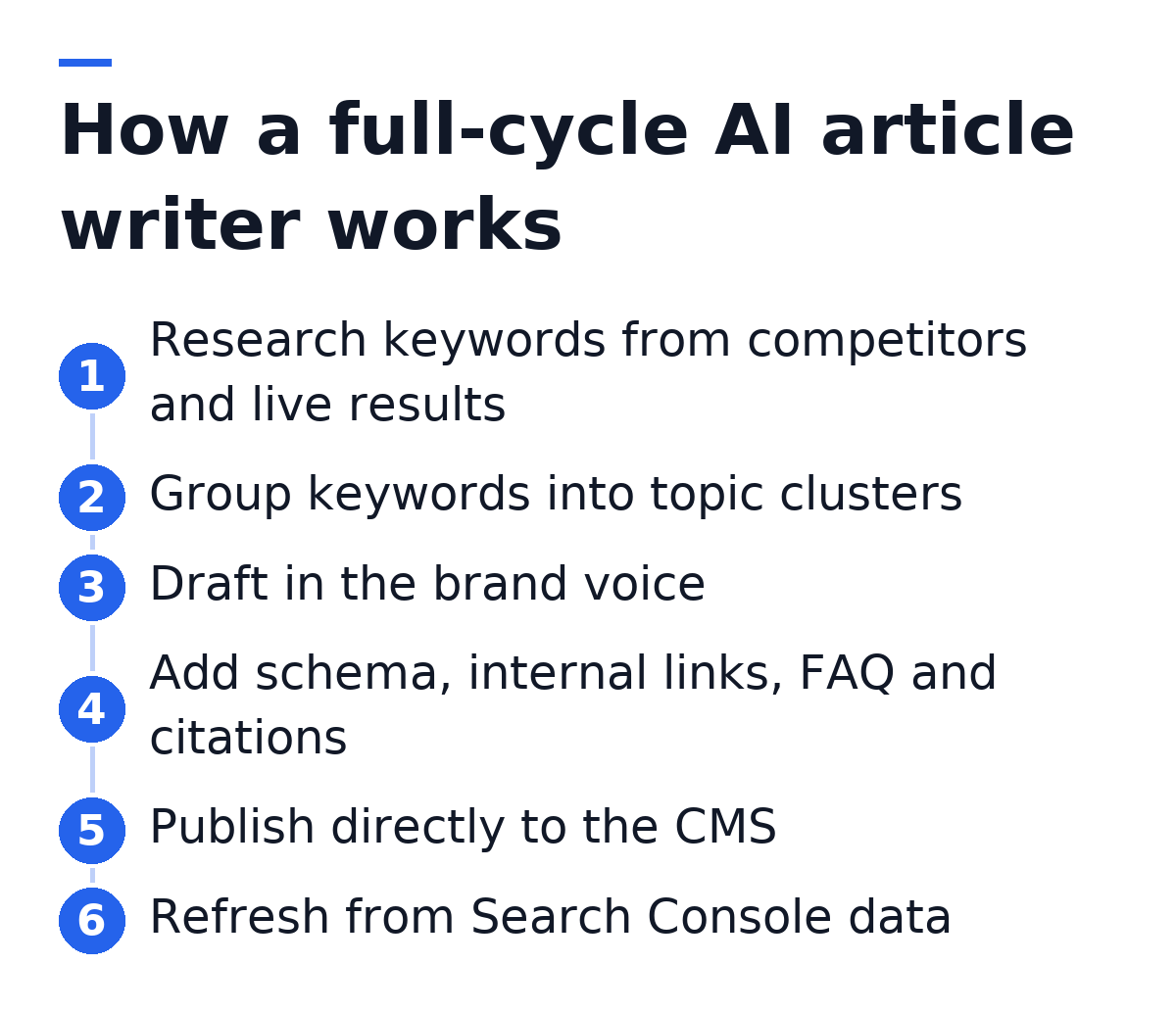
Research quality determines everything downstream. An article writer that guesses at topics produces pages nobody searches for or asks an AI about. Clustering matters because both Google and large language models reward sites that cover a subject coherently rather than as scattered one-offs. Drafting in a consistent brand voice keeps the site sounding like one company, not a patchwork of prompts.
Publishing and refresh are where autonomy compounds. In Gofylo, for example, the Content Engine produces 30 articles a month on the standard plan, each written in a few minutes, and publishes them to the CMS. The Search Console refresh then rewrites articles sitting just off page one and keeps the earlier version so you can restore it. That loop is the structural difference between a writing assistant and a growth system: the system keeps working on pages after they go live.
What Separates an SEO Article Writer From a Draft Generator
An SEO article writer produces pages built to be found and quoted, while a draft generator produces readable text and stops there. The difference sits in structure, not prose. Google needs a clear topic, a sensible heading hierarchy, relevant internal links and structured data that tells it what the page contains. AI assistants such as ChatGPT, Claude, Perplexity and Gemini need something slightly different: passages that answer a question cleanly on their own, so a model can lift and cite them without surrounding context. A draft generator rarely optimizes for either. It writes flowing paragraphs with pronouns that point back across headings, buries answers mid-section and leaves out FAQ blocks and source citations. An AI SEO article writer reverses those habits: answer first, one idea per paragraph, explicit FAQ schema, verified sources. In 2026 the two audiences overlap heavily, so formatting for AI citation usually improves traditional rankings too.
- Answer-first sections: the opening paragraph under each heading directly resolves the question that heading implies.
- Self-contained passages: no sentence depends on a pronoun defined in a previous section.
- Structured data: Article and FAQPage schema so crawlers and models can parse the page reliably.
- Internal links: placed between related articles in the same topic cluster, not bolted on afterward.
- Verified citations: claims tied to original sources rather than unsourced round numbers.
- Multilingual reach: the same quality bar across languages, which matters for teams selling internationally.
Google's own guidance is consistent on one point: it evaluates helpfulness and quality, not whether a person or a model typed the words. That shifts the burden onto the article writer's process. A generator that produces thin, unsourced text fails regardless of who or what produced it. A system that structures, sources and refreshes passes the same bar a strong human editor would.
Visibility in AI answers is measurable. Gofylo's AI Visibility Score shows how ChatGPT and Claude see your brand, and the free AI Search Grader gives any team a baseline before it changes how it produces content.
Where the Human Sits in Each Operating Model
The human sits in a different place in each model, and that placement determines cost and speed more than the software does. With a human article writer, a person does everything, so output scales only with headcount. With an assistive tool, the human remains the operator: they choose keywords, write prompts, stitch drafts together, format, add links and publish. The tool speeds up typing but not decision-making. With an autonomous system, the human becomes an editor and strategist: they set the brand voice, approve direction, spot-check articles and review performance, while research, writing, linking, publishing and refresh run on their own. For a bootstrapped founder or a two-person marketing team, this is the decisive variable. The question is not whether the prose is good, since most modern models write competent prose. It is how many hours per article your team must still contribute before a page goes live and starts earning traffic.
Assistive tools in practice
Beyond Jasper, which built its reputation as a brand-focused writing assistant, most assistive tools follow the same pattern: excellent at producing sections on request, dependent on a skilled operator for everything else. Chat assistants sit in this camp too. If you are weighing the two most common ones, the Claude vs ChatGPT decision mostly comes down to long-form tone and reasoning style, but neither will publish to your CMS or refresh a decaying page on its own.
Autonomous engines in practice
Autonomous platforms treat the article writer as one component in a pipeline. Several products in the market, including Outrank and Rankai, have moved toward this model, which signals where the category is heading. The practical differences between them show up in research depth, citation quality, CMS coverage and whether refresh is driven by real Search Console data. Gofylo, for instance, writes in 18+ languages and publishes to WordPress, WordPress.com, Webflow, Shopify, Wix, Notion, Ghost and Framer, plus a webhook for custom setups.
Misconceptions About Free and Low-Cost Article Writers
The most common misconception is that a free article writer saves money. It usually moves cost from the subscription line to your team's calendar. A free article writer app or browser tool generates a draft, but you still pay in hours for research, fact-checking, formatting, internal linking, schema and publishing, and those hours belong to founders and marketers whose time is expensive. A second misconception is that AI-written content is penalized by default. Search engines judge quality and usefulness, and AI assistants cite passages that answer questions clearly, regardless of origin. A third is that more words mean better rankings. Length helps only when it adds coverage the reader needs; padding dilutes the answer-first passages that AI engines quote. The last is that publishing is the finish line. Pages decay as competitors update theirs, so an article writer without a refresh loop slowly loses the traffic it earned.
Judge the pipeline, not prose. Nearly every modern article writer produces fluent text. Evaluate research, structure, citations, publishing and refresh, because those steps decide whether a page ever earns traffic.
Count your team's hours. The true cost of any article writer tool is its price plus the human time each article still needs. Low sticker prices often hide the most expensive line item.
Format for two audiences. Answer-first sections, self-contained passages, FAQ schema and verified sources serve Google rankings and AI citations at the same time.
Treat publishing as midpoint. Refreshing pages from Search Console data is how a content library compounds instead of quietly decaying.
On pricing, transparency helps you compare honestly. Gofylo runs a single all-in-one plan at $79/month, with a 3-day free trial and cancellation at any time, so the full pipeline cost is visible up front. Whatever you choose, put the per-article human hours next to the subscription fee before deciding which article writer is actually cheaper.
Frequently Asked Questions
These answers cover the questions founders, content leads and solo operators raise most often when deciding what kind of article writer fits their team. Each answer stands on its own, so you can skip straight to the one that matches your situation. The short version: decide which steps of the content pipeline you want to own personally, then choose a person or system that reliably handles the rest. Fluent writing is table stakes in 2026; research quality, structure, citations, publishing and refresh are what separate an article writer that compounds traffic from one that produces pages nobody finds. Keep both Google rankings and AI answers in mind, because the same page now has to serve a human searcher and a language model choosing what to quote. If a question below touches on cost, remember to include your own team's time alongside any subscription or freelance fee when you compare options.
What are the best tools for writing SEO-friendly content?
The best tools handle the whole pipeline: keyword research, topic clustering, answer-first drafting, schema, internal links, citations, publishing and refresh. Chat assistants like ChatGPT and Claude are useful for drafting, while an autonomous platform such as Gofylo covers every step and formats articles for AI citation as well as Google.
What do you call a person who writes an article?
A person who writes an article is usually called a writer, author, content writer or, in journalism, a columnist or correspondent. In marketing teams the role is often titled content writer or content marketer, and freelancers frequently describe themselves simply as an article writer.
Which website does pay for writing articles?
Paid writing work typically comes from freelance marketplaces such as Upwork, trade and industry publications that accept pitches, and company blogs, especially B2B SaaS firms that need subject-matter expertise. Rates vary widely by niche and experience, so writers with technical knowledge in areas like software, security or finance tend to command more.
Which AI is better than ChatGPT for writing?
For long-form writing, many teams prefer Claude for its tone and handling of nuanced instructions, though the better choice depends on the task. For SEO articles specifically, an autonomous system built on these models often beats either chat assistant because it adds research, structure, linking and publishing around the draft.
Is a free article writer good enough for a SaaS blog?
A free article writer can produce usable drafts, but it rarely handles research, schema, internal links or publishing. For a SaaS blog meant to drive pipeline, the hours spent finishing those drafts usually cost more than a paid system that does the full job.
Want an article writer that researches, writes, publishes and refreshes for you? Start a 3-day free trial of Gofylo, connect your CMS and see your first articles go live this week, or run the free AI Search Grader to benchmark how ChatGPT and Claude see your brand today.