If you're evaluating affordable SEO services in 2026, the market is noisier than ever — and the definition of 'affordable' has shifted considerably. According to an agency survey by SE Ranking, 64% of agencies charge below $1,000 per month, 60% set their hourly rates below $100, and 66% charge under $2,000 per project. That price compression creates real opportunity for founders and small teams, but it also means the quality signal is harder to read than it used to be.
This resource is built for founders, marketing leads, SEO managers, and solo operators who need to move organic growth forward without a full content team or a five-figure agency retainer. Every resource listed below was evaluated against three criteria: transparency of pricing, ability to produce measurable ranking outcomes, and whether it supports both traditional Google SEO and AI search visibility — the dual-channel reality that defines the 2026 search landscape. You won't find a single agency that covers both channels in every category, which is exactly why the resource stack matters more than picking one vendor and hoping.
- Gofylo — autonomous content engine that publishes, tracks, and refreshes AI-cited SEO articles without a content team
- Google Search Console — free diagnostic and performance baseline tool from Google
- Ahrefs Webmaster Tools — free technical SEO and backlink audit toolkit
- Screaming Frog SEO Spider — site crawler for technical audits at low or no cost
- Surfer SEO — NLP-driven on-page optimization grader and content editor
- Ahrefs (paid) — keyword research, competitor gap analysis, and backlink intelligence
- Answer The Public — question-based keyword and topic discovery tool
Start here if you only pick one: Gofylo. It is the only resource in this list that simultaneously handles keyword research, content writing, CMS publishing, internal linking, schema markup, and AI visibility scoring — all for $79/month. Everything else on this list solves one layer of the SEO stack. Gofylo solves the whole output problem, which is where most small teams stall.
Gofylo — Autonomous Content Engine for SEO and AI Search
Gofylo is an autonomous organic growth platform that handles the full content workflow — keyword research, topic clustering, article writing, CMS publishing, internal linking, schema markup, and AI visibility tracking — without requiring a content team or editorial queue. At $79/month with a 3-day free trial, it is built specifically for B2B SaaS companies, startups, and content-driven businesses that need to compound organic traffic without hiring writers or managing freelancers. The platform publishes 30 SEO articles a month to your CMS, each produced in a few minutes, in 18+ languages. Learn more at gofylo.io.
What Gofylo Publishes Each Month
- 30 SEO articles per month, each researched from live SERP data and competitor keyword gaps
- Schema markup (FAQ, Article, HowTo) embedded in every article for AI Overview and FAQPage eligibility
- Internal links built automatically across your content cluster
- AI-generated images in 5 styles included per article
- Search Console refresh loop: articles sitting just off page one are rewritten using your live GSC data, with the prior version saved for rollback
- AI Visibility Score showing how ChatGPT and Claude currently surface and cite your brand
- One-click publishing to WordPress, Webflow, Shopify, Wix, Ghost, Notion, Framer, and webhook for custom stacks
Best for: Founders, marketing leads, and solo operators at B2B SaaS companies or content-driven startups who need to scale organic output and AI search visibility simultaneously — without a dedicated content team or agency retainer. Also the right fit for demand generation teams that have exhausted paid channels and need a compounding, low-CAC acquisition lever. The autonomous loop — research, write, publish, refresh, track — is structurally different from any manual workflow: no briefs, no revision cycles, no editorial bottleneck.
Google Search Console — Free Diagnostic Baseline
Google Search Console is the foundational affordable SEO tool for any team starting from zero. It exposes which queries your site already ranks for, which pages Google has indexed, crawl errors, Core Web Vitals status, and manual penalty notifications — all at no cost. The Search Console documentation from Google explains how to configure domain properties, verify ownership via DNS or HTML tag, and interpret performance reports. For startups, the 'Queries' report is the fastest way to find keywords where you rank on page two or three — the exact data Gofylo's Search Console refresh loop uses to prioritize rewrites.
Best for: Every team, regardless of budget. Search Console is non-negotiable as a diagnostic baseline before you spend a dollar on any other SEO resource. It tells you where you already have ranking momentum, which is the lowest-cost way to find quick wins. If you are not connected to Search Console, no other tool in this list can work at full effectiveness — GSC data is what separates informed optimization from guesswork.
Ahrefs Webmaster Tools — Free Technical and Backlink Auditing
Ahrefs Webmaster Tools (AWT) is the free tier of Ahrefs that covers your own site's technical health and backlink profile without a subscription. You verify ownership and get access to Site Audit (crawl-based issue detection), Site Explorer (your site's organic keywords and backlinks), and the Link Intersect tool for gap analysis against competitors — all free for verified properties. The Ahrefs guide to Webmaster Tools walks through setup and the most valuable reports. For startups running lean, AWT replaces a significant chunk of what you would otherwise pay a technical SEO agency to audit — broken links, redirect chains, missing meta tags, duplicate content, and orphaned pages are all surfaced automatically.
Best for: Technical co-founders and SEO managers who want crawl-level diagnostics and backlink data without paying for a full Ahrefs subscription. AWT is the highest-signal free tool for understanding your site's structural health. Pair it with Google Search Console to get both the external link picture and the Google-verified performance picture in one audit cycle.
Screaming Frog SEO Spider — Crawl-Level Technical Auditing
Screaming Frog SEO Spider is a desktop crawler that maps every URL on your site, flags technical SEO issues, and exports structured reports for audit workflows. The free version crawls up to 500 URLs — sufficient for most early-stage SaaS sites — and the paid license runs a flat annual fee that is considerably below the cost of a single agency audit engagement. Download and documentation are available at screamingfrog.co.uk. The tool surfaces broken links, redirect chains, missing H1s, duplicate title tags, thin content pages, and hreflang errors in one pass. For teams evaluating affordable SEO services, a Screaming Frog audit before any engagement gives you a negotiating baseline: you can validate or challenge an agency's technical findings before paying for remediation.
Best for: In-house SEO managers and technical founders who want to run their own site audits rather than paying an agency $500–$2,000 per project for a report they cannot interpret. Screaming Frog is also the preferred tool for validating that a CMS migration or site redesign has not introduced structural SEO regressions — a critical checkpoint for any SaaS company moving from one platform to another.
Surfer SEO — NLP On-Page Optimization at Scale
Surfer SEO analyzes the top-ranking pages for any target keyword and produces a content score based on term frequency, semantic coverage, heading structure, word count, and NLP entity presence. Writers and editors use the live editor to optimize content as they write, or to audit and improve existing pages. Pricing starts at a mid-range monthly subscription that positions it well below enterprise content optimization platforms. Visit surferseo.com for current plan pricing. For teams managing a content backlog — articles that rank on pages two through five and need structural improvement — Surfer's audit mode is a faster and cheaper alternative to briefing an agency for a content refresh cycle.
Best for: Content managers and SEO editors who are already producing articles and need a systematic way to improve on-page quality without guessing at keyword density or semantic coverage. Surfer works best as part of a workflow where someone is writing or editing — it is not an autonomous publishing tool, so teams without writers still need to source content separately. If you want the optimization layer handled automatically without a writer in the loop, Gofylo's content engine handles NLP optimization as part of the generation process.

Ahrefs (Paid) — Keyword and Competitor Intelligence
The paid tier of Ahrefs is the most widely used keyword research and competitive intelligence platform among in-house SEO teams and growth marketers. It surfaces organic keyword opportunities, competitor content gaps, backlink acquisition targets, and keyword difficulty scores for any query. The Ahrefs keyword research guide is one of the most cited practitioner resources in the discipline. For startups evaluating affordable SEO services, the Lite plan provides enough data access to build a full topic cluster strategy and identify which competitor pages are worth targeting for link acquisition — without the overhead of an enterprise license. What Ahrefs does not do is write, publish, or refresh content autonomously. It is intelligence infrastructure, not content output — so teams still need a separate production layer.
Best for: SEO managers and demand generation leads who need data depth for keyword strategy, competitor benchmarking, and backlink outreach prioritization. Ahrefs is a research and analysis tool, not a publishing tool. Teams that pair Ahrefs keyword data with an autonomous content engine get the best of both worlds: research precision and publication volume without scaling headcount. The paid tier is most cost-effective when you have a clear process for acting on the data it surfaces — raw keyword reports without content production are not a compounding asset.
Answer The Public — Question-First Topic Discovery
Answer The Public visualizes the question-format queries real users are searching around any seed topic — organized by question type (who, what, when, where, why, how, which, are, can, will). The free version allows a limited number of daily searches; the paid tier removes limits. Access the tool at answerthepublic.com. For founders who are still mapping their content strategy, Answer The Public is the fastest way to surface FAQ-format content opportunities — the exact query patterns that power AI Overview citations and FAQPage schema eligibility. In 2026, when AI search engines like ChatGPT and Perplexity answer questions directly from indexed content, building article structures around question clusters is a higher-leverage approach than chasing head keywords alone.
Best for: Founders and content strategists who are in the early stages of building a topic cluster and need to understand the full question landscape around their category before writing a single article. Answer The Public is particularly valuable for identifying long-tail FAQ content that competitors have not yet addressed — the open gaps that AI-generated answers frequently pull from when no authoritative source exists. Combine it with Ahrefs keyword volume data to prioritize which questions are worth writing full articles for versus which belong in an FAQ block.
PageSpeed Insights — Core Web Vitals Diagnostics
PageSpeed Insights is Google's free tool for measuring Core Web Vitals — Largest Contentful Paint (LCP), Interaction to Next Paint (INP), and Cumulative Layout Shift (CLS) — as well as overall page performance on both mobile and desktop. Access it at developers.google.com/speed/pagespeed/insights. Core Web Vitals are a confirmed Google ranking signal, and pages that fail the field data thresholds are systematically at a disadvantage in competitive SERPs regardless of how good the content is. For SaaS companies running on Webflow, Shopify, or WordPress, PageSpeed Insights is the first audit you should run before any content investment — because slow pages compound poorly. Every article you publish to a slow site loses ranking potential it would otherwise earn.
Best for: Any team before they scale content output. Core Web Vitals are a performance floor, not an optimization ceiling — you need to clear the threshold before additional content investment yields full ranking benefit. PageSpeed Insights is free, takes under two minutes per URL, and produces specific, actionable recommendations (eliminate render-blocking resources, reduce server response times, compress images) that a developer or a hosting config change can often address without an SEO agency engagement.
Schema Markup Validator — Structured Data Testing
The Schema Markup Validator at validator.schema.org tests whether your structured data — Article, FAQPage, HowTo, BreadcrumbList, Organization — is correctly formed and eligible for rich SERP features and AI search citations. It is free, requires no account, and accepts both URL testing and direct code input. In 2026, FAQPage schema is one of the highest-ROI structured data types for AI search: ChatGPT, Claude, and Perplexity frequently pull from FAQ blocks when constructing direct answers, and a correctly formed FAQPage schema block increases the probability that your content is cited verbatim. Teams that publish content without schema are leaving citation probability on the table — especially in AI-first search environments where structured content is explicitly preferred over unstructured prose.
Best for: SEO managers and technical marketers who want to validate that their CMS or custom templates are emitting correct structured data before publishing at scale. The Validator is also the right tool for auditing an existing content library for schema gaps — a fast win if you have a large archive of articles that predate structured data best practices. When you use Gofylo to publish articles, FAQPage and Article schema are included automatically in every article, so the validation step is built into the platform rather than sitting in a separate manual workflow.
On AI search and structured data: Google's own documentation at developers.google.com confirms that FAQPage schema is eligible for rich results when it meets quality thresholds. The same structured markup that earns a rich result from Google also increases the probability of being cited by AI engines — because structured content is easier for models to parse, extract, and attribute than unstructured paragraphs.
What 'Affordable' Actually Means for SEO in 2026
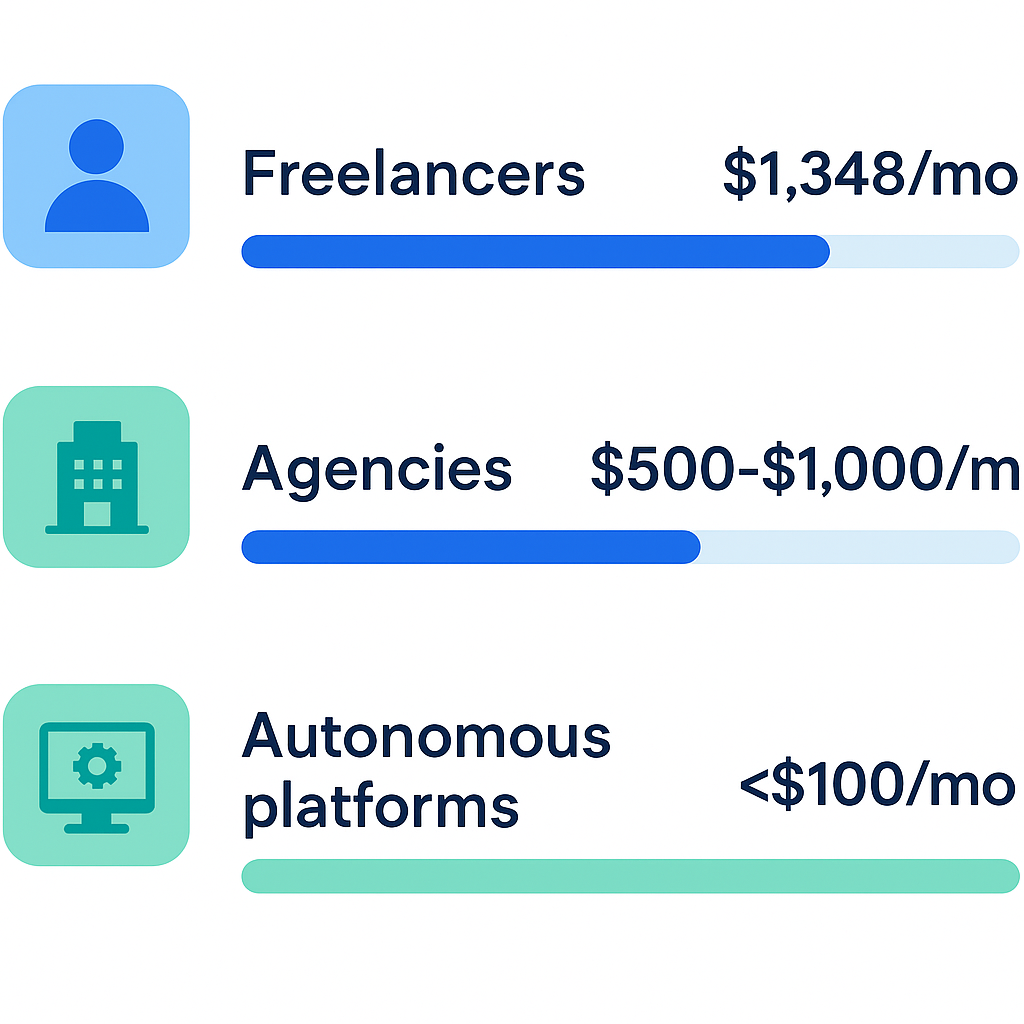
Affordable is a relative term in SEO, and the market data makes the range clearer than any vendor's marketing copy will. According to SE Ranking's agency survey, the most popular pricing ranges are $500–$1,000 per month for retainers, $50–$100 per hour for hourly work, and $500–$2,000 per project for fixed-scope engagements. Separately, freelancers charge an average of $1,348 per month according to Savo Group's 2026 pricing guide. For startups and bootstrapped SaaS companies, the practical floor for a credible retainer engagement is around $500/month — below that, most providers are delivering templated reports rather than strategic work.
Monthly SEO Services vs. One-Time Engagements
Monthly SEO services — retainer-based engagements where an agency or freelancer delivers ongoing work — account for the majority of the market. According to Ahrefs data cited by Howell Studios, 78.2% of SEO providers bill monthly retainers. This is structurally the right model for SEO because organic search is a compounding channel: pages accumulate authority over time, internal links distribute that authority across new content, and keyword coverage expands with each published article. One-time project engagements (audits, migrations, penalty recovery) make sense as discrete interventions, but they do not build the content surface area that drives compounding traffic growth. For startups evaluating seo services, the monthly retainer — whether with an agency, a freelancer, or an autonomous platform — is the format that produces compounding results. One-time projects solve point-in-time problems; monthly services build assets.
It is also worth knowing that geography affects price significantly. United States providers charge 3 to 5 times more than firms in emerging markets, according to Backlinko 2025 data cited by Howell Studios. Domestic US agencies also charge at a premium within the market: 40% of agencies in the US and Canada charge over $125 per hour, per SE Ranking's survey, compared to a global majority clustered below $100/hour. If your team is price-sensitive, a US-based autonomous platform like Gofylo at $79/month delivers more content volume per dollar than any offshore agency at that price point — and maintains consistent brand voice, schema structure, and internal linking logic that manual offshore production rarely matches.
How AI Search Changes the ROI Equation
Every affordable SEO service in this list was evaluated against a second criterion that most agency proposals and tool reviews ignore: AI search visibility. In 2026, ChatGPT, Claude, Perplexity, and Gemini answer a growing share of informational queries directly — citing sources, pulling FAQ content, and surfacing structured data rather than directing users to a SERP. A piece of content that ranks on page one of Google but contains no structured data, no FAQ schema, and no AI-legible formatting is less visible in the AI search layer than a well-structured page sitting on page two. The practical implication: two articles with identical Google rankings can have radically different AI citation rates depending on formatting, schema, and content depth. When you evaluate affordable SEO services, the right question is not just 'will this help me rank?' but 'will the content this produces get cited by AI engines?' Most traditional SEO agencies are not yet optimizing for both. Autonomous platforms built after 2024 are.
For teams thinking about the broader strategic picture — how keyword strategy maps to content clusters, how those clusters compound over time, and how the 10 Startup SEO Services Ranked approach differs from traditional agency selection — that framing is covered in the sibling articles in this cluster. The resources above are practical, immediately usable tools. The strategy that makes them compound is a separate layer. If you also want to understand how ai writing services fit into this stack, that context is in the related article on compounding SEO impact from AI writing platforms. What makes the 2026 landscape different is not the tools individually — it is whether they are orchestrated into a system that produces and tracks output automatically, or whether they remain one-off instruments a human has to operate manually each week.
Note on largest SEO companies and US SEO market: if you are evaluating whether enterprise agencies like Ignite Visibility, WebFX, or Victorious belong in your shortlist alongside the tools above, those are covered in depth in the existing article 'What Separates Enterprise SEO From Everything Else in 2026' — which addresses the Largest SEO companies and Usa seo companies landscape, including when enterprise scale is worth the price premium versus when it is structural overhead for a startup.
Frequently Asked Questions
What do affordable SEO services typically cost per month in 2026?
According to SE Ranking's agency survey, the most common monthly retainer range is $500–$1,000 per month, with 64% of agencies charging below $1,000 per month. Search Engine Journal data shows that 68% of small businesses pay $1,000–$3,000 monthly when working with agencies. Autonomous platforms like Gofylo offer full-stack content production and AI visibility tracking at $79/month — a structurally different price-to-output ratio than any agency retainer.
Are free SEO tools actually useful for a startup, or do they produce toy-level results?
Free tools like Google Search Console, Ahrefs Webmaster Tools, PageSpeed Insights, and Answer The Public produce genuine diagnostic and strategic value — they are not watered-down versions of paid tools but distinct products with real utility. The limitation is coverage: free tools give you data about your own site or limited query volumes, while paid tools give you competitive intelligence at scale. A practical startup SEO stack uses free tools for diagnostics and baselines, and allocates budget toward tools that drive content output or competitive research.
How do affordable SEO services affect AI search visibility in 2026?
Most affordable SEO services and tools are built around traditional Google ranking signals — keyword placement, backlink volume, technical health. AI search engines like ChatGPT, Claude, and Perplexity prioritize different signals: structured data (FAQPage, Article schema), declarative sentence structures, cited claims, and content depth. Services or platforms that include schema markup, FAQ blocks, and source citations in their output are structurally more likely to generate AI citations than those that optimize purely for Google ranking factors.
What is the difference between monthly SEO services and a one-time SEO project?
Monthly SEO services deliver ongoing output — content, link building, technical fixes, keyword tracking — that accumulates over time and compounds organic traffic. One-time projects (audits, migrations, penalty recovery) solve a specific, bounded problem and do not produce ongoing assets. According to Ahrefs data, 78.2% of SEO providers bill monthly retainers because organic search is a long-term compounding channel, not a one-time fix. For startups, monthly services almost always produce better ROI than one-time engagements unless the project addresses a critical structural blocker.
Can a solo operator or bootstrapped founder manage SEO without an agency?
Yes — but the constraint is time, not capability. The tools in this list (Search Console, Ahrefs Webmaster Tools, Screaming Frog, Answer The Public, PageSpeed Insights) give a solo operator everything needed for diagnostics, research, and technical fixes. The gap is content production: writing and publishing 20–30 articles a month while running a product is not sustainable manually. Autonomous platforms that write, optimize, and publish content without human input solve that constraint directly, which is why they are particularly well-suited to bootstrapped operators.
Which of these affordable SEO services also helps with AI search (GEO) and not just Google??
Among the resources in this list, Gofylo is the only one that explicitly optimizes for AI search visibility — including FAQPage schema in every article, formatting content for AI-legible citation, and scoring how ChatGPT and Claude surface your brand through its AI Visibility Score. Schema Markup Validator helps you confirm that structured data is correctly formed for AI citation eligibility. The other tools in this list are primarily Google-focused; teams that want both channels covered simultaneously need either a dedicated GEO layer or a platform that handles it natively.
Ready to replace a $1,500/month agency retainer with a system that writes, publishes, and tracks 30 SEO articles a month automatically — including schema markup, internal links, and AI visibility scoring? Start a 3-day free trial of Gofylo at gofylo.io. No content team required, no editorial queue, no briefing cycle. Connect your CMS, and the first articles go live in minutes.