In 2026, asking what is the best AI for writing is really asking two different questions at once: which tool produces the best prose, and which tool builds the kind of content infrastructure that compounds over time? For founders and marketing leads at B2B SaaS companies, the first question matters less than the second. Fluent sentences are table stakes. What separates tools now is whether they handle keyword research, internal linking, schema markup, AI search citation formatting, and CMS publishing automatically, or whether they hand you a draft and leave the rest to you.
This comparison focuses on seven tools that B2B content teams seriously consider in 2026: Gofylo, ChatGPT, Claude, Writesonic, Clearscope, Outrank, and Rankai. Each occupies a genuinely different position in the stack. Some are generalist AI assistants, some are SEO-first editors, and one (Gofylo, the author's own product) is an autonomous content engine that handles the full cycle from research to publication without a standing content team. The decision you face is not which tool writes the most elegant paragraph, but which tool fits the growth motion you are actually trying to run.
Quick verdict: If you want a conversational AI layer for ad hoc writing, ChatGPT or Claude wins depending on task length. If you need autonomous, compounding content that ranks on Google and gets cited by AI engines, Gofylo is built for that job. Writesonic suits teams that want volume with moderate SEO scaffolding. Clearscope, Outrank, and Rankai sit in the optimization and GEO-tracking tier rather than the generation tier.
At a Glance: How These Tools Actually Differ
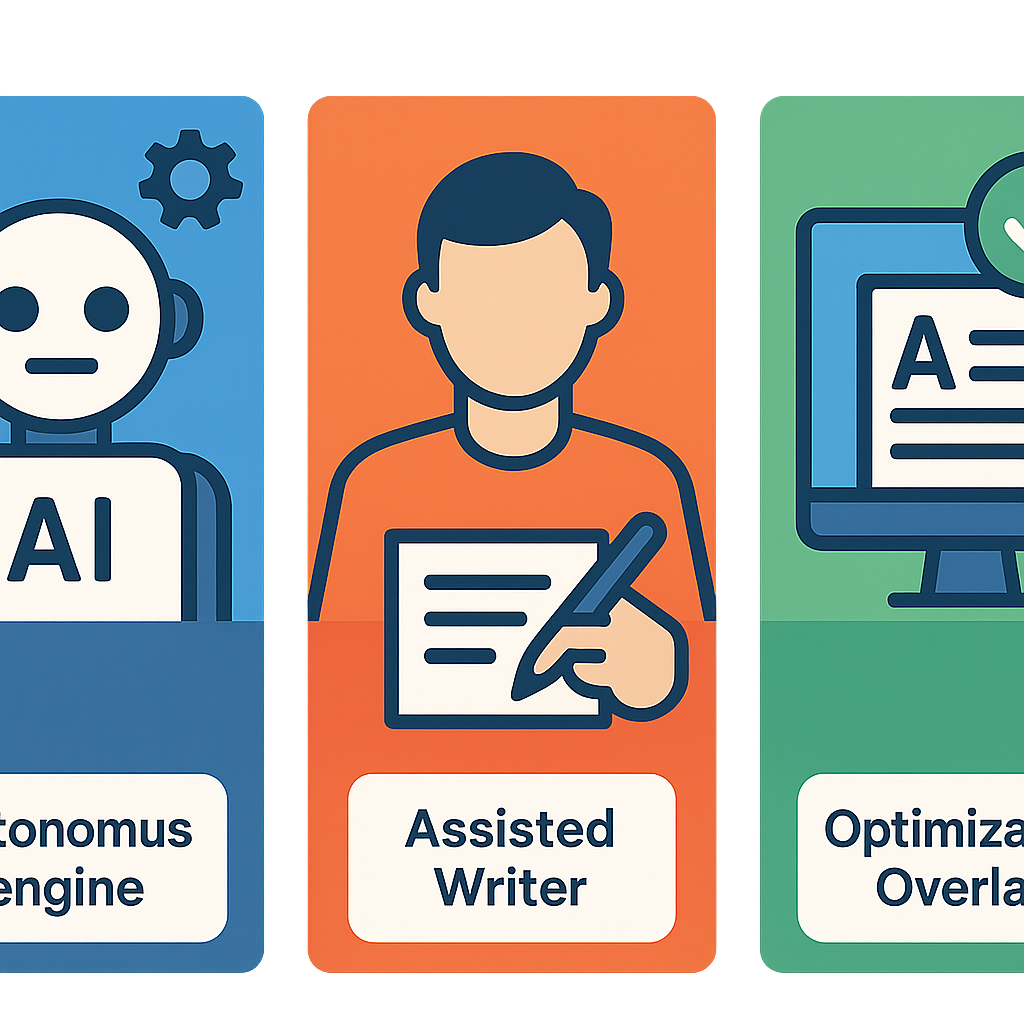
Most AI writing tool comparisons treat every product as a variation of the same thing: a text box that outputs prose. That framing is misleading in 2026. The more useful taxonomy splits tools into three tiers: autonomous content engines that research, write, optimize, and publish without human prompts; assisted writing layers that accelerate human writers but require a person at every step; and optimization overlays that grade or structure content but do not generate it from scratch. Understanding which tier a tool occupies tells you more about the right choice than any feature checklist. The six axes below are the ones that actually decide the question for B2B SaaS teams: automation depth, SEO output quality, AI search formatting, price, CMS integration, and context window size.
- Automation depth: does the tool research, draft, internally link, and publish on its own schedule, or does a human initiate every step?
- SEO output: does the article include schema markup, keyword clustering, and structured headings automatically?
- GEO formatting: is the content structured so AI engines like ChatGPT, Claude, Perplexity, and Gemini can extract and cite it?
- Context window: can the model handle long briefs, brand voice documents, or full article threads without truncating?
- CMS integration: does the tool publish directly to WordPress, Webflow, Shopify, or other platforms without manual copy-paste?
- Pricing model: is the cost per article, per seat, or a flat all-in-one monthly fee?

Axis 1: Automation Depth and Content Volume
Automation depth is the clearest differentiator across the tools in this comparison. It determines whether your content operation scales linearly with headcount or compounds on its own. A tool that writes a great draft but requires a strategist to pick keywords, a writer to edit, an SEO specialist to add schema, and a developer to publish is still a four-person workflow. An autonomous content engine collapses those roles into a single system that runs on a set schedule. For early-stage B2B SaaS teams where every hire competes with product and sales investment, this distinction is not abstract. It is the difference between publishing four articles a quarter and publishing thirty a month.
Gofylo
Gofylo (the author's product) Gofylo is purpose-built for autonomous volume. The platform researches keywords from competitor sites and live search results, groups them into topic clusters, writes articles in the brand's voice, adds schema markup and internal links, attaches AI-generated images in five styles, and publishes directly to the connected CMS. The standard plan delivers thirty articles a month, each produced in a few minutes. Gofylo also monitors Google Search Console data and rewrites articles that are sitting just off page one, keeping the earlier version so teams can restore it if needed. This is a compounding loop: research feeds writing, writing feeds publishing, publishing feeds ranking data, and ranking data feeds rewrites, all without a human initiating each step. For a founder or solo operator who cannot staff a content team, this is the mechanism that makes organic growth structurally possible.
ChatGPT
ChatGPT (GPT-4o) ChatGPT is the most widely used AI writing layer in the world, and for good reason. It is fast, conversational, and capable of producing coherent first drafts across almost any format: blog posts, email sequences, LinkedIn threads, landing page copy, and technical documentation. However, ChatGPT operates entirely on human prompts. The tool has no awareness of your keyword strategy, no CMS connection, no schema output, and no scheduled publishing cadence. Every article requires a person to define the brief, prompt the model, review the output, add SEO metadata, and publish manually. ChatGPT is a powerful acceleration layer for a writer who already exists. It is not a substitute for a content team.
Claude
Claude (Anthropic) Claude is Anthropic's model and its primary advantage over ChatGPT is context. According to a 2025 comparison by independent analyst M. Huzaif Ariz, Claude processes up to 200,000 tokens compared to ChatGPT's 128K limit, which matters when you feed it a full brand voice document, a competitor article, a long-form brief, and a style guide all at once. Claude also tends to produce more measured, nuanced prose that reads less like generated content, which is valuable for thought leadership and case study writing. Like ChatGPT, though, Claude is a prompt-and-respond tool. It does not research keywords, does not publish, and does not track how its output performs in search. The automation ceiling is the same as ChatGPT's: a human initiates every step.
Writesonic
Writesonic Writesonic sits between the full autonomy of Gofylo and the prompt-first model of ChatGPT and Claude. The platform at writesonic.com offers an AI article writer, a Chatsonic assistant (built on live web data), and an SEO-oriented long-form editor. Teams can produce substantial article volume with Writesonic, and the tool includes some keyword and on-page suggestions. Where it falls short relative to an autonomous engine is in the publishing and optimization loop: Writesonic generates, but does not publish to your CMS, does not rewrite based on Search Console performance, and does not run a scheduled content calendar without human scheduling. It is a good fit for content teams that want to accelerate their writing velocity while keeping editorial control over each article.
Clearscope, Outrank, and Rankai
Clearscope, Outrank, and Rankai These three tools operate primarily in the optimization tier rather than the generation tier. Clearscope at clearscope.io is a content grading tool: it analyzes top-ranking SERP results for a target keyword, identifies related terms, and grades a draft in real time against that term set. It is excellent for ensuring an already-written article is topically comprehensive, but it does not generate the article. Outrank at outrank.so focuses on AI-assisted SEO content production with a brief-builder orientation. Rankai at rankai.ai is positioned as an AI SEO agent that can surface keyword opportunities and generate content briefs. None of the three replaces a content team the way an autonomous engine does. They are best understood as tools that make a content team more efficient, not tools that eliminate the need for one.
Axis 2: SEO and GEO Output Quality
Generating a readable article is not the same as generating a rankable one. For a B2B SaaS audience, the distinction matters because organic content is an investment with compounding returns only if the articles actually reach the first page of Google and get cited by AI engines. SEO output quality covers keyword density and placement, heading hierarchy, internal linking, schema markup (especially FAQ and Article schema), meta description generation, and image alt text. GEO output quality, the newer requirement, covers whether the article is formatted so that ChatGPT, Claude, Perplexity, and Gemini can extract clean, citable answers from it. According to Ahrefs' 2026 content research, structured content with clear answer paragraphs and FAQ blocks consistently outperforms unstructured prose for both featured snippets and AI Overview citations.
Gofylo
Gofylo Every article Gofylo produces includes schema markup, internal links drawn from the existing site, FAQ blocks formatted for FAQPage schema, and meta descriptions. The keyword research phase uses competitor data and live SERP results to identify terms that have ranking potential rather than just search volume. Because Gofylo is built specifically around GEO formatting, articles are structured with declarative answer paragraphs under each heading, which is the format AI engines preferentially lift and cite. The AI Visibility Score feature shows how ChatGPT and Claude see the brand at a point in time, which gives teams a signal beyond rank position. This is a measurable GEO output that most writing tools do not attempt.
ChatGPT
ChatGPT ChatGPT can produce SEO-structured content when prompted carefully: a prompt that specifies heading hierarchy, target keyword, FAQ block, and meta description will return a draft that covers most of those elements. The gap is consistency and depth. ChatGPT does not have access to your site's current internal link graph, does not know which keywords your competitors rank for, and does not apply schema markup. A skilled content manager with a disciplined prompt library can close some of these gaps manually, but that is time investment that compounds into overhead at scale. For GEO formatting specifically, ChatGPT output often works against itself: the model tends toward discursive prose rather than the declarative, one-idea-per-sentence structure that AI engines extract most reliably.
Claude
Claude Claude's longer context window is a genuine SEO advantage in one specific scenario: when you need to feed the model a full competitor article, a keyword brief, and a brand voice guide simultaneously and get a coherent first draft that integrates all three. The output quality for long-form articles is often stronger than ChatGPT in terms of logical structure and citation accuracy. For GEO formatting, Claude tends to produce cleaner, more structured prose when prompted, which gives it an edge as an AI search citation source compared to more conversational models. Still, Claude produces a draft, not a published, optimized article. All the SEO infrastructure work remains manual.
Writesonic
Writesonic Writesonic's article editor includes on-page SEO suggestions and integrates keyword inputs into its generation flow. For teams that want a faster draft with some SEO scaffolding included, it is meaningfully ahead of a raw ChatGPT prompt. The GEO formatting capability is limited: Writesonic does not produce FAQPage schema, does not structure articles for AI citation, and does not include an AI visibility measurement layer. As a tool that sits Beyond Jasper in the SEO-oriented AI writing space, Writesonic is a solid mid-tier choice for content teams that value speed and moderate SEO coverage without full automation.
Clearscope, Outrank, and Rankai
Clearscope, Outrank, Rankai Clearscope's core strength is SEO output grading. Its term-frequency scoring ensures that a drafted article covers the topical depth that top-ranking competitors cover, which is directly connected to on-page SEO quality. Outrank combines content production with SEO briefing and is particularly focused on generating articles that match search intent at scale. Rankai is positioned more explicitly around AI search, surfacing how well a brand appears in generative engine results. Among the three, Rankai is the most GEO-adjacent, though none of them offer the full research-to-publish loop that an autonomous engine delivers.
Axis 3: AI Search Visibility and GEO Formatting
AI search visibility is the new frontier in 2026 content strategy. When a user asks ChatGPT, Claude, Perplexity, or Gemini a product-relevant question, the answer they receive is pulled from indexed content that the model trusts as authoritative, well-structured, and cited. If your articles are not formatted for GEO, they will not be cited regardless of how well they rank in Google. Google's own documentation on AI Overviews confirms that structured, answer-first content is significantly more likely to be surfaced in generative results. This is a structural shift that separates tools built before 2025 from those designed with GEO as a first-class output requirement.
Gofylo
Gofylo Gofylo is the only tool in this comparison that explicitly formats articles for AI search citation as a default output, not an optional feature. Every article includes FAQ blocks with FAQPage schema, declarative answer paragraphs positioned immediately under each H2, outbound citations to authoritative domains, and structured heading hierarchies. The AI Visibility Score dashboard shows how ChatGPT and Claude see the brand, with Perplexity and Gemini being added to the scoring set. This means a Gofylo customer can see, in a single dashboard, whether their content output is shifting their AI search presence over time. For B2B SaaS companies where a prospect's first touchpoint may now be an AI assistant rather than a Google result, this visibility signal is a strategic asset.
ChatGPT and Claude
ChatGPT and Claude Neither ChatGPT nor Claude produces content with GEO formatting as a default. Both models can be prompted to structure output with declarative paragraphs and FAQ blocks, but the prompt discipline required to make that consistent across thirty articles a month is significant. More importantly, neither tool measures or tracks how published content performs in AI search. A team using ChatGPT or Claude for content production has no signal about whether their articles are being cited by AI engines, which means GEO performance is invisible to them. The Claude vs ChatGPT debate often centers on prose quality and context window, but for GEO purposes, both tools have the same fundamental limitation: they are generators, not systems.
Writesonic
Writesonic Writesonic has made moves toward AI search awareness, including a web-grounded generation mode via Chatsonic. However, GEO formatting is not a core output requirement in Writesonic's standard article generation flow. Articles do not automatically include FAQPage schema, AI-citation-optimized paragraph structure, or an AI visibility measurement layer. For teams whose primary concern is traditional SEO volume, this is an acceptable trade-off. For teams building a 2026 content strategy that needs to perform in both Google and AI engines simultaneously, Writesonic leaves a gap.
Clearscope, Outrank, and Rankai
Clearscope, Outrank, Rankai Clearscope is primarily a traditional SEO grading tool and does not yet have a dedicated GEO formatting layer. Outrank is building toward a more complete AI search presence, but its core product remains brief-and-generate rather than measure-and-optimize for AI citations. Rankai is the most GEO-explicit of the three, with features designed to surface how a brand appears in generative AI results and identify content gaps. For teams specifically focused on AI search visibility as a standalone discipline, Rankai is worth evaluating. It is not an all-in-one content engine, but it fills a specific GEO intelligence gap that the other tools leave open.
Axis 4: Pricing and Team Size Fit
Pricing structure matters as much as the price itself. A per-seat model scales poorly for a two-person marketing team that adds contractors. A per-article credit model creates anxiety around publishing volume. A flat monthly fee with a defined output ceiling is the most predictable model for a B2B SaaS company with a quarterly content budget. In 2026, the tools in this comparison have landed on meaningfully different pricing shapes, and each shape implies a different organizational fit.
Gofylo Gofylo is priced at $79 per month for the all-in-one plan, which includes thirty articles a month, CMS publishing, Search Console refresh rewrites, AI Visibility Score, schema markup, internal links, images, and 18-plus language support. There is a three-day free trial and cancellation at any time. For a bootstrapped founder or a growth-stage team that would otherwise pay a content agency several thousand dollars a month for equivalent volume, the economics are straightforward. The model is also predictable: one line item covers the full content stack.
ChatGPT and Claude ChatGPT Plus costs a fixed monthly fee per user and gives access to GPT-4o with a large context window. Claude Pro is similarly priced at $20 per month per user and provides the 200,000-token context window. Both tools are inexpensive in isolation, but the true cost of using either for a scaled content program includes the time cost of prompting, editing, adding SEO metadata, managing internal links, and publishing manually. At that article volume, the time cost typically exceeds the flat fee of an autonomous engine by a meaningful margin, which shifts the comparison significantly in favor of the autonomous model.
Writesonic Writesonic's pricing scales with word count and features, with plans ranging from a free tier to higher-volume paid plans. The model is broadly per-credit, which means teams that push volume encounter cost increases that are not always predictable at budget time. For a content manager who wants to augment their writing speed without replacing the team, Writesonic's pricing is reasonable. For a founder who wants to replace a content team, the per-credit model adds friction that a flat-fee engine avoids.
Clearscope, Outrank, Rankai Clearscope is positioned at the premium end of SEO tooling. Its per-document pricing model means costs scale with the number of articles optimized, and at high volume, Clearscope becomes expensive relative to the value it adds as an optimization layer alone. Outrank and Rankai are newer entrants with pricing that is actively evolving. Teams evaluating either should request current pricing directly, as published rates shift frequently in this category.
Axis 5: CMS Integration and Publishing Workflow
Publishing friction is one of the most underestimated costs in a content program. A team that generates a high volume of articles each month but spends an hour per article on manual formatting, image uploading, meta tag entry, and CMS publishing is consuming a substantial block of time before a single word of editorial review happens. CMS integration that handles the full publish step, not just the export step, is the difference between a content operation that scales and one that bottlenecks on the ops side. The tools in this comparison handle this very differently, and the gap is larger than most buyers expect before they start using the tools.
Gofylo Gofylo publishes directly to WordPress, WordPress.com, Webflow, Shopify, Wix, Notion, Ghost, and Framer. A webhook integration covers custom setups. The publish step is not manual export plus paste: the tool handles metadata, images, schema, and internal links as part of the publish action. For teams running on any of these platforms, the integration removes the publishing bottleneck entirely. The AI-generated images in five styles are included and sized for web, which removes a second common bottleneck: sourcing or creating visual assets for each article.
ChatGPT and Claude Neither ChatGPT nor Claude integrates with a CMS at the native platform level. Both tools produce text output that requires copy-paste into a CMS, manual image sourcing, manual meta tag entry, and manual internal link identification. For one or two articles, this is a minor inconvenience. At thirty articles a month, it is a meaningful recurring time cost. Some teams use Zapier or Make to pipe ChatGPT or Claude output into a CMS via API, but that configuration requires technical setup and ongoing maintenance, and it still does not handle SEO metadata or schema automatically.
Writesonic Writesonic offers some CMS integrations through its publishing features, including WordPress connectivity in higher-tier plans. The integration is more limited than a native publish-with-schema flow, but it reduces the manual copy-paste step for teams already on WordPress. Teams on Webflow, Shopify, or custom setups will typically still need to handle the publish step manually or through a third-party connector.
Clearscope, Outrank, Rankai Clearscope integrates with Google Docs and WordPress for grading purposes, meaning writers can see content scores inside their editor. It does not handle publishing. Outrank and Rankai are similarly focused on the research and brief layer, not the publish layer. Teams using these tools will still need a separate publishing workflow and a separate CMS integration if they want to remove the manual step from their process.
CMS integration is a compounding efficiency gain. A team that removes meaningful publishing friction per article saves a significant number of hours each month at high article volumes. Over a year, those recovered hours can go into strategy, distribution, or conversion optimization instead.
Is ChatGPT or Claude Better for Writing?
For B2B SaaS writing specifically, Claude has a consistent edge over ChatGPT in three scenarios: very long-form content (because of its larger context window), nuanced thought leadership that requires careful hedging and tone calibration, and situations where you need to feed the model a large corpus of background material all at once. Claude's 200,000-token context window (documented by analyst M. Huzaif Ariz in a 2025 comparison) means it can hold an entire content strategy document plus a competitor article plus a brand guide in a single session, which ChatGPT's 128K window cannot always accommodate cleanly. However, ChatGPT has the larger plugin and integration ecosystem, stronger coding assistance for technical product marketers, and more predictable pricing at scale. The honest answer to which is better for writing depends on whether your bottleneck is context length, prose quality, integration breadth, or cost. For most B2B SaaS marketing teams doing ad hoc content work, the differences are meaningful but not decisive. The Claude vs ChatGPT question is well worth examining in depth if your team is trying to settle on a primary AI writing layer for the full content workflow.
If your writing tasks are mostly shorter pieces, ChatGPT and Claude are close to equivalent in quality. If you regularly write long-form pillar content or need to process large reference documents, Claude's extended context window becomes a genuine differentiator.
Which AI Is Better Than ChatGPT for Writing?
Several AI tools outperform ChatGPT for specific writing tasks in 2026, and the right answer depends on what dimension of writing matters most to your team. For long-form nuance and document-processing depth, Claude is consistently rated above GPT-4o by practitioners working with complex briefs. For autonomous, structured SEO content at volume, Gofylo produces output that ChatGPT cannot replicate without a skilled prompt engineer managing every article. For paraphrasing and citation-checking workflows, QuillBot has built a large user base, with the platform reporting tools delivered to over 60 million users according to a 2025 review by Macrohype. Sudowrite occupies a niche that is largely non-overlapping with B2B marketing: it is purpose-built for fiction prose, and authors who use it report meaningfully better creative output than any general-purpose model. According to Semrush's 2026 content marketing benchmarks, teams that use purpose-built AI writing tools rather than general-purpose LLMs report higher content quality scores and faster time-to-publish, which suggests the specialization premium is real. For B2B SaaS teams specifically, the answer to 'which AI is better than ChatGPT' is almost always either Claude (for quality) or an autonomous engine like Gofylo (for compounding output) depending on the workflow.
Is ChatGPT Still the Best AI?
ChatGPT is still the most widely used AI writing tool in the world in 2026, and its brand recognition means it is often the default choice for teams that have not done a structured evaluation. But being the most popular is not the same as being the best fit for a specific use case. ChatGPT's primary strength is versatility: it handles short-form copy, code, data analysis, brainstorming, and conversational drafting across a single interface. For B2B SaaS content teams, versatility is valuable but not the primary requirement. The primary requirement is ranked, cited, published content at a pace that compounds. On that dimension, ChatGPT requires so much human scaffolding that it is not competitive with purpose-built tools. The honest framing is that ChatGPT is an exceptional general-purpose ai tool that remains the right choice for ad hoc tasks, exploratory writing, and teams that need flexibility across many content types. It is not the right choice as the primary engine for a systematic B2B content program in 2026, because the volume, SEO structure, GEO formatting, and publishing loop all require additional systems on top of it.
Do Professional Writers Use ChatGPT?
Professional writers use ChatGPT extensively in 2026, but almost never as a replacement for their own writing. The most common professional use cases are: generating outlines and section structures before drafting, producing research summaries from uploaded documents, rewriting awkward sentences in an existing draft, checking that a tone is consistent across a long document, and generating variation options for headlines and meta descriptions. Writers who use ChatGPT as a first-draft engine and then edit the output report mixed results: the time savings are real for some content types (listicles, how-to guides) and minimal for others (genuine thought leadership, case studies, technical deep dives) where the human judgment layer is the actual value. The more interesting trend in 2026 is that professional content teams are splitting tasks: ChatGPT or Claude handles research summaries and outline generation, while autonomous engines like Gofylo handle the systematic, scheduled content program that does not require a professional writer's specific expertise for every article. This hybrid model separates high-value editorial work from high-volume commodity content, which is where most B2B SaaS content budgets are wasted when they try to staff both manually.
Verdict: Which Tool Should You Choose?
The answer to what is the best AI for writing depends entirely on the job to be done. There is no single winner across all dimensions, but there is a clear winner for each archetype of B2B SaaS team. A bootstrapped founder who needs thirty articles a month without hiring anyone needs an autonomous engine. A senior content manager at a series B company who is writing strategic thought leadership needs Claude's long context window and prose quality. A content team optimizing existing articles needs Clearscope's grading layer. A team trying to measure AI search visibility as a separate metric from Google rank needs a GEO-aware tool with an AI visibility score. The question is not which tool is objectively best. The question is which tool matches your content motion: the frequency, the format, the distribution channel, and the team size.
- Choose Gofylo if you need autonomous, compounding content production (thirty articles a month), CMS publishing, GEO formatting, and an AI Visibility Score without hiring a content team.
- Choose Claude if you are a professional writer or senior strategist who needs a large context window, careful prose, and deep document processing for high-stakes, low-volume content.
- Choose ChatGPT if you need a versatile AI layer for ad hoc writing tasks across many content types and your team already manages the SEO and publishing workflow manually.
- Choose Writesonic if you want to accelerate a small content team's output with moderate SEO scaffolding included, and your team handles final optimization and publishing steps.
- Choose Clearscope if you already have a content team and a writing workflow, and you need a grading tool to ensure topical coverage meets SERP standards before publishing.
- Choose Outrank or Rankai if your primary concern is brief generation, AI search visibility measurement, or identifying GEO gaps rather than full-cycle content production.
For most growth-stage B2B SaaS teams evaluating what is the best AI for writing, the highest-ROI move in 2026 is an autonomous content engine that handles research, writing, schema, and publishing in one system. Gofylo's $79 flat-fee plan covers the full cycle with a three-day free trial and no long-term contract.
Frequently Asked Questions
Which AI is better than ChatGPT for writing?
For long-form, nuanced writing, Claude outperforms ChatGPT because of its larger context window (up to 200,000 tokens versus ChatGPT's 128K) and more measured prose style. For autonomous, compounding content production with SEO and GEO formatting built in, tools like Gofylo outperform ChatGPT because they handle research, writing, publishing, and optimization in a single loop without requiring human prompts for each article. The answer depends on whether the bottleneck is prose quality or operational scale.
Is ChatGPT or Claude better for writing?
Claude is generally better for long-form writing tasks that require processing large documents or maintaining nuanced tone across extended content. ChatGPT is better for short-form versatility, integration with third-party tools, and teams that need a single AI layer across many content types. For B2B SaaS content specifically, Claude's 200,000-token context window is a practical advantage when feeding it full brand briefs, competitor analysis, and style guides simultaneously.
Is ChatGPT still the best AI?
ChatGPT remains the most widely used AI writing tool in 2026, but it is not the best choice for every task. For ad hoc, versatile writing across many content types, it is hard to beat. For systematic B2B content production that needs to rank on Google and get cited by AI engines, purpose-built tools with autonomous publishing and GEO formatting outperform it. Popularity and best-fit are different measurements, and the gap between them grows as content programs scale.
Do professional writers use ChatGPT?
Yes, most professional writers use ChatGPT in 2026 as an acceleration layer for specific tasks: outline generation, research summaries, headline variations, and sentence-level rewrites. Very few professional writers use it as a direct replacement for their own draft, particularly for thought leadership or case study content where the human insight is the core value. The most effective professional workflows in 2026 split tasks between AI generation for volume and human writing for high-stakes content.
What is the best AI for writing free content?
ChatGPT's free tier (GPT-3.5-level access) and Claude's free tier both provide capable AI writing assistance without a subscription. QuillBot offers free paraphrasing and grammar tools used by over 60 million users globally. For SEO-focused free content, Gofylo offers a free AI Search Grader that grades a brand's current AI search visibility with actionable scoring, which is a useful starting point before committing to a paid content engine.
What is the best AI for writing essays?
For academic essays and structured long-form arguments, Claude is widely regarded as the strongest generalist model in 2026 because of its reasoning depth and ability to maintain a logical thread across a long document. For B2B SaaS marketing content that functions like an essay (thought leadership, strategic analysis, market commentary), Claude combined with a brand voice brief tends to produce more credible output than ChatGPT. For students specifically, the same AI writing tools that serve B2B marketing teams often apply, though academic integrity policies vary by institution.
If you want to see how your brand currently appears in AI search results before choosing a tool, Gofylo's free AI Search Grader gives you a scored baseline in minutes. From there, the $79 all-in-one plan handles research, writing, publishing, and AI visibility tracking automatically. Start your three-day free trial at Gofylo with no commitment required.