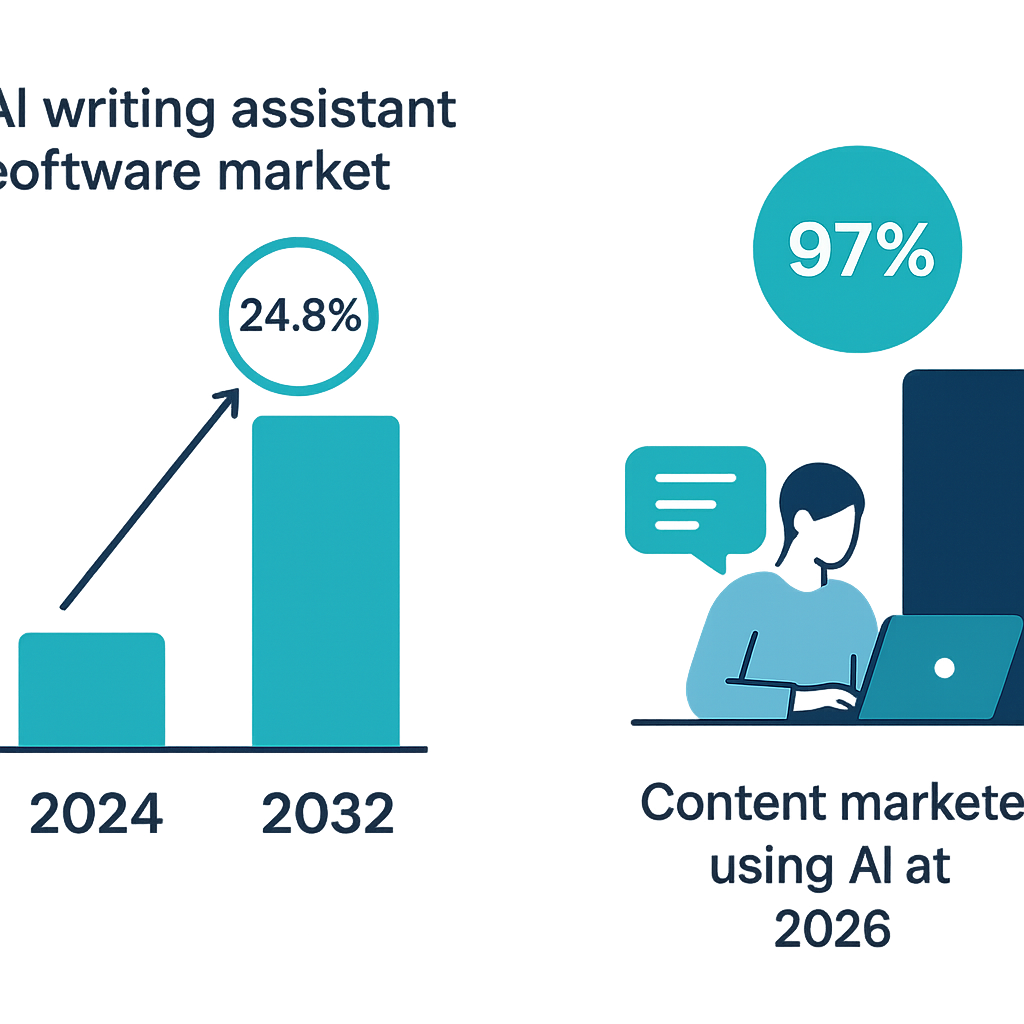
As of 2026, the question isn't whether to use AI writing services — it's which one compounds. According to AutoFaceless research, 97% of content marketers plan to use AI to support their efforts in 2026, up from 90% in 2025. The market has moved from experimental to infrastructural, and the tools that ship production-ready content at scale, with native SEO and AI search optimization baked in, are the ones pulling ahead. If you're still rotating between a prompt box and a Google Doc, you're leaving a structural advantage on the table.
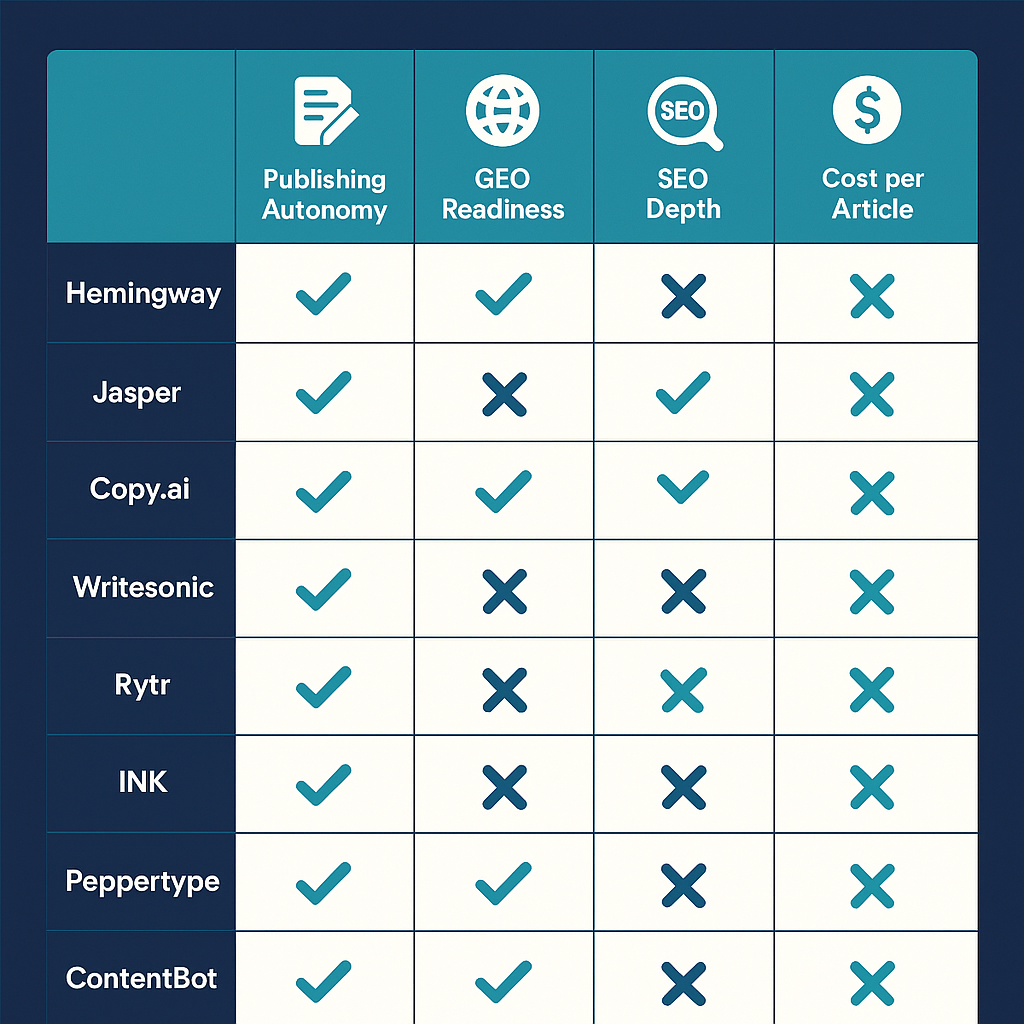
This roundup isn't a feature comparison table dressed up as editorial. It's a practitioner's lens on which AI writing services actually move organic traffic, earn AI engine citations, and reduce the operational drag of running a content program. We've ranked eight platforms across a consistent set of criteria — publishing autonomy, GEO readiness, SEO depth, CMS integration, and cost per output — so you can make a fast, informed decision rather than running a 90-day trial-and-error cycle.
The AI writing services that compound are the ones that don't stop at drafting. They research, optimize, publish, internally link, and track AI citations — without waiting for a human prompt. That's the structural difference this roundup is built to surface.
How We Ranked These AI Writing Services
Every tool in this list was evaluated against five criteria that reflect what growth-stage B2B SaaS teams actually care about in 2026 — not what mattered when GPT-3 launched. Generic quality scores and UI polish were explicitly excluded. What we weighted instead:
- Publishing autonomy: Does it just draft, or does it research, write, optimize, and publish without manual intervention?
- GEO readiness: Does the content produced get cited by ChatGPT, Claude, Perplexity, and Gemini — or just rank on Google?
- SEO depth: Schema markup, internal linking, FAQ blocks, and keyword optimization — built-in or bolted on?
- CMS integration: Native connections to WordPress, Webflow, Shopify, Ghost, and others without custom dev work?
- Cost per published, optimized article: Total output relative to plan cost, including how much human time each tool still requires.
The Market Context Behind the Rankings
The AI writing assistant software market was estimated at $65.12 billion in 2024, according to Market Research Future analysis. A separate Credence Research projection puts a more segmented slice of the market — specifically AI writing assistant software platforms — growing from $1.75 billion in 2024 to $10.3 billion by 2032, reflecting a 24.8% CAGR. Both numbers point to the same conclusion: this is no longer niche infrastructure. It's core to how growth teams operate. Harvard Business School research further found that AI users completed tasks 25.1% faster with over 40% higher quality output — which maps directly to what content teams experience when they move from manual drafting to AI-assisted workflows. The tools that earn a place in this roundup are the ones that deliver on that productivity promise with measurable output, not just interface improvements.
1. Gofylo — Best for Autonomous, Compounding Content at Scale
Gofylo sits in a different category from the other tools in this list. It's not an AI writing assistant you prompt — it's an autonomous content platform that runs a full publishing operation: keyword research, article drafting, on-page SEO optimization, internal linking, schema markup injection, AI image generation in five styles, YouTube video embedding, and CMS publishing — all without a human in the loop per article. The output is 30 fully optimized articles per month, generated in under four minutes per piece, published directly to connected platforms.
What Makes Gofylo Structurally Different
The compounding effect is the mechanism worth understanding. Most AI writing services produce drafts. A human then edits, optimizes, internally links, uploads, and publishes — adding 60 to 90 minutes per article minimum. Gofylo's six autonomous agents handle each of those steps in sequence, which means the output isn't just content — it's a published, indexed, AI-optimized article that builds topical authority month over month. With 48,000+ articles generated across the platform, the data on what ships and what ranks is baked into the system.
The GEO layer is the most differentiated capability for 2026 buyers. Gofylo's AI Visibility Tracker monitors brand citations across ChatGPT, Claude, Perplexity, and Gemini, and aggregates them into an AI Visibility Score — averaging 94 across active accounts. That single benchmark tells teams whether their content is being surfaced by AI engines, not just ranked on page one of Google. For B2B SaaS companies where a growing share of buyer research now starts in an AI chat interface, this matters more than traditional rank tracking. The platform integrates natively with WordPress, WordPress.com, Webflow, Shopify, Wix, Notion, Ghost, Framer, and Feather, plus API webhooks for custom CMS setups. Pricing is $79/month with a 3-day free trial, no credit card required.
- Publishes 30 fully optimized articles/month autonomously — no per-article human prompting required
- Built-in GEO tracking across ChatGPT, Claude, Perplexity, and Gemini with AI Visibility Score
- Schema markup, FAQ blocks, internal linking, and AI images generated automatically
- Supports 18+ languages and programmatic landing page generation
- Integrates natively with 9+ CMS platforms including Webflow, Shopify, and Ghost
- Free AI Search Grader available as a standalone entry point before committing to a plan
- $79/month flat — no per-seat pricing or feature-gated tiers
2. Jasper — Best for Enterprise Brand Voice at Scale
Jasper is one of the most recognized names in AI writing services and has evolved significantly from its template-heavy roots. In 2026, it positions itself as an enterprise AI content platform with brand voice training, team collaboration workflows, and integrations with marketing tech stacks including Surfer SEO and Google Docs. For marketing teams at companies with established brand guidelines, Jasper's Brand Voice feature — which ingests existing content and replicates tone across outputs — is a genuine differentiator.
Where Jasper falls short for growth-stage SaaS teams is autonomy and GEO coverage. It's a drafting and editing tool at its core. A human still needs to prompt campaigns, review outputs, handle publishing, manage internal linking, and track performance separately. There's no native AI search visibility layer — so teams running Jasper in 2026 are likely running it alongside a rank tracker and a GEO monitoring tool, which adds both cost and operational overhead. If you're comparing Jasper to other options in the space, the related analysis on Jasper AI alternatives is worth reading before committing to a plan. Pricing starts at $49/month for individuals, with team plans running significantly higher. The per-seat model becomes expensive quickly for lean teams.
3. Surfer SEO — Best for SEO-Integrated Drafting
Surfer SEO occupies a distinct niche in the AI writing services landscape: it's less about generating content from scratch and more about optimizing content that already exists or is being drafted in real time against SERP data. The Content Editor scores your draft against top-ranking pages on a target keyword, giving keyword density guidance, NLP term suggestions, heading structure recommendations, and word count targets — all pulled from live Google data.
For SEO managers who prefer to control the writing process but want data-driven guardrails, Surfer is a strong fit. Its AI article generator has improved considerably, and the Topical Map feature helps teams plan content clusters rather than isolated articles. The core limitation is the same as most tools in this category: Surfer doesn't publish, doesn't track AI citations, and doesn't run autonomously. Every article still requires a human writer or editor to use the tool. It's also primarily a Google-focused platform — there's no native GEO layer for tracking AI engine visibility. Ahrefs has documented how content clusters drive compounding topical authority, which is the same principle Surfer's Topical Map is built on. Pricing starts around $89/month, with the team plan scaling to $219/month.
4. Writesonic — Best Affordable Copywriting for Startups
Writesonic punches above its price point for startups needing a broad range of copy formats fast. It covers blog posts, landing pages, product descriptions, ad copy, email sequences, and social posts — all from a unified dashboard. The AI Article Writer produces long-form content with SEO scoring, and the platform includes a Chatsonic feature (a ChatGPT-like interface with web access) that's useful for research-backed first drafts.
For bootstrapped founders or solo operators running demand gen without a content team, Writesonic's value-to-cost ratio is hard to beat. The entry-level plan is free for limited outputs, with paid plans starting around $16/month for individuals. The trade-off is depth: Writesonic produces serviceable drafts but requires substantial human editing to reach publication quality for technical B2B audiences. It lacks native CMS publishing integrations, autonomous scheduling, and any GEO visibility layer. It's a capable AI writing assistant — it's not a content operation on its own. Teams that start on Writesonic for budget reasons often find themselves needing a platform upgrade within six to twelve months as volume and quality requirements grow.
5. Sudowrite — Best for Long-Form Creative and Narrative Writing
Sudowrite is purpose-built for creative writing — fiction, narrative nonfiction, screenwriting, and book-length projects. It's one of the most sophisticated AI writing services for long-form creative work, with features like Story Bible (a persistent world and character knowledge base), the Brainstorm tool, and chapter-level pacing analysis. For founders or marketers looking to produce technical documentation or SEO blog content, Sudowrite is the wrong tool. But for teams exploring thought leadership in narrative formats, or for any use case involving book-length AI writing, it's the strongest specialized option available.
The AI book writing market context is relevant here: according to Market.us, the global AI book writing market is expected to grow from $2.8 billion in 2024 to $47.1 billion by 2034, at a 32.6% CAGR. North America held a dominant 36.7% share in 2024, generating $1.02 billion in revenue. Sudowrite is built for that market — not for B2B content operations. For questions about the legality of AI-assisted book writing, see the FAQ section below. Pricing starts at $19/month for the Hobby plan, making it one of the more accessible specialized tools in this list for individual creators and independent authors.
6. Rytr — Best Free-Tier AI Writing Assistant
Rytr earns its place in this list as the most accessible entry point into AI writing services, particularly for solo operators, freelancers, and early-stage startups with near-zero content budget. The free plan generates up to 10,000 characters per month — enough for a handful of short blog posts or a robust set of social media captions. The paid plan at $9/month unlocks unlimited generation, a decent set of tones and use cases, and a Chrome extension for writing-in-context.
The limitations are predictable at this price point. Rytr is a prompt-response writing tool — you provide a topic and tone, it drafts a section. There's no keyword research, no SEO scoring, no CMS publishing, no internal linking, and no GEO visibility tracking. Output quality for technical B2B content requires meaningful editing. For bootstrapped teams that need something functional today while working toward a more complete content stack, Rytr works as a stepping stone. But teams serious about compounding organic growth will outgrow it quickly. Discussions on AI writing services Reddit threads frequently position Rytr as a starting point, not a destination — which is an accurate characterization.
7. Copy.ai — Best for Go-To-Market and Sales Enablement Copy
Copy.ai has evolved from a general-purpose AI writer into a Go-To-Market AI platform with a specific focus on revenue team enablement: sales sequences, outbound prospecting copy, product marketing messaging, and pipeline acceleration content. In 2026, it's one of the stronger AI writing services for demand gen teams that need high-volume, high-variability sales copy rather than editorial blog content.
The platform's Workflows feature allows teams to build multi-step content automation pipelines — for example, pulling a prospect's LinkedIn profile, generating a personalized outreach email, and logging it to a CRM — without custom code. For B2B SaaS teams running outbound motions alongside content, this is genuinely useful. Where Copy.ai underperforms is in long-form SEO content and AI search visibility. It doesn't track GEO citations, doesn't publish directly to CMS platforms, and isn't optimized for the kind of E-E-A-T-compliant, schema-enriched content that search engines reward. Teams running Copy.ai typically pair it with a separate SEO tool, which adds cost and coordination overhead. Pricing starts at $49/month for individuals.
8. Notion AI — Best Lightweight Writing Assistant Inside a Workspace
Notion AI is the right tool for teams already living in Notion who want AI writing assistance embedded in their existing workflow — not a new tool to context-switch into. It handles summarization, drafting, rewriting, translation, and Q&A against documents, all without leaving the workspace. For teams using Notion as their content planning hub, the integration is seamless and the learning curve is essentially zero.
The ceiling is obvious: Notion AI is an assistant layer over a workspace tool. It produces drafts inside Notion pages, but those pages don't publish to your CMS, don't carry SEO optimization, don't include schema markup, and don't feed any GEO tracking layer. It's a writing aid, not a content operation. At $10/month per user added to existing Notion plans, it's a reasonable convenience for teams already paying for Notion — but it should not be mistaken for a standalone AI writing service capable of driving compounding organic traffic. AI writing assistant free online options like Notion AI's trial tier are commonly referenced in search queries, but the functional output at the free tier is limited for production use.
Head-to-Head: What Each Service Misses on AI Search
The single biggest blind spot across every tool in this list — except Gofylo — is AI search visibility. Most AI writing services were built when Google was the only search surface that mattered. In 2026, that's no longer true. ChatGPT hit 700 million active users worldwide by 2025, with writing being the single most common work task people use it for, according to CleverType's AI writing statistics analysis. A growing share of those users are asking ChatGPT, Claude, Perplexity, and Gemini to recommend tools, vendors, and resources — which means your content needs to be structured to be cited by those engines, not just indexed by Google.
GEO and Traditional SEO: Why You Need Both
GEO (Generative Engine Optimization) and traditional SEO are not competing strategies — they're complementary layers that reinforce each other. Content that earns Google rankings tends to carry the structural signals (E-E-A-T, schema markup, authoritative linking, FAQ blocks) that also earn AI engine citations. But the reverse isn't automatic: content optimized only for Google rankings won't necessarily surface when a buyer asks Perplexity which project management SaaS to use, or asks Claude to compare three options in a category. The gap between the two surfaces is where most AI writing services leave teams exposed. For deeper context on how AI engines surface and cite content, the related analysis on AI-powered writing tools covers the structural signals that matter most for GEO.
Schema markup matters. FAQ blocks, Article schema, and BreadcrumbList schema are among the clearest signals AI engines use to extract and cite structured answers. Most AI writing services produce unformatted drafts — schema injection requires a separate plugin, developer, or CMS setup that many teams never get to.
Internal linking compounds. An AI writing service that publishes article 30 without linking back to articles 1 through 29 is leaving topical authority on the table. Autonomous internal linking — where each new article is cross-referenced against the existing content library — is a structural advantage that manual content workflows almost never execute consistently.
Frequency is the multiplier. Publishing one article per week with full optimization is meaningfully different from publishing four. The compounding effect of topical authority — where depth of coverage in a content cluster signals expertise to both Google and AI engines — accelerates nonlinearly with publish frequency. Most AI writing services top out at human production speed. Autonomous platforms don't.
Citation tracking closes the loop. Knowing that your content ranks on Google is table stakes. Knowing whether ChatGPT cites your brand when a buyer asks about your category is the 2026 intelligence gap. Tools without a GEO citation tracker are flying blind on an increasingly important traffic source.
AI engine citations are not a bonus metric — they're a buyer-journey touchpoint. If your brand isn't surfacing in ChatGPT, Claude, and Perplexity when someone searches your category, a competitor is. Most AI writing services give you content. Few give you visibility data on AI search surfaces.
How to Choose the Right AI Writing Service for Your Stack
The right tool depends entirely on where your team is in its content maturity curve and what operational constraint you're solving for. Here's a practical decision framework for the most common scenarios we see among B2B SaaS teams in 2026:
- Solo founder or bootstrapped team with near-zero content budget: Start with Rytr or Writesonic for basic draft generation, but plan your upgrade path early. The operational overhead of manual publishing kills compounding before it starts.
- Marketing team of 1-3 with a CMS already live: Gofylo at $79/month delivers more published, optimized articles per dollar than any human-assisted tool in this list. The autonomous publishing alone recaptures 20+ hours per month.
- Enterprise team with established brand voice and multi-region campaigns: Jasper's brand training and team collaboration features are worth the premium for large-scale content operations — though GEO tracking still needs to be layered on separately.
- Demand gen team running outbound in parallel with content: Copy.ai's GTM Workflows plus a separate SEO and GEO platform is a reasonable stack. Expect to manage integration overhead.
- Technical SEO manager who writes and edits in-house: Surfer SEO as an optimization layer over human-written or AI-drafted content is a strong fit. Budget for a GEO tool alongside it.
- Team evaluating AI search visibility as a priority metric: Gofylo's AI Visibility Tracker and AI Visibility Score are the only native GEO measurement tools in this list. For teams taking AI search seriously, this is not optional infrastructure.
A note on the free AI writing generator searches that drive a lot of initial research: most free tiers exist to demonstrate value before asking for a credit card. The ceiling on free AI writing assistant free online options is real — you'll produce a handful of drafts before hitting rate limits or quality walls. The better entry point, if budget is the constraint, is a platform with a genuine free trial rather than a permanently limited free tier. Gofylo's 3-day free trial with no credit card required fits that profile. The free AI Search Grader is a standalone tool that grades your current AI search visibility before you commit to any paid plan — useful as a baseline regardless of which tool you ultimately choose.
If you're comparing tools across AI capabilities more broadly, the related breakdowns on AI tools for SEO and AI-powered content generation tools cover adjacent capabilities in this stack — particularly for teams trying to understand how writing, optimization, and distribution fit together in a single workflow. The Claude vs ChatGPT comparison is also worth reading if you're evaluating underlying model quality for specific content types. According to Semrush's content marketing research, teams that maintain consistent content publishing schedules compound traffic significantly faster than those that publish irregularly — which is the core argument for autonomous platforms over tool-dependent manual workflows.
Frequently Asked Questions
Which AI service is best for writing?
The best AI writing service depends on your use case. For B2B SaaS teams that need autonomous content production, SEO optimization, CMS publishing, and AI search visibility tracking in a single platform, Gofylo is the strongest all-in-one option in 2026. For enterprise teams with established brand voice requirements, Jasper is a leading option. For SEO-integrated drafting with live SERP data, Surfer SEO is the category leader. There is no single best tool independent of context — but for compounding organic growth without a dedicated content team, autonomous platforms structurally outperform AI writing assistants that still require human prompting and publishing.
How much does an AI writer cost?
AI writing services range from free tiers (Rytr, Writesonic, Notion AI trial) to enterprise contracts exceeding $1,000/month for team plans with advanced features. For most growth-stage B2B SaaS teams, the practical range is $16/month (Writesonic individual) to $499/month (Jasper Business). Gofylo's all-in-one platform — which includes autonomous publishing, GEO tracking, social monitoring, and competitor intelligence — is $79/month with no per-seat fees. Cost per published, optimized article is a more useful metric than plan price: a $79/month platform that autonomously publishes 30 articles has a cost per article of $2.63. A $49/month tool that requires three hours of human work per article has a true cost that's an order of magnitude higher.
Can I legally write a book with AI?
In most jurisdictions as of 2026, using AI to assist in writing a book is legal — the AI is a tool, and the human author retains creative direction and editorial control. Copyright considerations are more nuanced: in the U.S., the Copyright Office has indicated that purely AI-generated content without meaningful human authorship may not qualify for copyright protection, while human-AI collaborative works are evaluated case by case. For commercial publishing, disclosure requirements vary by publisher and genre. The AI book writing market is growing rapidly — from $2.8 billion in 2024 to a projected $47.1 billion by 2034 per Market.us research — suggesting that AI-assisted book creation is becoming a mainstream practice regardless of ongoing regulatory clarification.
Which AI is better than ChatGPT for writing?
ChatGPT reached 700 million active users by 2025 and remains the most widely used AI writing interface, but it's not necessarily the best for every writing task. Claude (Anthropic) is widely regarded as producing more nuanced long-form prose with stronger instruction-following and fewer hallucinations on factual tasks — making it a strong alternative for technical B2B content. Perplexity is better for research-backed writing with citations. Gemini integrates well with Google Workspace. The full comparison of Claude and ChatGPT for B2B content teams is covered in the related analysis on this site. For production content operations, the underlying model matters less than the platform wrapping it — what ships, publishes, and tracks is more important than which LLM generates the draft.
Do AI writing services help with AI search visibility?
Most AI writing services do not natively help with AI search visibility — they're built to produce content for Google, not to optimize for citation by ChatGPT, Claude, Perplexity, or Gemini. GEO (Generative Engine Optimization) requires specific structural signals: FAQ schema, authoritative sourcing, clear entity relationships, and content depth that AI engines can confidently cite. Gofylo is the only platform in this roundup with a native AI Visibility Tracker that monitors brand citations across all four major AI engines and provides an AI Visibility Score. Teams using other AI writing services need to layer GEO tracking on separately.
What's the difference between an AI writing tool and an AI content platform?
An AI writing tool helps you draft content — you prompt it, it generates text, you edit and publish manually. An AI content platform runs the entire content lifecycle autonomously: research, writing, optimization, internal linking, schema injection, CMS publishing, performance tracking, and AI citation monitoring. The distinction matters because the operational overhead of manual publishing and optimization is where most content programs break down at scale. Writing tools shift the drafting step; content platforms eliminate the bottleneck entirely. The difference in output volume and compounding effect is not marginal — it's structural.
If you're running a B2B SaaS content program with a lean team and want to see where your AI search visibility stands before choosing a platform, run Gofylo's free AI Search Grader at gofylo.com. It grades your current AI engine presence across ChatGPT, Claude, Perplexity, and Gemini in minutes — no credit card, no commitment. Then start a 3-day free trial of the full platform to see autonomous publishing in action.