Organic traffic generation is one of those terms that sounds simple until you try to build a reliable system around it. As of 2026, the landscape has fractured: you're no longer optimizing for a single algorithm. You're optimizing for Google's traditional index, plus four major AI surfaces — ChatGPT, Claude, Perplexity, and Gemini — each of which surfaces content based on different signals than keyword density or backlink count. Most teams are still running playbooks written for 2022. That gap is where compounding advantages get built or squandered.
This guide breaks down what organic traffic generation actually means across both traditional and AI search, why the underlying mechanics differ more than most people realize, and what separates teams that compound organic reach from those that plateau after a few dozen articles. If you already know the basics of SEO and want a structural understanding — not a checklist — this is for you.
Thesis: In 2026, organic traffic generation is a dual-channel problem. Ranking on Google and getting cited by AI engines require overlapping but distinct content strategies. Teams that understand both mechanisms — and build systems that serve both simultaneously — will compound traffic in ways that paid acquisition simply cannot match.
What Organic Traffic Generation Actually Means in 2026
Organic traffic generation is the process of earning visits to your site without paying for each click — primarily through search engines, but increasingly through AI assistant responses, content syndication, and knowledge graph appearances. The word 'earning' is load-bearing here. Organic reach is not free in effort or time; it's free in the sense that the marginal cost of the thousandth visitor from an article is zero, whereas the thousandth paid click costs the same as the first. That asymmetry is the core economic argument for investing in organic. According to Ahrefs' 2025 analysis of 4 billion pages, over 90% of pages get zero organic traffic from Google — meaning the barrier to getting any return at all is higher than most teams anticipate. What separates the 10% that do rank is almost always structural: consistent topical depth, proper technical foundations, and a content architecture that signals authority to crawlers and AI training sets alike.
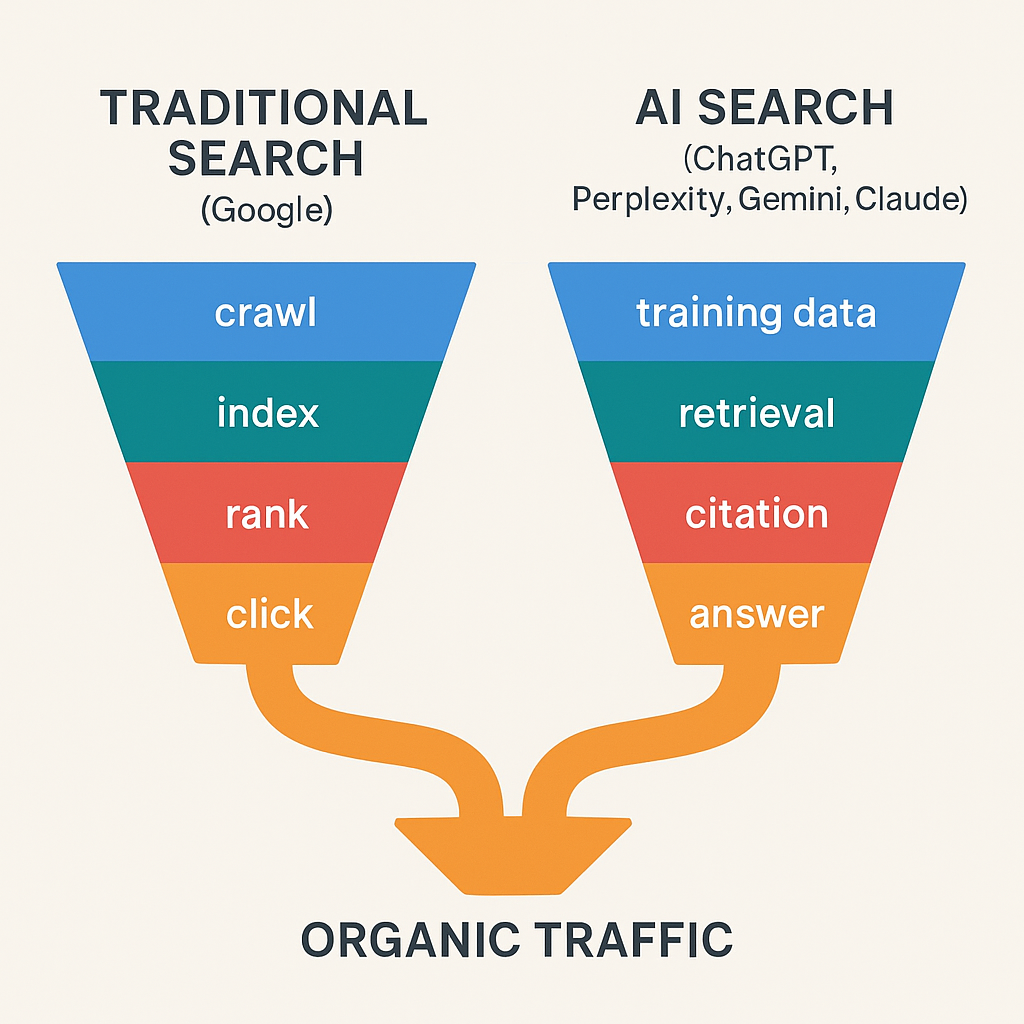
Traditional SEO vs. AI Search: Two Ranking Mechanisms
Understanding why traditional SEO and AI search behave differently is essential for building a strategy that captures both. Google's ranking algorithm evaluates hundreds of signals — backlink authority, page experience, structured data, keyword relevance, dwell time — and returns a ranked list of URLs. AI engines like Perplexity or ChatGPT with web browsing don't return a ranked list; they synthesize an answer and optionally cite sources. The content that gets cited by AI is typically content that is factually dense, clearly structured, written with specific named claims rather than vague generalities, and hosted on domains with some established credibility. These are overlapping but not identical criteria to what Google rewards. A page can rank on Google without being citation-worthy to an AI, and vice versa. Building for both requires understanding the distinct intent behind each surface.
How Google Rankings Work at a Structural Level
Google's ranking system is fundamentally a relevance and authority calculation. Google's developer documentation on how search works outlines three core phases: crawling, indexing, and serving results. At the serving stage, hundreds of factors determine which pages appear for a given query. The most durable signals are topical relevance (does the page deeply address the query's intent?), domain authority derived from backlinks (do credible sites link to this content?), and technical accessibility (can Google's crawlers read and understand the page?). For B2B SaaS companies, the practical implication is that winning on Google is largely about consistent publication of high-quality content within a defined topic cluster — not individual heroic articles. A single well-written piece rarely outranks an entrenched competitor with fifty related articles supporting it from within the same domain.
How AI Engines Decide What to Cite
AI search engines use a hybrid of retrieval-augmented generation (RAG) and their pre-training data to construct answers. When a user asks ChatGPT or Perplexity a question, the system retrieves candidate documents, evaluates their relevance to the query, and synthesizes a response — often citing sources inline. The content that wins citations tends to share specific characteristics: it contains named statistics with attributed sources, it's structured with clear H2/H3 headings that map to distinct sub-questions, and it answers questions directly in the first paragraph after each heading rather than building to the answer gradually. Schema markup, FAQ blocks, and semantically rich metadata also increase the probability of being surfaced. According to SEMrush's 2025 State of Search report, AI-driven search features now influence over 60% of search sessions in the US — a signal that AI citability is no longer a secondary optimization goal.
The Compounding Nature of Organic Content
Organic traffic generation is structurally different from paid acquisition in one decisive way: it compounds. A paid campaign stops producing traffic the moment you stop paying. A well-optimized article continues to rank, attract backlinks, and get cited by AI engines for months or years after publication. This compounding dynamic is why the most capital-efficient growth strategies in B2B SaaS almost always include a significant organic content component. The compounding effect isn't automatic — it requires a sufficient volume of interlocked content that builds topical authority across a cluster, not just isolated pages. Understanding this mechanism is more valuable than any individual content tactic, because it explains why teams that publish consistently for 12 months often see non-linear traffic growth in months 10 through 18.
Why Content Volume and Internal Linking Drive Topical Authority
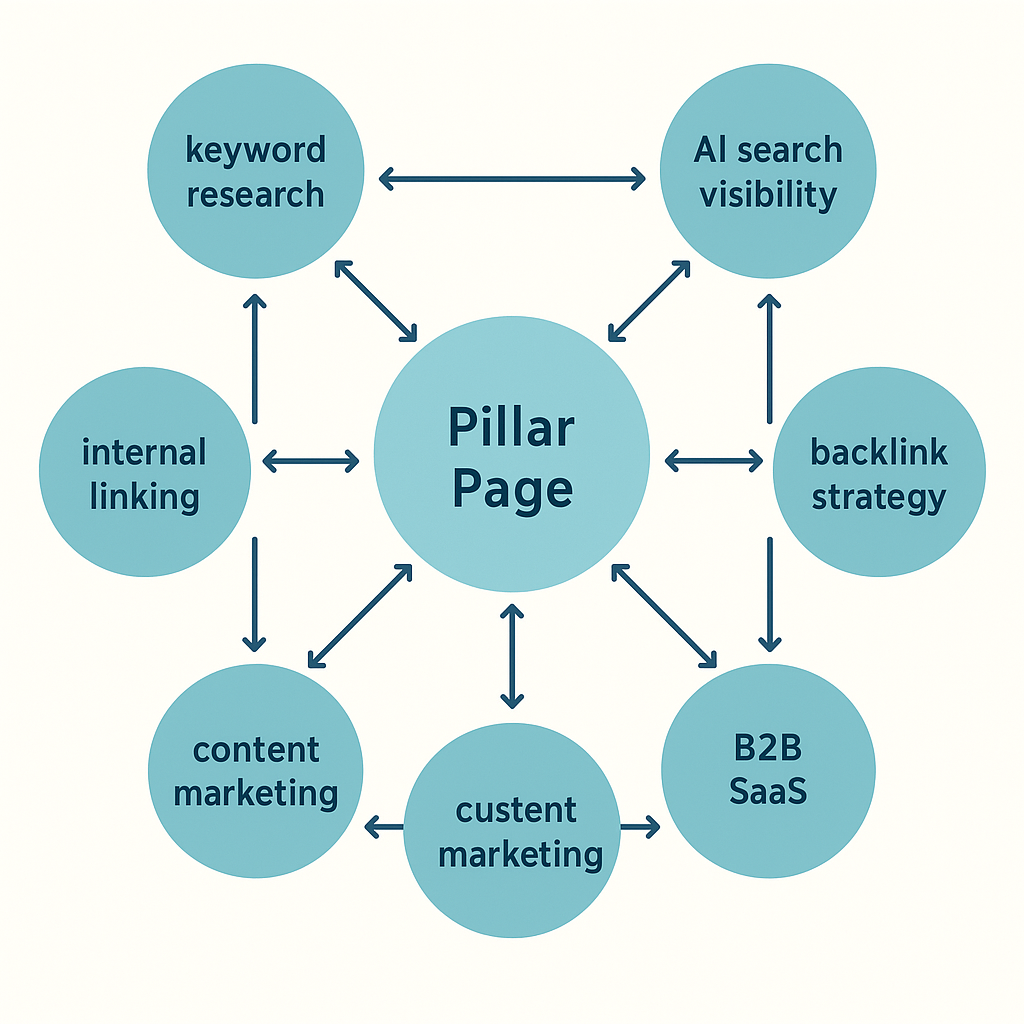
Topical authority is the concept that a domain earns ranking trust for a subject area by publishing a comprehensive, interlinked body of content on that topic. Google's systems infer expertise partly from the breadth and depth of coverage. When a site has thirty articles on organic traffic generation — covering everything from keyword research methodology to AI search visibility scoring — each individual article benefits from the authority signals of all the others. Internal links pass PageRank between pages and signal the semantic relationship between topics. For a bootstrapped SaaS founder or a lean content team, this creates a scaling challenge: topical authority requires volume, but most teams can only produce a handful of articles per month. This is precisely the structural gap that autonomous content systems are designed to close — not by sacrificing quality, but by removing the human bottleneck from the research-write-publish loop.
The E-E-A-T Signal Layer
Google's quality evaluator guidelines center on a framework called E-E-A-T: Experience, Expertise, Authoritativeness, and Trustworthiness. These are not direct ranking factors in the algorithmic sense, but they inform the training of quality raters and influence how Google's systems assess content quality at scale. For B2B SaaS content, demonstrating E-E-A-T means grounding claims in real data with named sources, including schema markup that identifies authors and publication dates, maintaining consistent updating practices so content doesn't go stale, and earning backlinks from recognized industry publications. The 'Experience' dimension added in 2022 specifically rewards content written by practitioners who have done the thing they're describing — which is why first-person, specific, technically credible content tends to outperform generic AI-generated fluff even when both cover the same keywords.
Key distinction: E-E-A-T compliance isn't just about Google rankings. AI engines like Claude and Gemini are trained on quality-filtered web data. Content that meets E-E-A-T signals — specific claims, named sources, clear authorship, structured formatting — is more likely to appear in training datasets and more likely to be cited in AI-generated answers.
Keyword Strategy as a Concept, Not a Tactic
Keyword strategy is often misunderstood as a list-building exercise — find high-volume, low-competition terms, write articles targeting them, repeat. That framing produces content that technically targets keywords but fails to build the topical depth that modern search rewards. A more accurate model treats keyword research as a map of your audience's informational needs across different stages of awareness and intent. Informational keywords (like 'how does organic traffic generation work') serve top-of-funnel audiences building understanding. Comparison keywords serve mid-funnel audiences evaluating options. Bottom-of-funnel keywords ('best organic traffic platform for SaaS') target people ready to act. A well-structured keyword strategy covers all three layers, and each layer's content internally links to the others — pulling a reader from curiosity to consideration to intent. According to Ahrefs' keyword difficulty research, the majority of search queries with commercial intent have a keyword difficulty score that makes them attainable for domains with even moderate authority, provided the content genuinely answers the query better than existing results.
- Informational intent: 'what is organic traffic generation' — builds awareness, earns AI citations
- Navigational intent: 'Gofylo organic traffic tool' — captures brand-aware searchers
- Commercial investigation: 'organic traffic platform comparison' — serves evaluation-stage buyers
- Transactional intent: 'organic traffic tool for SaaS free trial' — captures high-intent converters
- Long-tail specifics: 'organic traffic generation for B2B SaaS without a content team' — lower volume, higher conversion rates
- Question-based: 'how long does organic traffic take to compound' — aligns with AI search query formats
Content Architecture and How It Scales
Content architecture refers to the structural organization of a site's content — how topics are clustered, how pages link to each other, and how the information hierarchy signals topical focus to both search crawlers and AI retrieval systems. A strong content architecture is built around pillar pages (comprehensive guides on core topics) supported by cluster articles (focused pieces on specific subtopics) that link back to the pillar. This hub-and-spoke model has been a best practice for Google SEO for years, but it also maps neatly onto how AI engines identify authoritative sources: a domain with a dense, interlinked cluster of content on a subject signals concentrated expertise in a way that a single long article cannot. The practical challenge for growth-stage teams is executing this at scale — a well-structured cluster typically requires 20 to 50 articles to establish meaningful topical authority.
Programmatic vs. Editorial Content Models
Programmatic content generation uses structured data and templates to produce large volumes of pages targeting specific, repeatable query patterns — think location pages, product comparison pages, or use-case landing pages. Editorial content involves human judgment to craft pieces that go deeper on nuanced topics. Both have a role in a mature organic content strategy. Programmatic content is excellent for capturing long-tail, high-specificity traffic at scale — for example, a SaaS company might generate hundreds of integration-specific landing pages that each rank for '[product] + [integration]' queries. Editorial content earns backlinks and AI citations more reliably because it contains original analysis, specific data points, and narrative depth. The distinction matters for planning: teams that try to use a purely programmatic approach often build traffic that's thin on engagement and conversion; teams that rely only on editorial output rarely publish enough to build topical authority quickly.
The Role of Autonomous Content Systems
The core bottleneck in organic traffic generation for lean teams is output velocity. A single content writer can produce roughly 4 to 8 articles per month while maintaining research and editorial quality. Building a topical cluster of 40+ articles at that rate takes a year or more — by which time the competitive landscape has shifted. Autonomous content systems change this calculus structurally, not just incrementally. Instead of a human writing each article from scratch, an AI agent handles the keyword research, article structure, internal link mapping, schema markup, FAQ generation, and CMS publishing as a single automated pipeline. The human role shifts from production to strategy and quality review. Gofylo's Content Engine, for example, has generated 48,000+ articles across customer accounts, with each article completing the full research-to-publish cycle in under 4 minutes — producing 30 articles per month on the standard plan. That's a 5x to 7x output multiplier over a single skilled content writer, with consistent E-E-A-T compliance built into each piece. Across 18+ supported languages and with programmatic landing page generation included, it's designed for the specific scenario where a growth-stage SaaS team needs topical authority fast but can't staff a content department.
Output velocity matters because topical authority is not a binary state — it builds gradually as Google and AI engines observe more interlinked, high-quality content from your domain. Every article you publish this month slightly improves the ranking probability of every article you've already published. That network effect only activates at volume.
AI citability requires structure not just volume. Articles published through autonomous systems that include FAQ blocks, schema markup, and answer-first paragraph structure after each heading are materially more likely to be cited by Perplexity, Claude, and ChatGPT than articles that are well-written but loosely formatted. Structure is a signal, not just a style choice.
The compounding return from autonomous organic content becomes visible around months 4 to 6, when enough cluster articles exist to reinforce each other's authority signals. Teams that start this process 12 months from now will be 12 months behind peers who started today — organic traffic does not respond to sprints the way paid campaigns do.
GEO is not optional in 2026. With over 60% of search sessions now influenced by AI-generated answers (SEMrush, 2025), a brand that ranks on Google but is invisible on ChatGPT and Perplexity is leaving a significant share of top-of-funnel awareness on the table. Tracking your AI Visibility Score alongside traditional rank positions is the only way to know whether your content is actually being surfaced where your audience is asking questions.
What Metrics Actually Signal Organic Growth Health
Most teams track organic sessions and keyword rankings, which are lagging indicators — they reflect what happened, not what's about to happen. The leading indicators of organic traffic generation health are less commonly tracked but more actionable. According to Semrush's Organic Traffic Insights documentation, the most predictive metrics for future organic growth are keyword coverage growth (how many new keywords is your domain ranking for month-over-month), topical coverage ratio (what percentage of your target topic cluster has published content), indexed page count growth, and AI citation frequency across major LLM surfaces. Teams that track these leading metrics can identify compounding before it shows up in session data — and can course-correct structural issues like thin content, broken internal links, or missing schema markup before they suppress rankings for an entire cluster.
- Organic keyword count growth (month-over-month new keyword rankings as a leading indicator)
- Indexed page count and crawl rate (signals whether Google is actively processing new content)
- Topical coverage ratio (percentage of your target cluster that has published, interlinked content)
- AI citation frequency (how often your brand or content is cited in ChatGPT, Claude, Perplexity, Gemini answers)
- AI Visibility Score (a composite benchmark — Gofylo reports an average of 94 across active accounts)
- Backlink velocity to new content (how quickly new articles earn inbound links, signaling content quality)
- Organic CTR by intent tier (informational vs. commercial keywords often have very different click-through patterns)
A note on AI Visibility Score: This is a relatively new benchmark, but it's becoming a primary KPI for content teams that understand where B2B buyer research is migrating. Gofylo's AI Visibility Tracker monitors brand citation presence across ChatGPT, Claude, Perplexity, and Gemini, returning a single composite score. Customers using the platform average a score of 94 — well above what most teams achieve with traditional SEO-only strategies.
Frequently Asked Questions About Organic Traffic Generation
These are the questions we see most often from founders, content leads, and demand generation teams who are building or rebuilding their organic content strategy. The answers here are meant to be conceptual — to build understanding rather than prescribe a single tactic.
How long does it take for organic traffic generation to compound?
The honest answer is 6 to 12 months for meaningful compounding to become visible in analytics, assuming consistent publication at volume. The first 3 months are typically indexing and authority accumulation — you're building the infrastructure for growth that becomes visible later. Teams that publish 20 to 30 articles per month within a well-defined topic cluster typically see non-linear growth beginning around month 8 to 10, as topical authority reinforces individual article rankings and internal links distribute PageRank more effectively across the cluster. This is why the compounding frame matters: the output in month 12 is disproportionately larger than the output in month 1, even if the input rate (articles published per month) is identical.
Is organic traffic generation different for AI search versus Google?
Yes, in meaningful ways. Google ranks pages in a list and rewards relevance, authority, and technical accessibility. AI engines like Perplexity and ChatGPT synthesize answers and cite sources — they reward factual density, clear structure, named statistics with attributed sources, and direct answer-first formatting. Content that performs well on both channels tends to be deeply researched, structured with logical H2/H3 hierarchies, grounded in verifiable data, and technically clean with schema markup. The overlap is large enough that a single well-executed content strategy can serve both surfaces — but teams optimizing only for traditional SEO will increasingly find themselves invisible in AI-driven search sessions.
Can a small team realistically build organic traffic at scale?
Yes, but only if they remove the human bottleneck from the production layer. A single content writer or SEO manager cannot produce the 30 to 50 articles per month that topical authority requires without burning out or sacrificing quality. Autonomous content systems — where AI agents handle research, writing, optimization, internal linking, schema generation, and CMS publishing — allow a one-person team to operate at the output level of a 5-person content department. The human role in this model is strategic: defining topic clusters, reviewing quality at intervals, setting brand voice guidelines, and interpreting analytics. The production work is delegated to the system.
What's the relationship between backlinks and organic traffic generation?
Backlinks remain one of the strongest signals of domain authority in Google's ranking algorithm — and by extension, one of the most reliable drivers of organic traffic at scale. High-quality backlinks from relevant, authoritative domains signal to Google that your content is worth surfacing. For AI engines, backlinks are a secondary signal — content from domains with strong backlink profiles is more likely to have appeared in high-quality training data and more likely to be surfaced in retrieval-augmented generation. The most effective way to earn backlinks organically is to publish content that is genuinely more comprehensive and more useful than what currently exists on the topic — which is a function of depth, structure, and specificity rather than volume alone.
Related: How to Increase Organic Traffic Without a Full Content Team
Related: 12 Proven Tactics to Boost Organic Traffic in 2026
Related: 11 Advantages of Content Marketing That Compound Over Time
Related: Blogging for Business: Patterns That Move the Needle in 2026
Related: Organic Traffic Explained: What It Is and Why It Compounds
Related: How to Read Organic Traffic in Google Analytics Without Missing What Matters
If you're building organic traffic strategy for a B2B SaaS company and want to understand where you stand on AI search visibility today, Gofylo's free AI Search Grader gives you an immediate, actionable score. Or start a 3-day free trial of the full platform — no credit card required — and see how 30 fully optimized articles per month changes your compounding trajectory. Start at gofylo.com.