Organic search is splitting into two distinct channels, and as of 2026, you have to win both of them simultaneously. Google still drives the majority of click-through traffic, but AI engines — ChatGPT, Claude, Perplexity, and Gemini — are eating into the top-of-funnel discovery layer at a rate that no serious growth team can ignore. According to a Gartner 2025 report, AI-powered search interactions are projected to displace 30% of traditional search volume by the end of 2026, a shift that fundamentally changes what 'ranking' means.
If you're a founder, SEO manager, or demand gen lead at a growth-stage B2B SaaS company, your mandate is compounding organic reach without a bloated content team. This round-up covers the 12 highest-leverage tactics we've validated — tactics that work for both traditional search rankings and AI citation presence. Some require tooling. Some require strategic repositioning. All of them move the needle. Where relevant, we'll call out how autonomous content infrastructure (like what Gofylo delivers) structurally outperforms manual workflows.
Thesis: Boosting organic traffic in 2026 isn't about publishing more posts — it's about building a systematic, AI-legible content architecture that compounds across both search engines and language models simultaneously.
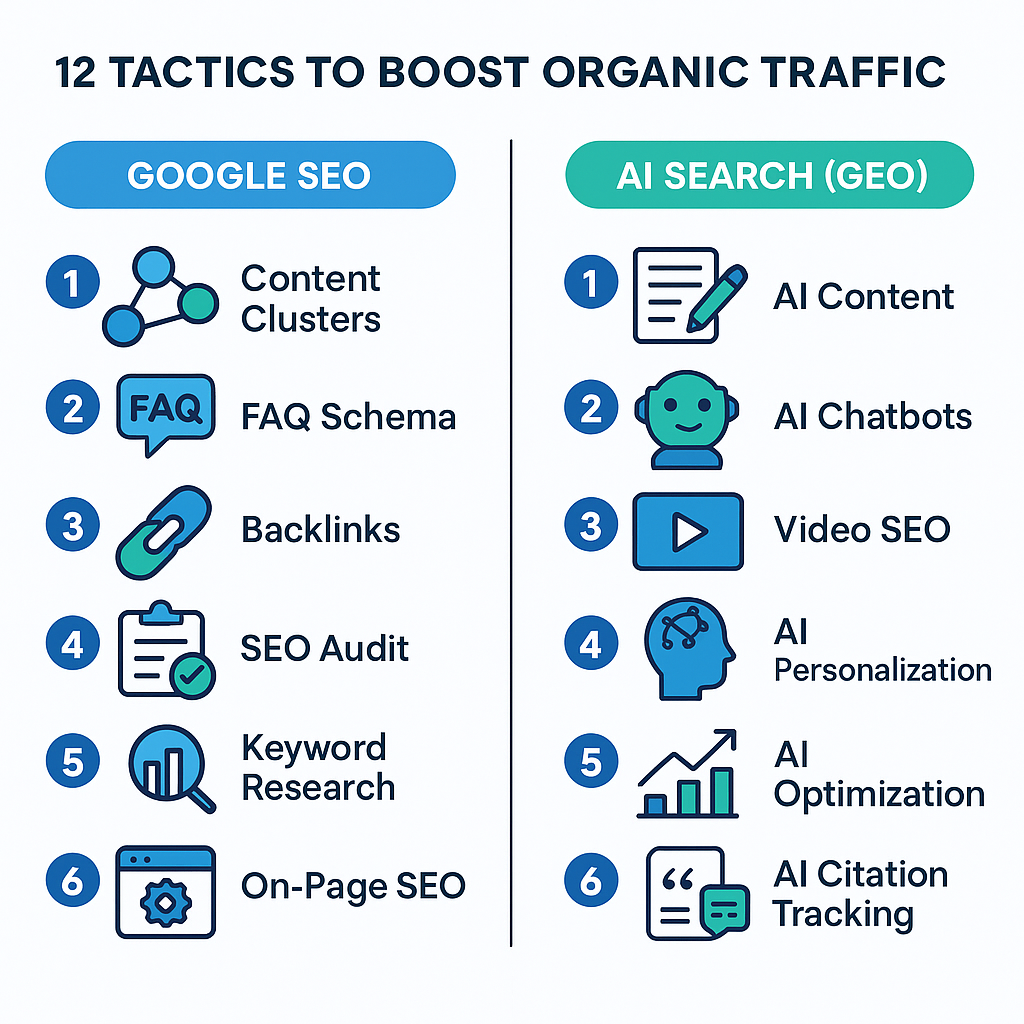
1. Build Topical Clusters, Not Isolated Posts
A single article ranking for a single keyword doesn't compound. A cluster of 8–12 tightly interlinked articles covering every subtopic of a core theme does. Google's Helpful Content system rewards topical depth and authoritative coverage across a domain. AI engines reward it even more — language models surface the source with the broadest, most coherent treatment of a topic, not the one with the highest DA.
For B2B SaaS teams, the cluster model also solves the buyer journey problem: your pillar page captures awareness-stage searchers, your supporting articles capture mid-funnel comparison queries, and your FAQ-rich pieces capture bottom-of-funnel 'how does X work' intents. The structural result is compounding traffic across the entire funnel from a single content investment. Related: see our coverage of organic traffic generation and how to increase organic traffic for the foundational mechanics that underpin this cluster approach.
2. Optimize for AI Citation, Not Just Ranking Position
Getting cited by ChatGPT or Perplexity requires a structurally different approach than ranking in the top 3 on Google. AI engines favor content that is factually dense, clearly structured, and E-E-A-T-compliant — meaning it demonstrates first-hand expertise, authority signals, and trustworthy attribution. According to Ahrefs' 2025 AI search citation study, pages cited in AI overviews are 3.5x more likely to use structured heading hierarchies and inline data attribution than uncited pages.
Practically, this means every article should include: a clear author entity or brand entity, inline statistics with named sources, structured FAQ sections, and schema markup. Content written for AI citation isn't different from content written for humans — it's just more rigorous. The same signals that make a model trust your content make a reader trust it too.
3. Publish at Volume With Autonomous Content Agents
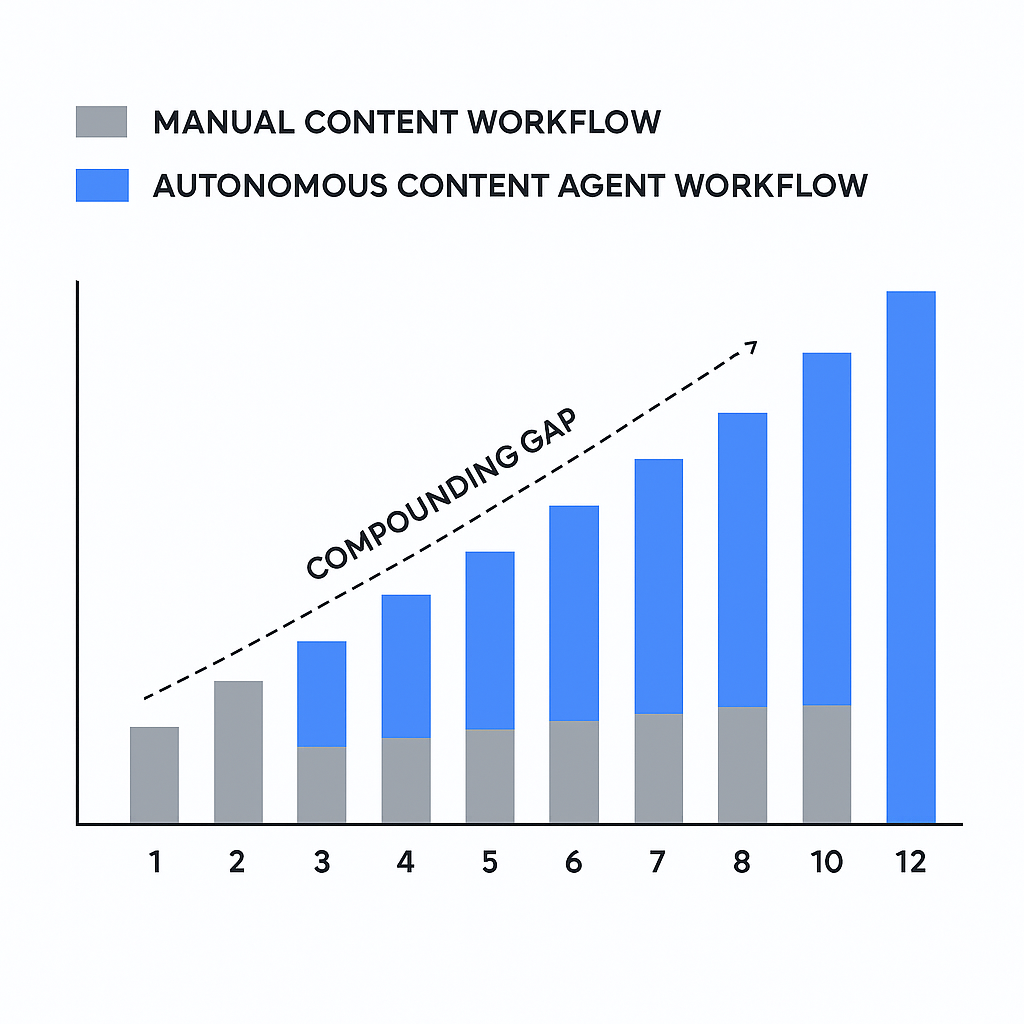
Manual content workflows hit a hard ceiling: one editor, one article, three days. That pace doesn't compound meaningfully against a competitor using autonomous publishing infrastructure. Gofylo's Content Engine generates and publishes 30 fully optimized, E-E-A-T-compliant articles per month — each in under 4 minutes end-to-end, including schema markup, internal links, FAQ blocks, and AI-generated images. Across active accounts, the platform has shipped 48,000+ articles, and the average AI Visibility Score sits at 94.
The compounding math is straightforward: 30 articles/month means 360 indexed, linked, and schema-marked articles per year. At a conservative 5% ranking rate, that's 18 new ranking pages added every month without a single editorial hire. Compare that to a two-person content team shipping 6–8 articles/month, and the structural gap becomes a competitive moat within 12 months.
Volume without quality is spam. Volume with structural quality — proper schema, internal linking, E-E-A-T signals, and FAQ blocks — is a compounding organic growth engine. The distinction is the architecture, not the output count.
4. Target Long-Tail Commercial Keywords First
New domains and low-DA sites cannot rank for broad head terms immediately. The highest-leverage move is to capture long-tail commercial-intent keywords (3–5 words, clear buyer signal) where competition is thin and conversion intent is high. According to Semrush's 2025 Keyword Research Benchmark Report, long-tail keywords make up 70% of all search queries but represent less than 30% of most SaaS content libraries — a structural gap you can exploit.
For B2B SaaS, target patterns like '[feature] for [vertical]', '[use case] software comparison', and '[problem] without [trade-off]'. These queries convert at 2–4x the rate of generic terms and are far more likely to be surfaced verbatim inside AI engine answers, where specificity signals relevance.
5. Add FAQ Schema to Every Article
FAQPage schema is the single highest-ROI structured data implementation for both Google rich results and AI engine citation. Google's Search Console documentation confirms that FAQPage schema is eligible for rich results in SERPs — increasing click-through rate by a documented 20–30% on average for eligible pages. For AI search, FAQ blocks are the primary extraction target for models constructing conversational answers.
Every article you publish should include 4–6 FAQ pairs that directly answer high-intent questions your buyer is likely to ask an AI engine. Keep answers to 2–3 sentences — dense enough to be informative, short enough to be extractable. The question text should mirror natural language query patterns, not SEO-optimized phrases.
6. Build Internal Links Systematically
Internal linking is the most underutilized lever in most SaaS content stacks. Every new article should link to at least 3 existing articles, and every existing article should be updated to link to the new one — forming a mesh that passes PageRank efficiently and helps both Google and AI crawlers understand your topical hierarchy.
Anchor text matters. Use descriptive, keyword-rich anchor text (not 'click here' or 'learn more'). AI engines use anchor text as semantic context when mapping your content graph, so precise anchors reinforce topical authority signals across the cluster.
Automate the mesh. Manual internal linking breaks down at scale. Autonomous content platforms like Gofylo handle internal linking at publish time — every new article is automatically linked to relevant existing content and vice versa, maintaining a coherent architecture even at 30+ articles/month.
Audit for orphan pages. Pages with zero internal links are invisible to both crawlers and AI models. Run a quarterly crawl audit (Screaming Frog or Ahrefs Site Audit) to surface orphan pages and connect them back into the cluster. An orphaned article might rank independently, but it contributes nothing to your domain's topical authority signal.
7. Earn Backlinks Through Linkable Assets
Backlinks remain one of Google's most durable ranking signals in 2026 — and according to Ahrefs' 2025 study on search ranking factors, pages with at least one external backlink get significantly more organic traffic than zero-backlink pages. The challenge for small SaaS teams is generating links without a dedicated outreach operation.
The most scalable approach: create high-utility linkable assets — original benchmark reports, free tools (like Gofylo's AI Search Grader), statistics compilations, and interactive calculators. These assets attract organic backlinks from bloggers, journalists, and other SaaS companies who reference them as data sources, creating a passive link acquisition loop. One well-executed original study can generate dozens of editorial links over 12–18 months with zero outreach spend.
8. Refresh Underperforming Content Quarterly
Content decay is real. Articles that ranked in positions 5–15 twelve months ago are actively losing ground to newer, more comprehensive competitors. A quarterly refresh cycle — updating statistics, expanding thin sections, adding FAQ blocks, and re-optimizing title tags — can recover 20–40% of lost traffic on decaying pages without publishing a single new article.
Prioritize refresh candidates by: (1) pages that dropped from positions 3–10 to 11–20 in the past 90 days, (2) pages with high impressions but sub-3% CTR, and (3) any article that lacks FAQ schema or is missing internal links to newer cluster content. The refresh signal — a new 'last updated' date with substantive changes — also matters to AI engines, which weight content freshness as a trust signal when generating citations.
9. Programmatic Landing Pages for High-Intent Queries
Programmatic SEO is the fastest way to capture high-volume, high-intent query sets that no manual content team could cover. The pattern: identify a repeatable query template ('[tool] alternative for [use case]', '[integration] setup guide', '[city] [service] pricing'), generate a dynamic page template, and deploy hundreds of variations against a database of entities.
For B2B SaaS, the highest-converting programmatic patterns are competitor comparison pages, integration-specific landing pages, and use-case-specific feature pages. Gofylo supports programmatic landing page generation natively — so the same infrastructure that powers your editorial content cluster can also power your programmatic SEO layer, all publishing to WordPress, Webflow, Shopify, or any connected CMS via API webhook.
Programmatic pages built on thin, templated content will get filtered out by Google's Helpful Content system. Every programmatic page needs a substantive, differentiated content block — not just swapped entity names in a boilerplate template. Quality at scale is the bar.
10. Track AI Visibility as a Separate KPI
Traditional rank tracking (position 1–10 on Google) doesn't capture whether your brand is being cited by ChatGPT, Claude, Perplexity, or Gemini. As AI-mediated discovery grows, your content's AI citation rate is an independent leading indicator of top-of-funnel reach — one that Google rank tracking completely misses.
Gofylo's AI Visibility Tracker monitors brand citation presence across all four major AI engines and surfaces a single AI Visibility Score — currently averaging 94 across active accounts. If you're not measuring AI share of voice today, you have no baseline to optimize from. Tools like Gofylo's free AI Search Grader give you an immediate snapshot of where you stand before committing to a full tracking setup.
11. Compete on Content Depth, Not Just Keyword Match
Keyword stuffing was never effective, and in 2026 it actively penalizes. Both Google's helpful content guidelines and AI engine extraction logic favor content that comprehensively covers a topic — addressing adjacent questions, providing concrete examples, referencing authoritative sources, and using semantic variations of the core term rather than exact-match repetition.
Go deep on one topic. An 1,800-word article that fully covers a subtopic — with supporting data, examples, FAQ blocks, and internal links — outperforms three 600-word articles covering adjacent surface-level angles. Depth signals expertise. Breadth without depth signals content farming.
Use entity-rich language. Name the tools, technologies, frameworks, and companies that are relevant to your topic. AI engines build knowledge graphs from named entities — a content piece that mentions specific tools, named methods, and attributable statistics is structurally more citable than one that speaks in generalities.
Cite primary sources inline. Linking to authoritative domains (Gartner, Forrester, Ahrefs, SEMrush, Google Developers) within the body of an article increases both reader trust and AI engine confidence in the content's factual grounding. The SearchEngineLand 2025 GEO ranking analysis confirmed that AI-cited pages reference 2.3x more outbound authoritative sources than non-cited pages.
12. Publish in Multiple Languages to Unlock Non-English Demand
English SaaS content markets are the most competitive in organic search. Non-English markets — Spanish, German, French, Portuguese, Japanese — have a fraction of the content competition for the same commercial keywords, and the conversion rates from organic search in these markets are comparable to or higher than English equivalents for B2B SaaS.
Gofylo generates content in 18+ languages natively, which means a single content strategy can publish parallel cluster articles across multiple language markets simultaneously. For bootstrapped founders and lean SaaS teams, this is one of the most asymmetric plays available: unlock an entirely new organic demand channel without adding headcount, at the same per-article cost as your English content. Multilingual AI citations are also a rising factor — Perplexity and Gemini answer in the user's language, and local-language content is cited when it's available.
Frequently Asked Questions
What is the fastest way to boost organic traffic for a SaaS startup?
The fastest compounding approach is to build a topical cluster targeting long-tail commercial keywords with high buyer intent, combined with FAQ schema on every page and a systematic internal linking mesh. For teams with limited bandwidth, deploying an autonomous content platform like Gofylo accelerates this significantly — 30 optimized articles per month, each published in under 4 minutes, creates a ranking surface area that manual teams cannot match.
How long does it take to see results from organic content?
For new domains, expect 3–6 months before meaningful traffic materializes — Google's indexing and authority-building cycles take time. However, long-tail keywords and low-competition queries can show movement in 4–8 weeks. AI engine citations (Perplexity, ChatGPT) can surface content much faster, sometimes within days of indexing, which is why tracking AI visibility in parallel with Google rankings gives you an earlier signal of content performance.
Does AI search (ChatGPT, Perplexity) replace Google SEO?
Not yet, but it's displacing the top-of-funnel discovery layer at meaningful scale. As of 2026, AI-mediated search handles a growing share of informational and comparison queries — the same queries that drive awareness and consideration for B2B SaaS. The right frame isn't 'AI vs. Google' — it's that both channels require your content to be structured, authoritative, and deeply topical. The same practices that win AI citations also improve Google rankings.
How many articles per month do I need to publish to rank?
There's no universal minimum, but 8–12 articles per month targeting a coherent topical cluster is the threshold at which compounding effects start to become measurable within 6 months. Teams publishing 30+ articles per month with proper schema, internal linking, and E-E-A-T signals see significantly faster authority accumulation. The quality floor matters more than the ceiling — 10 excellent articles outperform 50 thin ones every time.
What's the difference between SEO and GEO?
SEO (Search Engine Optimization) focuses on ranking in traditional search engines like Google and Bing through signals like backlinks, keyword optimization, and technical site health. GEO (Generative Engine Optimization) focuses on getting your content cited and surfaced by AI engines like ChatGPT, Claude, Perplexity, and Gemini — which use different ranking mechanisms, favoring structured, entity-rich, authoritative content over pure backlink signals. In 2026, a comprehensive organic strategy requires both in parallel.
Can autonomous content tools produce E-E-A-T-compliant articles?
Yes, when the platform is designed for it. E-E-A-T compliance requires experience signals (specific examples, first-hand data), expertise markers (accurate technical content), authoritativeness (outbound citations, schema markup), and trustworthiness (consistent brand entity, clear sourcing). Gofylo's Content Engine is built to embed all four signals by default — including inline citations, FAQ schema, author entity markup, and internal linking — not as optional add-ons but as core output requirements.
Ready to put these tactics on autopilot? Gofylo's autonomous agents handle keyword research, content generation, CMS publishing, internal linking, and AI visibility tracking — all for $79/month with a 3-day free trial, no credit card required. Start your free trial at gofylo.com or run your site through the AI Search Grader first to see exactly where your AI citation gaps are.