Scaling organic traffic in 2026 is a two-front war. You need to rank in Google's traditional index, and you need to appear in the generative answers that ChatGPT, Claude, Perplexity, and Gemini are now serving to buyers who never click a blue link. Most content teams are still optimizing for only one of those surfaces — which means they're leaving a significant portion of addressable traffic on the table. According to Ahrefs' 2025 State of Search report, over 57% of searches now return a zero-click result, which means AI-generated answers are displacing traditional organic visits faster than most SEO playbooks account for.
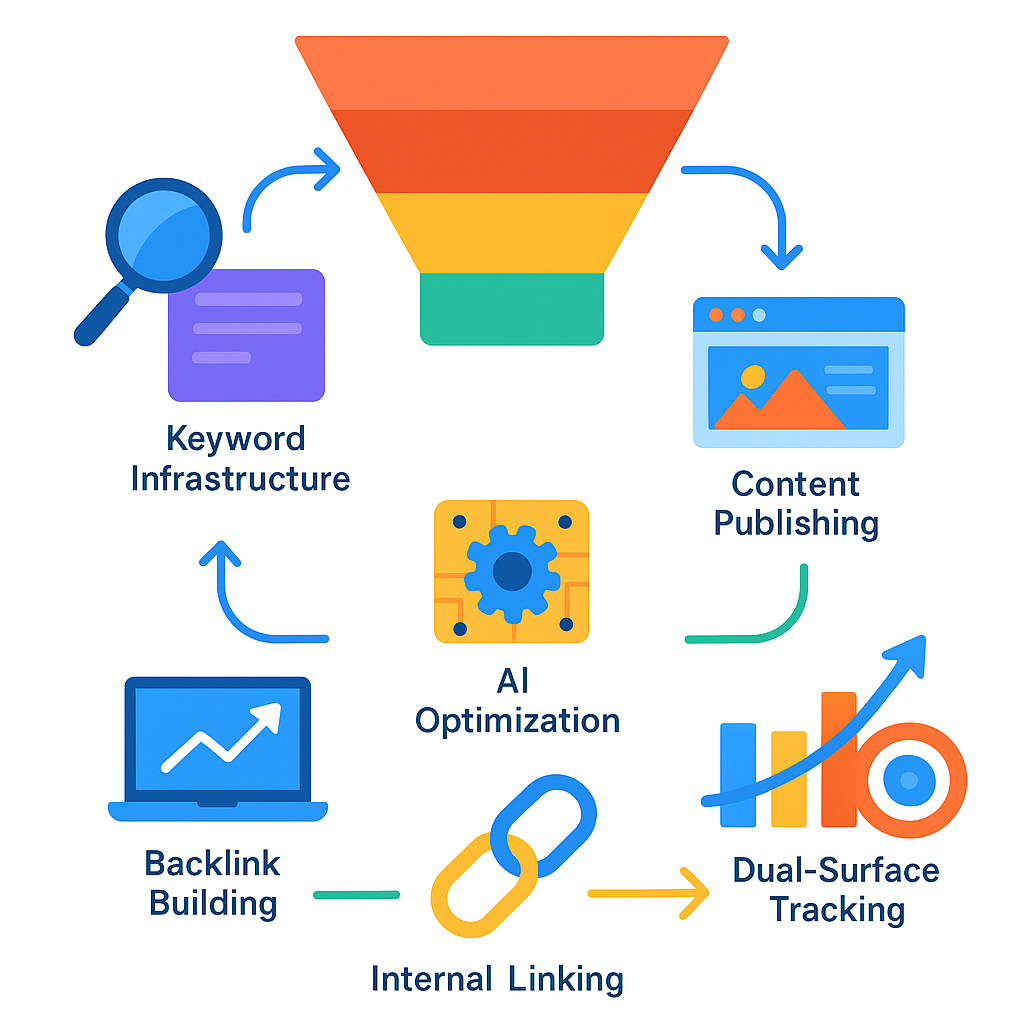
This guide is built for founders, marketing leads, and SEO managers who want a repeatable system — not a one-time content sprint. Each step is sequential and designed to compound: the work you do in Step 1 makes Step 3 easier, and Step 3 amplifies the returns of Step 5. We'll cover keyword infrastructure, content velocity, technical SEO, AI search visibility, and autonomous publishing workflows that let a team of one compete with a team of ten.
Thesis: Increasing organic traffic in 2026 requires a dual-surface strategy — traditional SEO signals for Google and structured, authoritative content for AI citation engines. The teams that build both simultaneously are compounding; the teams that pick one are falling behind.
Prerequisites: What You Need Before You Start
Before running any of the steps below, confirm you have these in place. Skipping prerequisites is the most common reason organic growth strategies stall at the six-month mark — not because the strategy is wrong, but because the foundation isn't ready to hold it. You need a CMS that allows custom meta tags, schema markup, and internal linking (WordPress, Webflow, Ghost, and Framer all qualify). You need access to at least one keyword research tool — Ahrefs, Semrush, or Google Search Console at minimum. You need Google Search Console verified and connected to your domain so you have baseline impression and click data. And you need clarity on your primary ICP: who you're writing for, what problems they're solving, and what search queries they use at each stage of the buying journey. Everything downstream depends on that clarity.
- CMS with full meta, schema, and internal link control
- Verified Google Search Console account with at least 30 days of data
- Access to a keyword research tool (Ahrefs, Semrush, or equivalent)
- Defined ICP with mapped search intent by funnel stage
- A content publishing workflow — human or autonomous — capable of consistent output
- Analytics setup that separates organic, direct, and AI referral traffic
Step 1: Build a Keyword Infrastructure Around Topical Clusters
Keyword research in 2026 is less about finding individual high-volume terms and more about mapping a coherent topical universe that signals authority to both Google's ranking systems and AI citation models. Start by identifying three to five pillar topics that sit at the intersection of your product's value and your ICP's search behavior. Each pillar becomes the root of a cluster: a central long-form article supported by eight to fifteen narrower articles that address specific subtopics, questions, and use cases. This architecture tells Google you own the topic end-to-end, not just one keyword. It also dramatically increases the surface area for AI engines to cite your content, because LLMs favor sources that cover a topic comprehensively rather than superficially.
Map pillar topics to supporting articles
Use Ahrefs' Content Gap tool or Semrush's Keyword Magic Tool to identify the full universe of queries your competitors rank for that you don't. Filter for informational and commercial-investigation intent — these are the article types that generate organic traffic and build authority simultaneously. Assign each keyword a primary intent label (awareness, consideration, decision) and a difficulty score. Prioritize clusters where you can realistically rank within 90 days given your current domain authority. Build a publishing calendar that ships cluster content in coordinated batches, not random one-offs.
Step 2: Audit and Fix Your Technical SEO Foundation
No amount of content investment will compound if Googlebot can't efficiently crawl and index your pages. A technical audit isn't a one-time task — it's a prerequisite that needs to be clean before you accelerate publishing velocity. According to Google's own Search Central documentation, crawl budget is allocated based on page quality signals, which means slow, thin, or duplicate pages actively reduce the crawl frequency of your better content. Run a full crawl using Screaming Frog or Sitebulb, then prioritize fixes in this order: crawlability issues first, indexation errors second, page speed third, and structured data gaps fourth.
Core Web Vitals and crawlability
As of 2026, Core Web Vitals remain a confirmed Google ranking signal. Largest Contentful Paint (LCP) should be under 2.5 seconds, Cumulative Layout Shift (CLS) under 0.1, and Interaction to Next Paint (INP) under 200ms. Check your field data in Google Search Console's Core Web Vitals report, not just lab data from Lighthouse — field data reflects real user sessions and is what Google's algorithm uses. Fix image compression and lazy loading for LCP. Eliminate render-blocking scripts for INP. Reserve space for dynamic elements to resolve CLS. These are not optional refinements; they are the baseline for competing in dense SaaS keyword categories.
- Fix crawl errors and redirect chains before scaling content
- Submit an updated XML sitemap after each major publishing batch
- Resolve duplicate content with canonical tags or 301 redirects
- Ensure all important pages are within three clicks of the homepage
- Audit Core Web Vitals in GSC field data, not only Lighthouse scores
- Add structured data markup (Article, FAQPage, BreadcrumbList) to all content
Step 3: Publish High-Velocity, E-E-A-T-Compliant Content
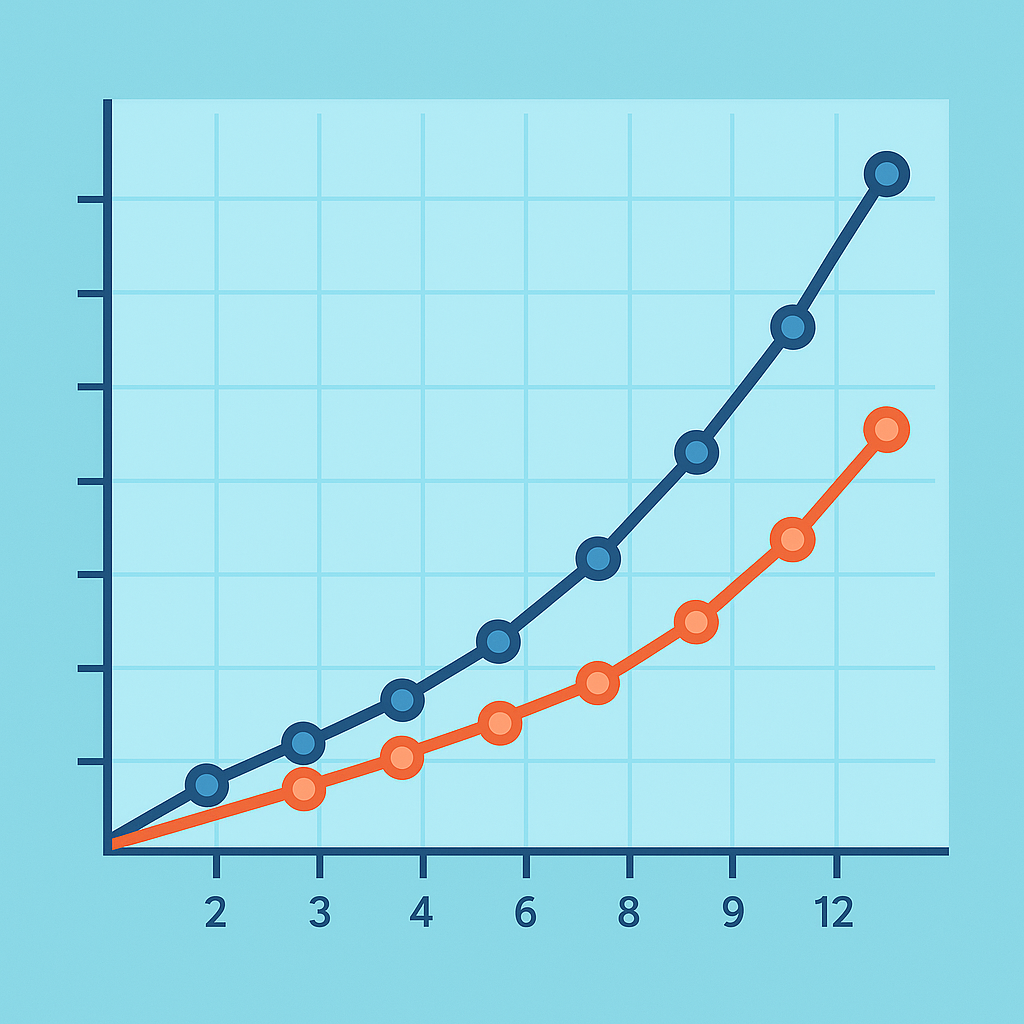
Content velocity is a structural advantage. A site publishing 30 optimized articles per month compounds its indexed footprint twelve times faster than a site publishing two to three articles per month — and indexed footprint correlates directly with the number of organic queries you can intercept. The challenge for lean teams is that quality cannot drop to enable volume. Google's E-E-A-T framework (Experience, Expertise, Authoritativeness, Trustworthiness) has grown more stringent with each helpful content update. Content that reads as generic or thin no longer ranks, regardless of keyword targeting. The solution is autonomous content infrastructure — AI agents that handle research, writing, optimization, internal linking, schema injection, and CMS publishing without requiring a human to prompt each step.
What E-E-A-T compliance actually requires in 2026
E-E-A-T compliance is not a checklist you add at the end of a draft. It's baked into the structure of the article: author attribution with demonstrated credentials, specific claims supported by named sources, first-person experience signals, FAQ sections with genuinely useful answers, and schema markup that surfaces all of the above to Google's quality evaluation systems. According to Semrush's 2025 State of Content Marketing report, pages with structured data receive 20–30% more organic clicks than equivalent pages without it — a measurable return on a relatively low-effort implementation. Build E-E-A-T signals into your content template, not as an afterthought.
Gofylo's Content Engine has generated 48,000+ articles, each with schema markup, FAQ blocks, internal links, and AI-generated images — published directly to connected CMS platforms in under 4 minutes per article. That's not a content sprint. That's a compounding infrastructure.
Consistency beats peaks. A site that publishes 30 solid articles every month for six months will outrank a site that publishes 100 articles in one sprint and then goes quiet. Google's crawl frequency adapts to your publishing cadence — consistent output trains the algorithm to index your new content faster.
Language coverage compounds reach. If your product serves international markets, publishing in multiple languages multiplies your indexed keyword universe without cannibalizing your English rankings. Gofylo supports content generation in 18+ languages, which means a single content workflow can address search demand across European, Latin American, and Asia-Pacific markets simultaneously.
Programmatic pages capture long-tail demand. For SaaS products with broad use cases, programmatic landing pages — dynamically generated for each integration, use case, or customer segment — can capture enormous long-tail search volume that editorial articles can't efficiently address. This is a distinct motion from your cluster content and should be built and tracked separately.
Step 4: Optimize for AI Search Citation
To increase organic traffic in 2026, you must treat AI search engines as a distinct but related distribution channel. ChatGPT, Claude, Perplexity, and Gemini don't rank URLs — they cite sources within generated answers. To get cited, your content needs to be structured in the way that LLMs parse and trust: clear headings that directly answer implied questions, FAQ sections with concise Q&A pairs, specific statistics attributed to named sources, and definitive language rather than hedged generalities. According to a Gartner 2025 report, AI-powered search tools are expected to influence over 30% of B2B purchase decisions by the end of 2026 — which means AI search visibility is no longer a nice-to-have for SaaS companies competing for enterprise deals.
Structured data and FAQ blocks
FAQPage schema is the highest-ROI structured data type for AI citation. When an LLM is generating an answer about your topic, it preferentially pulls from content that already presents information in a question-answer format — because that format maps cleanly onto its output structure. Every article in your content cluster should contain four to six FAQ pairs covering the most common questions your ICP asks at that stage of the buying journey. Mark them up with FAQPage schema. Use Google's Structured Data Testing Tool to validate implementation before publishing. This is the single highest-leverage technical change most content teams haven't made yet.
Step 5: Build Internal Links Systematically
Internal linking is the mechanism that distributes PageRank across your content cluster and signals to Google which pages you consider most authoritative. It's also a key signal for AI engines: when multiple pages on your site reference the same concept or article, it reinforces topical depth. Most teams treat internal linking as an editorial afterthought — adding a few links at the end of a draft rather than engineering a deliberate link architecture. The correct approach is to build an internal linking map when you plan your cluster, not after you publish it. Every new article should link to the pillar page and to two to three supporting articles in the same cluster. The pillar page should link out to every supporting article. This creates a hub-and-spoke structure that concentrates authority in the pages you most want to rank.
- Map internal links at the cluster planning stage, not post-publish
- Every supporting article links back to its pillar page
- The pillar page links out to all supporting articles in the cluster
- Use descriptive, keyword-rich anchor text — not 'click here' or 'learn more'
- Audit internal links quarterly using Google Search Console's Links report
- Prioritize adding internal links to new content from your highest-traffic existing pages
Step 6: Earn Backlinks at Scale
Backlinks remain one of the strongest ranking signals in Google's algorithm — and despite years of predictions that links would be devalued, the 2026 data still shows a strong correlation between referring domain count and first-page rankings. According to Ahrefs' analysis of their link index, the top-ranking page for any keyword has an average of 3.8x more backlinks than pages ranking in positions 2–10. For lean SaaS teams, the highest-ROI link building activities are: original data and research (publishable studies that journalists and bloggers cite naturally), tool-based link magnets (free calculators, graders, or templates that earn links passively), and guest contribution to high-authority industry publications. Avoid link schemes and low-quality directory submissions — these generate manual actions, not rankings.
Original data earns links. A survey of 200 SaaS founders, a benchmark study on content production costs, or an analysis of AI search citation patterns — these are articles that earn backlinks because they give other writers a citable source. Prioritize at least one original research piece per quarter.
Free tools convert and earn links. Gofylo's AI Search Grader is an example of this motion: a free standalone tool that grades a brand's AI search visibility. Tools like this earn organic backlinks from bloggers and creators who want to recommend something useful, while simultaneously converting visitors into product-aware leads.
Step 7: Track Both Google Rankings and AI Visibility
Measurement defines what gets improved. If you're only tracking Google rankings and organic sessions in GA4, you're blind to an increasingly large share of your true search footprint. As of 2026, a meaningful percentage of B2B buyers are using AI chat interfaces as their primary research tool — and your brand's presence in those answers is not captured in any traditional rank tracker. You need two distinct tracking layers: a rank tracker for Google (Ahrefs, Semrush, or Search Console) and an AI visibility tracker that monitors whether your brand and content are being cited in ChatGPT, Claude, Perplexity, and Gemini responses. Gofylo's AI Visibility Tracker covers all four major LLMs and produces a single AI Visibility Score — the average across active accounts is 94 — so you have a benchmark rather than anecdotal evidence.
According to Semrush's 2025 benchmarks, brands that actively monitor and optimize for AI citation see 2–3x more AI-assisted referral traffic within six months compared to brands that only track traditional rankings. Dual-surface tracking is not optional at this stage of the search landscape's evolution.
- Track Google rankings weekly using Ahrefs or Semrush rank tracking
- Monitor AI citations across ChatGPT, Claude, Perplexity, and Gemini monthly
- Segment organic traffic by landing page cluster to identify which clusters are compounding
- Set up Google Search Console alerts for manual actions and coverage drops
- Review backlink acquisition monthly — track referring domain growth, not just link count
- Use AI visibility score as a board-level metric alongside organic session growth
Frequently Asked Questions
How long does it take to increase organic traffic?
Most B2B SaaS sites see measurable ranking movement within 90 to 120 days of consistent, optimized publishing. Compounding growth — where new content benefits from existing authority — typically becomes visible at the six-month mark. Accelerating publishing velocity and backlink acquisition shortens that timeline.
Does AI search replace Google for organic traffic?
Not yet, but it's a meaningful and growing channel. In 2026, Google still drives the majority of organic traffic for most B2B SaaS sites. However, AI search engines influence purchase decisions at an increasing rate, particularly in the awareness and consideration stages. Optimizing for both surfaces simultaneously is the lowest-risk strategy.
How many articles do I need to see compounding growth?
Topical clusters typically need eight to fifteen supporting articles per pillar before they generate meaningful compounding lift. A site with three to five fully developed clusters — 30 to 75 articles total — is generally sufficient to establish topical authority signals that Google reinforces over time.
What is topical authority and why does it matter?
Topical authority is Google's measure of how comprehensively and accurately a site covers a given subject area. Sites with strong topical authority rank for new keywords in their topic faster than sites without it, because Google trusts their content quality before it's independently validated by backlinks. Building topical authority through cluster content is the most efficient path to sustainable organic traffic growth.
Can a small team realistically execute this strategy?
Yes — but only with autonomous infrastructure. A single content manager manually writing and publishing two to three articles per month cannot compete with a team publishing thirty. Autonomous agents that handle the full content lifecycle — research, writing, schema markup, internal linking, CMS publishing — make high-velocity content operations accessible to teams of one. That's the structural shift that separates compounding growth from incremental growth.
Gofylo ships six autonomous agents that handle keyword research, article writing, CMS publishing, AI visibility tracking, competitor intelligence, and backlink generation — all on a single $79/month plan with a 3-day free trial and no credit card required. If you want to see where your brand stands in AI search before committing, start with the free AI Search Grader at gofylo.com.