As of 2026, the gap between content that compounds and content that flatlines has widened dramatically. Google ran over 700,000 experiments in 2023 alone, resulting in more than 4,000 improvements to Search — and the pace hasn't slowed. Every iteration moves the algorithm closer to rewarding genuine expertise and penalizing content that technically exists but adds nothing. Meanwhile, AI engines like ChatGPT, Claude, Perplexity, and Gemini now surface answers directly, pulling from content they've determined is authoritative, well-structured, and citation-worthy. If your content doesn't meet that bar, it doesn't get cited — not by Google, not by any AI engine.
SEO content quality isn't a single dial you can turn up. It's a layered system of signals — structural, semantic, experiential, and increasingly, AI-legibility signals that determine whether your content gets surfaced in generative answers. Most teams optimize for one layer and ignore the rest. This guide breaks down what each layer actually means, why it matters for both traditional search and AI search, and what separates content that compounds organic traffic from content that silently underperforms.
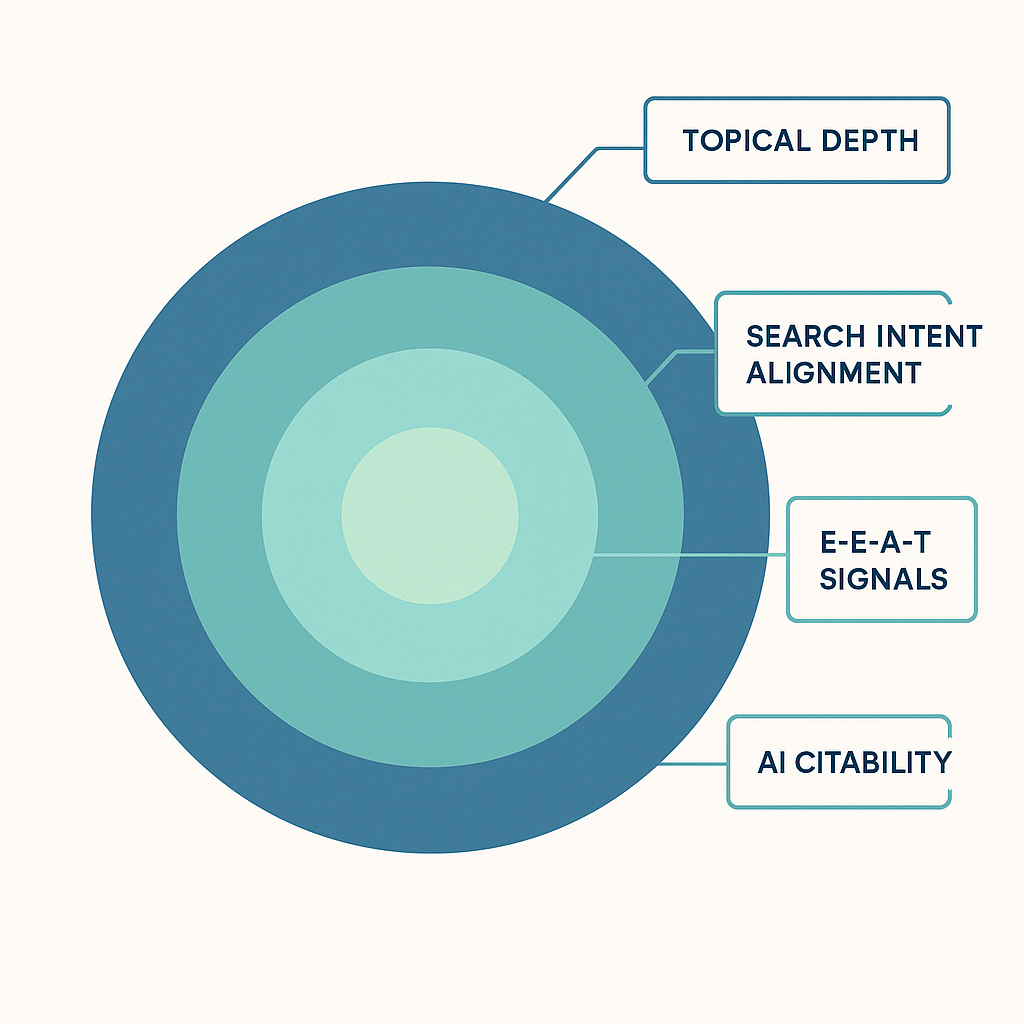
Thesis: SEO content quality is the intersection of topical depth, search intent alignment, E-E-A-T compliance, and AI citability. Teams that understand all four layers build content that compounds in both Google rankings and AI-generated answers — simultaneously.
What Content Quality Actually Means in SEO
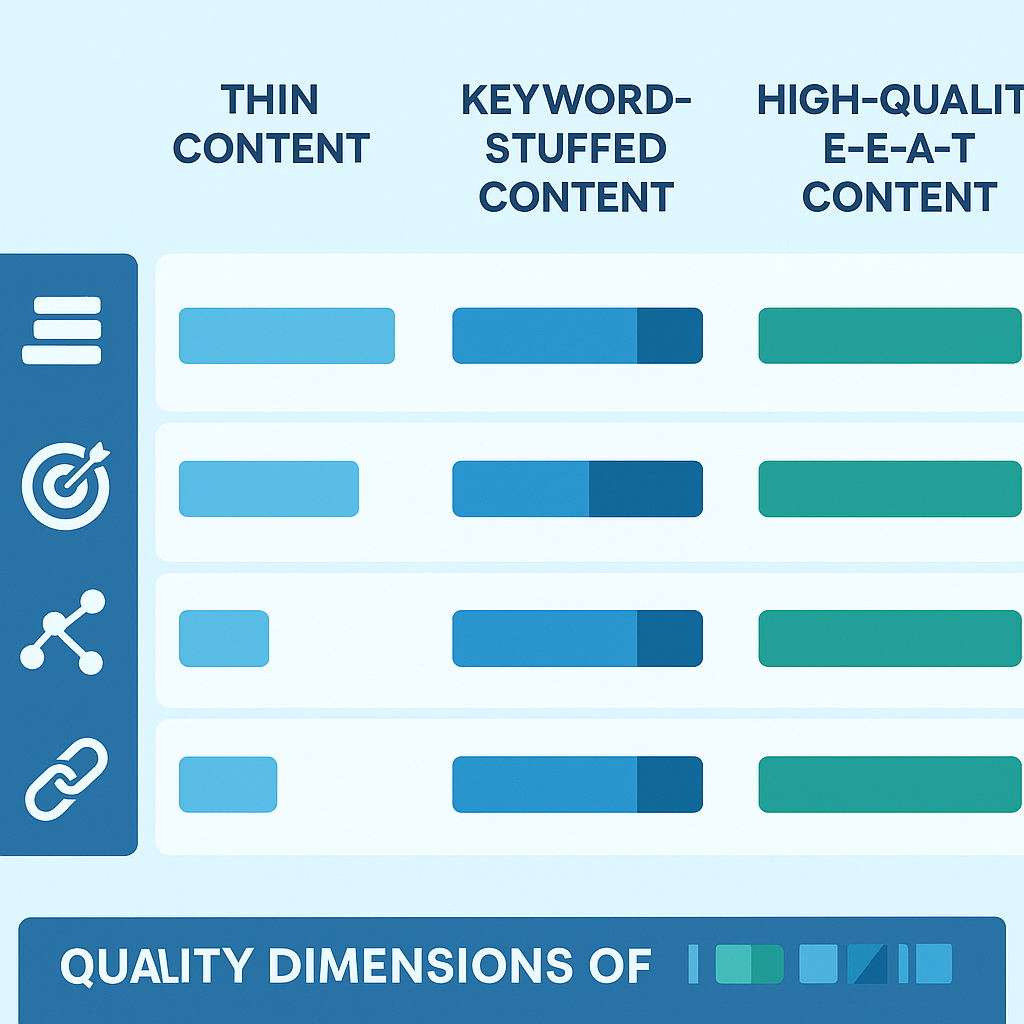
SEO content quality refers to how well a piece of content satisfies three simultaneous requirements: the intent of the person searching, the quality standards of the engine evaluating it, and the informational needs of the topic itself. A piece can be well-written and still fail all three — because 'well-written' is a human judgment, while search engines and AI systems evaluate structural signals, entity completeness, topical coverage, and behavioral outcomes like dwell time and click-through rate. Quality in SEO is always evaluated relative to the competing content available for a query, which means it's a moving target that shifts as the competitive landscape evolves. What ranked well in 2022 may now be considered thin by 2026 standards because the competitive floor has risen — not because Google fundamentally changed what it values, but because more content teams have gotten better at the basics, pushing mediocre content further down. High SEO content quality means your content is simultaneously the most useful, most trustworthy, and most structurally legible option for a given query.
Useful is not the same as comprehensive. A common mistake is equating quality with length or depth. A 4,000-word article that circles the same three points isn't high-quality — it's padded. Quality means the content answers the specific question a searcher has, at the right depth for their stage of awareness, without forcing them to look elsewhere for the core answer.
Quality is always competitive. Search engines don't evaluate content in isolation. They rank it relative to other pages targeting the same query. This means quality isn't an absolute standard — it's a relative one. The practical implication is that content that was 'good enough' two years ago may now be outranked by more thorough, better-structured competitors, even if nothing about your content changed.
AI engines raise the bar further. In 2026, content doesn't just need to rank — it needs to be citable. AI engines like Perplexity and Claude pull from content they can parse, attribute, and synthesize cleanly. Content that's too vague, too thin, or too structurally ambiguous gets skipped entirely, even if it technically ranks on page one. SEO content quality now includes a citability dimension that didn't exist three years ago.
The E-E-A-T Framework: Why Google's Quality Signals Matter More Than Ever
E-E-A-T — Experience, Expertise, Authoritativeness, and Trustworthiness — is Google's quality evaluation framework, formalized in its Search Quality Rater Guidelines and applied algorithmically through a combination of on-page signals and off-page authority indicators. By 2026, E-E-A-T is no longer a checklist for edge cases; it's the baseline quality threshold for any content targeting competitive, high-intent queries. The framework matters because it operationalizes something search engines struggled with for years: distinguishing genuinely useful content from content that merely looks useful. Each dimension of E-E-A-T maps to specific, measurable signals — not just qualitative judgments — which is why understanding it structurally matters more than treating it as an abstract principle. Teams that build content without explicitly considering each E-E-A-T dimension are leaving quality signals on the table, and AI engines increasingly use the same signals to decide which content gets cited in generative answers.
Experience and Expertise
Experience refers to first-hand knowledge demonstrated within the content itself — specific examples, original data, practitioner insights that couldn't have been written by someone without domain contact. Expertise refers to the demonstrable qualifications or depth of knowledge of the author or organization producing the content. For B2B SaaS content specifically, expertise signals include citing specific platform behaviors, product mechanics, or industry data with precise attribution. Google's Search Quality Rater Guidelines reinforce that content demonstrating real-world experience consistently scores higher for 'Your Money or Your Life' (YMYL) topics — and by 2026, that standard has expanded to include competitive commercial queries across most B2B categories. Writing that reads as generic — the kind that could apply to any company, any product, any use case — fails both the experience and expertise test, even if it's technically accurate.
Authoritativeness and Trustworthiness
Authoritativeness is largely an off-page signal — it's built through backlinks, brand mentions, citations in other content, and the overall domain authority that accumulates over time. Trustworthiness, however, has a strong on-page dimension: clear authorship, cited sources, transparent methodology, and accurate information that doesn't mislead. Trustworthiness is also where schema markup plays a direct role — structured data signals to search engines that your content is organized, attributable, and machine-readable in a trustworthy way. Building authoritativeness takes time, but trustworthiness can be improved immediately through on-page changes: adding author bios, citing sources inline, correcting outdated claims, and removing content that contradicts itself. The two signals compound together — trusted content attracts more backlinks, which builds authority, which increases the probability of being cited by AI engines.
How Search Intent Shapes Quality Judgment
Search intent is the single most important contextual filter applied to content quality evaluation. A piece of content can be deeply researched, well-written, and technically optimized — and still rank poorly if it doesn't match the underlying intent of the query it targets. Search engines infer intent from query patterns, user behavior, and the types of results that consistently earn engagement for a given term. Intent misalignment is one of the most common quality failures, and it's particularly prevalent in B2B SaaS content because teams often write for the product they're selling rather than the problem the searcher is trying to solve. Understanding intent isn't just about classifying queries as informational, navigational, or transactional — it's about understanding what kind of answer the searcher expects at their specific stage of awareness, and calibrating content depth, format, and framing accordingly. A searcher asking 'what is SEO content quality' wants a definitional explanation with examples. A searcher asking 'SEO content checker online free' wants a tool recommendation. Treating both with the same content type is a quality failure, regardless of how well-written the content is.
Informational vs. Commercial Intent
Informational intent queries demand content that educates without bias — the quality bar is depth of explanation, accuracy, and completeness. Commercial intent queries demand content that helps the reader make a decision — the quality bar shifts to specificity of comparison, evidence of real outcomes, and clarity of differentiation. Many B2B content teams publish informational content for commercial intent queries and vice versa, which produces high bounce rates and poor engagement signals — both of which feed back into quality scoring. In 2026, AI engines make this even more consequential: Perplexity and ChatGPT surface different content types depending on the intent they infer from a query, so intent-aligned content is more likely to be cited in the right context.
Intent misalignment is the most common, least diagnosed content quality failure in B2B SaaS. Before optimizing a single word, confirm the format, depth, and framing of your content matches what the searcher expects — not what your product team wants to say.
Structural Signals That Engines Read Before Humans Do
Content quality isn't only about what you say — it's about how legible that content is to machines before a human ever reads it. Search engines and AI crawlers evaluate structural signals to determine whether content is well-organized, trustworthy, and worth surfacing. These structural signals include heading hierarchy, internal linking patterns, schema markup, page speed, and Core Web Vitals. A piece of content with strong substance but poor structure loses quality points before the algorithmic evaluation of its actual substance begins. This is the dimension of SEO content quality that most content teams treat as a technical afterthought — and it's often where the largest gaps exist relative to top-ranking competitors. Structural quality also directly influences AI citability: AI engines parse structured content more reliably than free-form prose, and well-marked FAQ sections, numbered lists, and clear heading hierarchies all increase the probability that a specific passage gets extracted and cited in a generative answer.
Schema Markup and Rich Results
Schema markup is one of the highest-leverage structural quality signals available, yet it remains dramatically underused. According to Ahrefs' 2026 SEO statistics, only 33% of websites pass the Core Web Vitals threshold — a related signal that indicates how infrequently teams fully execute on technical quality. On the schema side, 72% of first-page results use schema markup, making their listings eligible for rich results like review stars, FAQs, prices, or event details (BrightEdge, via SEO Sherpa). This isn't coincidental — structured data makes content machine-readable in a standardized format, which benefits both Google's rich result eligibility and AI engines' ability to parse and cite specific content blocks. FAQPage schema is particularly powerful for AI search visibility because it maps directly to how AI engines structure their answer outputs.
Core Web Vitals and Technical Quality
Core Web Vitals — Largest Contentful Paint, Interaction to Next Paint, and Cumulative Layout Shift — measure the experiential quality of a page, not just its content. Google uses these as ranking signals because user experience is inseparable from content quality in practice: content that loads slowly, shifts during reading, or responds sluggishly to interaction produces poor engagement signals that drag down quality scores. The fact that only 33% of websites pass the Core Web Vitals threshold as of 2026 (Ahrefs) means this is an area where most content teams have a structural quality gap they're not addressing, often because it sits at the boundary between content and engineering responsibilities.
AI Citability: The Quality Dimension Most Teams Miss
AI citability is the emerging quality dimension that separates teams building for 2026 search from those still optimizing for 2022 search. When ChatGPT, Claude, Perplexity, or Gemini generate an answer to a query, they pull from content they can parse, attribute, and synthesize with confidence. Content that's vague, poorly attributed, or structurally ambiguous gets excluded from generated answers — even if it ranks on page one of Google. This matters because organic click-through rates have dropped sharply for queries where AI Overviews appear: organic CTR dropped 61% for those queries, falling from 1.76% in June 2024 to 0.61% in September 2025, according to Seer Interactive's analysis cited by SearchAtlas. That means ranking alone is no longer sufficient — content needs to be cited in the AI-generated answer itself, or it may not drive meaningful traffic regardless of its position. AI citability is built through specific quality signals: precise, attributable claims; clear entity definitions; FAQ blocks with structured schema; clean heading hierarchies; and content that directly answers specific questions rather than circling them.
- Use FAQ sections with FAQPage schema — AI engines extract these directly for structured answers
- Make every major claim attributable: named sources, specific numbers, clear methodology
- Write with entity clarity — define acronyms, name products and platforms explicitly, avoid ambiguous pronouns
- Structure content with a clear heading hierarchy that maps to how AI engines chunk text
- Avoid content that only makes sense in context — each section should be independently extractable
- Include original data, specific examples, or proprietary insights that can't be found in generic sources
- Align content to the specific question format that AI engines receive — not just broad topic coverage
The concern around AI-generated content quality is real and widely acknowledged: 65.14% of professionals cite content authenticity and quality as top concerns when it comes to generative AI, according to SEOClarity research cited by SearchAtlas. This creates an opportunity for teams that can produce genuinely expert, attributable content at scale — because generic AI-generated content has raised the floor of what exists while simultaneously lowering the average quality of what's available to cite. The teams that win in AI search are those producing content that a language model would prefer to cite over a generic summary.
Why Keyword Density Is the Wrong Metric to Chase
Keyword density is one of the most persistent misconceptions in SEO content quality, and chasing it actively degrades quality rather than improving it. The data is unambiguous: pages in the top 10 today have a 50% lower keyword density than those ranking a couple of years ago, according to BrightEdge research cited by SEO Sherpa. This trend reflects a fundamental shift in how search engines evaluate relevance — from surface-level keyword matching to semantic understanding of topics, entities, and user intent. Modern search algorithms understand that a page about 'SEO content quality' should naturally contain related terms like E-E-A-T, search intent, topical authority, and Core Web Vitals — without those terms being forced into the content at a predetermined frequency. The practical implication is that content written for keyword density tends to read unnaturally, which damages engagement metrics, reduces dwell time, and signals to search engines that the content is optimized for algorithms rather than people. SEO content quality in 2026 is evaluated through semantic completeness and topical coverage — not keyword repetition.
Semantic coverage beats density. Instead of asking 'how many times should I use this keyword,' ask 'what related concepts, entities, and questions should this content address to be genuinely complete on this topic.' That shift in framing produces content that naturally includes the target keyword while building the semantic depth that modern engines reward.
Topical authority compounds over time. Individual article quality is amplified by the topical authority of the surrounding content cluster. A well-written article on SEO content quality signals more authority when it's part of a cluster that also covers internal link strategy, topical authority, and high-quality content SEO — because the cluster collectively demonstrates domain expertise, not just individual piece completeness. This is why isolated content production, however high-quality, rarely compounds the way a structured topical cluster does.
What Long-Form Content Actually Signals
Long-form content doesn't rank better because of its length — it tends to rank better because length correlates with topical completeness, which is what search engines actually reward. The distinction matters because teams that chase word counts without adding genuine depth produce padded content that damages rather than improves SEO content quality. That said, the correlation between length and performance is real: long-form content typically attracts 77.2% more backlinks compared to shorter articles, according to WPBeginner's 2026 SEO research. Backlinks remain one of the strongest authority signals available, and longer, more comprehensive content earns them more naturally because it's more likely to be cited as a reference by other content producers. The mechanism isn't length itself — it's that comprehensive coverage of a topic produces more linkable assets: specific data points, defined frameworks, original examples, and structured sections that other writers can reference cleanly.
The SEO content quality implication is that depth of coverage should drive content length, not the reverse. A topic that can be fully addressed in 1,200 words shouldn't be stretched to 3,000. A topic with genuine complexity — like SEO content quality itself, which spans structural, semantic, experiential, and AI citability dimensions — deserves the space to cover each dimension thoroughly. The quality test for any section of a long-form article is whether it adds something the reader would have missed if that section didn't exist. If the answer is no, the section is padding. Beyond backlinks, Ahrefs' research on content quality and rankings consistently shows that comprehensive, well-structured content earns higher engagement signals — lower bounce rates, higher time-on-page — which feed back into quality scoring in a compounding loop. And from an AI citability perspective, longer content with clear section structure is more likely to contain the specific, attributable passage that an AI engine needs to generate a confident answer.
53% of SEO experts believe that creating high-quality content is the most effective way to improve rankings, according to WPBeginner's 2026 SEO research. The challenge isn't knowing that quality matters — it's producing it consistently at the volume required to build topical authority without a dedicated content team.
This is exactly the problem Gofylo was built to solve. Gofylo's Content Engine autonomously researches, writes, and publishes 30 SEO-optimized articles per month — each generated in under 4 minutes — with E-E-A-T compliance, schema markup, internal linking, FAQ blocks, and AI-generated images included by default. The AI visibility score shows how ChatGPT and Claude see a brand, based on asking those two engines about it directly. For teams that need to build topical authority at scale without a full content team, that's a structurally different capability than a content brief tool or an AI writing assistant.
Related: SEO Content Creation in 2026: What Ranks and Gets Cited
FAQ
What is content quality in SEO?
Content quality in SEO refers to how well a piece of content satisfies search intent, demonstrates E-E-A-T (Experience, Expertise, Authoritativeness, and Trustworthiness), and provides genuinely useful information relative to competing content for the same query. It's evaluated through a combination of on-page signals (depth, structure, accuracy, schema markup), off-page signals (backlinks, brand mentions), and user behavior signals (dwell time, bounce rate, click-through rate). In 2026, content quality also includes AI citability — whether AI engines like ChatGPT and Perplexity find the content clear and attributable enough to cite in generated answers.
What is the 80/20 rule in SEO?
The 80/20 rule in SEO refers to the observation that roughly 80% of organic traffic typically comes from 20% of a site's content — often the pages with the strongest topical authority, highest-quality coverage, and best alignment to high-volume search intent. The practical implication is that identifying and strengthening that top 20% yields disproportionate returns compared to producing more average content. From a quality standpoint, it reinforces the principle that depth and specificity on fewer, well-chosen topics outperforms broad but thin coverage across many topics.
What is high-quality content for SEO?
High-quality content for SEO is content that fully satisfies the search intent of its target query, demonstrates genuine expertise through specific examples and accurate data, is structured for both human readability and machine parsability (via schema and clear headings), and earns engagement signals like low bounce rates and strong time-on-page. In 2026, high-quality content also needs to be AI-citable — structured with FAQ sections, attributable claims, and entity clarity so that AI engines can extract and cite specific passages in generative answers. According to WPBeginner's 2026 research, 53% of SEO experts identify high-quality content as the single most effective ranking lever available.
What are the 5 components of SEO?
The five commonly cited components of SEO are: (1) technical SEO — site speed, crawlability, Core Web Vitals, and structured data; (2) on-page SEO — content quality, keyword relevance, heading structure, and meta data; (3) off-page SEO — backlinks, brand authority, and external citations; (4) content strategy — topical authority, search intent alignment, and content depth; and (5) user experience — engagement signals, mobile usability, and page experience. In 2026, a sixth component is increasingly recognized: AI search visibility — how well content performs in generative AI answers across platforms like ChatGPT, Claude, Perplexity, and Gemini.
How does SEO content quality affect AI search visibility?
AI engines prioritize content that is precise, attributable, and structurally parsable. High SEO content quality — meaning clear headings, FAQ schema, inline citations, and specific claims — directly increases the probability that a piece of content gets cited in a generative answer. Content that reads as vague, unsourced, or structurally ambiguous gets skipped even if it ranks well on Google. Since organic CTR drops sharply for queries where AI Overviews appear (down 61% according to Seer Interactive data cited by SearchAtlas), being cited in the AI answer itself is increasingly the more valuable outcome.
How can I check my SEO content quality without expensive tools?
Several free and accessible approaches exist for evaluating SEO content quality. Google Search Central's documentation provides the official quality criteria Google applies. Manually comparing your content against the top three ranking pages for your target query reveals gap areas in depth, structure, and topical coverage. For AI search visibility specifically, Gofylo's free AI Search Grader tool grades your brand's current AI citation presence across major AI engines and provides actionable scoring — without requiring a paid account.
If your content is well-written but not compounding, the bottleneck is usually volume, structure, or AI citability — not writing quality. Gofylo's autonomous Content Engine handles all three: publishing 30 E-E-A-T-optimized articles per month with schema, internal links, and FAQ blocks built in. Start a free 3-day trial at gofylo.io.