As of 2026, Google's ranking systems and AI engines like ChatGPT, Perplexity, and Claude are converging on a shared signal: depth of coverage. A single well-optimized article no longer earns sustained rankings the way it did in 2019. What earns rankings — and more importantly, citations in AI-generated answers — is a website that has demonstrably covered every meaningful angle of a topic cluster. That's the core mechanism behind topical authority, and it's why the strategy has become the default playbook for growth-stage SaaS teams with limited content headcount.
2026 data from Ahrefs shows that sites with tightly clustered content covering a topic comprehensively rank for 3x more keywords than those with isolated pages targeting the same terms. The implication isn't subtle: Google's systems, and the large language models that now drive AI search, reward breadth plus depth. Individual articles are table stakes. The structural relationship between them is what converts a content library into a compounding organic asset.
Topical authority is the structural property that makes a website the definitive source on a subject — not just for Google's crawlers, but for the AI engines that synthesize answers from content they trust most. Building it changes the economics of content from linear effort to compounding returns.
What Topical Authority Actually Means
Topical authority is the degree to which a website is recognized — by search engines and AI systems — as a comprehensive, reliable source on a specific subject domain. It's an emergent property, not a single metric. You don't earn topical authority by writing one exceptional article; you earn it by building a library of content that covers a topic's full conceptual surface area: definitions, use cases, comparisons, implementation details, edge cases, and related subtopics. When a search engine's model encounters a query in your domain, topical authority determines whether your site is in the first retrieval pool or not. It's essentially the answer to the question: 'Does this site know everything worth knowing about this subject?'
How It Differs From Domain Authority
Domain authority, a concept popularized by Moz and echoed in Ahrefs' Domain Rating, is primarily a backlink-derived signal — it reflects the quantity and quality of external sites linking to yours. Topical authority is orthogonal to this. A relatively new site with few backlinks can outrank an established domain on a tightly scoped topic if it has published more thorough, interlinked coverage of that topic. The practical distinction matters for SaaS startups: you don't need ten years of link acquisition to compete. You need to cover your subject more completely than any competitor already has, and connect those pieces intelligently through internal linking and schema structure.
Why AI Search Engines Weight Topical Depth Heavily
AI search engines — including ChatGPT's web browsing mode, Perplexity, Claude, and Gemini — don't rank pages in the traditional sense. They retrieve content, evaluate its reliability and completeness, then synthesize an answer and (often) cite a source. The retrieval step is where topical authority becomes decisive. When an LLM encounters a query about, say, content distribution strategy, it favors sources that have demonstrated consistent, authoritative coverage of adjacent concepts: content strategy, SEO content creation, content audits, and distribution channels. A site that has covered all of these in depth is structurally more likely to be retrieved and cited than a site that published a single strong article on one piece of the puzzle.
How AI Engines Evaluate Coverage
The mechanism isn't fully transparent, but Semrush's 2025 AI Search study found that pages cited in AI-generated answers had an average of 40% more semantically related content on the same domain than pages that ranked in traditional search but weren't cited in AI answers. In other words, AI engines appear to use co-citation patterns across a site to assess how much they trust a given page. Coverage breadth functions as a trust proxy. This is why building topical authority in 2026 is simultaneously a Google SEO play and a GEO (Generative Engine Optimization) play — the structural signal that satisfies one engine increasingly satisfies the other.
GEO insight: AI engines appear to weight a site's broader topical coverage when deciding whether to cite a specific page. This means every cluster article you publish strengthens the authority of every other article in the cluster — a compounding dynamic that single-article content programs can't replicate.
The Architecture of a Topical Authority Play
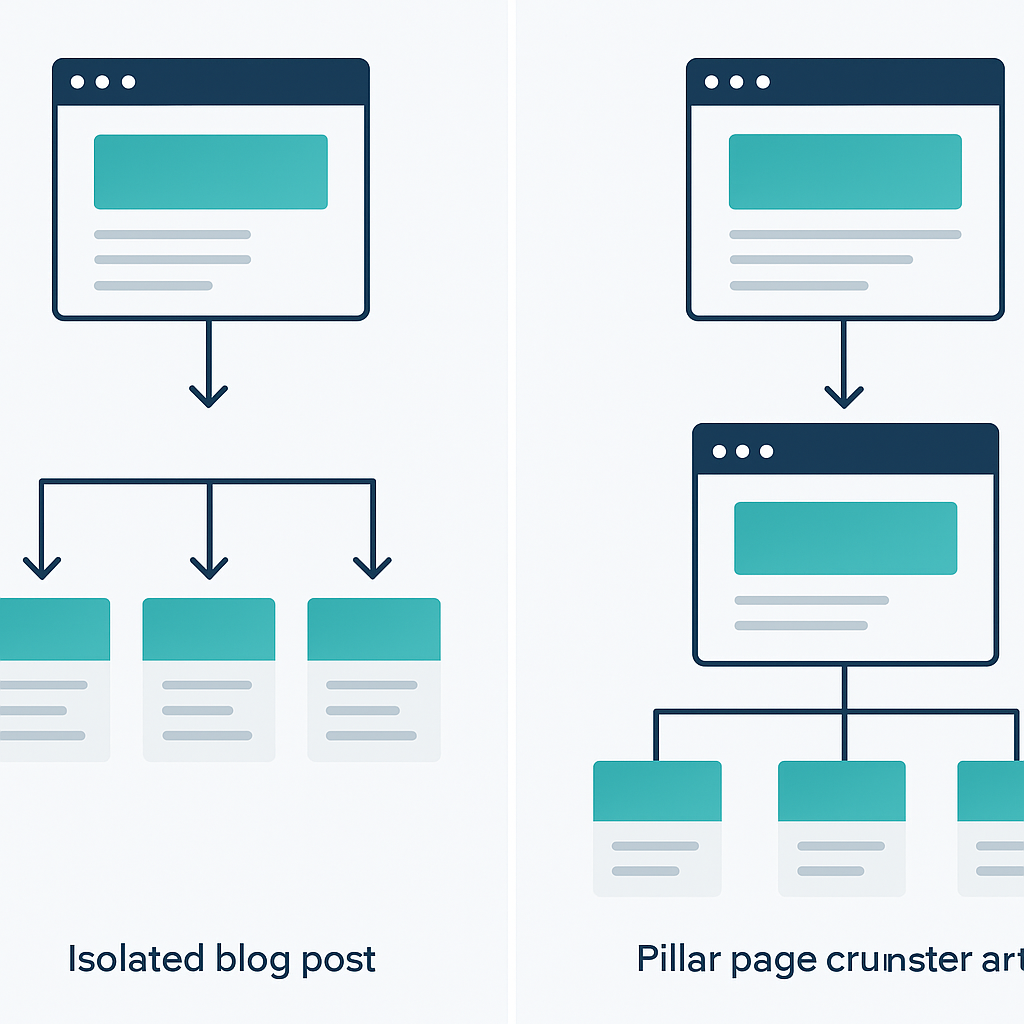
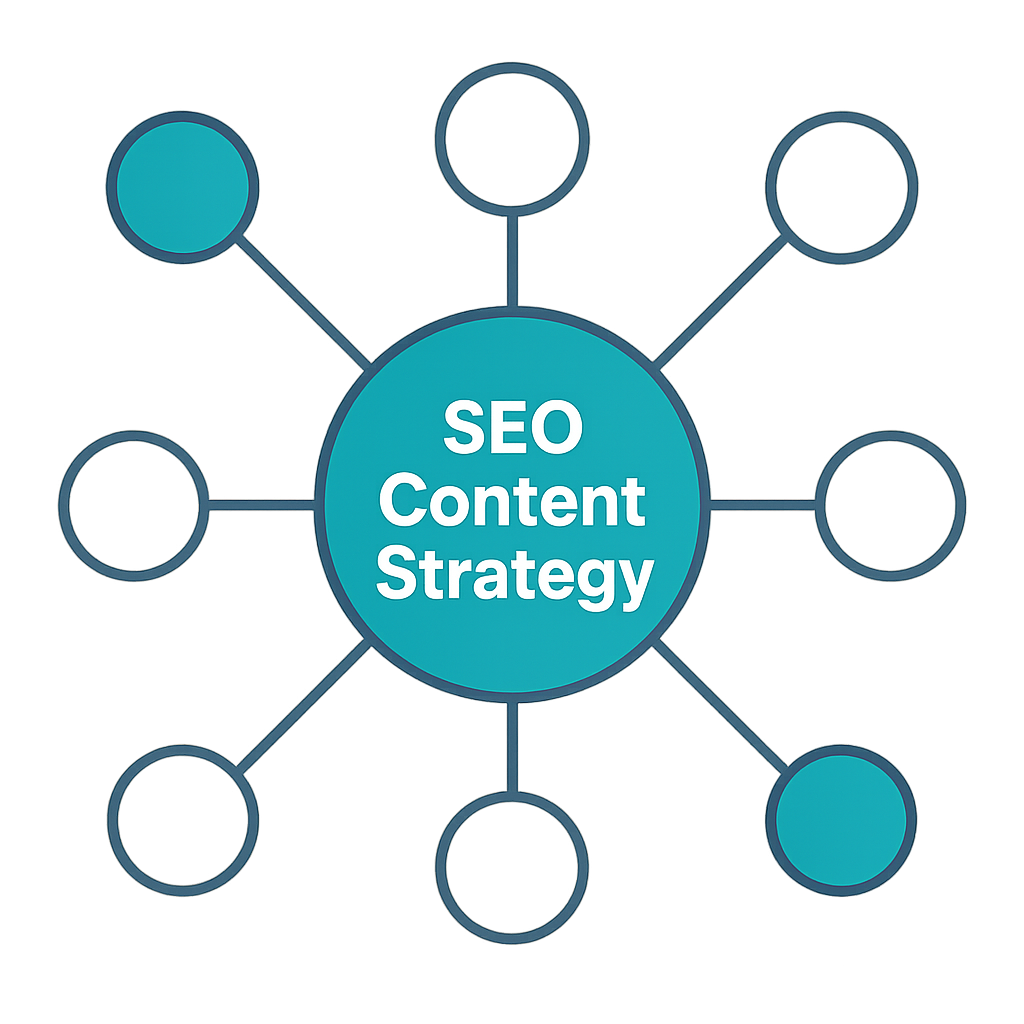
Topical authority is built through a deliberate content architecture, not through volume alone. The structure that consistently performs — in Google rankings and AI citations — is the pillar-cluster model: one comprehensive pillar page anchors a topic, and a constellation of cluster articles explores every subtopic, question, and use case branching from it. The pillar page targets broad, high-intent keywords and provides the conceptual overview. The cluster articles target long-tail variations and answer specific questions with depth. Together, they create a web of semantic signals that search engines interpret as expertise at scale.
Pillar Pages vs. Cluster Articles
A pillar page is not simply a long article — it's the definitional resource for a topic within your domain. It covers the what, why, and landscape of a subject at a level that would satisfy a reader who wants orientation before going deeper. Cluster articles, by contrast, are surgical: they go narrow and deep on a single subtopic, answering a specific question thoroughly. For an SEO content strategy cluster, the pillar might be 'SEO content strategy fundamentals,' while clusters address SEO content creation, high-quality content for SEO, internal linking in SEO, FAQ schema for SEO, and SEO content audits — each reinforcing the pillar and cross-linking to siblings where relevant.
Internal Linking as the Connective Tissue
Internal linking is the mechanism that transforms a collection of articles into a recognized topical cluster. When a cluster article about, say, internal linking in SEO links back to the pillar and forward to a related piece on content audits, the search engine crawling that site sees a coherent graph of related content — not isolated pages. Google's own documentation on site structure confirms that well-structured internal linking helps crawlers understand the relationship between pages and distributes PageRank across the site. From a topical authority standpoint, the link graph is evidence that the site's coverage of a topic is organized and intentional, not accidental.
What Signals Tell Google You Own a Topic
Google's systems evaluate topical authority through a layered set of signals that, taken together, answer whether your site is the best available resource on a subject. These aren't secret — Google's Search Quality Rater Guidelines and the E-E-A-T framework make the evaluation criteria reasonably transparent. The signals span content quality, structural coherence, external validation (backlinks and mentions), and author credentials. For B2B SaaS companies, the most actionable signals are those within direct control: content depth, coverage breadth, schema markup, and the internal architecture that connects pieces into a coherent whole.
E-E-A-T and Its Role in Authority
Experience, Expertise, Authoritativeness, and Trustworthiness (E-E-A-T) is Google's framework for evaluating whether content creators and publishers are qualified to speak on a topic. For SaaS companies, E-E-A-T is operationalized through demonstrated depth: articles that cite real data, address counterarguments, include schema markup, reference primary sources, and are internally consistent with the rest of the site's coverage. According to Search Engine Land's 2025 E-E-A-T analysis, pages that satisfy all four E-E-A-T dimensions are significantly more likely to appear in both AI Overviews and traditional top-ten results — reinforcing that the same quality signal satisfies both surfaces.
- Content depth: Articles that answer primary and secondary questions within the same piece
- Coverage breadth: A cluster of interlinked articles spanning the topic's full conceptual surface
- Schema markup: FAQ, Article, and HowTo schema that makes content machine-readable for both Google and AI retrieval
- Internal link graph: Deliberate linking between pillar and cluster that signals topical coherence
- External validation: Backlinks from domain-relevant sources citing specific articles as references
- Author credentials: Named authors with demonstrable expertise referenced in bylines and author pages
- Freshness signals: Regular content updates and publication of new cluster articles that extend the topic's coverage
Why Most SaaS Content Programs Stall Before Reaching Authority
The majority of B2B SaaS content programs produce content for months without achieving meaningful topical authority — not because the content is poor, but because the output rate is too slow to fully cover a topic before the market moves, and the coverage map has too many gaps to signal completeness. A typical in-house content team producing four to six articles per month takes two to three years to build a topic cluster of the depth that modern search engines require. During that time, competitors are publishing, AI engines are forming their initial citation preferences, and the window for establishing primary authority in a topic domain is actively narrowing.
The Coverage Gap Problem
A coverage gap is any subtopic, question, or use case within your target domain that your site hasn't addressed — and that a competitor or AI training corpus has. Coverage gaps are consequential in two ways: Google sees incomplete coverage as evidence that the site isn't the definitive source, and AI engines draw on whatever content is available when formulating answers, meaning your competitor's article gets cited on your topic. Identifying and closing coverage gaps is the operational work of topical authority building, and it requires systematic keyword and semantic analysis rather than intuition-driven editorial calendars. A proper SEO content audit is the tool for surfacing these gaps before they calcify into competitor advantages.
How Autonomous Content Systems Change the Equation
The structural problem with building topical authority manually isn't effort — it's throughput. A topic cluster that requires 60 to 80 articles to achieve comprehensive coverage takes a four-person content team roughly 18 months at standard production rates. The compounding benefit of authority only materializes once coverage crosses a completeness threshold, which means the ROI curve is backloaded and most teams abandon the strategy before it pays off. Autonomous content systems change this by decoupling coverage rate from headcount. Gofylo's Content Engine, for instance, publishes 30 fully optimized, E-E-A-T-compliant articles per month — each with schema markup, internal links, FAQ blocks, and AI-generated images — in under 4 minutes per article. The standard plan publishes 30 articles a month. That production rate allows a startup to close a 60-article coverage gap in two months rather than eighteen.
Speed compounds authority. The faster a site covers a topic cluster, the sooner it reaches the completeness threshold that search engines and AI engines recognize as authoritative. Early movers in a topic domain tend to retain citation primacy even as competitors publish later — AI engines develop citation preferences based on historical retrieval patterns, and dislodging an established source requires significantly deeper or more current coverage.
Structural consistency matters. Autonomous systems don't just produce volume — they enforce structural consistency across every article. Schema markup, internal linking patterns, FAQ blocks, and heading hierarchies are applied uniformly, which means the topical cluster's signal quality doesn't degrade as coverage scales. Manual content programs almost always introduce inconsistency at scale — articles that lack schema, miss internal links, or vary wildly in depth — which dilutes the authority signal.
AI visibility is measurable. Gofylo gives an AI visibility score by asking ChatGPT and Claude about your brand, showing how those two engines see you. This closes the feedback loop that traditional SEO analytics leave open: you can see whether your topical authority investments are translating into AI search citations, not just Google rankings. That dual-surface visibility is the 2026 benchmark for content program effectiveness.
The 18-language advantage. Topical authority is language-specific. A site that dominates English coverage of a topic but has no presence in German, French, or Spanish is leaving AI citation share on the table in those markets. Platforms that support programmatic multilingual publishing — Gofylo generates content in 18+ languages — extend the compounding dynamic across language markets simultaneously, which is structurally inaccessible to manual content workflows.
Measuring Topical Authority: The Metrics That Matter
Topical authority doesn't have a single canonical score, but a combination of proxy metrics gives a reliable picture of where a site stands. The most operationally useful measurements combine traditional SEO signals with the newer AI search visibility layer. Tracking only one surface — Google rankings without AI citation presence, or vice versa — produces an incomplete picture of a content program's actual performance in 2026's split-attention search landscape.
- Topical coverage ratio: The percentage of target subtopics with published, indexed content versus total identified subtopics in the cluster
- Keyword cluster ranking distribution: How many keywords in a topic cluster rank in positions 1–10 versus 11–30
- AI citation frequency: How often pages from the domain are cited in AI-generated answers for topic-relevant queries across ChatGPT, Perplexity, Claude, and Gemini
- Internal link graph density: The average number of relevant internal links per article in the cluster
- Organic traffic per cluster: Aggregate traffic to all pages in a topic cluster, which reflects authority more accurately than individual page traffic
- Featured snippet and AI Overview capture rate: The proportion of target queries for which the site appears in a featured snippet or AI Overview
A practical benchmark: according to Ahrefs, sites that publish at least 20 cluster articles around a core pillar see, on average, a 68% increase in organic impressions for that topic cluster within six months. Coverage volume has a direct, measurable effect on topical authority accrual — but only when the articles are interlinked and structurally sound.
Frequently Asked Questions About Topical Authority
These are the questions that come up most often when SaaS teams start implementing a topical authority strategy — answered directly, without the hedging you'll find in most SEO content.
- How many articles do I need to build topical authority? There's no fixed number, but most competitive B2B SaaS topic clusters require between 40 and 80 interlinked articles to cross the completeness threshold that search engines recognize. Shallower niches may require fewer; high-competition categories like marketing technology or developer tooling tend to require more.
- Does topical authority apply differently to AI search versus Google? The underlying signal is the same — depth and breadth of coverage — but the mechanism differs. Google rewards topical clusters through ranking systems; AI engines use topical breadth as a retrieval trust signal. Building for one increasingly builds for the other.
- Can a new site build topical authority without backlinks? Yes, though it takes longer to convert authority into rankings without external validation. The faster path is to close coverage gaps aggressively, enforce structural consistency, and allow backlinks to accumulate as a byproduct of comprehensive content that earns citations organically.
- How does topical authority relate to content audits? A content audit is the diagnostic tool for identifying where existing coverage is thin, outdated, or structurally weak. It's the starting point for any authority-building program — you need to know your current coverage map before you can plan what to publish next.
- Does publishing in multiple languages multiply topical authority? Topical authority is language- and region-specific. Publishing translated or localized clusters in additional languages creates separate authority positions in those language markets, effectively multiplying the compounding surface area of a content program.
If your content program is producing articles but not compounding organic or AI search visibility, the most likely explanation is incomplete topical coverage — not content quality. Gofylo's Content Engine publishes 30 structured, schema-complete articles per month and gives you an AI visibility score based on how ChatGPT and Claude see your brand, so you can close coverage gaps at the speed the 2026 search landscape demands. Start a 3-day free trial at gofylo.io, or run your site through the free AI Search Grader to see how ChatGPT and Claude see your brand today.