As of 2026, SEO for enterprise companies isn't a louder version of what a 10-person startup does. It's a structurally different discipline — one where the bottlenecks, failure modes, and leverage points are almost entirely distinct from SMB or mid-market search programs. You're no longer fighting for 20 keyword rankings. You're managing thousands of URLs across multiple domains, coordinating SEO decisions across legal, engineering, product, and marketing teams, and trying to show up in both Google's index and the large language models that now answer a growing share of B2B queries.
The scale of investment reflects the stakes. According to Market Research Future, the Enterprise SEO Platforms Market was estimated at $9.63 billion in 2024 and is projected to reach $58.29 billion by 2035 — a 17.78% CAGR. That's not speculative growth; it reflects what happens when organizations realize that organic search, including AI search, compounds in a way paid channels simply don't. Yet 57% of enterprise brands say limited in-house SEO skills is their most challenging obstacle, according to Marketing LTB's 2026 SEO Statistics report. The gap between what enterprise SEO requires and what most teams can actually execute is the defining tension of the discipline.
Enterprise SEO isn't just bigger — it's categorically different. The architecture, the governance model, the tooling, and the growth mechanism all change at scale. This article breaks down what that actually means, layer by layer.
What Enterprise SEO Actually Is
Enterprise SEO is the practice of managing organic search visibility at organizational scale — typically for companies with large website footprints, multiple product lines, regional or multilingual domains, and complex internal approval chains. The threshold isn't purely headcount or revenue. A company with 500 employees and a 200-page website probably doesn't need enterprise SEO processes. A growth-stage B2B SaaS company with 15 people but 50,000 product-generated URLs, a global audience, and a content program spanning 12 languages absolutely does. What triggers enterprise SEO isn't the size of your team; it's the size of your surface area and the complexity of coordinating decisions across it. Enterprise SEO programs tend to be defined by four characteristics: a website with thousands of indexable pages, a need to manage multiple domains or subdomains, a content production requirement that exceeds what any individual or small team can manually sustain, and a need for governance — clear ownership over who approves what, when, and why. At this scale, the organic channel stops being a project and becomes infrastructure.
Scale vs. Headcount: A Crucial Distinction
One of the most persistent misconceptions about enterprise SEO is that it's something only large companies with dedicated SEO teams need to worry about. In practice, the enterprise threshold has much more to do with the complexity and volume of your digital presence than with how many people you employ. A bootstrapped SaaS company that uses programmatic landing page generation to target 10,000 long-tail keyword variants is operating an enterprise SEO architecture — even if the team is three people. Conversely, a 5,000-person company with a single-domain, 100-page marketing site probably doesn't need an enterprise SEO platform at all. The operative question is: does your SEO program require automation, crawl management, cross-team coordination, or multi-domain strategy to function effectively? If yes, you're in enterprise territory. The distinction matters because the tools, workflows, and investment levels that apply to enterprise SEO are categorically different — not incrementally more expensive or complex, but structurally different in what they require and what they reward.
Governance and Cross-Functional Complexity
At enterprise scale, SEO stops being a marketing team problem and becomes an organizational coordination problem. A technical SEO change that requires modifying URL structure touches product, engineering, legal, and marketing — often with conflicting priorities and approval timelines that can stretch weeks. Content SEO at scale requires editorial workflows that span multiple writers, editors, and subject matter experts, often across geographies and languages. This governance complexity is why enterprise SEO programs frequently stall: the technical insight is there, the strategy is sound, but the ability to execute across organizational silos is the binding constraint. Effective enterprise SEO programs treat governance as a first-class concern, not an afterthought. That means clearly defined ownership (who is the SEO DRI for each domain?), documented escalation paths for technical changes, and content workflows that can scale without bottlenecking on a single approver. Platforms and tools matter, but they're only as effective as the organizational structure they sit on top of.
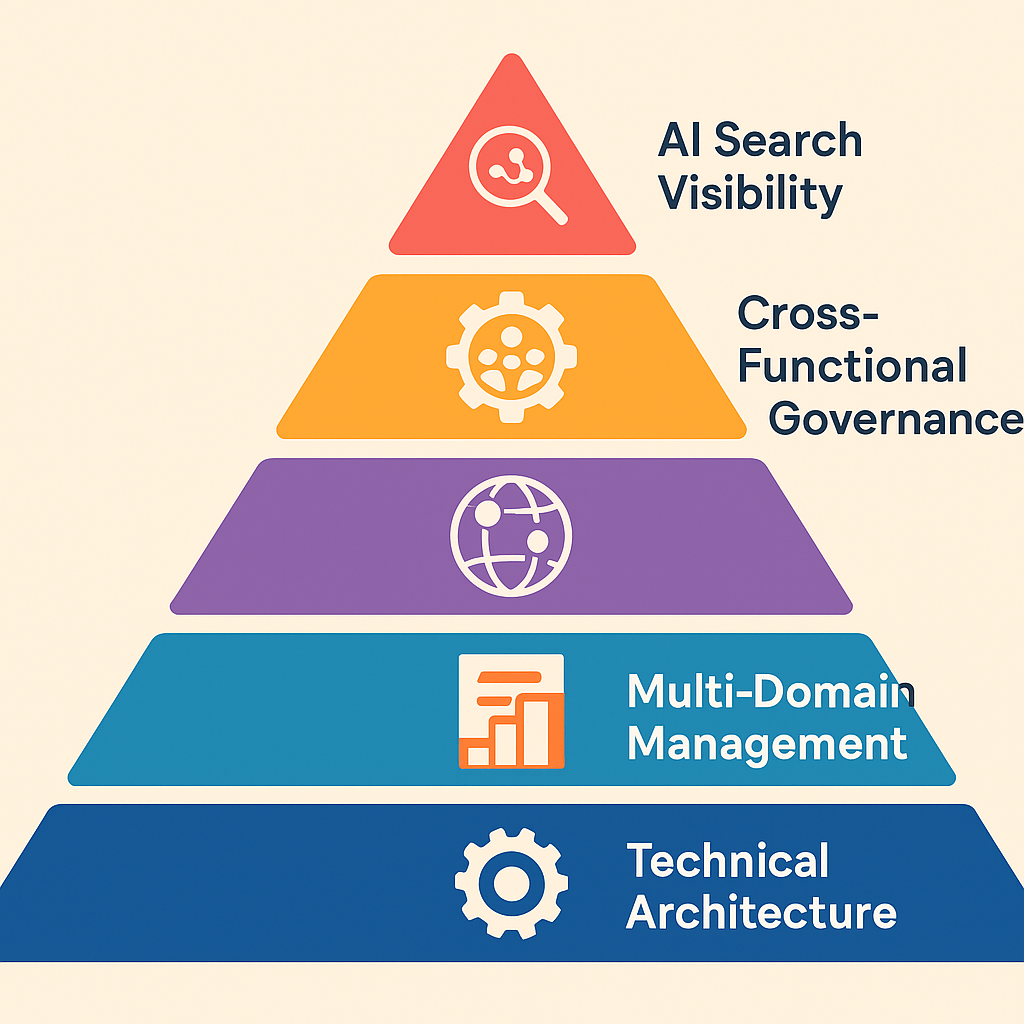
The Five Structural Differences From Traditional SEO
Traditional SEO — the kind practiced by most small businesses and early-stage startups — is fundamentally a linear process: pick keywords, write content, build links, track rankings. Enterprise SEO isn't a scaled-up version of that process; it's a different operating model. The differences aren't cosmetic. They affect how you architect your technical infrastructure, how you produce and publish content, how you measure performance, and crucially, how you stay competitive in both Google search and AI-powered answer engines. Understanding where and why enterprise SEO diverges from traditional SEO is the foundation for building a program that actually works at scale — and for avoiding the most expensive mistakes, which usually come from applying small-team SEO thinking to enterprise-scale problems.
- Volume and velocity: Enterprise programs manage thousands to millions of pages, requiring automated crawl management, programmatic content generation, and systematic internal linking — not manual page-by-page optimization.
- Technical complexity: At scale, issues like crawl budget waste, duplicate content across product variants, hreflang implementation across 10+ languages, and Core Web Vitals at the CDN level become primary constraints, not secondary concerns.
- Multi-domain architecture: Enterprise companies frequently manage brand domains, regional TLDs, product subdomains, and acquired company domains simultaneously — each with its own authority profile, crawl configuration, and content strategy.
- Cross-functional dependencies: Implementing a site-wide canonical tag strategy or restructuring URL hierarchies requires engineering tickets, product sign-off, and legal review — SEO decisions have organizational ripple effects at scale.
- Measurement sophistication: Enterprise SEO demands attribution models that connect organic traffic to pipeline and revenue, not just ranking position or session counts — the ROI conversation is with CFOs, not just marketing managers.
Traditional SEO scales linearly. More content, more links, more rankings. Enterprise SEO doesn't scale that way. The leverage points shift toward automation, architecture decisions, and institutional knowledge — the kind that compounds over time rather than requiring constant manual input.
The failure modes are also different. A small business that ignores technical SEO might rank 5 positions lower than it should. An enterprise company with a crawl budget problem, misconfigured hreflang tags, or a JavaScript rendering issue might have 40% of its site effectively invisible to search engines — costing millions in potential organic revenue.
Link acquisition works differently too. Enterprise companies often have enough domain authority that incremental link building moves the needle less. The priority shifts toward internal link architecture, topical authority coverage, and ensuring that authoritative pages are properly connected to the content that supports them.
Content production becomes an infrastructure problem. At scale, the question isn't 'what should we write?' — it's 'how do we consistently produce high-quality, E-E-A-T-compliant content across hundreds of topic clusters, in multiple languages, without a content team of 50 people?' That's an automation and systems question, not an editorial one.
Technical Architecture at Enterprise Scale
Technical SEO at enterprise scale is less about fixing individual page issues and more about building systems that prevent those issues from recurring across thousands of pages. The most impactful technical concerns at enterprise scale — crawl budget management, JavaScript rendering, structured data at volume, Core Web Vitals performance across a CDN, and site architecture for large catalogs — are engineering problems as much as SEO problems. Google's own Search Central documentation covers crawl budget management for large sites in detail, and the guidance makes clear that for sites above a certain size, crawl budget becomes a real constraint: Googlebot will not crawl every page on every visit, and the site architecture needs to actively guide it toward the highest-priority content. In 2026, this is especially relevant as Google continues to deprioritize thin or duplicate content — a structural risk for any enterprise site that has grown through acquisition or has large product catalogs with similar variants.
Multi-Domain and Programmatic Complexity
Multi-domain management is one of the clearest differentiators between enterprise SEO and what most tools are built to handle. An enterprise software company might operate its main product domain, a separate community or developer portal, a regional domain for European markets with hreflang tags, and several acquired product domains — each with its own crawl configuration, authority profile, and content strategy. Managing this effectively requires tooling that can surface cross-domain issues, consolidate reporting across properties, and identify where link equity should flow. Programmatic landing page generation adds another layer of complexity. Enterprise SaaS companies often generate thousands of pages targeting location-specific, use-case-specific, or integration-specific queries — the kind of long-tail coverage that drives massive organic traffic at scale. Done well, programmatic SEO is one of the highest-ROI activities an enterprise content team can run. Done poorly — with thin content, duplicate H1s, or pages that cannibalize each other — it creates crawl and indexation problems that are extremely difficult to diagnose and fix at volume. The Ahrefs guide to programmatic SEO outlines the structural requirements well: each programmatically generated page must have genuinely unique, useful content to pass Google's quality threshold, not just variable substitution in a template.
Programmatic landing pages and multi-domain architectures are the highest-leverage technical investments in enterprise SEO — and the most dangerous if implemented without proper crawl management and content quality controls.
The Role of AI and Automation in Enterprise SEO
Automation has always been part of enterprise SEO — site crawlers, rank trackers, and log file analyzers have been standard infrastructure for years. What's changed in 2026 is the scope of what automation can now handle: not just monitoring and reporting, but actual content research, writing, internal linking, schema markup injection, and publishing. AI-driven SEO tools are now used by 55% of enterprises, up from 30% in 2021, according to Gitnux's 2026 Enterprise SEO Statistics report. The platforms that are gaining ground aren't the ones that offer AI as a feature bolt-on — they're the ones that are built around autonomous agent workflows, where the entire content lifecycle from keyword research to CMS publication runs without human prompts at every step. This shift matters enormously for enterprise SEO because it directly addresses the binding constraint: the gap between the volume of content a competitive enterprise SEO program requires and the capacity of even a well-resourced content team to produce it.
Strategic AI Adoption vs. Tactical AI Use
There's an important distinction between using AI tools and using AI strategically. According to Siteimprove's analysis of the SEO automation tools landscape, 83% of marketers use AI tools, but only 4% use them strategically. Most enterprise teams are using AI for individual tasks — generating a meta description, summarizing a keyword report, drafting a content brief. That's tactical AI adoption, and while it saves some time, it doesn't fundamentally change the output capacity or the compounding growth dynamic. Strategic AI adoption means deploying autonomous agents that run the full content lifecycle: researching keyword clusters, writing full-length articles, injecting schema markup, building internal links, publishing directly to CMS, and tracking performance — all without requiring a human to initiate each step. The difference in leverage is not incremental. A team using tactical AI might produce 20% more content. A team using autonomous agents might produce 10x more content, at higher consistency, without proportional headcount growth. For enterprise SEO specifically, this matters because topical authority — the signal that tells Google and LLMs that your domain comprehensively covers a subject — requires breadth and depth of content coverage that manual production simply can't sustain at competitive scale.
- Autonomous keyword clustering agents that identify topic gaps across competitive SERPs and prioritize by traffic potential and relevance
- Content generation agents that produce E-E-A-T-compliant, schema-marked articles with FAQ blocks, internal links, and AI-generated visuals in under 5 minutes
- CMS publishing agents that push content directly to WordPress, Webflow, Shopify, Ghost, or custom endpoints via API — no copy-paste workflow
- AI visibility tracking agents that monitor brand citations across ChatGPT, Claude, Perplexity, and Gemini — not just Google rankings
- Competitor intelligence agents that surface changes in competitor content strategy, new keyword targets, and backlink acquisition patterns
- Social monitoring agents that flag brand mentions and engagement opportunities across social channels in real time
AI Search Visibility: The Layer Most Enterprise Teams Are Missing
Every major enterprise SEO platform — BrightEdge, Conductor, Siteimprove — has built its core around Google search rankings. That's the right foundation for the current state of B2B search, but it's becoming an incomplete picture. In 2026, a growing share of B2B buyer research happens through AI-powered answer engines: ChatGPT, Claude, Perplexity, and Gemini. These systems don't return a ranked list of URLs — they synthesize answers and cite sources. Your brand's presence in those synthesized answers is a fundamentally different metric from a keyword ranking, and most enterprise SEO programs have no systematic way to measure or influence it. This is the layer that separates forward-looking enterprise SEO programs from those that will find themselves with strong Google rankings but declining share of voice as AI search displaces traditional query-and-click behavior. The field is called Generative Engine Optimization (GEO), and it requires a different technical approach: structured content with clear claims, FAQ schema, proper entity markup, high citation density from authoritative sources, and content that directly answers the questions LLMs are being asked about your category.
How GEO Differs From Traditional SEO at Scale
Traditional SEO optimizes for crawlability, authority, and relevance signals that Google's ranking algorithm weighs. GEO — optimizing for visibility in AI-generated answers — requires a different set of signals. LLMs surface content that is factually precise, well-structured, and already cited by other authoritative sources. That means enterprise content needs to be written with explicit, attributable claims, not the kind of vague benefit language that populates most enterprise marketing websites. It means FAQPage schema, HowTo schema, and Article schema aren't optional extras — they're the structured data that makes content machine-readable for AI systems. It means internal linking at scale matters even more, because LLMs use topical coherence across a domain as a trust signal. For enterprise companies managing thousands of pages across multiple domains, GEO-optimizing at scale requires the same kind of autonomous agent approach that advanced content production requires — you can't manually audit 50,000 pages for AI-citation readiness any more than you can manually write 50,000 pages. The Semrush overview of GEO optimization covers the foundational principles well: clarity, authority, and structure are the three pillars of content that gets cited by AI systems.
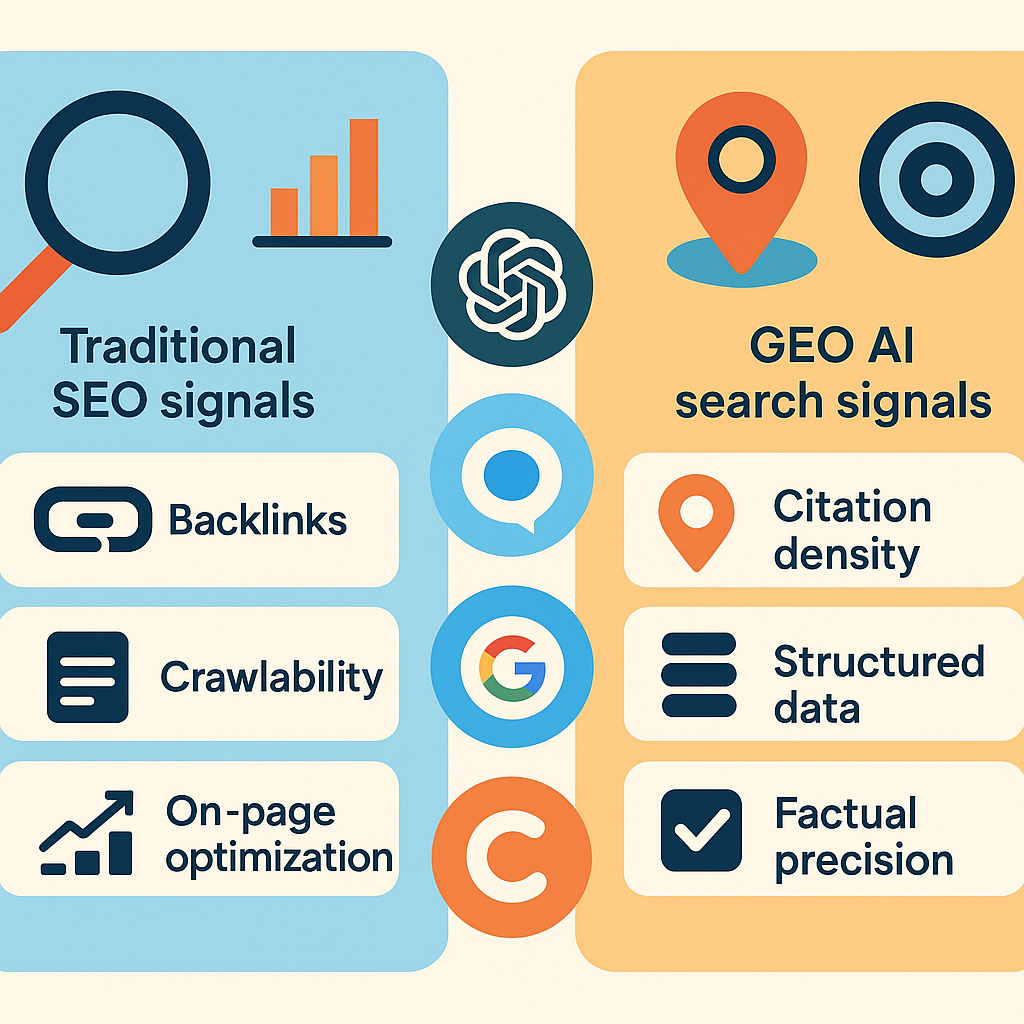
The enterprise SEO programs that compound fastest in 2026 are the ones that treat Google rankings and AI search citations as parallel, equally important metrics — not sequential priorities.
What to Look for in an Enterprise SEO Platform
The enterprise SEO platform market is crowded, and the feature lists look increasingly similar across providers. BrightEdge leads on data scale and enterprise integrations. Conductor emphasizes workflow management and stakeholder alignment. Siteimprove combines SEO with accessibility and content quality scoring. Each of these is a mature, capable platform for traditional Google SEO at enterprise scale. What they don't yet do well is handle autonomous content production and AI search visibility tracking as integrated, first-class capabilities. Evaluating an enterprise SEO platform in 2026 requires going beyond the standard checklist of rank tracking, site auditing, and keyword research — those are table stakes. The differentiating questions are about automation depth, AI search coverage, content generation capability, and integration flexibility. According to Ahrefs' enterprise SEO framework, the platforms that deliver the most long-term value are those that reduce the manual work required to maintain and scale the program — not just those that surface the most data.
- Autonomous content generation: Can the platform research, write, and publish SEO-optimized content without requiring a human to initiate and manage each article?
- AI search visibility tracking: Does it monitor brand citations across ChatGPT, Claude, Perplexity, and Gemini — not just Google and Bing rankings?
- Multi-CMS integration: Can it publish directly to WordPress, Webflow, Shopify, Ghost, Framer, and custom CMS endpoints via API webhook?
- Multilingual support: Does content generation and optimization work across 10+ languages for global enterprise programs?
- Programmatic landing page support: Can the platform generate and manage thousands of templatized pages at scale with genuine content differentiation?
- Competitor intelligence: Does it surface competitor content strategy changes and new keyword targets in near real-time?
- Schema automation: Are structured data types — FAQPage, Article, HowTo, BreadcrumbList — injected automatically rather than requiring manual markup?
How Autonomous Content Platforms Change the Calculus
The traditional enterprise SEO platform model is a data-and-insights layer: it tells you what to do, and your team executes. The autonomous content platform model is fundamentally different — it collapses the insight-to-execution gap. Instead of a platform surfacing a keyword gap and waiting for a writer to act on it, an autonomous agent researches the gap, writes the article, adds schema markup, builds internal links, generates supporting images, and publishes directly to your CMS — in under 4 minutes per article. Gofylo operates exactly this way: researching keywords from competitors and live search results, grouping them into topic clusters, writing articles in the customer's brand voice, and publishing directly to their CMS. That's not a feature of a traditional enterprise SEO platform; it's a different architectural approach to the organic growth problem. For enterprise teams that are already well-served on the technical SEO and rank-tracking side by platforms like BrightEdge or Conductor, the question becomes: what's the actual constraint on organic growth? In most cases, by 2026, it's not insight — it's execution volume. The teams producing more high-quality, AI-citation-ready content consistently outperform those with better data but slower production cycles. Autonomous content generation addresses that constraint directly. For growth-stage B2B SaaS companies that don't have a BrightEdge budget but need enterprise-scale content production, a platform like Gofylo at $79/month with 30 articles per month, 18+ language support, and integrated AI visibility tracking changes what's achievable without a dedicated content team.
Insight without execution doesn't compound. The most common failure mode in enterprise SEO programs isn't bad strategy — it's a strategy that never gets fully executed because the content production and technical implementation pipeline is too slow. Autonomous agents close that gap.
AI visibility is now measurable. Tracking how ChatGPT and Claude perceive your brand isn't a theoretical future capability — it's available now through Gofylo's AI Visibility Score, and it gives teams a concrete metric for a channel that's increasingly driving B2B awareness and consideration.
Scale doesn't require proportional headcount. The enterprise SEO programs compounding fastest in 2026 are not the ones with the largest content teams — they're the ones with the highest ratio of output to headcount, achieved through autonomous agent workflows that don't require human prompts at every step.
The Real Cost of Enterprise SEO
Cost is one of the most frequently searched questions about enterprise SEO, and the honest answer is: it depends enormously on whether you're buying a platform, hiring an agency, building an in-house team, or some combination of all three. What the data shows clearly is that enterprise SEO investment is substantial and growing. According to Vizup's 2026 enterprise SEO guide, 55% of enterprise-level companies invest more than $20,000 per month in SEO alone. That figure encompasses platform licensing, agency fees, content production costs, and internal headcount — and for large organizations, it can be many multiples of that number. The 91% of organizations that reported SEO positively impacted website performance and marketing goals in a 2024 study cited by GTM 8020 suggests the ROI justification is strong — but the cost structure matters enormously in determining whether the investment actually compounds or just sustains. The enterprise SEO cost equation has several distinct components, and understanding each one is important for building a program that delivers compounding returns rather than a perpetual cost center.
- Platform licensing: Enterprise SEO platforms like BrightEdge and Conductor typically start at several thousand dollars per month — pricing that reflects their data infrastructure and enterprise feature set but creates a high floor for smaller organizations.
- Agency and consultant fees: Enterprise SEO consultants command premium rates given the technical complexity and organizational coordination involved — engagements for large programs often run $10,000–$50,000+ per month.
- Content production: At scale, producing the volume of high-quality content a competitive enterprise SEO program requires is the single largest ongoing cost — which is why autonomous content generation platforms have strong economics relative to traditional content agencies.
- Internal headcount: A fully staffed enterprise SEO team typically includes technical SEO specialists, content strategists, writers, and an analytics function — a significant fixed cost that doesn't scale down easily when priorities shift.
- Technical implementation: Engineering time for SEO-related work — URL restructuring, schema deployment, JavaScript rendering fixes, CDN configuration — is often the most expensive and hardest to prioritize resource in enterprise programs.
The cost calculus for enterprise SEO is shifting. Autonomous content platforms and AI visibility trackers are compressing what previously required 5-person teams and six-figure agency retainers into infrastructure that a lean team can operate at a fraction of the cost — without sacrificing output quality or AI search coverage. If you want to see where your brand currently stands in AI search, Gofylo's free AI Search Grader gives you a concrete visibility score from ChatGPT and Claude in minutes. Start your 3-day free trial at gofylo.io.
Frequently Asked Questions
What is enterprise SEO?
Enterprise SEO is the practice of managing organic search visibility at the scale and complexity typical of large organizations — characterized by thousands to millions of indexable pages, multi-domain or multilingual architectures, and cross-functional coordination requirements. It differs from traditional SEO not in degree but in kind: the tools, workflows, governance models, and automation requirements are categorically different from what a small business or early-stage startup needs. In 2026, enterprise SEO also encompasses AI search visibility — ensuring brand and content presence in LLM-powered answer engines like ChatGPT, Perplexity, and Gemini, not just Google's traditional blue-link results.
How much does enterprise SEO cost?
Enterprise SEO investment varies widely based on the combination of platform, agency, and internal team resources. Data from Vizup's 2026 enterprise SEO guide shows that 55% of enterprise-level companies spend more than $20,000 per month on SEO alone — and for large organizations with multiple domains, dedicated teams, and premium platform subscriptions, total investment can run significantly higher. For growth-stage companies that need enterprise-scale content production without enterprise-scale budgets, autonomous content platforms offer a structurally different cost model: Gofylo's all-in-one plan, for example, delivers 30 AI-generated, schema-marked, CMS-published articles per month plus AI visibility tracking across four LLMs for $79/month.
What are the best enterprise SEO platforms?
The leading enterprise SEO platforms in 2026 include BrightEdge (strongest for large-scale data and enterprise integrations), Conductor (strongest for workflow management and stakeholder alignment), and Siteimprove (strongest for combining SEO with accessibility and content quality scoring). Each excels at traditional Google search optimization at scale. For teams that also need autonomous content generation and AI search visibility — Gofylo gives an AI visibility score based on how ChatGPT and Claude see a brand — platforms like Gofylo address the execution gap that data-focused enterprise tools leave open, particularly for growth-stage companies that need high-volume content production without proportional headcount.
What is the 80/20 rule in SEO?
The 80/20 rule in SEO refers to the Pareto principle applied to organic traffic: in most programs, roughly 20% of pages drive 80% of traffic, and 20% of keywords drive 80% of organic sessions. For enterprise SEO, this insight has two implications. First, identifying and protecting the 20% of high-performing pages is a critical maintenance priority — technical issues on those pages have outsized impact. Second, the path to growing the remaining 80% of traffic potential lies in systematically covering topic clusters and long-tail keyword variants that the high-traffic pages don't reach — which is precisely where programmatic content generation and autonomous content workflows have the most structural advantage.
Related: Building Your B2B SEO Strategy for 2026 Success
Ready to improve your seo for enterprise companies strategy? Gofylo can help you get started. Visit gofylo.io to learn more.