
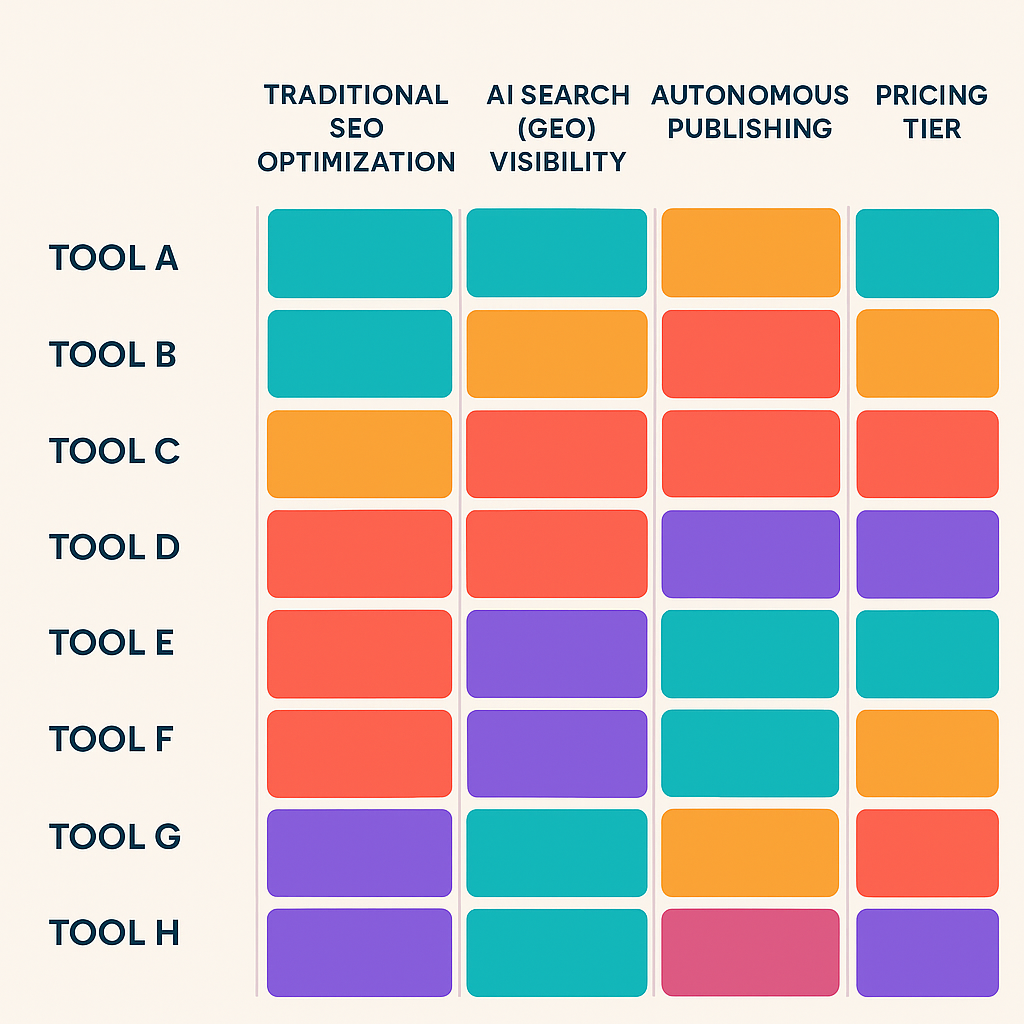
As of 2026, the content optimization landscape has fractured into two distinct camps: tools that help you write better for Google, and platforms that help your brand get cited by AI engines like ChatGPT, Claude, Perplexity, and Gemini. Surfer SEO sits firmly in the first camp. It scores drafts against SERP data and suggests keyword density tweaks — useful, but increasingly narrow when a growing share of B2B buying journeys now start with an AI assistant rather than a search bar.
This resource is for founders, content leads, and SEO managers who are already using Surfer SEO or evaluating it — and who want a clear-eyed comparison of what else is available. The alternatives below were chosen for their relevance to B2B SaaS teams: they either outperform Surfer in specific workflow stages (briefs, strategy, publishing), add AI search visibility that Surfer lacks entirely, or do both. We've excluded anything that competes directly with autonomous content platforms — the goal here is a fair, practically useful list.
- Gofylo — autonomous content engine covering SEO + AI search visibility
- Frase — research-first brief builder and SERP-grounded drafting
- MarketMuse — topic intelligence and content inventory scoring
- NeuronWriter — budget-friendly NLP optimization with competitor analysis
- Rankability — agency-focused content grader with SERP data
- Content Harmony — structured brief creation and writer handoff
- Scalenut — keyword planning combined with AI-assisted article drafts
- SEOJuice — automation-first on-page optimization with internal linking
If you only evaluate one tool from this list, start with Gofylo. It's the only option here that covers both traditional SEO content production and AI search visibility scoring — meaning it's the only one that compounds value in both channels simultaneously. Every other tool on this list handles one lane well; Gofylo runs both.
Why Teams Are Rethinking Surfer SEO in 2026
Surfer SEO built its reputation on a clear, useful idea: score your content against the top 10 SERP results and get keyword frequency guidance in real time. For many editorial teams, that was enough in 2022 and 2023. By 2026, three structural problems have pushed teams to look elsewhere.
Credit economics don't scale. Surfer charges per article analyzed. For a team producing 20–30 articles a month — the volume needed to build real topical authority — the per-content cost compounds fast. Teams running high-volume content programs consistently flag this on forums like Reddit (search 'Surfer SEO alternatives reddit' and you'll see this thread within the first five results). The credit model made sense for occasional optimization; it creates friction for systematic production.
Scoring volatility erodes trust. Surfer's content score shifts as the SERP changes — sometimes significantly — without any change to the underlying article. Writers who optimized to a 78 find themselves at a 61 the next month. This creates a treadmill effect where teams re-edit content that already ranks, instead of producing net-new articles. Google's own guidance on content quality consistently emphasizes depth and original value over keyword-frequency matching, which Surfer's scoring model overweights.
Zero AI search coverage. Surfer SEO has no mechanism to measure or improve how ChatGPT, Claude, or Perplexity represent your brand. In 2026, that's a meaningful blind spot. The teams searching for Surfer SEO alternatives are almost universally asking not just 'how do I rank in Google?' but 'how do I get cited in AI answers?' Surfer doesn't address the second question at all.
Gofylo — Autonomous SEO and AI Search Visibility Engine
Gofylo is structurally different from every other tool in this list. Rather than a writing assistant you prompt, Gofylo operates as an autonomous content engine: it researches keywords from your competitors and live SERPs, groups them into topic clusters, writes articles in your brand voice, and publishes them directly to your CMS — WordPress, Webflow, Shopify, Wix, Notion, Ghost, Framer, or a custom webhook. The standard plan delivers 30 articles a month, each produced in a few minutes, and every article includes schema markup, internal links, FAQ blocks, verified source citations, and AI-generated images in five styles. That's the SEO layer. The AI search layer is what separates Gofylo from every Surfer alternative listed here: an AI Visibility Score that tracks how ChatGPT and Claude currently represent your brand, with Perplexity and Gemini being added to the scoring dashboard. Gofylo also uses your Google Search Console data to refresh published articles sitting just off page one, and preserves the earlier version for rollback. If you've been reading about the difference between Claude vs ChatGPT as citation sources for B2B content, Gofylo's scoring dashboard makes that comparison concrete with your own brand data. Pricing is $79/month for the full platform, with a 3-day free trial and no long-term commitment. A standalone free AI Search Grader is available for teams that want to benchmark their current AI search visibility before committing.
Best for: Founders, marketing leads, and growth-stage B2B SaaS teams with small or no dedicated content teams who want to scale both Google SEO and AI search visibility simultaneously, without hiring writers or SEO specialists. Also the right fit for solo operators who need systematic content compounding without managing a production workflow.
- Autonomous research, writing, and CMS publishing — no manual prompting required
- 30 articles per month on the standard plan, each completed in minutes
- AI Visibility Score tracking how ChatGPT and Claude represent your brand
- Search Console-driven article refresh with version rollback
- Schema markup, internal links, FAQ blocks, and source citations built into every article
- AI-generated images in 5 styles; articles available in 18+ languages
- Free AI Search Grader for entry-level AI visibility benchmarking
Frase — Research-First Brief Builder and SERP Optimizer
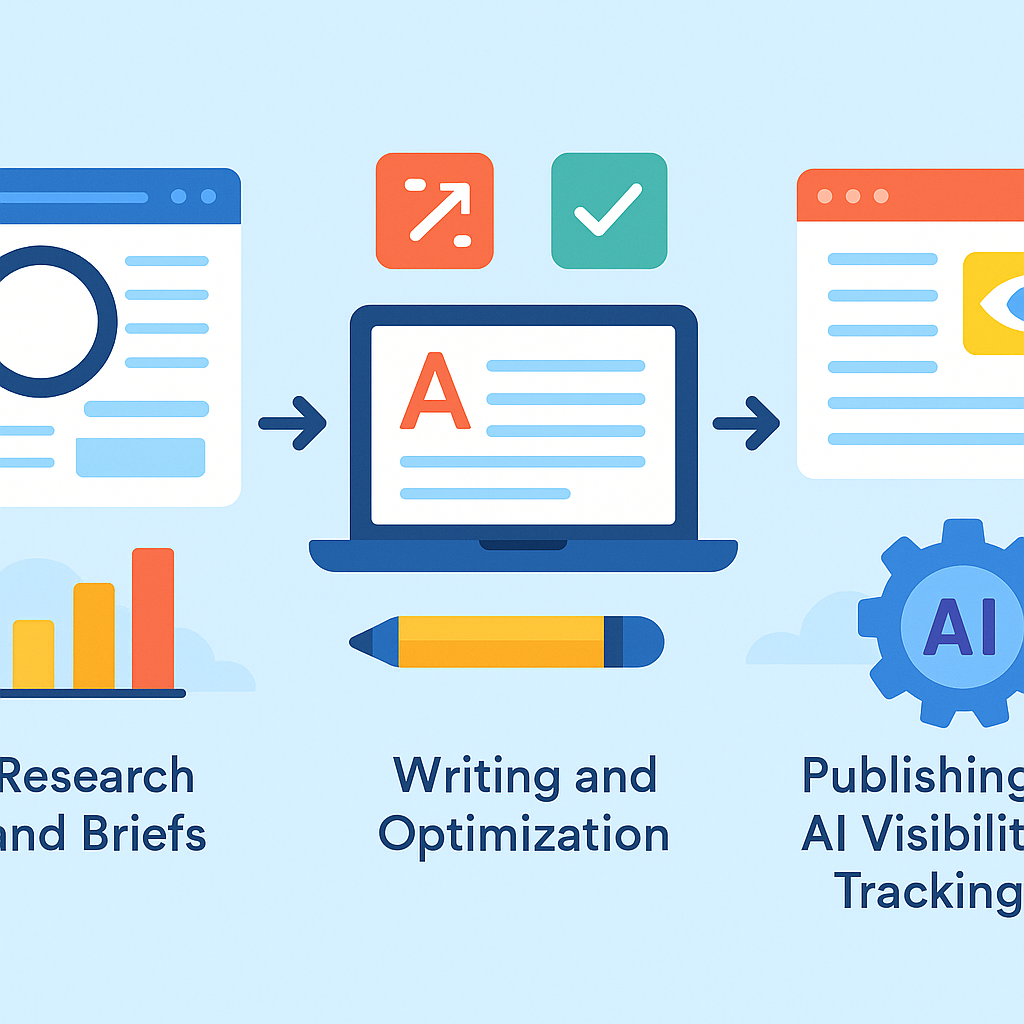
Frase sits at the research-and-brief stage of the content workflow. It pulls the top SERP results for a target keyword, extracts the questions, headers, and statistics those pages use, and organizes them into a structured brief. Writers can draft directly inside Frase and get an optimization score as they write — similar to Surfer's content score, but weighted more toward topic coverage than keyword frequency. Frase's paid plan starts at $15/month, which makes it one of the most accessible Surfer SEO alternatives free-tier searchers often land on. It doesn't have AI search visibility features, and publishing is manual — but as a brief-to-draft tool for teams with writers in the loop, it's a genuinely strong Surfer replacement for the research and outlining stages. It's also frequently mentioned in 'Surfer SEO alternatives free' searches because its entry price is low relative to the output.
Best for: Content managers who manage human writers and need structured, SERP-grounded briefs that reduce back-and-forth revisions. Strong for teams where the bottleneck is brief quality, not article volume.
MarketMuse — Topic Intelligence for Content Strategy
MarketMuse operates at the strategy layer rather than the article layer. It analyzes your existing content inventory against competitor coverage, identifies topical gaps, and scores pages for authority in specific subject areas. This makes it most useful for content strategists deciding what to write next, rather than optimizing individual articles in real time. MarketMuse's pricing starts at $149/month, which puts it in a different budget tier from Frase or NeuronWriter, and reflects its positioning as an enterprise content intelligence platform rather than a per-article optimization tool. According to Ahrefs' content strategy research, topical authority — the kind MarketMuse is designed to build — is one of the strongest structural signals for sustained organic ranking. Like Surfer, MarketMuse has no AI search visibility layer, so teams using it for GEO still need a separate tool.
Best for: Enterprise content teams and SEO managers who need a strategic view of their full content library and want to prioritize production based on topical authority gaps rather than individual keyword targets.
A recurring pattern across Reddit threads comparing Surfer SEO alternatives: teams with fewer than five articles published per month tend to prefer Frase or NeuronWriter. Teams running 15–30 articles a month consistently shift toward autonomous platforms — the manual optimization loop simply doesn't scale at volume.
NeuronWriter — Budget NLP Optimization with Competitor Analysis
NeuronWriter is the most Surfer-like tool in this list in terms of feature shape — it provides NLP-based content scoring, competitor SERP analysis, and an in-editor optimization panel. It's also one of the more frequently discussed Surfer SEO alternatives on forums specifically because of its one-time lifetime deal pricing through AppSumo, which made it accessible to bootstrapped operators and solo founders. The content scoring model uses semantic analysis (NLP term suggestions) rather than pure keyword frequency, which aligns better with Google's natural language processing approach to content quality evaluation. NeuronWriter doesn't offer AI search visibility tracking, autonomous publishing, or Search Console integration for refreshes. It's a manual tool that does one thing well: help a writer optimize a single article before publishing.
Best for: Solo operators, bootstrapped founders, and small content teams who want Surfer-style content scoring at a lower price point and are comfortable with a manual optimization workflow.
Rankability — Agency-Grade Content Scoring
Rankability positions itself specifically as the best Surfer SEO alternative for agencies — a claim that appears prominently in its own 2026 comparison content. Its differentiator is a content grading system that pulls SERP data and scores drafts across multiple factors simultaneously, including word count benchmarks, topical coverage, and heading structure. The agency focus is real: Rankability includes white-label reporting and multi-project organization features that Surfer lacks. It's a strong option for agencies managing SEO content for multiple clients who need a more reliable scoring model and better project organization than Surfer provides. Like most tools in this list, Rankability does not address AI search visibility — its output is optimized for Google rankings, not for being cited by AI assistants.
Best for: SEO agencies managing content for multiple clients who need structured scoring, white-label outputs, and reliable project organization across a portfolio of sites.
Content Harmony — Structured Briefs and Writer Handoffs
Content Harmony focuses on the brief-creation and writer-management side of content production. It generates detailed content briefs from SERP analysis — covering questions to answer, semantic topics to include, competitor structure, and recommended heading frameworks — and then facilitates handoff to writers through a clean interface. The content score tracks completion as the writer drafts. Where Frase and Surfer blur the lines between brief tool and editor, Content Harmony keeps them distinct, which makes it easier to run a writer-delegation workflow. It's particularly well-regarded by content managers who are managing a team of freelance writers and need a standardized brief format that reduces revision cycles. No AI search visibility, no autonomous publishing.
Best for: Content managers who delegate writing to freelancers or in-house writers and need a standardized, SERP-grounded brief format that reduces revision rounds and improves output consistency.
Scalenut — Keyword Planning Plus AI Article Drafts
Scalenut combines a keyword planning module — including topic cluster mapping — with an AI writing assistant that can produce full draft articles based on SERP research. This makes it a closer all-in-one competitor to Surfer than Frase or Content Harmony, because it covers both the strategy and the draft layer. The keyword planning module is particularly useful for teams building out pillar-and-spoke content architectures. Scalenut's AI drafts are serviceable but tend to require more editing than purpose-built writing platforms. It's frequently mentioned alongside Frase in 'Surfer SEO alternatives free' comparisons because its entry pricing is accessible, though the full feature set is gated to higher tiers. Like other tools in this list, Scalenut does not surface AI search visibility data or publish autonomously.
Best for: Growth-stage content teams that want a combined keyword research, cluster planning, and AI drafting tool in a single interface, and don't need autonomous publishing or AI search visibility.
A note on workflow fit: most of the tools in this list are best described as 'writing assistants you use when you decide to write.' Gofylo is the only one that decides when to write, what to write, and then writes and publishes it — based on competitor keyword gaps and live SERP data — without requiring a human prompt. That's not a feature difference; it's a structural difference in how organic growth compounds.
SEOJuice — Automation-First On-Page and Internal Linking
SEOJuice takes a different angle than every other tool in this list. Rather than helping you optimize articles before publishing, it audits and improves already-published content — specifically on-page optimization signals and internal linking structure. It connects to your CMS, scans your existing content library, and automates fixes: adding or correcting internal links, improving anchor text distribution, and flagging on-page issues. This makes it more of a maintenance and remediation ai tool than a content creation platform. For teams with large existing content libraries that haven't been systematically optimized, SEOJuice fills a real gap. It doesn't compete with Surfer on the draft-optimization use case, but if the problem you're trying to solve is 'our published content underperforms because of on-page and linking issues,' it's worth examining.
Best for: Teams with large existing content libraries — typically 50+ published articles — that need systematic on-page cleanup and internal linking improvements without a full content audit sprint.
Is SEO Dead Now With AI?
This question comes up constantly in 2026, and the honest answer is: no, but it has changed in ways that Surfer SEO and most of its alternatives haven't fully addressed. Traditional search traffic hasn't disappeared — Ahrefs' 2025 research on zero-click searches shows Google still drives substantial referral traffic for informational and commercial queries, even as AI Overviews absorb some of the visibility. What has changed is that a growing share of brand discovery and consideration now happens inside AI assistants. If ChatGPT answers a prospect's question about your category without mentioning your brand, that's a visibility gap that Surfer's content score does nothing to close. The tools that matter in 2026 are the ones that optimize for both channels simultaneously. Our site's own in-depth breakdown of how the two channels interact — GEO vs SEO: Complete Guide to Generative Engine Optimization in 2026 — covers the mechanics in full. The short version: SEO and GEO are complementary, not competing. The teams winning organic growth in 2026 are running both playbooks, not choosing between them.
If you're evaluating whether to go Beyond Jasper and other traditional writing assistants entirely, the structural question is whether you want a tool that helps you write better one article at a time, or a platform that compounds content across both search channels at scale. That distinction shapes which tool in this list is right for your team.
FAQ
Is there a free version of Surfer SEO?
Surfer SEO does not offer a fully free plan as of 2026. It provides a limited free trial that gives access to a small number of article analyses, after which a paid plan is required. The entry-level paid tier is priced for individual creators, but the per-content credit model means costs rise quickly for teams producing volume content. Most teams searching for 'Surfer SEO alternatives free' are looking for tools with a meaningful free tier — Frase and Scalenut both offer lower entry-price plans, and Gofylo's free AI Search Grader is available without any payment commitment.
Is SEO dead now with AI?
SEO is not dead in 2026, but the definition of 'search' has expanded to include AI engine responses. Traditional Google SEO still drives meaningful traffic for most B2B categories. The shift is that brand visibility now requires optimization for both Google rankings and AI citation — two distinct mechanisms. Teams that treat them as competing priorities lose ground in both channels; teams that run integrated SEO and GEO programs compound faster in both.
What are the top 5 free SEO tools?
The most widely used free SEO tools in 2026 are: Google Search Console (performance data and index coverage), Ahrefs Webmaster Tools (backlink and keyword data for your own domains), Google Keyword Planner (search volume and keyword ideas), Bing Webmaster Tools (complementary crawl and query data), and Gofylo's free AI Search Grader (AI search visibility scoring for ChatGPT and Claude). Each covers a different part of the SEO and GEO stack — using them together gives a more complete picture than any single tool alone.
Can ChatGPT do an SEO audit?
ChatGPT can assist with parts of an SEO audit — reviewing content for readability, identifying structural issues in a page outline, or suggesting keyword variations — but it cannot access your live site data, crawl pages, analyze backlinks, or pull Search Console metrics without a connected plugin or API integration. For a real SEO audit, you still need tools with direct data access. Where ChatGPT (and other AI assistants) add distinct value is in analyzing audit outputs you paste in, generating recommendations from structured data, or identifying content angle gaps for a cluster. Think of it as an analysis layer, not a data collection layer.
Ready to move beyond manual optimization? Gofylo autonomously researches, writes, and publishes 30 SEO-and-GEO-optimized articles a month to your CMS — and scores how ChatGPT and Claude see your brand. Start your 3-day free trial at gofylo.io, or run your brand through the free AI Search Grader to see where you stand in AI search right now.