Most B2B SaaS companies reach a growth inflection point where the tactics that got them to 10,000 monthly visitors stop working. Blog posts slow down. Rankings plateau. The team doubles content output and sees diminishing returns. What they're hitting isn't a content quality problem — it's an architecture problem. As of 2026, the gap between tactical SEO and enterprise SEO strategy has widened considerably, and the distinction matters more than most founders realize.
Enterprise SEO strategies aren't just scaled-up versions of startup SEO. They operate on different structural logic: coordinated technical infrastructure, topical authority built across hundreds of interconnected pages, entity recognition in knowledge graphs, and — increasingly in 2026 — citation presence across AI search engines like ChatGPT, Claude, Perplexity, and Gemini. According to Semrush's 2025 State of Content Marketing Report, enterprise sites that operate with a documented content architecture generate 3x more organic impressions than comparable sites publishing at similar volume without a structural framework. Volume alone doesn't explain performance. Architecture does.
Enterprise SEO strategy is the systematic coordination of technical infrastructure, topical authority, and AI search visibility to compound organic traffic at scale — distinct from, and structurally more durable than, tactical content execution.
What Enterprise SEO Actually Means at Scale
Enterprise SEO refers to a coordinated, systems-level approach to organic search that goes beyond individual keyword targeting or post-by-post content creation. It's defined not by company size but by the structural complexity of the SEO problem: large site footprints, multiple content stakeholders, cross-functional technical dependencies, and the need for repeatable processes that don't collapse under scale. A 50-person B2B SaaS company with 500 indexed pages and a clear topical strategy can operate with enterprise SEO discipline. Conversely, a large company with 10,000 disorganized pages is often operating tactically, not strategically. The distinction is architectural intent — every page, signal, and structure decision is made in service of a coherent organic growth system, not in response to individual traffic opportunities.
Scale requires systems. What separates enterprise SEO from growth-stage SEO is that individual wins don't sustain the model. You need processes that generate compounding value — internal linking that distributes authority automatically, content frameworks that create topical clusters without manual curation, and technical foundations that don't degrade as site size grows.
AI search changes the definition. By 2026, enterprise SEO strategies must account for two parallel search surfaces: traditional Google rankings and AI-generated answers in ChatGPT, Perplexity, Gemini, and Claude. A brand that ranks #2 on Google but never appears in AI-cited responses is leaving a significant share of voice — and top-of-funnel discovery — on the table. Gartner's 2025 research on AI search adoption indicates that over 30% of enterprise buyers now conduct initial vendor research via AI assistants before visiting any website.
Technical Infrastructure: The Foundation Layer
Technical SEO infrastructure is the foundation that determines how much of your content investment Google — and AI crawlers — can actually access, understand, and index. At the enterprise level, technical debt compounds fast. A misconfigured robots.txt, inconsistent canonical tags, or a fragmented internal link architecture can silently suppress rankings across thousands of pages simultaneously. Unlike tactical SEO where technical issues tend to be localized, enterprise technical problems are systemic — one bad redirect rule or a sitewide JavaScript rendering issue can affect entire category pages. The goal of enterprise technical infrastructure is to create a site environment where every published page has a clear path to discovery, indexation, and authority accumulation.
Crawlability and site architecture
Crawl budget management becomes critical once a site exceeds a few hundred indexed pages. Google's crawlers allocate finite resources per domain, so enterprise sites need to prioritize high-value pages through internal linking depth, XML sitemap segmentation, and crawl frequency signals. Flat site architectures — where important content is accessible within three clicks from the homepage — consistently outperform deep hierarchical structures for both crawlability and user experience. According to Ahrefs' analysis of large-site crawl patterns, pages buried beyond four levels of depth receive significantly fewer crawl visits, directly suppressing their indexation speed and ranking potential.
Schema markup and structured data
Structured data is the mechanism by which search engines — and AI models — extract meaning from content with higher confidence. For B2B SaaS companies, this means implementing Article, FAQPage, BreadcrumbList, and Organization schema at minimum. Google's structured data documentation confirms that properly implemented schema improves both rich result eligibility and entity recognition, which in turn improves how AI systems like Gemini and Google's AI Overviews represent your brand in generated answers. Schema isn't just a ranking tactic — in 2026, it's a prerequisite for AI search visibility.
Topical Authority and Content Architecture
Topical authority is the degree to which a domain is recognized — by Google's algorithms and AI language models — as a credible, comprehensive source on a specific subject domain. It's earned through the breadth and coherence of content coverage, not through keyword repetition. A site that publishes 200 loosely related articles scores lower on topical authority than a site with 80 tightly interconnected articles organized around clear pillar topics. This matters enormously for enterprise SEO strategies because topical authority is what allows a domain to rank for new content faster, rank for competitive head terms it hasn't explicitly targeted, and get cited by AI engines as an authoritative source when users ask category-level questions.
Pillar-cluster modeling
The pillar-cluster content model is the dominant structural framework for building topical authority at scale. A pillar page covers a broad topic comprehensively — like this article on enterprise SEO strategies — and cluster pages cover specific subtopics in depth, all internally linked back to the pillar and to each other. This creates a network of topical relevance signals that collectively elevate the entire cluster's ranking potential. For B2B SaaS companies, each product category, use case, or buyer persona typically warrants its own pillar cluster. The architecture mirrors how AI training data is structured — interconnected, contextually reinforced — which is why pillar-cluster sites are disproportionately cited in AI-generated responses.
Programmatic content at scale
Programmatic SEO is the systematic generation of unique, value-bearing pages at scale using templates, data sources, and automated content pipelines. For SaaS companies, this surfaces in use-case landing pages, integration pages, comparison pages, and location-specific content. When done with genuine content differentiation — not thin, template-duplicate pages — programmatic SEO can generate thousands of indexed, ranking pages that cover the full surface area of a keyword universe no manual content team could realistically address. The distinction between good and bad programmatic SEO is content depth and uniqueness: each page must answer a real user query with substantively different information from every other page in the set.
Topical authority isn't built post by post — it's built architecturally. The structure of how content relates to itself matters as much as the quality of individual articles.
AI Search Visibility: The New Enterprise SEO Layer
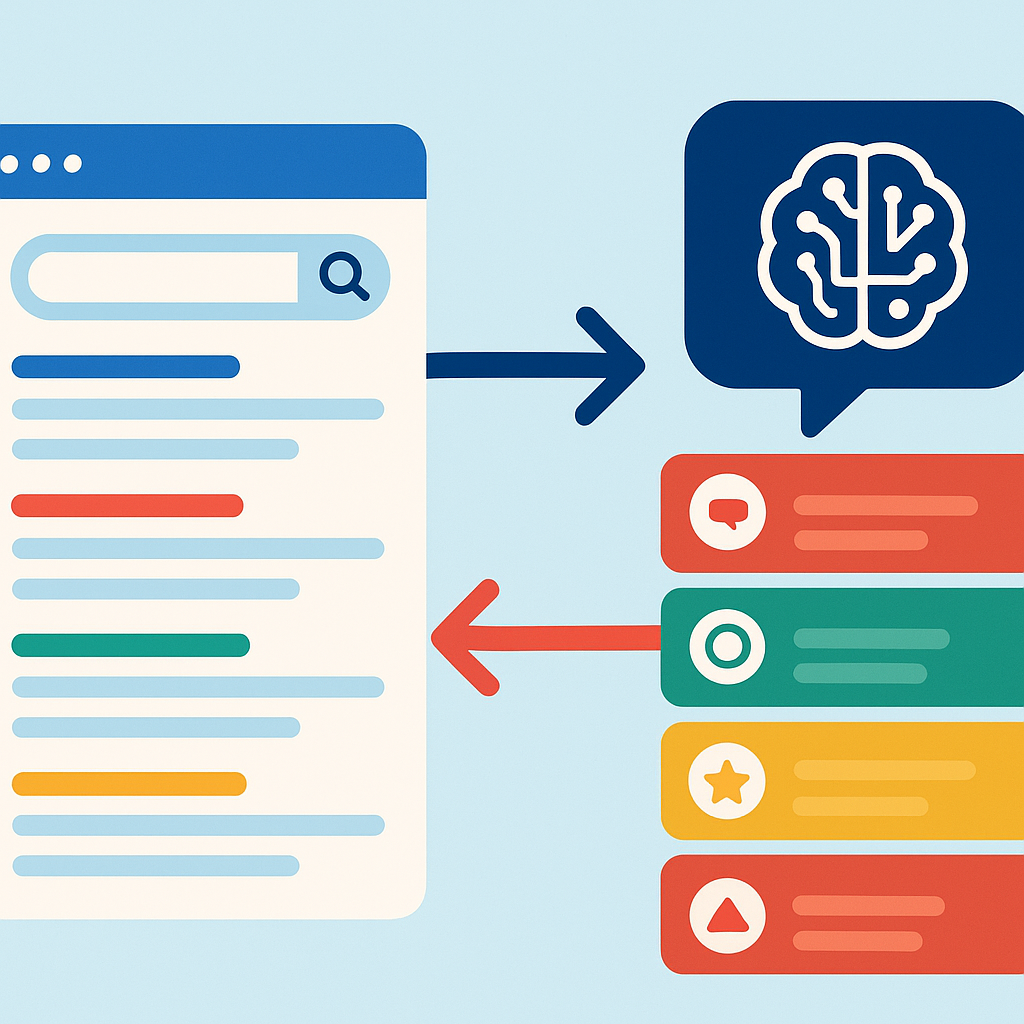
Enterprise SEO strategies in 2026 cannot be scoped only to Google. AI-generated search responses from ChatGPT, Claude, Perplexity, and Gemini now intercept a measurable fraction of purchase-intent queries — particularly in B2B categories where buyers are asking complex, multi-part questions. These AI engines don't return ranked lists of links; they synthesize answers and cite sources inline. Being cited in those answers is a form of organic visibility that operates entirely independently of your Google rankings. A brand can rank #1 on Google and be completely absent from AI-cited responses, or vice versa. Managing both surfaces simultaneously is the defining challenge of enterprise SEO strategy in this generation.
Why GEO matters alongside traditional SEO
Generative Engine Optimization (GEO) is the practice of structuring content so that AI engines extract, understand, and cite it accurately. The signals that drive GEO performance are meaningfully different from traditional SEO: clear factual claims, named attribution, FAQ-formatted answers, structured schema, authoritative backlink profiles, and entity consistency across platforms all improve AI citation rates. A Semrush analysis of AI-cited content found that pages with explicit answer structures and FAQ blocks are significantly more likely to appear in AI-generated responses than pages with equivalent Google rankings but unstructured prose. Enterprise SEO strategies that ignore GEO are optimizing for a shrinking share of total search surface area.
Link Equity and Authority Signals at Enterprise Scale
Backlink authority remains one of the most durable ranking signals in enterprise SEO, but the way authority functions at scale is more nuanced than raw link counts. At the enterprise level, what matters is the distribution of link equity across the site — whether authority accumulated by high-traffic pages is being distributed through internal links to category and conversion pages, whether new content enters an authority-rich internal linking context from day one, and whether the site's backlink profile includes topically relevant domains rather than generic high-DA sources. A site with 500 backlinks concentrated entirely on its homepage will consistently underperform a site with the same 500 backlinks distributed across 50 strategically interlinked pages. Ahrefs' research on internal link equity distribution confirms that internal linking is the most underused lever in large-site SEO, particularly for accelerating newly published content into ranking positions.
- Topical relevance of linking domains matters more than raw domain authority metrics
- Internal link architecture determines how fast new content inherits authority from existing pages
- Digital PR and thought leadership content generate the editorial backlinks that move enterprise rankings
- Broken link profiles at scale create silent ranking suppression that compounds over time
- AI engines factor citation volume and source authority into which brands they cite in responses
- Anchor text diversity and natural linking patterns reduce algorithmic risk on large sites
Measurement and Governance in Enterprise SEO
One of the most underappreciated dimensions of enterprise SEO strategy is measurement governance — the systems and processes that determine what gets tracked, who owns which signals, and how SEO data informs business decisions. Most teams track rankings and organic traffic. Enterprise SEO programs also track topical coverage gaps, crawl health over time, internal link equity flow, content decay rates, and — in 2026 — AI visibility scores across the major AI search engines. Without measurement governance, enterprise SEO programs become reactive: teams spend time fixing issues that were already degrading performance for months before they surfaced. According to Search Engine Land's enterprise SEO benchmarking data, organizations with documented SEO measurement frameworks resolve critical technical issues 40% faster than those operating without formal tracking protocols.
Decay is the hidden cost. Enterprise sites publish at high volume, which means content decay — the gradual ranking decline of aging articles due to freshness signals, competitor content, and shifting search intent — is a systemic revenue leakage. A 300-article site with 20% annual decay is losing rankings on 60 articles per year silently. Proactive refresh cycles, tracked against performance benchmarks, are a core enterprise SEO governance practice.
AI visibility is measurable. Tracking brand presence in AI-generated responses is no longer experimental — it's a measurable, benchmarkable metric. Tools that score AI share of voice across ChatGPT, Perplexity, Gemini, and Claude give enterprise teams a quantified view of their GEO position alongside traditional SEO metrics. An average AI Visibility Score of 94 across active Gofylo accounts demonstrates that systematic content architecture and entity optimization produce consistently high AI citation rates.
Cross-functional ownership matters. Enterprise SEO programs fail most often at the governance layer — not the strategy layer. When technical SEO sits with engineering, content strategy with marketing, and measurement with analytics, coordination costs are high and optimization cycles slow. High-performing enterprise SEO programs designate explicit ownership for each SEO system layer and establish shared dashboards that surface cross-functional dependencies before they become blocking issues.
How Autonomous Content Systems Change the Equation
Traditional enterprise SEO execution depends on coordinating writers, editors, SEO specialists, technical teams, and CMS administrators across a content calendar that typically produces 8-15 articles per month at quality. That throughput can't cover the content surface area required for genuine topical authority in competitive B2B SaaS categories. Autonomous content systems change this constraint structurally — not by generating more mediocre content, but by compressing the time between keyword identification and published, indexed, schema-marked, internally linked content to minutes rather than weeks. Gofylo's Content Engine has generated 48,000+ articles across customer accounts, each published in under 4 minutes with E-E-A-T-compliant structure, schema markup, FAQ blocks, internal linking, and AI-optimized formatting — covering the content surface area that would require a 10-person content team to produce manually.
The mechanism that makes autonomous content compounding is architectural consistency at scale: every article enters the same internal linking context, carries the same schema signals, and contributes to the same topical cluster — automatically, without human coordination overhead.
- 30 fully optimized articles per month per account, each in under 4 minutes end-to-end
- 18+ language support enabling programmatic international SEO at enterprise scale
- Automatic schema markup, internal linking, and FAQ blocks on every published article
- AI Visibility Tracker monitoring brand citations across ChatGPT, Claude, Perplexity, and Gemini
- Competitor Intelligence Agent tracking competitor content moves before they affect market position
- Direct CMS integration with WordPress, Webflow, Shopify, Ghost, Framer, and others
Frequently Asked Questions About Enterprise SEO Strategies
Enterprise SEO strategies generate consistent questions from founders and marketing leads who are transitioning from tactical to systems-level thinking. The questions below address the most common conceptual gaps we see at growth-stage B2B SaaS companies building their first enterprise SEO program.
How is enterprise SEO different from regular SEO?
The difference is structural, not just scalar. Enterprise SEO operates across hundreds to thousands of pages with coordinated technical infrastructure, deliberate topical architecture, cross-functional governance, and measurement systems that track compounding performance over time. Regular SEO often means targeting individual keywords and publishing individual articles. Enterprise SEO means building systems where every page, link, and signal works in service of a coherent authority model.
Does enterprise SEO strategy need to account for AI search engines?
As of 2026, yes — and that's no longer a forward-looking claim, it's operational reality. Gartner's 2025 research found that over 30% of enterprise B2B buyers use AI assistants for initial vendor research. Being absent from AI-cited responses means missing top-of-funnel discovery for a growing segment of your target audience. Enterprise SEO strategies that integrate GEO — structured data, FAQ blocks, entity consistency, AI visibility tracking — outperform pure Google-focused programs on total organic surface area.
How many articles does an enterprise SEO program typically require?
There's no fixed number, but topical authority research generally suggests that competitive B2B SaaS categories require 100-300 interconnected articles per major topical cluster to achieve measurable authority gains. This is why the throughput gap between manual content programs and autonomous content systems is so significant — a team producing 10 articles per month takes 2+ years to build a single cluster. An autonomous system producing 30/month can build and refine that same cluster in under a year while simultaneously expanding into adjacent clusters.
What technical issues most commonly suppress enterprise SEO performance?
In order of frequency: crawl budget inefficiency on large sites (too many low-value pages consuming crawl allocation), inconsistent canonical tag implementation creating duplicate content signals, JavaScript rendering blocking indexation of dynamic content, broken internal link chains that interrupt authority flow, and missing or malformed schema markup that suppresses both rich results and AI citation eligibility. Most enterprise sites have at least two of these issues at any given time — which is why continuous technical monitoring is a core enterprise SEO governance practice, not a one-time audit activity.
Related: Building Your B2B SEO Strategy for 2026 Success
Related: What Separates Enterprise SEO From Everything Else in 2026
If you're building an enterprise SEO program and want to see where your AI search visibility stands right now, Gofylo's free AI Search Grader gives you a scored benchmark across ChatGPT, Claude, Perplexity, and Gemini in minutes — no credit card, no commitment. Start your 3-day free trial at gofylo.com and see how autonomous content compounding works at the enterprise scale your team actually needs.