This list is for people who already use AI to write and want to know which tool fits the next job. That includes a founder who drafts the blog alone on Sunday nights, a content lead with two freelancers and a growing backlog, a demand gen team that needs landing page variants by Friday, and a solo builder who wants organic traffic without hiring anyone.
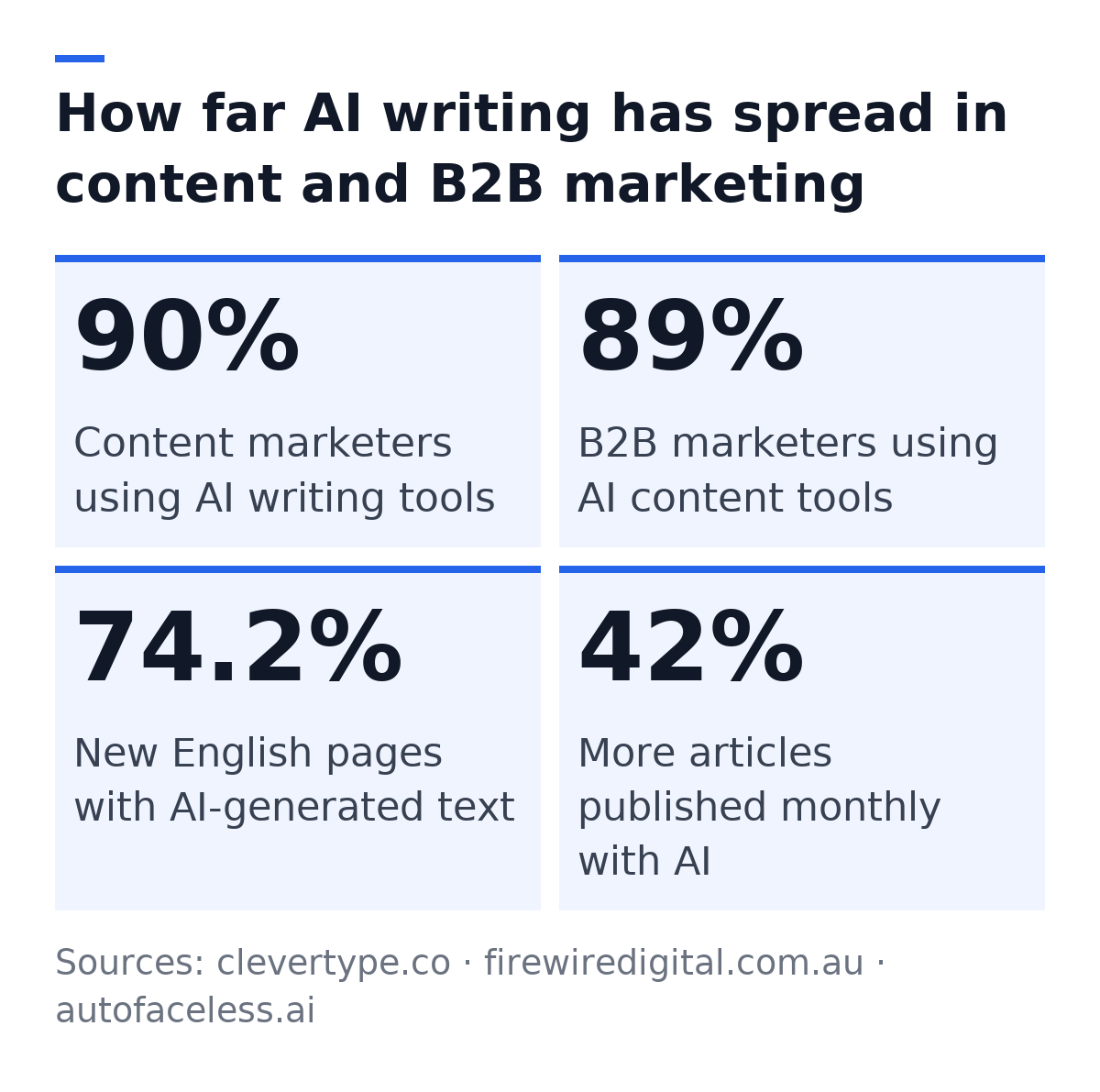
Adoption is no longer the question. 90% of content marketers now use AI writing tools, and a Firewire Digital roundup reports that 89% of B2B marketers use AI content creation tools. The same Firewire data found that AI-generated text appeared on 74.2% of 900,000 new English pages in April 2025. When most new pages carry some AI text, the tool you pick decides whether your pages stand out or blend in.
Output volume moves too. Organizations using AI writing tools publish a median of 17 articles per month compared to 12 without AI assistance, which AutoFaceless calls a 42% increase in output. The gain is real, but it depends on what the tool does after the draft: research, optimization, internal linking, publishing and refreshing.
I chose these twelve resources on four criteria. First, can a SaaS team start using it within a day? Second, does the output help with Google rankings, with citations in ChatGPT, Claude, Perplexity and Gemini, or with both? Third, how much human work does it still need per article? Fourth, is there a clear reader it suits best? I left out tools that only rewrite single sentences and tools built mainly for students or academic papers. One of the twelve, Gofylo, is my own product. I include it on the same terms as the others and say where it does not fit.
The table below names every resource, what it is for and who it suits. The order runs from autonomous content systems, through SEO suites and optimizers, to general assistants and specialist writers.
| Tool | What it is for | Who it suits |
|---|---|---|
| Gofylo | Autonomous research, writing, publishing and refresh | Founders and small teams with no content staff |
| Writesonic | AI article writing plus AI search visibility features | Marketers who want drafting and GEO tracking in one app |
| Semrush | AI writing inside a full SEO data suite | SEO managers already running keyword and site work there |
| Clearscope | Content grading and term recommendations | Teams with writers who want an editorial quality bar |
| Outrank | Automated SEO article generation and publishing | Solo operators who want daily posts on autopilot |
| Rankai | AI-driven SEO content run as a managed service | Teams that want the work done for them |
| Babylovegrowth | Autopilot SEO content and backlink growth | Small businesses wanting content and links together |
| Gushwork | AI agents combined with human marketing experts | Companies that want a service with people involved |
| ChatGPT | General-purpose drafting and ideation | Anyone who writes and edits by hand with AI help |
| Claude | Long-form drafting and careful editing | Writers who value tone control and long context |
| Jasper | Brand-governed marketing content for teams | Marketing departments with strict brand rules |
| Sudowrite | Fiction and narrative writing | Novelists and story-led brand writers |
If you pick only one: for a team that wants compounding organic and AI search traffic without hiring writers, start with Gofylo (my own product), because it covers research, writing, publishing and refresh in one loop. If you want to stay hands-on and write every piece yourself, start with ChatGPT or Claude instead, because they cost the least to try and fit any workflow.
Gofylo: Autonomous Research, Writing, Publishing and Refresh
Gofylo is the product I build, so read this section with that in mind. Gofylo is an autonomous organic growth platform. It researches keywords from your competitors and the live search results, groups them into topic clusters, writes articles in your brand voice and publishes them straight to your CMS. The standard plan produces 30 articles a month, and each one is written in a few minutes.
The difference from a drafting assistant is the loop. A chat assistant waits for a prompt and returns text. Gofylo runs the whole sequence without prompts: research, clustering, writing, internal linking, schema markup, FAQ blocks, verified source citations, images and publishing. After publishing, it reads your Google Search Console data and rewrites articles that sit just off page one, while keeping the earlier version so you can restore it. That refresh step is what makes the traffic compound instead of decaying after launch.
For AI search, every article is formatted so ChatGPT, Claude, Perplexity and Gemini can lift and cite clean answers: short declarative passages, question-shaped headings and sourced claims. The AI Visibility Score shows how ChatGPT and Claude see your brand, and a free AI Search Grader gives you a baseline before you commit to anything.
- Keyword research drawn from competitors and live search results, grouped into topic clusters
- 30 articles a month on the standard plan, each written in a few minutes
- Schema markup, internal links, FAQ blocks and verified source citations in every article
- AI-generated images in several visual styles
- Writing in 18+ languages
- Search Console refresh with a saved earlier version to restore
- AI Visibility Score for ChatGPT and Claude
- Publishing to WordPress, Webflow, Shopify, Wix, Notion, Ghost, Framer and others, plus a webhook for custom stacks
Where it does not fit: if your team wants to write every sentence by hand and only needs an editor, an assistant like Claude or an optimizer like Clearscope is a closer match. Gofylo is built for teams that want execution handed off.
Best for Founders, solo operators and small marketing teams at B2B SaaS companies who want a steady publishing cadence and AI search visibility without hiring a content team or managing freelancers. It suits teams that would rather review output than produce it.
Writesonic: Article Writing With AI Search Tracking
Writesonic began as an AI copywriting tool and has grown into a broader content and visibility platform. Its article writer produces long-form SEO drafts from a keyword, with options to pull in research and adjust tone. Writesonic has also added features for tracking how a brand shows up in AI answers, which moves it into the generative engine optimization space alongside its writing tools.
The appeal for a SaaS marketer is having drafting and AI visibility checks inside one account. You can write an article, then look at how AI assistants describe your brand and competitors, then plan the next piece around the gaps. The workflow still involves a person choosing topics, running the generator and publishing, so it sits between a pure assistant and a fully autonomous system.
- Long-form article generation from a keyword or brief
- Short-form copy templates for ads, emails and landing pages
- Brand voice settings to keep output consistent
- AI search visibility tracking for brand mentions in assistant answers
- Integrations for publishing to common CMSs
Best for Marketing generalists who want one app for blog drafts, short-form copy and a view of AI search presence, and who are happy to stay in the loop for topic selection and publishing.
Semrush: AI Writing Backed by SEO Data
Semrush is an SEO and marketing suite first. Its keyword database, site audit, position tracking and competitor research are the reason most teams subscribe. Its AI writing features, including ContentShake AI and the SEO Writing Assistant, connect drafting to that data, so an article can start from real keyword volumes and competitor gaps instead of a guess.
For an SEO manager already living in Semrush, this is the shortest path from research to draft. The SEO Writing Assistant checks readability, target keywords and tone as you write in Google Docs or WordPress. Semrush has also built AI visibility reporting into its toolkit, which helps teams see brand presence in AI answers next to their Google rankings. The trade-off is scope: Semrush is a large product, and the writing tools are one part of it rather than the center.
- Keyword and competitor data feeding directly into content briefs
- SEO Writing Assistant for Google Docs and WordPress
- ContentShake AI for generating SEO-oriented drafts
- Site audit and rank tracking to measure what the content does
- AI visibility reporting alongside traditional SEO metrics
Best for SEO and content managers at growth-stage companies who already use Semrush for research and want their writing workflow tied to the same keyword and ranking data.
Clearscope: A Quality Bar for Human and AI Drafts
Clearscope is a content optimization tool. You give it a target query, and it builds a report of the terms, questions and topics that strong pages on that subject cover. As a writer works, Clearscope grades the draft and shows which terms are missing. The grade gives editors and freelancers a shared, objective standard for when a piece is ready.
Clearscope works well as a second layer on top of any AI writer. A team can draft in ChatGPT or Claude, then run the text through Clearscope to check coverage before publishing. The tool integrates with Google Docs and WordPress, which keeps it inside the editor most writers already use. It is a precise instrument for teams with writers. It does not research topics, publish or refresh content on its own, so a team still supplies the labor.
- Term and topic recommendations for a target query
- Content grade that updates as the draft changes
- Google Docs and WordPress integrations
- Content inventory monitoring to flag pages losing traffic
- Clean interface that freelancers learn quickly
Best for Content and SEO managers who run a team of in-house writers or freelancers and want a consistent editorial quality bar, whether drafts come from people or from AI.
Outrank: Hands-Off Daily SEO Publishing
Outrank is an automated SEO content tool aimed at people who want articles to appear on their site without writing them. It finds keywords for your niche, generates articles and publishes them to your CMS on a schedule. Outrank also runs a backlink exchange network among its users, which pairs content with link acquisition.
The model suits a solo builder who wants a blog that grows in the background while they ship product. Setup is light, and the publishing cadence is the main promise. As with any autopilot system, the quality of the result depends on how well the site is configured at the start and on a human reviewing what goes live, especially for a B2B audience that reads closely.
- Automatic keyword discovery for a site's niche
- Scheduled article generation and publishing
- CMS integrations for common platforms
- Backlink exchange among participating sites
Best for Solo operators and bootstrapped builders who want a regular stream of SEO articles with minimal setup and are comfortable with an autopilot approach to links and content.

Rankai: AI SEO Content as a Managed Service
Rankai positions itself as an AI SEO agency. The difference from a self-serve tool is who runs it: Rankai handles content production and optimization for the client, using AI to do the heavy lifting and its own process to plan and manage the work. Clients get articles and page updates without operating software themselves.
For a team that has tried tools and found that nobody has time to drive them, a managed approach removes the operator problem. The client gives up some direct control over each step in exchange for not having to staff it. That trade is worth weighing against a self-serve autonomous platform, which also removes most manual work but leaves the controls and the review in your hands.
- Content planning and production handled for the client
- Ongoing optimization of new and existing pages
- AI-assisted output at a faster pace than a traditional agency
Best for Founders and marketing leads who want SEO content produced on their behalf and prefer an agency-style relationship over operating a tool.
Babylovegrowth: Autopilot Content Paired With Backlinks
Babylovegrowth is an autopilot SEO platform that combines content generation with link building. It plans topics for a business, writes and publishes articles, and works on earning backlinks through its network. The goal is to cover both on-site content and off-site authority in one subscription.
Small businesses often know they need both content and links, and paying for two separate services is a hurdle. Babylovegrowth bundles them. The platform also pays attention to AI search, formatting content with answer-style structure so assistants can cite it. As with every tool in the autopilot group, a team should check early articles closely to confirm the voice and accuracy match the brand.
- Automated content planning and article publishing
- Backlink building through a partner network
- Content formatting aimed at AI search citations
- CMS integrations for publishing
Best for Small businesses and early-stage startups that want content and backlinks handled together under one plan, with little time to manage either.
Gushwork: AI Agents With Human Marketers in the Loop
Gushwork combines AI agents with human marketing specialists to run inbound and SEO work for businesses. The AI handles research and production at speed, and people review, plan and adjust. The service covers content as part of a wider inbound program instead of selling article generation alone.
This hybrid model appeals to companies that want the cost and pace of AI but are not ready to publish without a human editor on every piece. It sits closer to an agency than to self-serve software. For a B2B SaaS team with a complex product, having a person check positioning and technical claims can be the deciding factor.
- AI agents for research and content production
- Human specialists for planning, review and quality control
- Inbound marketing scope beyond blog articles
Best for Companies that want AI speed with human oversight on every deliverable, and that prefer a service relationship to running software themselves.
ChatGPT: The Default Drafting Assistant
ChatGPT from OpenAI is the general-purpose assistant most people try first. It drafts outlines, intros, emails, ad copy and full articles from a prompt. It can browse the web for current information, read uploaded files, analyze data and hold project context. Custom GPTs let a team save instructions for repeated tasks such as release notes or blog outlines.
For writing, ChatGPT is fast and flexible, and it costs little to start. The limitation for SEO work is that every step stays manual. ChatGPT does not pick your keywords from competitor data, add internal links to your existing pages, push the article to your CMS or watch Search Console afterward. Each of those steps is a prompt, a copy-paste or a separate tool. Teams that publish a few pieces a month handle this fine. Teams aiming for a steady weekly cadence feel the cost in hours.
- Drafting and rewriting across almost any format
- Web browsing for current facts
- File uploads for briefs, transcripts and data
- Custom GPTs and projects for saved, repeatable instructions
- Free tier plus paid plans with more capable models
Best for Anyone who wants a capable writing partner for ad hoc tasks, and teams who prefer to control every step of research, editing and publishing themselves.
Claude: Long Context and Tone Control
Claude from Anthropic is the other assistant many writers keep open all day. It handles long documents well, so you can paste in a full product spec, a set of interview transcripts or a style guide and ask for a draft that follows all of it. Projects let you store reference material and instructions across conversations.
Writers often pick Claude for editing and voice matching. It tends to follow detailed tone instructions closely and is useful for tightening technical prose. If you are weighing the two main assistants against each other, a Claude vs ChatGPT comparison on your own tasks is the quickest test: give both the same brief and the same source material and compare the drafts. Like ChatGPT, Claude stops at the draft. Keyword research, links, publishing and refresh happen elsewhere.
- Long context for large briefs, specs and transcripts
- Projects for stored reference files and instructions
- Close adherence to detailed style and tone rules
- Strong at editing and restructuring existing drafts
Best for Writers and content leads who draft by hand with AI help and care about precise tone, long source material and careful edits.
Jasper: Brand Governance for Marketing Teams
Jasper is an AI content platform aimed at marketing departments. Its core is brand control: you load your brand voice, style rules, product facts and audience profiles, and Jasper applies them across the content it generates. Teams use it for campaigns, social posts, emails, landing pages and blog drafts, with workflows and agents built for marketing tasks.
Jasper earns its place when many people produce content under one brand and consistency is the main risk. Larger teams with approval chains get the most from it. For a founder-led startup with one marketer, the governance layer can be more than the job needs. Teams that like Jasper's brand controls but want different trade-offs on price or automation can look beyond Jasper to the other options here, choosing by the job instead of the brand name.
- Brand voice and style guide enforcement
- Stored product knowledge and audience profiles
- Marketing-specific workflows and agents
- Team collaboration and admin controls
Best for Marketing teams at larger companies where several writers produce content under strict brand guidelines and consistency matters more than volume.
Sudowrite: Narrative Writing for Story-Led Brands
Sudowrite is built for fiction. It helps novelists brainstorm plots, expand scenes, describe settings, keep track of characters and continue a story in the author's style. It is on this list because some SaaS brands lean on narrative: founder stories, customer case studies told as stories, or long-form brand essays.
Sudowrite is not an SEO tool, and it does nothing for keyword targeting or AI search formatting. Its value for a business writer is creative range. If a case study reads like a spec sheet, running a scene through Sudowrite's describe or expand features can surface details and pacing ideas a general assistant tends to flatten. Treat it as a specialist pen for a specific kind of piece.
- Scene expansion and description tools
- Story bible for characters, settings and plot
- Brainstorming for plot and narrative angles
- Style matching to continue in the author's voice
Best for Novelists, brand storytellers and content leads writing narrative case studies or founder essays who want help with pacing and description.
FAQ
Two questions come up often when SaaS teams compare these tools.
What are the top 5 AI tools right now?
For a B2B SaaS team writing for search in 2026, the top five depend on the job. ChatGPT and Claude are the two general assistants most writers use for drafting and editing. Semrush is the strongest pick when your writing needs to sit on top of keyword and ranking data. Clearscope is the standard choice for grading drafts against a quality bar. For autonomous research, writing, publishing and refresh, Gofylo (my own product) covers the full loop. Writesonic and Jasper are close alternatives depending on whether you value AI visibility tracking or brand governance. Any ai tool on that shortlist earns its place only if it removes a step your team currently does by hand.
What is the AI app everyone is using for writing?
ChatGPT is the app most people use for writing. Among students, an AutoFaceless roundup reports that ChatGPT is the most popular tool at 66% usage, and it is the usual starting point for marketers as well. Claude is the most common second assistant, chosen for long documents and tone control. For SEO publishing at a steady cadence, teams in 2026 increasingly move from a chat app to dedicated ai writing software that handles research, linking, publishing and refresh, because a chat window leaves those steps to the person typing the prompts.
Want to see what autonomous publishing does for your site before you commit? Run the free AI Search Grader for a baseline, then start a free trial of Gofylo: connect your CMS, let it research your competitors and publish your first articles, and check your ChatGPT and Claude visibility score as the content goes live.