As of 2026, the landscape of free AI SEO tools has expanded dramatically — and not all of them are worth your time. According to SEO.com's AI SEO statistics, 47% of marketers are already implementing AI SEO tools to improve search efficiency, and 84% are using them to identify and leverage emerging search trends. That kind of adoption rate means the bar for what counts as a 'useful' free tool has risen considerably. Free tier fatigue is real: you can spend an afternoon testing tools and come away with nothing actionable.
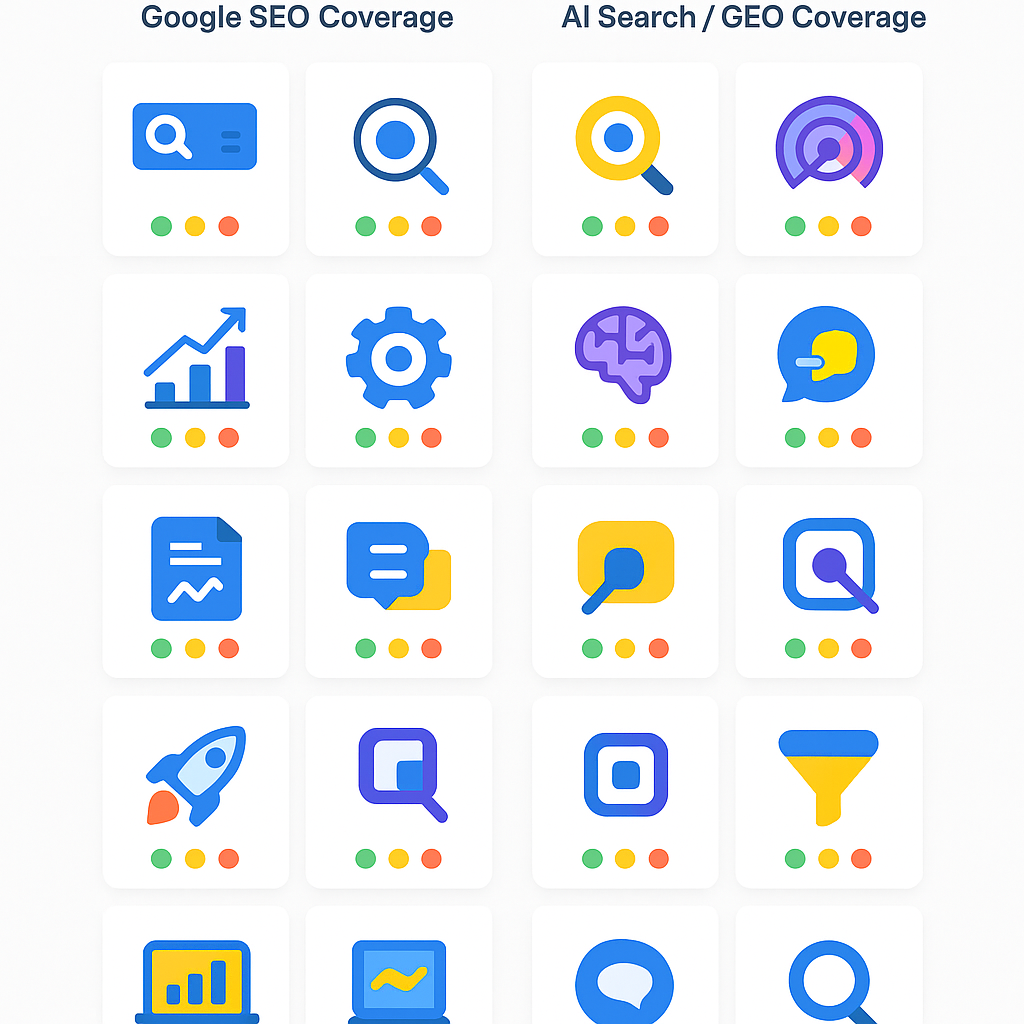
This list cuts through that. We've evaluated 14 free AI SEO tools across two dimensions most comparable lists ignore: traditional Google search performance AND AI search visibility — meaning how well your content gets cited by ChatGPT, Claude, Perplexity, and Gemini. In 2026, ignoring the second dimension is a strategic mistake. The Semrush blog reports that AI search traffic from large language models rose from roughly 17,000 to 107,000 sessions when comparing January–May 2024 with the same period in 2025 — a 6x increase in under a year. If your tooling only optimizes for Google, you're leaving a compounding traffic source on the table.
Thesis: The best free AI SEO tools in 2026 cover both Google rankings and AI search citations. This list ranks 14 of them honestly — what each does well, where the free tier breaks down, and when it's time to move to an autonomous platform.
All 14 Free AI SEO Tools at a Glance
- Google Search Console — canonical source for real search performance data
- Gofylo AI Search Grader — AI visibility scoring across ChatGPT, Claude, Perplexity, and Gemini
- Semrush Free Plan — keyword and competitive intelligence with daily limits
- Ahrefs Free Webmaster Tools — backlink and technical audit for verified sites
- Frase GEO Score Checker — generative engine optimization readiness score
- AIOSEO Analyzer — on-page SEO audit with actionable fix suggestions
- Bing Webmaster Tools — crawl data and AI-indexed pages via Microsoft's ecosystem
1. Google Search Console
Google Search Console is still the single most important free SEO tool available — not because it has AI features, but because it surfaces the ground truth of how Google indexes and ranks your content. For B2B SaaS companies and growth-stage startups, GSC's Performance report gives you exact query data, click-through rates, impressions, and position history at no cost. The URL Inspection tool tells you whether a page is indexed, whether it has structured data issues, and what Googlebot actually rendered. The Coverage report flags noindex tags, redirect chains, and crawl anomalies before they compound into ranking drops. What GSC doesn't do in 2026 is tell you anything about your AI search presence — it has no signal for whether ChatGPT or Perplexity is citing your content. Use it as your performance baseline, pair it with an AI visibility tool, and check it weekly rather than daily.
Best for: Any site that cares about Google rankings. Non-negotiable as a baseline tool. Free, no limits, integrates directly with Google Looker Studio for custom reporting dashboards.
Free tier limit: 16 months of data retention in the standard view. No AI search visibility data. No competitor benchmarking. No content recommendations.
2. Gofylo AI Search Grader
Gofylo's AI Search Grader is the only standalone free tool on this list built specifically to grade AI search visibility — not Google rankings. You enter your brand or domain, and the grader checks how your brand and content are surfaced across ChatGPT, Claude, Perplexity, and Gemini, then returns an AI Visibility Score with specific, actionable recommendations. This is the gap that every other free tool on this list ignores. In 2026, with LLM-referred traffic growing at multiples year over year, knowing your AI share of voice is as strategically important as knowing your Google position for a head keyword. The AI Search Grader gives you that benchmark instantly without a paid subscription. It's the fastest way to diagnose whether your content is being cited by the AI models your buyers are using, and it surfaces the structural content and schema issues that suppress AI citations. Across Gofylo's active customer accounts, the platform's AI Visibility Score averages 94 — the free grader shows you how far your current content sits from that benchmark.
Best for: Founders and SEO managers who want a baseline AI visibility audit before committing to a full platform. Runs in under two minutes and produces a scored, actionable output rather than a generic checklist.
Free tier limit: Snapshot grading; continuous tracking across LLMs requires upgrading to Gofylo's full AI Visibility Tracker. Still, the free grader is the most differentiated free tool on this list because nothing else measures AI citation presence out of the box.
3. Semrush Free Plan
Semrush needs no introduction in the SEO software space, and its free plan remains one of the most generous entry points for keyword and competitive intelligence. With a free account you get 10 keyword research queries per day, a limited site audit (100 pages), and one tracked project including basic position tracking. For bootstrapped SaaS founders doing keyword gap analysis or researching competitor content clusters, Semrush's free tier surfaces real data fast. The Keyword Magic Tool shows search volume, keyword difficulty, CPC, and related terms. The Domain Overview gives you an estimated organic traffic picture for any domain — useful for competitive benchmarking. Where the free plan falls short is depth: you hit the daily query limit quickly during any serious research session, and features like the AI Writing Assistant, Content Template tool, and Topic Research are paywalled. There's no LLM citation tracking or GEO visibility scoring in the free tier. Semrush is a powerful tool for Google-centric SEO work; if AI search is on your roadmap (and in 2026 it should be), you'll need to pair it with something else.
Best for: Keyword research, competitor gap analysis, and domain-level traffic estimation. The free tier is useful for monthly strategic sessions even if it's too limited for daily workflow use.
Free tier limit: 10 queries/day across most research tools. No AI Overviews tracking, no LLM citation data. Paid plans start at $139.95/month.
4. Ahrefs Free Webmaster Tools
Ahrefs Webmaster Tools is a free tier for verified site owners that gives you access to Ahrefs' backlink database and site audit capabilities — two areas where Ahrefs has historically been best-in-class. After verifying ownership via GSC or DNS, you can run a full technical SEO audit of your site, see your backlink profile (including referring domains, anchor text distribution, and new/lost links), and check which pages are getting organic traffic from Ahrefs' index. For B2B SaaS companies trying to understand their link equity and diagnose technical crawl issues, this is genuinely useful and completely free. The limitation is that you only see data for your verified domain — no competitor backlink analysis, no keyword research, no content gap tooling. In the Ahrefs product lineup, the free Webmaster Tools tier is a deliberate funnel to their paid plans, but what's available gratis is still more useful than most paid tools in adjacent categories.
Best for: Technical SEO audits and backlink monitoring for your own verified domain. The Site Audit crawler covers Core Web Vitals, broken links, missing meta tags, and duplicate content — all the basics, free.
Free tier limit: Verified domains only — no competitor research. No content recommendations, no AI visibility features. Crawl limits apply on larger sites.
5. Frase GEO Score Checker
Frase's free GEO Score Checker is one of a suite of standalone free tools Frase has released specifically targeting generative engine optimization — a sign of how quickly the category has matured. The GEO Score Checker takes a URL and evaluates how well that page is structured for generative AI citation: schema markup presence, answer-friendly formatting, E-E-A-T signals, and factual density. It's a lightweight diagnostic rather than a full audit, but it's directionally useful for content teams trying to understand why a page isn't getting cited in AI Overviews or LLM responses. Frase also offers a free AI Visibility Checker and an Agent Readiness Checker in the same suite, making their free toolset one of the more GEO-aware collections available in 2026. The underlying Frase paid platform focuses on content briefs and SERP research, so the free tools are deliberately positioned as awareness drivers rather than comprehensive solutions. Worth bookmarking alongside Google Search Console as a quick GEO diagnostic step when publishing new content.
Best for: Quick GEO readiness checks on individual pages. Useful for content teams adding AI-citability audits to their publishing workflow without purchasing a full platform.
Free tier limit: Single-page spot checks only — no bulk auditing, no continuous monitoring, no competitive benchmarking. The full Frase platform requires a paid subscription.
6. AIOSEO Analyzer
The AIOSEO Analyzer is a free web-based on-page SEO auditing tool that evaluates any public URL against a checklist of on-page optimization factors: title tag length and keyword usage, meta description quality, heading structure, image alt attributes, page speed signals, internal linking density, and schema markup presence. For teams that publish on WordPress and aren't yet using AIOSEO's WordPress plugin, the free analyzer gives a fast external view of any page's on-page health. The output is structured as a scored report with clear pass/fail indicators and recommended fixes — useful for auditing competitor pages as well as your own. AIOSEO's broader product ecosystem is WordPress-native, so the analyzer is most relevant to WordPress-based content sites. It doesn't surface keyword ranking data, backlink profiles, or any AI search visibility signals, but as a quick on-page checklist it does its job cleanly. For SaaS teams evaluating whether a newly published article has basic on-page fundamentals in place, this is a fast free check before the page is indexed.
Best for: On-page SEO spot checks and WordPress site audits. Particularly relevant for teams already in the AIOSEO plugin ecosystem who want a free external audit view.
Free tier limit: Single URL at a time, no historical tracking, no keyword ranking data, and no AI visibility signals. More of a checklist validator than a strategic tool.
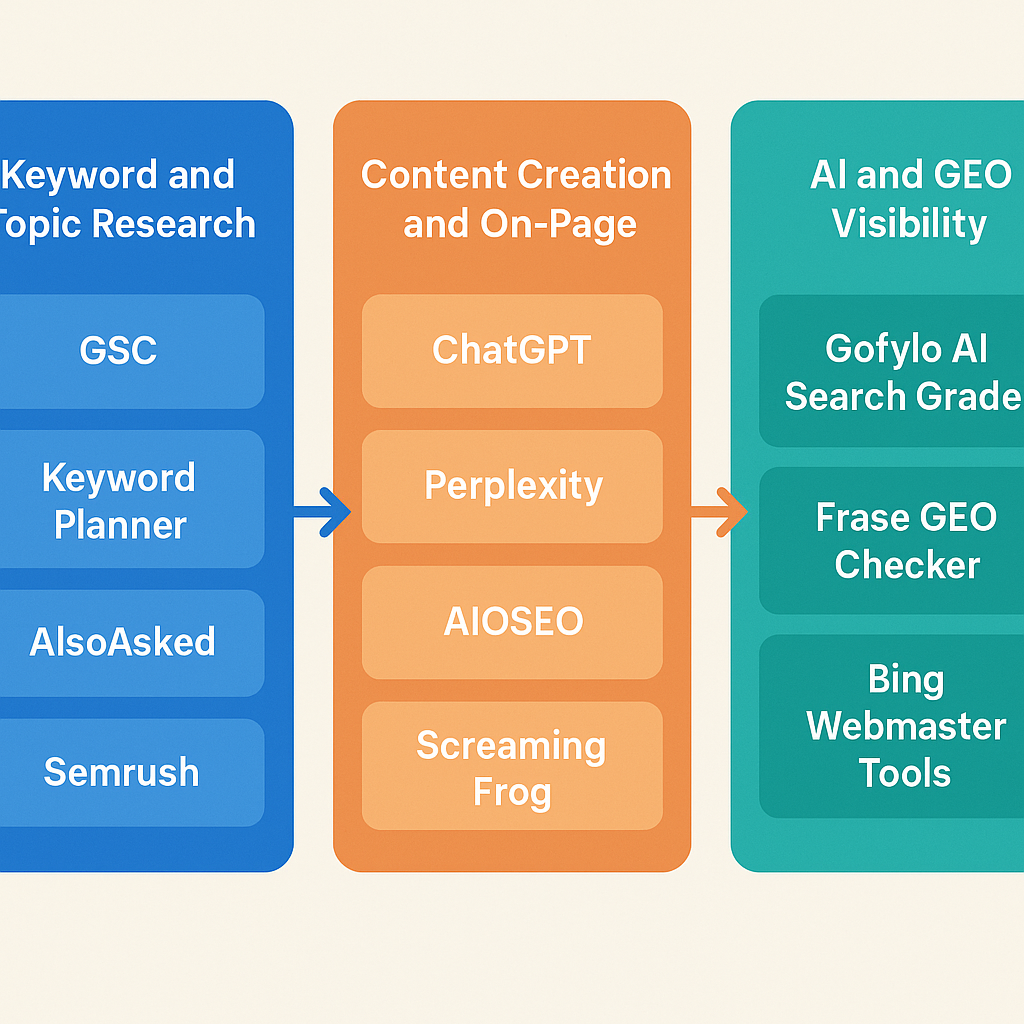
Pattern recognition: The best free AI SEO tools in 2026 cluster into three functional categories — technical audit tools (GSC, Ahrefs, Screaming Frog), keyword and content research tools (Semrush, Keyword Planner, AlsoAsked), and AI/GEO visibility tools (Gofylo AI Search Grader, Frase GEO Checker). A complete free stack needs at least one tool from each category.
7. Bing Webmaster Tools
Bing Webmaster Tools is the Microsoft equivalent of Google Search Console, and in 2026 it's more strategically relevant than many SEO teams realize. Microsoft's Copilot (formerly Bing Chat) is now one of the primary AI search interfaces in enterprise environments, drawing on Bing's index. If your content isn't indexed and performing in Bing, it's less likely to be cited by Copilot — and enterprise B2B buyers are heavily Copilot-adjacent given Microsoft 365 penetration. Bing Webmaster Tools gives you crawl data, keyword performance, backlink data from Bing's index, and a site scan tool that surfaces technical issues. The SEO Analyzer within the platform provides page-level recommendations. It's worth the 10 minutes of setup even if Google accounts for the bulk of your search traffic, purely for the AI search coverage it provides into the Microsoft/Copilot ecosystem. Learn more about Bing's indexing approach and webmaster guidelines at Microsoft's documentation.
Best for: B2B SaaS companies targeting enterprise buyers who use Microsoft 365 and Copilot. The Bing index is a meaningful AI citation source that Google-only tooling completely ignores.
Free tier limit: Bing's market share is smaller than Google's for most B2B audiences, so raw traffic impact may be modest — but the Copilot citation angle makes it worth monitoring in 2026.
8. Google Keyword Planner
Google Keyword Planner is the original free keyword research tool, and it remains one of the most reliable sources of search volume data because it comes directly from Google's ad infrastructure. For B2B SaaS content teams, it's most useful for validating search volume ranges on target keywords and identifying related terms that share commercial intent. You need a Google Ads account to access it (free, no ad spend required), and the data is presented as volume ranges rather than precise figures unless you're running active campaigns. The interface isn't as intuitive as modern SEO tools, but the underlying data is authoritative. Where Keyword Planner falls short is in keyword difficulty scoring (it has none), SERP analysis (none), and any AI search signal (none at all). It's a data source, not a strategic tool — layer it under a keyword research workflow that includes AlsoAsked for question mapping and Semrush for competitive difficulty scoring.
Best for: Validating search demand and discovering semantically related terms. Free and authoritative — the volume data comes from the same source Google uses for its own ad auction systems.
Free tier limit: No keyword difficulty data, no SERP analysis, no AI visibility signals. Volume shown as ranges unless you run active Google Ads campaigns.
9. AlsoAsked (Free Tier)
AlsoAsked visualizes the 'People Also Ask' relationships from Google SERPs as a hierarchical map — showing you the exact questions a topic branches into and how they're semantically nested. For content teams building topic clusters and trying to capture AI Overview citations (which disproportionately pull from FAQ-formatted, question-answering content), this tool is genuinely useful for structuring articles. Research from Marketing LTB shows that 74% of problem-solving queries trigger AI Overviews — meaning question-based content isn't just a Google tactic, it's a direct path to AI citation. AlsoAsked shows you the exact question language real users are typing, which is different from keyword research and more useful for FAQ block creation. The free tier limits you to a small number of searches per day and doesn't allow bulk exports, but for planning individual content pieces it covers the core use case. It integrates conceptually well with the broader AI-powered writing tools workflow where you're building answer-rich content designed to be cited.
Best for: FAQ block planning, topic cluster architecture, and AI Overview targeting. Question maps from AlsoAsked directly inform the heading structure and FAQ sections that get cited by LLMs.
Free tier limit: Limited searches per day. No bulk export in free tier. Data is Google-specific — no coverage of questions surfaced by Bing, Perplexity, or other AI engines.
10. ChatGPT (Free Tier for SEO Prompting)
ChatGPT's free tier is one of the most versatile free AI SEO tools available if you use it correctly — not as a content generator but as a structured prompting tool for SEO workflow tasks. Specifically: drafting title tag and meta description variants at scale, generating FAQ blocks from keyword lists, structuring content briefs from SERP analysis notes, creating schema markup JSON-LD drafts for FAQ and Article types, and generating internal link anchor text suggestions from a content inventory. These are tasks that are time-consuming to do manually, and ChatGPT does them reliably in seconds. What ChatGPT's free tier cannot do is browse the web in real time (that requires the paid tier with browsing enabled), access your Google Search Console data, or track how your content performs. It's a productivity tool, not an analytics tool. The distinction matters: teams that confuse 'I can produce content fast with ChatGPT' with 'I have an SEO strategy' are in a different situation than teams that use it as an accelerant within a structured workflow. For teams that want to understand how Claude compares for these same tasks, the conceptual comparison between AI writing assistants is covered in our analysis of whether Claude AI is better than ChatGPT.
Best for: Schema markup drafting, meta tag variant generation, FAQ block creation, and content brief structuring. A productivity layer, not a measurement tool.
Free tier limit: No real-time web access, no analytics integration, no AI visibility tracking. GPT-4o access on free tier has usage limits that reset daily.
11. Perplexity AI (Free Tier)
Perplexity AI functions differently from ChatGPT in one critical respect: it browses the web in real time and cites sources inline. This makes its free tier genuinely useful for competitive content research — you can ask it to summarize what's currently ranking for a topic, who's being cited as an authority, and what claims are being made across the SERP. For B2B SaaS teams trying to understand how a topic is represented in AI search right now (not six months ago), Perplexity is a faster diagnostic than manually reviewing SERPs. You can also use it to test whether your own brand or content is being surfaced for target queries — a manual version of what Gofylo's AI Visibility Tracker does automatically across all four major LLMs. The free tier is capable but limits you to the standard model; Pro users get access to more powerful models and higher query volumes. As a free AI SEO tool for content research and AI SERP reconnaissance, Perplexity fills a gap that no other free tool on this list covers in quite the same way.
Best for: Real-time AI SERP reconnaissance — understanding which brands and content pieces are getting cited by AI for your target topics. Also excellent for competitive content research briefs.
Free tier limit: Manual, query-by-query research only — no bulk monitoring, no historical tracking, no systematic brand visibility scoring. Pro plan required for advanced model access.
12. Ubersuggest Free Plan
Neil Patel's Ubersuggest offers a free plan that covers basic keyword research, site audit, and backlink data. For bootstrapped founders doing initial keyword research on a new SaaS product, it's a reasonable starting point — you get keyword volume, SEO difficulty scores, content ideas, and a basic site audit without paying anything. The free tier limits you to three searches per day and a site audit of up to 150 pages. The data quality for keyword research is generally adequate for directional decisions, though for precision work most experienced SEOs prefer Semrush or Ahrefs. Ubersuggest does have some AI content generation features in paid tiers, but these are absent in the free plan. In 2026, its main value proposition for the free tier is keyword discovery for teams that hit Semrush's daily query limit and want a backup tool. It's not differentiated on AI search visibility, GEO, or any LLM citation tracking.
Best for: Bootstrapped teams doing initial keyword research for new content areas. A serviceable backup to Semrush when you've hit daily query limits.
Free tier limit: 3 searches/day. No AI search visibility features. Site audit capped at 150 pages. No competitor content gap analysis in free tier.
13. Screaming Frog SEO Spider (Free Version)
Screaming Frog SEO Spider is the gold standard for technical SEO auditing, and the free version crawls up to 500 URLs — enough to cover most early-stage SaaS marketing sites and content hubs. It surfaces broken links, redirect chains, duplicate title tags, missing meta descriptions, thin content (by page size), non-indexable pages, and hreflang errors across all 500 URLs in a single crawl. For content-heavy sites, it's indispensable for maintaining crawl health, which is a prerequisite for both Google rankings and AI citation. Google's ability to index and represent your content in AI Overviews depends on it being crawlable and technically clean — Screaming Frog is the fastest way to verify that. The tool is desktop software (Windows, Mac, Ubuntu), runs locally, and produces exportable reports. There's no cloud sync, no historical tracking, and no AI visibility features, but for technical site health as a foundation layer, it's the most thorough free tool available. Google's Search Central documentation on crawling and indexing explains what Googlebot looks for — Screaming Frog simulates much of that crawl locally.
Best for: Technical SEO audits on sites up to 500 URLs. The free version is fully capable for early-stage SaaS sites and content hubs that need a crawl health baseline.
Free tier limit: 500 URL crawl cap. Desktop-only (no cloud). No AI features, no ranking data, no historical tracking. Paid license is £199/year for unlimited crawling.
14. Google Trends
Google Trends is underused as a strategic SEO tool. Its core value for B2B SaaS content teams in 2026 is topic demand validation and timing — understanding whether interest in a keyword is growing, declining, or seasonal before you invest in content production. For AI-adjacent topics specifically, Trends is revealing: searches for 'AI tools' averaged 4.2 million per month in 2025 and are projected to reach 7.4 million by 2028 according to Marketing LTB — a signal that investing in AI-category content now compounds significantly over the next two years. Trends also shows geographic distribution of interest and related queries, both of which inform which keyword variants to prioritize in your content cluster. It doesn't provide keyword difficulty, backlink data, or any AI search visibility signal, but paired with Keyword Planner and Semrush it rounds out a free keyword research stack with temporal demand data that neither of those tools provides as cleanly.
Best for: Topic timing validation, geographic demand analysis, and spotting rising keyword variants before they become competitive. Essential for content calendar planning.
Free tier limit: Relative index only — no absolute search volumes. No keyword difficulty, no backlink data, no AI visibility signals. Directional rather than precise.
How to Build a Workflow from Free Tools
Combining Traditional SEO and AI Visibility Checks
The mistake most teams make is treating these tools as parallel independent checkboxes rather than a sequential workflow. Here's a practical stack sequence that covers both Google SEO and AI search visibility using only the free tools on this list. Start with Google Trends and Keyword Planner to validate topic demand and identify keyword variants worth targeting. Move to Semrush's free tier and AlsoAsked to build a keyword cluster with question-based subtopics mapped out. Use ChatGPT or Perplexity to draft a content brief and FAQ block structure informed by that research. After publishing, run AIOSEO Analyzer and Screaming Frog (on your full site periodically) to verify on-page health and crawl integrity. Verify indexation via Google Search Console and Bing Webmaster Tools. Then — and this is the step most teams skip — run the Gofylo AI Search Grader and Frase GEO Score Checker on the published URL to assess AI citability. Use Perplexity AI manually to check whether your content is being surfaced for target queries. That complete loop covers both the traditional Google ranking pathway and the AI citation pathway, using entirely free tools. The gap is monitoring: none of these tools continuously track your AI visibility without manual effort.
When Free Tools Hit Their Ceiling
Free tools are point-in-time diagnostics. They tell you the state of a single page at a single moment, and they require manual effort to run and interpret. For a team publishing one to two pieces of content per month, that's manageable. For teams trying to build topical authority across dozens of keyword clusters — the strategy that actually compounds organic traffic in 2026 — the manual overhead becomes the bottleneck. According to Marketing LTB, nearly 44.1% of SEO tasks are now automated through AI tools, and the global AI SEO software market is estimated to reach $4.97 billion by 2033, up from $1.99 billion in 2024. That market growth is driven by exactly this pattern: teams discovering that free tools validate the need for automation but cannot deliver it. The specific ceiling you'll hit first is content velocity — you can research and optimize, but producing 10–30 articles per month without a content team is where free tools run out of answers.
The free tool ceiling is not a capability gap — it's a velocity gap. Free tools tell you what to do. An autonomous platform like Gofylo does it continuously, at scale, without requiring a human to run each step manually.
What Autonomous SEO Platforms Do That Free Tools Cannot
When you string together free AI SEO tools manually, you're building a process. Each tool requires a login, a query, interpretation, and a handoff to the next tool. For one article, that might take three to four hours of researcher and writer time. Autonomous SEO platforms — of which Gofylo is the most comprehensive for B2B SaaS — collapse that process into a single continuous loop. Gofylo's Content Engine researches, writes, and publishes 30 SEO-optimized articles per month in under four minutes per article, automatically including schema markup, internal linking, FAQ blocks, AI-generated images, and embedded YouTube videos. The published content is E-E-A-T-compliant and structured for both Google rankings and AI citation from day one. That's not a workflow improvement — it's a structural change in how organic growth compounds. A solo founder or a two-person marketing team can generate the content volume of a 10-person content operation without managing the process manually.
Beyond content production, Gofylo's AI Visibility Tracker continuously monitors brand citation presence across ChatGPT, Claude, Perplexity, and Gemini — the continuous monitoring that neither the Gofylo AI Search Grader (point-in-time) nor any other free tool can provide. The Competitor Intelligence Agent surfaces competitor content moves before they impact your market position. The Social Monitoring Agent tracks brand mentions and relevant conversations. And the Backlink Generation feature addresses the distribution layer that free tools can identify gaps in but cannot fill. For teams comparing Gofylo to tools like rankai.ai, the distinction is scope: Gofylo covers the full content lifecycle autonomously, while most AI SEO tools — free or paid — are still single-function tools that require human orchestration between them. The keyword research segment alone in the AI SEO tool market was valued at $800 million in 2024 and is projected to reach $3.8 billion by 2035 according to WiseGuyReports — a clear signal that the market is moving toward integrated, automated capability rather than point-solution free tools.
Gofylo integrates directly with WordPress, Webflow, Shopify, Wix, Ghost, Framer, Notion, and Feather, plus an API webhook for custom CMS setups — meaning content is published to your existing infrastructure without a migration. It generates content in 18+ languages, supports programmatic landing page generation, and delivers an average AI Visibility Score of 94 across active accounts. The starting price is $79/month with a 3-day free trial, no credit card required. For a growth-stage SaaS company or bootstrapped founder comparing the operational cost of managing 14 free tools manually versus running a single autonomous platform, the math is straightforward. For teams also building their AI-powered writing tool stack, our comparison of Jasper AI alternatives covers the content generation layer specifically, and our analysis of AI-based SEO tools goes deeper on the full-stack platform landscape. These free AI SEO tools are the right starting point — and Gofylo is where you go when you're ready for the strategy to run itself.
Frequently Asked Questions
Are free AI SEO tools actually useful for B2B SaaS companies?
Yes — for specific use cases. Google Search Console, Ahrefs Free Webmaster Tools, and Screaming Frog cover the technical audit layer at no cost. AlsoAsked and Perplexity are useful for content research. The gap free tools cannot fill is continuous monitoring and content velocity at scale — both of which require a paid platform if you're serious about compounding organic growth.
What's the difference between an AI SEO tool and a GEO tool?
An AI SEO tool uses artificial intelligence to assist with traditional search optimization tasks — keyword research, content generation, technical audits. A GEO (Generative Engine Optimization) tool specifically targets visibility in AI-generated answers from systems like ChatGPT, Claude, Perplexity, and Gemini. In 2026, the best platforms — like Gofylo — cover both dimensions simultaneously, since Google rankings and LLM citation are increasingly interdependent.
Can free tools help me rank in ChatGPT or Perplexity?
Partially. Tools like the Gofylo AI Search Grader and Frase GEO Score Checker can diagnose why your content isn't being cited and surface structural fixes. Perplexity's free tier lets you manually check whether you're appearing for target queries. But continuous AI search visibility monitoring — tracking citation presence across all major LLMs over time — requires a platform like Gofylo's AI Visibility Tracker.
How many free AI SEO tools should I use at once?
Three to five is the practical working limit before tool-switching overhead eats your productivity gains. A lean free stack that covers the essentials: Google Search Console (performance), Gofylo AI Search Grader (AI visibility), Ahrefs Free Webmaster Tools (technical and backlinks), AlsoAsked (content structure), and Screaming Frog (crawl audit). Add Semrush's free tier for periodic competitive keyword research.
When should I upgrade from free tools to a paid platform?
When content velocity becomes the bottleneck. If you're consistently publishing fewer articles per month than your content strategy requires — not because of strategy clarity, but because of production and optimization time — free tools have reached their ceiling. For most B2B SaaS teams targeting compounding organic growth, that ceiling appears between 5 and 10 articles per month of manual production. Beyond that, an autonomous platform like Gofylo at $79/month delivers exponentially more output per dollar than any combination of free tools plus human time.
Does Gofylo have a free tier?
Gofylo offers a free AI Search Grader tool available as a standalone entry point — no account required. The full platform, including the Content Engine, AI Visibility Tracker, and all six autonomous agents, starts at $79/month with a 3-day free trial and no credit card required. The trial gives you access to the full feature set, including CMS publishing and AI visibility scoring, so you can verify real output before committing.
Ready to see where your brand actually stands in AI search? Run Gofylo's free AI Search Grader on your domain — no account, no credit card, results in under two minutes. Then start a 3-day free trial of the full platform to see 30 published, E-E-A-T-compliant articles deliver in your first month. Start your free trial at gofylo.com.
Sources
- 26 AI SEO Statistics for 2026 + Insights They Reveal - semrush.com
- AI SEO Statistics in 2026: AI SEO Trends and Insights - seo.com
- AI SEO Statistics 2025: 99+ Stats & Insights Expert Analysis - Marketing LTB - marketingltb.com
- AI SEO Tool Market Trends | Competitive Market Analysis 2035 | WiseGuyReports - wiseguyreports.com