An AI search visibility checker runs the questions your buyers ask through AI assistants such as ChatGPT, Perplexity, Gemini and Claude, then records whether your brand is named, which competitors are named instead, and which pages get cited. The useful ones also tell you what to publish next. The weak ones hand you a score with no path from the number to a page.
I have tested a lot of these checkers on SaaS sites, including our own. The category has filled up fast in 2026, and most tools look alike in a demo. They differ in what they ask, how often they ask it, and what they do with the answers. This piece breaks down those differences so you can judge a checker on how it is built, not on its dashboard.
An AI search visibility checker is software that queries AI assistants with buyer-style prompts and reports whether your brand appears in the answers, who appears instead, and which sources the assistants cite. It matters to SaaS founders, SEO leads and demand gen teams whose buyers now ask AI assistants for vendor shortlists before they ever reach Google.

The Prompt Set Decides Everything Downstream
The prompt set is the single biggest factor in whether a checker's results mean anything. A checker can only report on the questions it asks. If those questions do not match how your buyers search, every chart built on them is measuring the wrong market.
Most SaaS teams underestimate this. They accept the default prompts a tool generates from their homepage, see a decent score, and assume they are visible. Then a prospect mentions that ChatGPT recommended three competitors and never named them.
Category prompts versus branded prompts
A branded prompt names you: "Is Acme a good project management tool?" A category prompt does not: "What project management tools work well for remote engineering teams?" Branded prompts almost always return your brand, because you put it in the question. They tell you how assistants describe you, which is useful for accuracy checks, but they say nothing about discovery.
Category prompts are where buyers form shortlists. A checker that weights branded prompts heavily will inflate your visibility. Ask any vendor what share of their default prompt set is unbranded, and whether you can see the full list.
Who writes the prompts
Prompts come from one of a few places, and each has a bias worth knowing:
- Generated from your site copy, which tends to mirror your own positioning and miss the language buyers use
- Derived from keyword data, which captures search demand but often reads like a search query, not a conversational question
- Written by your team, which reflects sales conversations but can drift toward the questions you already win
- Built from competitor gaps, which surfaces the prompts where rivals appear and you do not
The best setups mix sources and let you edit freely. If a checker locks the prompt list, you are renting its assumptions about your market.
Engine Coverage: Why Six Assistants Beat One
Each AI assistant answers the same question differently, so a checker that watches only one gives you a partial picture. ChatGPT, Perplexity, Gemini, Claude, Google AI Overviews and Google AI Mode retrieve sources differently, weight brands differently and change on different schedules.
Perplexity leans heavily on live web retrieval and shows citations openly, so fresh, well-structured pages can show up quickly. Claude and ChatGPT may answer from training data for some prompts and browse for others, which means older brand associations can persist. Google AI Overviews and AI Mode sit on top of Google's index, so classic SEO strength carries more weight there than anywhere else.
For a B2B SaaS team, the practical point is that your buyers do not all use the same assistant. An engineer may ask Claude, a VP of marketing may ask ChatGPT, and a procurement lead may see an AI Overview on a Google search. A checker that covers one engine can show you winning while you lose the other five.
Before trusting any visibility score, ask which assistants it covers and whether results are broken out per engine. A blended score across engines hides the one assistant where a competitor owns your category.
Mentions, Citations and Position Are Different Signals
A mention, a citation and a position are three separate measurements, and a good checker reports each one on its own. Collapsing them into one number makes the result easier to read and harder to act on.
Mention. The assistant names your brand in its answer text. This is the closest thing to being on the buyer's shortlist. It can happen with or without a link to your site.
Citation. The assistant links to a page as a source. That page may be yours, a review site, a comparison listicle or a competitor's blog. Citations reveal which pages are shaping the answer, which is the most actionable data a checker produces.
Position and framing. Being named fifth with a caveat is not the same as being named first as the default pick. Some checkers capture order and sentiment. Fewer capture framing, such as being described as "for enterprises" when you sell to startups.
The citation layer matters most for content planning. If an assistant keeps citing a third-party comparison page that lists your competitors and omits you, you have two options: get onto that page, or publish a better answer of your own that the assistant can cite instead. A checker that only reports mentions cannot show you either path.
Sampling, Repetition and Noise
AI answers are not deterministic. The same prompt, sent twice, can return different brands. A checker that runs each prompt once and reports the result is reporting a coin flip.
Reliable checkers repeat prompts across runs and over time, then report how often you appear. That frequency is far more stable than any single answer. When you evaluate a checker, look for these signs that it handles noise properly:
- Prompts run on a regular schedule, not only when you open the dashboard
- Trend lines over weeks, so a single bad run does not look like a collapse
- Raw answers you can read, so you can verify the tool's parsing
- Clear handling of answers where the assistant refuses or gives a generic reply
- Location and language settings, since answers vary by market
This is also why a one-off audit and continuous tracking answer different questions. The audit tells you roughly where you stand. Tracking tells you whether the pages you publish are moving the numbers. If you are building a measurement approach from scratch, From Rankings to LLM Mentions covers how those two layers fit together.
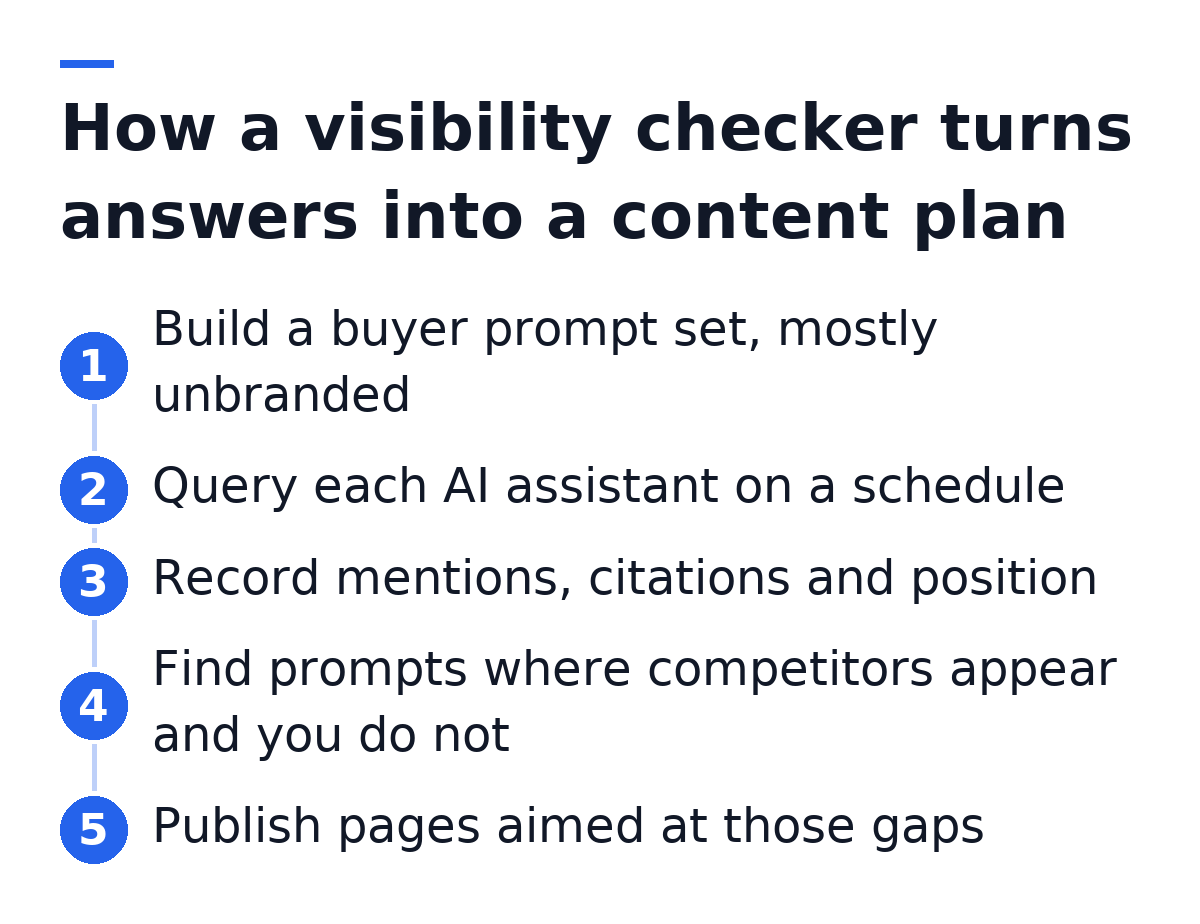
How a Checker Connects to Google SEO Data
AI visibility and Google rankings are linked, and a checker that ignores Google misses half the story. Google AI Overviews and AI Mode draw from Google's index, and several other assistants retrieve from web search when they browse. Pages that rank well tend to be the pages assistants can find.
The overlap runs both ways. A page sitting on positions 8 to 15 in Google for a buyer query is often close to being cited too, and lifting it onto page one can improve both channels at once. Your Search Console data shows exactly which pages sit in that zone. A checker that pairs AI answers with Search Console data can point you to the page edits with the shortest path to results, instead of asking you to write everything from scratch.
The reverse case matters as well. Some prompts surface brands with weak Google rankings because a strong third-party page mentions them. That tells you earned mentions on review and comparison sites carry weight in AI answers even when your own page does not rank.
From Diagnosis to Published Page
A visibility checker diagnoses. It does not fix anything on its own. The gap between the report and a published page is where most teams stall, especially teams without a dedicated content writer.
What a free checker can and cannot do
A free checker is a good first read. It can show whether you appear for a handful of buyer prompts, who appears instead, and which assistants are weakest for you. Our Free AI Search Grader is built for that first look, and the free AI Visibility report goes further by listing the pages worth writing.
What a free checker usually cannot do is track over time, cover a large prompt set, or measure whether your fixes worked. For that you need scheduled tracking. Once you have a report in hand, our guidance on ai visibility do next walks through turning gaps into a prioritized page list.
Monitoring-only versus monitoring plus execution
Paid tools split into two models. Monitoring-only platforms such as Profound and Peec AI focus on measurement depth: prompt volume, engine coverage and reporting. They suit teams with writers ready to act on the data. The comparison in Profound AI vs. Autonomous GEO goes into that tradeoff in detail.
The other model pairs tracking with content production, so each gap the checker finds becomes a researched, published article. The table below summarizes how the two models differ for a small team.
| Point | Monitoring-only | Monitoring plus execution |
|---|---|---|
| Main output | Reports and dashboards | Reports and published articles |
| Who writes the content | Your team or agency | The platform, published to your CMS |
| Best fit | Teams with writers on staff | Founder-led or small marketing teams |
| Feedback loop | Manual, depends on team capacity | Tracking shows whether new pages move results |
| Google SEO link | Varies by tool | Search Console data used to refresh pages |
Neither model is wrong. The right one depends on whether your bottleneck is knowing what to write or having the hours to write it. For most bootstrapped and growth-stage SaaS teams I work with, it is the hours.
Gofylo sits in the second group. It tracks six assistants (ChatGPT, Google AI Overviews, Google AI Mode, Gemini, Perplexity and Claude), shows where they name competitors instead of you, and researches, writes and publishes 10, 20 or 30 articles a month to your CMS depending on plan, with schema, internal links, FAQ blocks and verified citations. Published articles that sit just off page one get refreshed from your Search Console data, with the earlier version kept to restore.
Related: Your Guide to LLM Visibility Tools That Actually Work
Want to see which brands AI assistants name for your buyers' searches? Run the free AI Visibility report from Gofylo, then start a 7-day free trial (plans from $149 a month) to turn those gaps into published articles.