Most SaaS teams that go looking for a free SEO writing assistant already have a draft open in another tab. The question is rarely whether AI can write. It is whether a free tool can make that draft rank on Google and get named by ChatGPT, Perplexity or Gemini, without someone spending the afternoon fixing it.
I have tested a lot of these tools while building content workflows for small teams. The useful ones share a pattern: they help with one narrow slice of the job, and their free tier is designed to show you that slice, not to run your content program. This guide breaks down what that slice is, which parts of SEO and AI search visibility a free assistant can actually touch, and where the free model reaches its limits for a B2B SaaS company.
A free SEO writing assistant is a tool that helps you draft or improve web content for search at no cost, usually through keyword suggestions, on-page scoring, outline generation or AI drafting under a usage cap. It matters most to founders, solo operators and small marketing teams who need search traffic before they have budget for a content team.

The Four Jobs Hidden Inside SEO Writing
An SEO writing assistant is judged on writing, yet writing is only one of several jobs that decide whether a page earns traffic. Separating them makes it obvious why free tools feel helpful and incomplete at the same time.
- Research: choosing a topic with real demand, understanding search intent and seeing which pages and businesses already answer it.
- Drafting: turning that research into a structured, accurate article with headings, examples and a clear answer near the top.
- Optimization: checking coverage of related terms, entities and questions, adding schema, internal links and a meta description.
- Publishing: getting the page into the CMS with correct formatting, images and metadata.
- Maintenance: watching performance after launch and rewriting pages that stall just off page one or stop being cited by AI assistants.
Free assistants concentrate on drafting and light optimization, because those are cheap to demo and easy to judge in one session. Research, publishing and maintenance require ongoing data and integrations, which cost money to run. That gap explains most of the frustration teams feel after a few weeks on a free plan.
What Free Tiers Are Built to Show You
A free tier is a product demo with a meter attached. It shows the core experience clearly enough to convince you, then limits the parts that would let you run a program on it. Knowing which limit applies tells you how far the tool can actually take you.
Usage Caps and Feature Gates
Most free SEO writing assistants restrict you in one of two ways. Usage caps limit how many words, credits, documents or queries you get each month. Feature gates leave the volume open but hold back specific capabilities. Both models are reasonable, and each hurts a different kind of team.
- Word or credit caps hurt teams that want to publish regularly, since a single long-form article can use up most of a monthly allowance.
- Document caps hurt teams that revise often, because each rewrite counts against the limit.
- Gated content scoring leaves you with a draft but no way to check how it compares to the pages it is competing with.
- Gated integrations mean every article is copied by hand into WordPress, Webflow or Shopify.
- Gated history or collaboration makes it hard for a second person to review the work.
The Data Behind the Suggestions
The quality of an SEO assistant's advice depends on the data underneath it. A tool that suggests keywords without live search data is guessing from language patterns. A tool that scores your draft against current top results is giving you something closer to evidence. Free tiers often run on lighter or cached data, so the suggestions read well but may not reflect what is ranking or being cited in 2026.
Before you trust a free assistant's keyword or scoring advice, check where the data comes from. Suggestions generated only from a language model are writing help, not search research.
How a Free Assistant Affects Google Rankings
A free assistant can improve the on-page quality of an article, and that does help on Google. It cannot fix the factors that sit outside the draft. Google ranks pages, and a page's position depends on intent match, topical depth across the site, internal linking, technical health and authority built over time.
Where free tools help on Google. They speed up outlining, catch missing subtopics, suggest headings that match how people phrase a query and tighten copy so the answer appears early. For a solo founder writing one strong piece, that is real value.
Where they stop. Free tools rarely plan a set of related articles that support each other, add internal links across your existing pages, generate structured data or tell you which published pages are slipping. Those site-level signals usually separate a page that ranks from one that sits on page three. Tracking those positions is its own discipline, and teams that need it compare the best rank tracking options separately from their writing tools.
How a Free Assistant Affects AI Search Citations
AI assistants such as ChatGPT, Claude, Perplexity, Gemini and Google AI Overviews choose sources differently than a ranked list of links. They pull passages that answer a question cleanly, come from sources they can identify, and agree with other material they find. A free writing assistant can help with the first of those and does very little for the rest.
- Answer-first passages: short, self-contained statements an AI assistant can quote without surrounding context.
- Clear entities: consistent naming of your product, category and use cases so a model connects your brand to the problem.
- Structured data and FAQ blocks that make questions and answers easy to extract.
- Verifiable citations to original sources, which make a passage safer for an assistant to repeat.
- Coverage of the exact questions buyers ask assistants, which often differ from the keywords they type into Google.
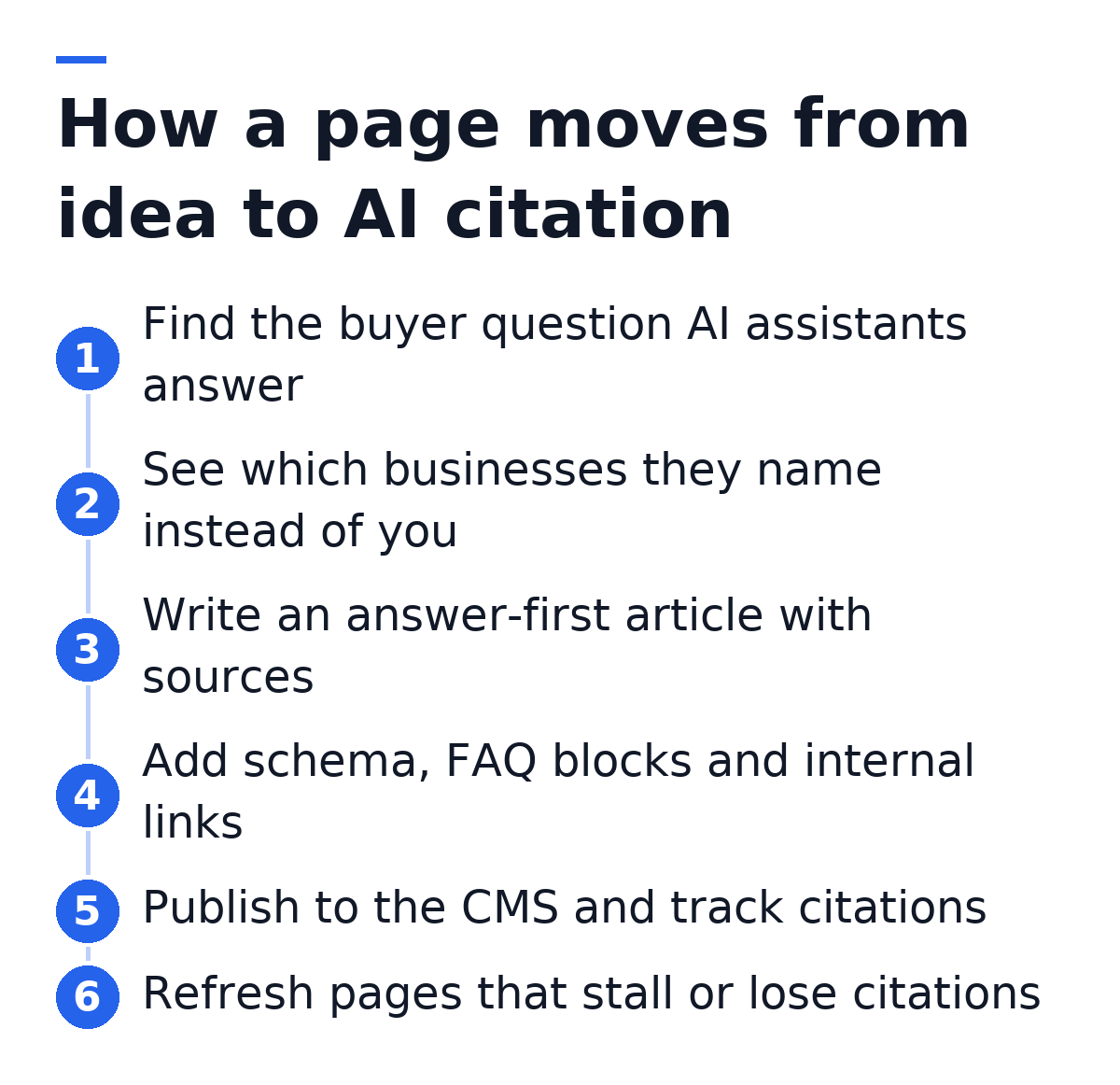
The larger gap is visibility. No free writing assistant I have used tells you which businesses ChatGPT or Perplexity name when a buyer asks for a tool in your category. Without that view, you are optimizing for AI search blind. You write a good article, but you cannot see whether it closed the gap where a competitor gets recommended instead of you.
The Hidden Cost of Free: Your Time
A free assistant moves the cost from your budget to your calendar. Every job the tool skips becomes a manual task, and on a small team that task lands on the founder or the one marketer who also runs paid campaigns, product launches and the newsletter.
A typical free-tier workflow looks like this: research keywords in one tool, draft in a chat assistant, check the draft against a scoring tool, fix formatting, add links by hand, paste into the CMS, find or make images, write the meta description, and set a reminder to check performance later. Each step is small. Together they turn one article into a half day of work, and the maintenance step is usually the one that never happens.
Paid tools in this space solve different parts of that chain. Some, like Clearscope, focus on scoring drafts against search results. Some suites, like Semrush, bundle writing help with broader keyword data. Chat assistants like ChatGPT and Claude are strong at drafting but leave research, publishing and tracking to you. If you are weighing drafting quality on its own, our comparison of the best ai writing assistant options and the wider field of ai writing platforms covers that ground, and Beyond Jasper looks at long-standing writing tools in detail.
| Job | Free SEO writing assistant | General chat AI | Autonomous content engine |
|---|---|---|---|
| Keyword and topic research | Light, often capped | Guesswork without live data | Built into planning |
| Drafting | Yes, within limits | Yes | Yes |
| Schema, FAQ and internal links | Rarely | Manual, if prompted | Included |
| Publishing to the CMS | Usually manual | Manual | Direct to the CMS |
| AI assistant visibility tracking | No | No | Yes |
| Refreshing published pages | No | Manual | Driven by Search Console data |
The table shows the structural difference. A free assistant and a chat AI both make you faster at writing. An autonomous engine takes the whole chain off your plate, so the output compounds without a person moving drafts between tabs.
When a Free Assistant Is the Right Call
A free SEO writing assistant is the right choice when the bottleneck is writing itself and you have the time to handle everything around it. That describes more teams than you might expect, especially early on.
- You are pre-launch or validating positioning and need a handful of foundational pages, not a publishing cadence.
- You enjoy writing and want help with structure and coverage, not a replacement.
- You are testing whether organic search is a viable channel before committing budget.
- You publish rarely and can do research, linking and publishing by hand without it crowding out other work.
- You need a second pair of eyes on drafts that a human writer or agency already produces.
In those cases, stretching a free tier is a sensible decision. Pair it with Google Search Console, which is free and shows the queries your pages already appear for, and you have a workable starter setup.
Signs You Have Outgrown the Free Tier
Most teams outgrow free assistants the moment content becomes a channel they depend on. The signals tend to show up together.
- You hit usage caps before the month is half over.
- Drafts pile up unpublished because formatting and CMS work keep slipping.
- Pages that launched months ago have never been revisited.
- A prospect mentions that ChatGPT or Perplexity recommended a competitor, and you have no way to see how often that happens.
- Internal linking and schema are inconsistent because they depend on whoever published the page.
- Content is the job of someone whose real role is something else.
When three or more of these apply, the question shifts from which free tool writes best to whether you want to keep running the content process yourself. That is where autonomous execution starts to pay back, because the work that free tools leave behind is the work that compounds: consistent publishing, site-level structure, and refreshing pages that have already earned some traction.
FAQ
Can ChatGPT do SEO?
ChatGPT can help with parts of SEO, mainly drafting, outlining, rewriting and suggesting questions to answer. It has no built-in view of live search data, your rankings, your Search Console performance or which businesses AI assistants recommend in your category. It also does not publish to your CMS or maintain pages after launch. Treat it as a capable writer that needs research, optimization and tracking supplied from elsewhere.
Is SEO dead or evolving in 2026?
SEO is evolving in 2026, not dying. Google search still drives a large share of B2B discovery, and AI assistants such as ChatGPT, Gemini, Perplexity, Claude and Google AI Overviews now answer many buyer questions directly. The fundamentals carry over: clear answers, strong structure, credible sources and topical depth. What has changed is that teams now need to track whether AI assistants name them, alongside where their pages rank.
If a free assistant has taken you as far as it can, see what the next step looks like. Gofylo researches, writes and publishes 10, 20 or 30 articles a month to your CMS, with schema, FAQ blocks, internal links and source citations, refreshes published pages from your Search Console data, and tracks how ChatGPT, Google AI Overviews, Google AI Mode, Gemini, Perplexity and Claude answer your buyers' searches. Start with the free AI Visibility report to see which businesses AI assistants name instead of you, or start a 7-day free trial on plans from $149 a month.