As of 2026, link building remains the most time-intensive SEO activity for the majority of practitioners — and the gap between teams that automate it and those that don't is widening fast. According to industry data, 65% of SEO professionals say link building is their most time-intensive activity, yet fewer than 20% have a systematic process in place. Meanwhile, the tools designed to close that gap have matured significantly, moving from basic crawler alerts into full-stack outreach, prospecting, monitoring, and AI-citation pipelines.
The market reflects this shift. The global link building software market was valued at $2.8 billion in 2025 and is projected to reach $7.1 billion by 2034, expanding at a CAGR of 10.9%. That growth isn't speculative — it tracks directly with the explosion of AI-driven search, where earning citations in ChatGPT, Claude, Perplexity, and Gemini requires structured, authoritative backlink profiles just as much as ranking in Google does. The 9 tools below are evaluated across both dimensions: traditional search link equity and AI search citation potential.
Thesis: The best backlink automation software in 2026 isn't just about link volume — it's about building the kind of authoritative profile that earns citations from both Google and large language models. Here are the 9 tools worth evaluating, ranked by real-world impact.
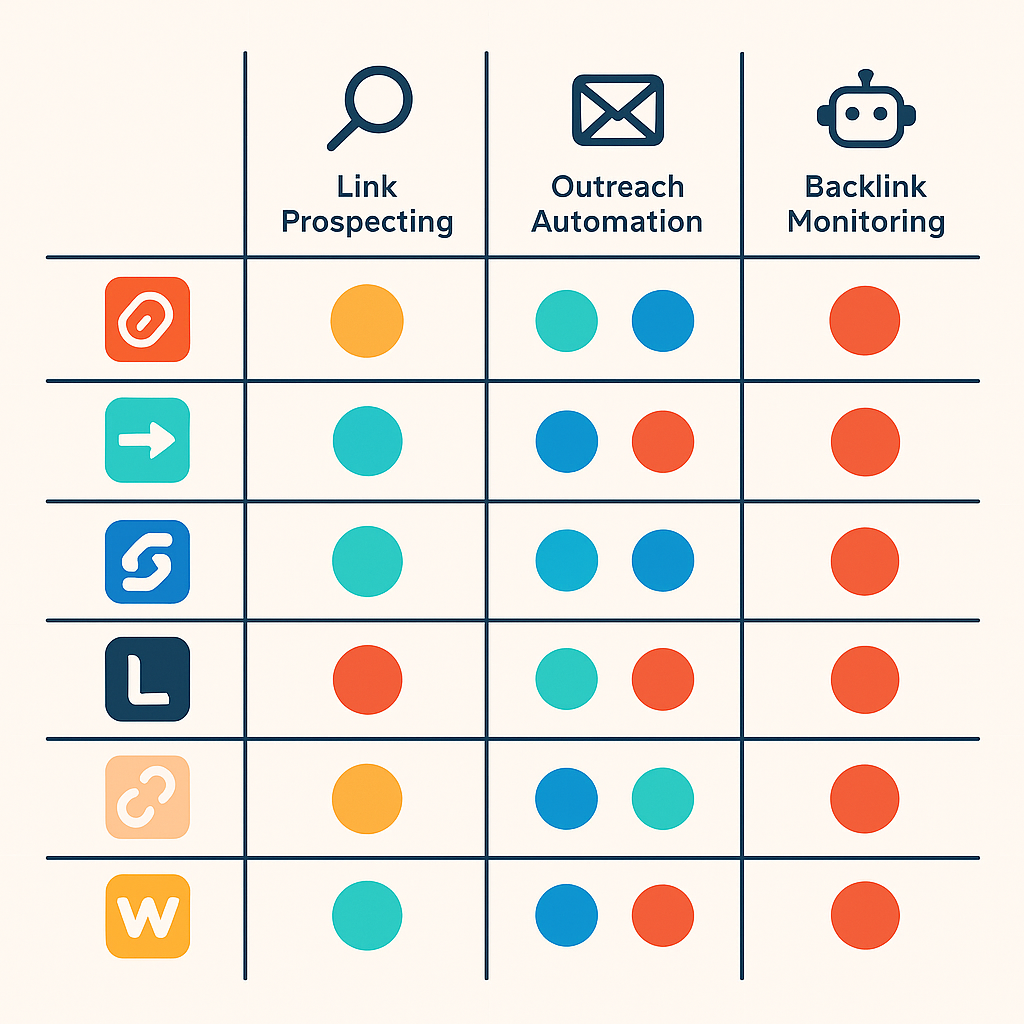
All 9 Tools at a Glance
- Ahrefs — deep backlink data, gap analysis, link prospecting
- Semrush Link Building Tool — end-to-end outreach with CRM-style pipeline
- Pitchbox — high-volume automated outreach with personalization at scale
- BuzzStream — relationship-based outreach and contact management
- Majestic — Trust Flow and Citation Flow metrics, historical link data
- Linkody — lightweight backlink monitoring and alert automation
- Hunter.io — contact discovery and cold email sequencing
Ahrefs
Ahrefs is the reference-standard tool for backlink intelligence. Its Site Explorer surfaces the full referring domain profile of any URL, shows which pages attract the most links, and surfaces competitor link gaps you can target systematically. The Link Intersect feature is particularly useful for B2B SaaS teams: paste in 3-5 competitors and Ahrefs returns every domain linking to them but not to you — a prioritized outreach list built in minutes. Content Explorer doubles as a link prospecting engine, letting you find high-DR pages on any topic that are actively acquiring new backlinks. Ahrefs doesn't do outreach — it's a research and audit layer — but its data quality is unmatched and it integrates cleanly with most outreach tools in this list.
Semrush Link Building Tool
Semrush's Link Building Tool takes the workflow one step further than pure research. It pulls prospect lists based on your target keywords and competitors, ranks them by authority and relevance, and presents them in a pipeline you can manage directly inside the platform. From there you can send outreach emails, track responses, and monitor the status of acquired links — all without switching tools. For teams that want a single-vendor solution covering keyword research, content audit, and link acquisition, Semrush is the most integrated option in this list. The tradeoff is cost: full access to the Link Building Tool requires a Guru or Business plan, which runs significantly higher than standalone tools.
Pitchbox
Pitchbox is purpose-built for scaled outreach campaigns. It integrates with Ahrefs, Semrush, and Moz to pull prospect data directly into campaign workflows, then automates personalized follow-up sequences based on engagement signals. Where Pitchbox differentiates is in its conditional logic: if a prospect doesn't open after 5 days, send variant B; if they click but don't reply, trigger a different follow-up. This kind of behavior-based automation is what makes Pitchbox the preferred tool for digital PR agencies and high-volume growth teams running 50+ outreach campaigns simultaneously. It's overkill for a two-person startup, but for a SaaS company with a dedicated SEO manager running link acquisition as a primary channel, it's purpose-fit.
BuzzStream
BuzzStream sits at the relationship end of the backlink automation spectrum. Rather than blasting cold sequences, it's built around managing ongoing relationships with publishers, bloggers, and journalists. Its browser extension lets you save prospects while browsing, auto-populate contact information, and log conversations. If your link-building strategy is grounded in guest posting, co-marketing, or editorial partnerships — common for B2B SaaS companies targeting niche publications — BuzzStream provides better contact context than any other tool here. It won't generate link volume at Pitchbox's pace, but for teams that view link building as relationship capital rather than transactional outreach, the quality-per-contact ratio is higher.
Key distinction: Tools like Pitchbox and BuzzStream automate the outreach layer. Tools like Ahrefs and Majestic automate the research layer. Very few tools in this list handle content creation — the upstream activity that actually earns links without asking. That gap is where Gofylo plays.
Majestic
Majestic pioneered two metrics that remain industry standards: Trust Flow (a quality signal based on proximity to trusted seed sites) and Citation Flow (a volume-based authority proxy). Its Topical Trust Flow layer maps backlinks to specific topic categories, which is useful for B2B SaaS companies trying to build authority in a defined vertical rather than across the broad web. According to G2 data cited by SEO Sandwitch, Majestic and Linkody are popular for automated backlink tracking, used by 28% of users. Majestic's historical index is one of the deepest available, making it particularly valuable for competitive analysis and for auditing link profiles on older domains you're considering acquiring or targeting.
Linkody
Linkody is the lightweight monitoring specialist in this group. It continuously crawls your backlink profile, surfaces new and lost links, and sends automated alerts when something changes. For teams that have already built a substantial link profile and need to protect it — rather than grow it aggressively — Linkody provides high-signal monitoring without the overhead of an enterprise platform. According to Ahrefs-cited data via SEO Sandwitch, automated backlink alerts reduce response time to lost links by 60%, which directly translates to faster reclamation outreach and less authority bleed. Linkody is priced accessibly and pairs well with any outreach tool on this list as a monitoring layer.
Hunter.io
Hunter.io solves a specific but critical bottleneck: finding verified contact information for the people who actually control editorial decisions. Its domain search returns email addresses associated with any domain, confidence scores, and source URLs. The Email Finder extracts contacts from bylines and author pages. Its Campaigns feature adds cold email sequencing with open and reply tracking — making it a self-contained outreach tool for smaller teams that don't need Pitchbox's campaign sophistication. For bootstrapped operators or early-stage SaaS founders doing their own outreach, Hunter.io is often the most efficient entry point: low cost, fast to learn, and tightly focused on the contact discovery problem.
Respona
Respona occupies the intersection between content-aware prospecting and automated outreach. It integrates with Google Search Console and Ahrefs to identify which of your existing pages have the highest link-earning potential, then surfaces prospects for those specific URLs. Personalization is template-driven but pulls live data — author name, publication, recent article titles — to make cold pitches feel less cold. Where Respona earns marks over pure outreach tools is its podcast booking workflow and its journalist targeting features, which are increasingly relevant as digital PR becomes the dominant high-authority link tactic. According to SEOmator, 86% of SEO professionals leverage AI tools for backlink automation, and Respona's AI-assisted personalization layer is a practical example of what that looks like in production.
Gofylo
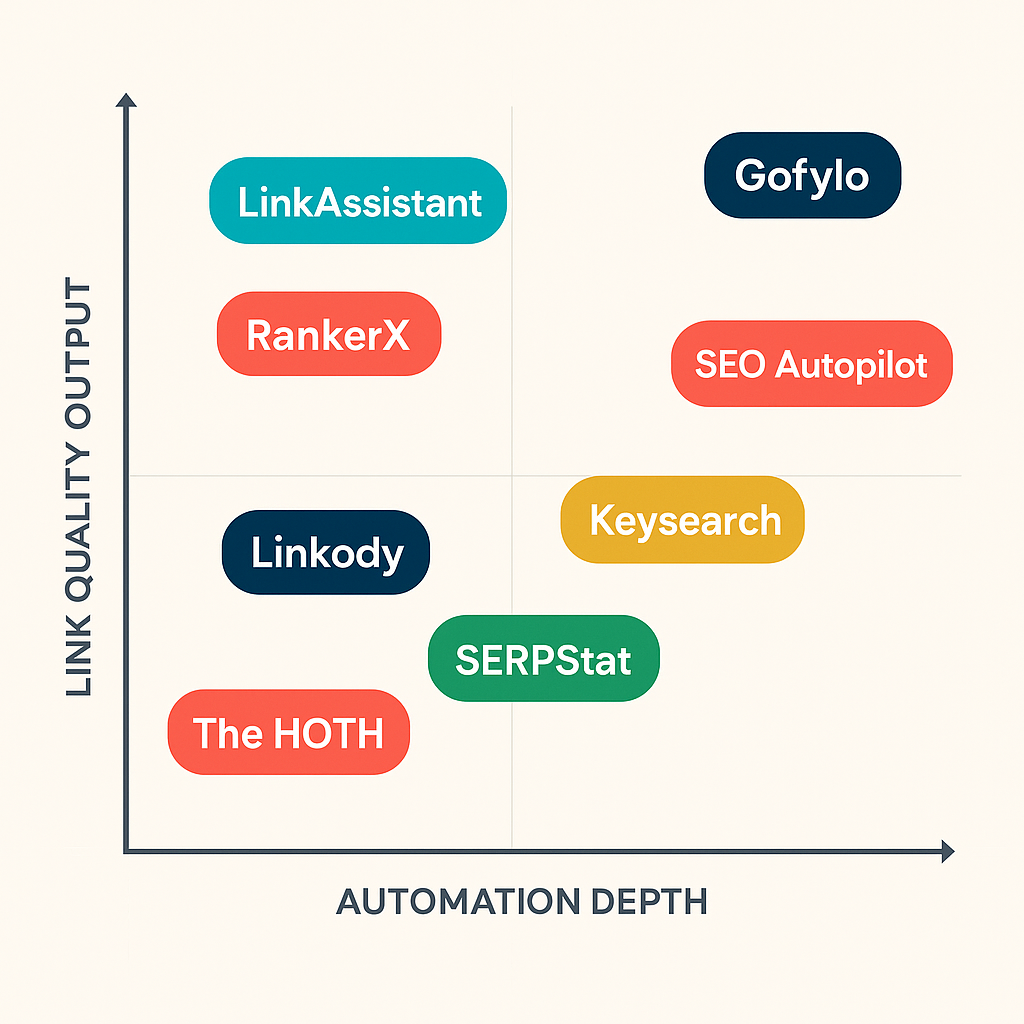
Gofylo approaches content generation from a structurally different angle than every other tool on this list. Rather than automating outreach to request links, Gofylo autonomously creates the content assets that attract links and AI citations — then gives an AI visibility score based on how ChatGPT and Claude see the brand. Its Content Engine publishes fully optimized pieces written in a few minutes per article, with 30 articles per month on the standard plan. Each article includes schema markup, internal linking, FAQ blocks, and AI-generated images — the structural signals that make content citable by both search engines and large language models.
What makes Gofylo relevant specifically to the backlink problem is that earned links — links from publishers who discover and reference your content organically — carry substantially more authority than acquired links from outreach. A team publishing 30 well-researched, deeply structured articles per month in their vertical creates a compounding asset base that attracts inbound links at scale. Gofylo's AI visibility score closes the loop: it asks ChatGPT and Claude about the brand and scores how visible it is in AI-driven search — not just traditional SERPs. For B2B SaaS companies that care about being cited when a prospect asks an AI assistant for tool recommendations, this layer is difficult to replicate with any other tool in this list. Plans start at $79/month with a 3-day free trial at gofylo.io.
How to Choose the Right Tool for Your Stack
Start with the bottleneck. If your biggest gap is knowing which links to go after, start with Ahrefs or Majestic for research depth. If you have prospects but can't scale outreach, Pitchbox or Respona solves that. If you have an active link profile you're not monitoring, Linkody is a low-cost addition. If you have no content attracting links in the first place, no outreach tool will fix the underlying problem — that's where Gofylo's content-first approach changes the calculus.
Match tool complexity to team size. Solo operators and founders doing their own link building get the most leverage from Hunter.io and Linkody — simple, affordable, and fast to deploy. Growth-stage companies with a dedicated SEO manager should evaluate Semrush's integrated suite or Pitchbox for campaign volume. Enterprise teams running digital PR at scale will layer Pitchbox on top of Ahrefs, with Linkody or Majestic for monitoring.
Don't ignore AI search. By 2026, a growing share of B2B purchase research starts in AI assistants rather than search engines. Links from high-authority domains that are themselves cited frequently in LLM training corpora carry more weight for AI search visibility than link volume alone. Tools that monitor only traditional SERP rankings are giving you half the picture. Gofylo's AI visibility score measures the other half by asking ChatGPT and Claude how they see your brand.
Budget reality check. According to Upwork data cited by SEO Sandwitch, 52% of freelancers automate at least part of their link-building strategy, which suggests even resource-constrained operators are finding ROI from these tools. Businesses using AI for SEO see 68% higher ROI when implemented effectively. The tools in this list range from under $30/month (Linkody) to several hundred per month (Semrush Business, Pitchbox). Stack selection should map to the value of a single acquired link in your vertical — for SaaS companies, that math almost always favors investing in automation.
Backlink Automation and AI Search Visibility
Most backlink automation software treats Google as the only channel worth optimizing for. That assumption no longer holds in 2026. When a prospect asks ChatGPT which project management tools integrate with Salesforce, the AI model doesn't crawl the web in real time — it draws on training data shaped by which content was most frequently linked, cited, and referenced across authoritative sources. Building a strong backlink profile is therefore upstream of AI search visibility, not separate from it. The structural signals that earn Google trust — topical depth, E-E-A-T compliance, schema markup, inbound links from relevant domains — are the same signals that increase the probability of an LLM surfacing your brand in a recommendation. Teams that treat these as separate workstreams will underperform against teams that manage them as a unified organic growth strategy. For a deeper look at how this plays out tactically, see our coverage of backlink strategies and building backlinks as interconnected disciplines.
The tools that win in 2026 aren't the ones with the largest outreach databases — they're the ones that help you build content assets authoritative enough to earn links and LLM citations simultaneously. That's the compounding loop worth optimizing for.
Frequently Asked Questions
What is backlink automation software?
Backlink automation software refers to tools that systematize one or more stages of the link-building process — including prospect discovery, contact finding, outreach sequencing, link monitoring, and alert generation. The category spans lightweight monitoring tools like Linkody to full-stack outreach platforms like Pitchbox, and increasingly includes content generation platforms like Gofylo that create linkable assets autonomously rather than requesting links manually.
Is automated link building safe for SEO?
The safety of automation depends entirely on what's being automated. Automating research, monitoring, and outreach personalization is explicitly within Google's guidelines on link schemes — the concern is with automated link creation (paid links, link farms, PBNs), not automated prospecting or outreach. All nine tools in this list operate within safe parameters when used for legitimate outreach and content-driven link acquisition.
How does backlink automation affect AI search visibility?
Backlinks are a proxy for authority, and authority influences which content gets embedded into LLM training datasets. A strong backlink profile from topically relevant, high-trust domains increases the probability that your content is represented in the training corpora that ChatGPT, Claude, Perplexity, and Gemini draw from. Tracking this explicitly — as Gofylo's AI visibility score does, by querying ChatGPT and Claude about your brand — gives teams a measurable signal rather than relying on inference.
What's a realistic ROI from backlink automation software?
ROI varies significantly by vertical and current link profile, but the directional data is consistent: businesses using AI for SEO see 68% higher ROI when implemented effectively, according to research cited by Planetary Labour. According to Linkody data cited by SEO Sandwitch, link-building tools increased link volume by 27% for SMBs in 2024 — by 2026, that baseline has risen further as tooling has improved. The compounding nature of link equity means early-stage investment pays dividends disproportionate to cost.
Do I need multiple tools, or can one platform cover everything?
Most mature SEO teams stack two to three tools: a research layer (Ahrefs or Majestic), an outreach layer (Pitchbox, Respona, or BuzzStream), and a monitoring layer (Linkody). For teams that want to collapse the stack and add content-driven output, Gofylo covers keyword research from competitors and live search results, topic clustering, article writing in the customer's brand voice, and publishing to their CMS — all on a single $79/month plan — while also giving an AI visibility score based on how ChatGPT and Claude see the brand, a dimension most point solutions lack.
If you're building a link profile from scratch or want to audit your current AI search visibility, start with Gofylo's free AI Search Grader — it gives your brand a visibility score from ChatGPT and Claude. Then explore the full platform at $79/month, which includes keyword research from competitors and live search results, topic clustering, article writing in your brand voice, publishing to your CMS, article refreshes from Google Search Console data, and an AI visibility score based on how ChatGPT and Claude see your brand.
Sources
- Link Building Software Market Research Report 2034 - dataintelo.com
- Mind-Blowing SEO Automation Statistics For 2025 - seosandwitch.com
- The State of Backlinks in 2025: What the Data Reveals - SEOmator - seomator.com
- Best Backlink Automation Software Guide 2026 - adaptify.ai
- Automated Backlink Building: Complete AI Guide 2026 - planetarylabour.com