As of 2026, the way buyers find software, services, and answers has fundamentally shifted. A growing share of B2B search journeys now start inside ChatGPT, Perplexity, Claude, or Gemini — not a Google results page. These generative engines don't return a ranked list of blue links. They synthesize an answer, cite a handful of sources, and end the conversation before the user clicks anywhere. If your brand isn't cited in that answer, you effectively don't exist for that query. That's the core challenge GEO AI search was built to solve.
GEO — Generative Engine Optimization — is the practice of structuring, writing, and distributing content so that large language models (LLMs) and AI-powered search engines pull from it when synthesizing responses. It's categorically different from traditional SEO, which optimizes for crawlers and ranking algorithms. GEO optimizes for the probability that a model selects your content as a trustworthy source when it constructs an answer. Understanding why that difference matters — and how to act on it — is what this article is about. According to Walker Sands research, 90% of B2B buyers are now using generative AI at some point during their buying journey — which means your content strategy needs to account for the channels those buyers are actually using.
Thesis: GEO AI search is not a replacement for SEO — it's a parallel layer of visibility that determines whether your brand gets cited when LLMs synthesize answers for your target buyers. In 2026, optimizing for both is the minimum viable content strategy.
What GEO AI Search Actually Means
GEO AI search is the intersection of two distinct ideas: the optimization practice (GEO) and the new category of search infrastructure it targets (AI search engines). When someone types a query into Perplexity or uses ChatGPT's web-browsing mode, the system doesn't rank pages — it reads, synthesizes, and generates an answer grounded in whatever sources it deems credible. GEO is the discipline of making your content one of those sources. At its core, GEO asks a different question than SEO does. SEO asks: 'Can Google's crawler find, parse, and rank this page?' GEO asks: 'When a language model is constructing an answer about this topic, does it consider my content credible enough to cite?' The mechanisms behind those two questions are fundamentally different, which is why a site that ranks #1 on Google can still be completely invisible in AI-generated responses — and vice versa. For B2B SaaS teams, this distinction is operationally significant because your buyers may be using AI engines to shortlist vendors, compare features, or draft evaluation criteria before they ever run a traditional Google search.
How Generative Engines Decide What to Cite
Generative engines use a combination of pre-training data, real-time retrieval (via RAG — Retrieval-Augmented Generation), and internal quality signals to decide which sources to surface. In the pre-training layer, models like GPT-4o and Claude Opus are trained on enormous corpora of web text; content that appeared frequently, was widely linked, and was written with clarity and authority is statistically more likely to be 'known' by the model. In the retrieval layer, which powers tools like Perplexity and ChatGPT with web browsing, the engine fetches pages in real time, reads them, and selects passages that best answer the query. This is where on-page structure — headers, FAQ blocks, direct declarative statements, schema markup — becomes a decisive factor. Content that is dense with hedging language, generic claims, or poor scannability is less likely to be excerpted. Content that states clear, specific, attributable facts in accessible prose is structurally more citable. That's the foundational logic of GEO AI search.
Why GEO and SEO Are Structurally Different
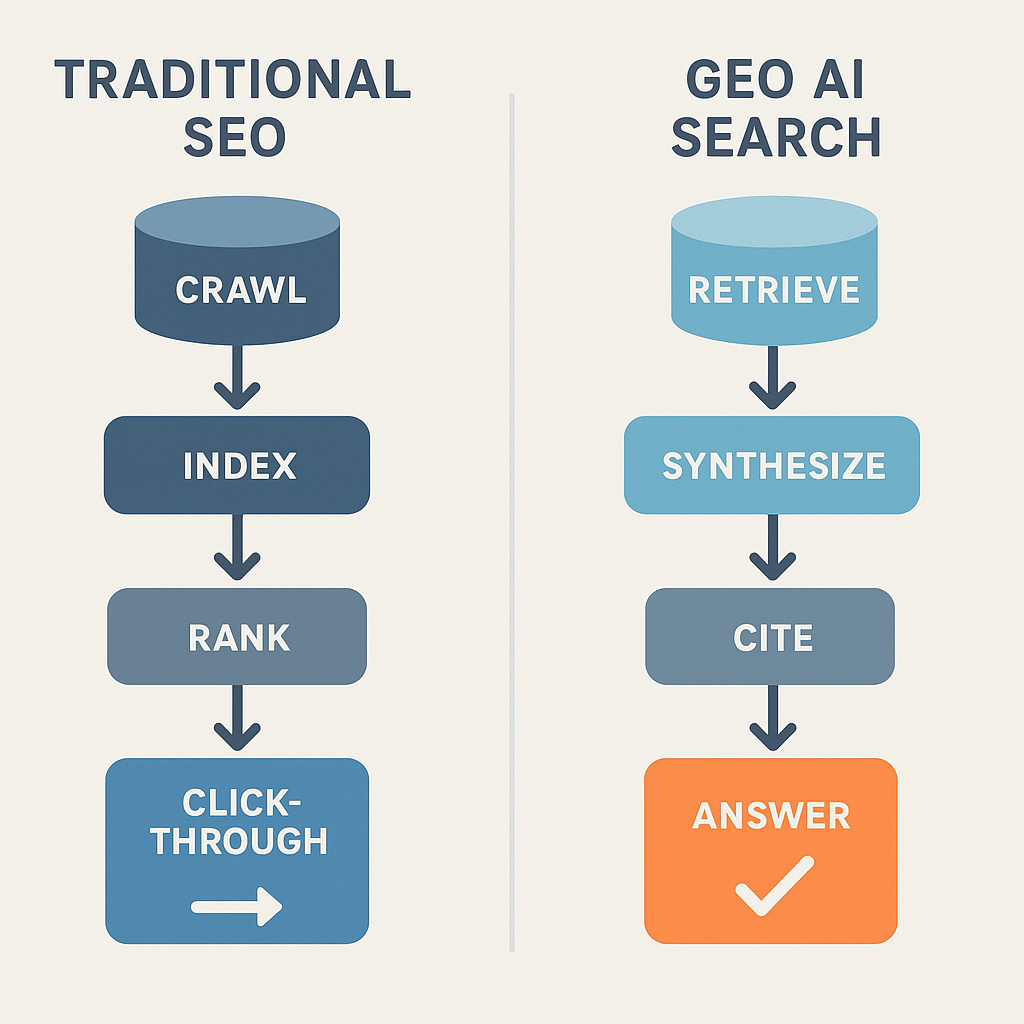
SEO and GEO share some surface-level techniques — both reward high-quality content, authoritative backlinks, and clear site architecture. But the underlying optimization targets are different enough that treating GEO as a subset of SEO will leave you underperforming in AI-driven channels. SEO is fundamentally about satisfying a ranking algorithm that scores pages on hundreds of technical and content signals, then presents the highest-scoring pages as options for the user to choose from. GEO is about satisfying a synthesis engine that evaluates whether your content can be trusted to represent a factual answer — and then uses your content as the basis of that answer without necessarily sending traffic your way. That's the part most teams miss: AI citations often don't produce a click. They produce brand recognition, implied authority, and downstream intent. A buyer who hears your product name cited as a solution by ChatGPT three times during their research phase arrives at your site with a very different disposition than one who found you through a cold organic ranking. Understanding this distinction conceptually is the prerequisite for building an effective GEO strategy.
The ranking target shifts. In traditional SEO, you're optimizing for position 1-10 on a results page. In GEO AI search, you're optimizing for selection as a cited source in a synthesized answer. There is no 'position 3' in an LLM response — you're either cited or you're not. That binary nature means topical authority and content depth matter more than keyword density.
Traffic mechanics differ. Google's AI Overviews and traditional blue-link results both drive clicks, even if AI Overviews reduce click-through rates on some queries. Pure AI engines like ChatGPT and Perplexity often satisfy the user's query without a click at all. GEO optimization therefore generates brand impressions and citation authority as primary value — not just traffic. Teams that only measure GEO success by referral clicks are systematically undercounting its impact.
Content formats diverge. SEO-optimized content often uses long-tail keyword repetition, anchor text diversity, and metadata signals. GEO-optimized content prioritizes direct declarative statements, FAQ-style Q&A blocks, structured schema, and high information density per paragraph. These aren't mutually exclusive — but they require deliberate design to achieve both simultaneously.
Measurement requires new tools. Traditional rank trackers show you where you appear in Google SERPs. They cannot tell you whether your brand is being cited by Claude when someone asks about your category. GEO performance measurement requires tools that actively query LLMs with relevant prompts and track whether your brand, product, or content appears in the output. These are structurally different products from rank trackers, and as of 2026, only a small set of platforms have built this capability properly.
The Market Signals Behind GEO's Rise
The commercial signal behind GEO AI search isn't subtle. According to Precedence Research, the global AI search engine market was evaluated at USD 16.30 billion in 2025 and is predicted to reach USD 182.17 billion by 2035, growing at a CAGR of 27.30%. That's not a niche — it's a structural shift in how information is retrieved commercially. On the optimization side, the GEO market itself reflects similar momentum: according to Dimension Market Research via Superlines, the GEO market is valued at $848 million in 2025 and projected to reach $33.7 billion by 2034 at a 50.5% CAGR. The driver behind these numbers isn't speculative — it's user behavior. ChatGPT reached 1 billion monthly active users in early 2026, up from 400 million in early 2025 (OpenAI via Cintra). More importantly for B2B teams, LLM referral traffic grew 527% year-over-year between January–May 2024 and the same period in 2025. That's not a rounding error in your analytics. That's a channel that didn't exist at meaningful scale two years ago and now demands a dedicated optimization strategy.
The 527% YoY growth in LLM referral traffic means that for many B2B SaaS companies, AI search is already their fastest-growing inbound channel — they just aren't tracking it yet.
AI Overviews vs. Pure AI Search: Two Distinct Channels
One of the most common points of confusion in GEO AI search discussions is conflating two distinct channels: Google's AI Overviews and standalone AI search engines like ChatGPT, Perplexity, Claude, and Gemini. They share surface-level similarity — both generate synthesized answers — but they operate under different retrieval logic, serve different user intents, and require somewhat different optimization approaches. Google's AI Overviews appear directly in Google Search results, sitting above the traditional blue-link results. As of 2026, AI Overviews appear in 25.11% of Google searches, up from 13.14% in March 2025, based on Conductor's analysis of 21.9 million queries. Optimizing for AI Overviews means staying grounded in Google's existing quality signals — E-E-A-T, structured data, Core Web Vitals — while also writing content that is synthesizable. Google's own documentation at developers.google.com outlines that foundational SEO best practices remain the baseline for AI Overview inclusion. Pure AI search engines — Perplexity, ChatGPT with search, and the AI modes of Gemini — operate outside Google's index and use their own retrieval and ranking logic. These platforms reward content that is widely cited on the web, clearly structured for machine reading, written with consistent topical authority, and updated regularly. For B2B SaaS companies, both channels matter: Google AI Overviews intercept buyers mid-funnel when they're still using traditional search; standalone AI engines are increasingly used for deeper research, vendor comparison, and even procurement evaluation.
- Google AI Overviews: appear in 25%+ of searches, retrieval logic rooted in Google's index and E-E-A-T signals
- ChatGPT (web mode): RAG-based retrieval favors well-cited, clearly structured, authoritative pages
- Perplexity: real-time web retrieval with explicit source citations, rewards information density and credibility signals
- Claude (web access): emphasis on factual accuracy, long-form synthesis, and source diversity
- Gemini: deep integration with Google's knowledge graph and Search index, rewards structured data and brand authority
- All channels: reward direct declarative statements, FAQ schema, and consistent topical depth across a content cluster
The Content Signals That Drive GEO Visibility
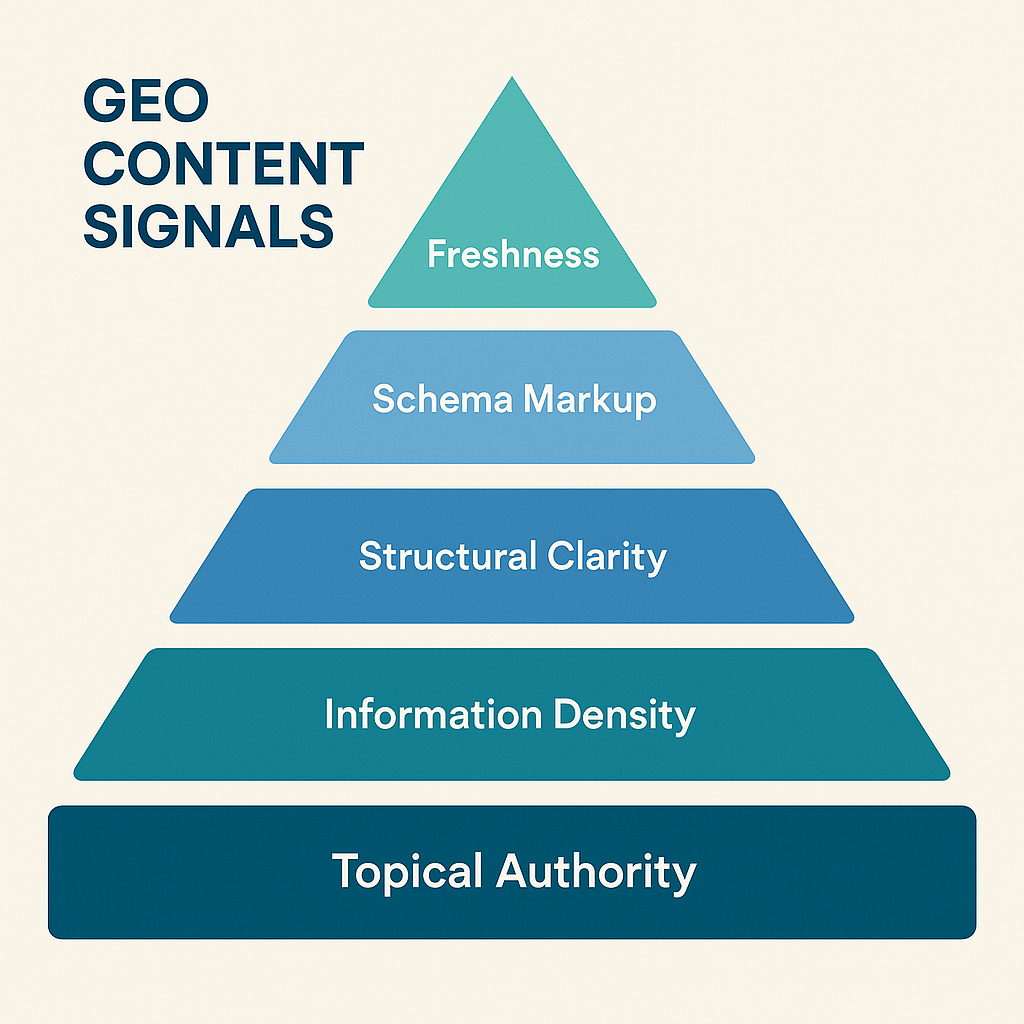
Understanding what GEO AI search rewards at the content level is where strategy becomes actionable. Generative engines are, fundamentally, prediction machines trained on vast corpora of human-written text. When they retrieve and synthesize answers, they favor content that exhibits the same characteristics as the most-cited, most-authoritative sources in their training data. That means there's a learnable pattern to what gets cited — and teams that systematically apply that pattern compound their GEO visibility over time. The most critical signals are: topical authority (a site that covers a subject comprehensively and consistently is more likely to be modeled as an expert source), information density (high-signal paragraphs with specific facts, figures, and named attributions are more citable than hedged or generic prose), structural clarity (headers, FAQ blocks, and well-delineated sections make it easier for retrieval layers to extract relevant passages), and freshness (LLM retrieval systems, particularly Perplexity and ChatGPT's browse mode, weight recently updated content more heavily for time-sensitive queries). None of these signals are secret. What separates teams that win GEO visibility from those that don't is the operational capacity to produce content at the volume and consistency required to establish topical authority across a category — not just publish a single optimized piece.
E-E-A-T, Schema, and Technical Structure in GEO Context
Google's E-E-A-T framework — Experience, Expertise, Authoritativeness, and Trustworthiness — was originally designed as a quality signal for human quality raters evaluating Search results. In the GEO AI search era, it has become a proxy for what generative engines reward as well, because the content that consistently scores well on E-E-A-T dimensions is precisely the content that LLMs are more likely to have encountered often in training and retrieval. Experience means demonstrating first-hand knowledge — specific examples, original case studies, concrete numbers. Expertise means writing from a position of clear subject-matter depth, not paraphrasing other sources. Authoritativeness means having backlinks and citations from other credible sources pointing to your content. Trustworthiness means clear attribution, accurate facts, and author credentials. On the technical side, schema markup — particularly FAQPage, Article, and HowTo schema — provides structured signals that both Google and AI retrieval layers can use to identify and extract specific answer types. A well-implemented FAQPage schema block doesn't just improve traditional rich result eligibility; it makes your Q&A content structurally parseable for LLM retrieval. According to Semrush's GEO guidance, structured content that directly answers specific questions is among the highest-ROI investments in GEO optimization — consistent with what we observe across Gofylo's customer base.
Why Autonomous Content Production Changes the GEO Equation
GEO AI search rewards volume, consistency, and topical depth — qualities that are structurally difficult to achieve with small manual content teams. Publishing one well-optimized article per week establishes a topical footprint. Publishing thirty per month — consistently, across a planned semantic cluster — establishes topical authority at a category level. That difference isn't incremental; it's the difference between being a source that an LLM occasionally cites and being the source it defaults to when a query touches your category. This is the mechanism behind autonomous content production as a GEO strategy, and it's what Gofylo's Content Engine was designed to operationalize. Rather than replacing human strategy, the system executes on a research-approved content plan autonomously: keyword research agents identify high-intent, low-competition topics; writing agents produce E-E-A-T-compliant, schema-structured articles in under 4 minutes per piece; publishing agents push directly to connected CMS platforms including WordPress, Webflow, Shopify, and Ghost; internal linking agents create the semantic cluster structure that both Google and LLM retrievers use to assess topical authority. With a standard plan shipping 30 articles per month, the compounding effect on GEO visibility is measurable within a single quarter for most B2B SaaS use cases. That's not a marketing claim — it's the structural output of running an optimization system at sufficient volume and consistency to move the topical authority dial. For comparison, tools like Clearscope or Surfer SEO help human writers optimize individual articles; they don't close the production gap that makes autonomous GEO competitive.
Topical authority is not built by one great article. It's built by consistently covering every angle of a topic cluster over time — exactly the kind of compounding output that autonomous content agents make possible for teams without a dedicated content department.
Measuring GEO Performance: What Good Looks Like
Measuring GEO AI search performance requires a different instrumentation layer than traditional SEO analytics. Google Search Console can tell you how often your pages appear in AI Overviews — Google added AI Overview impression data to Search Console in its 2026 reporting updates. But Search Console tells you nothing about whether your brand is being cited inside ChatGPT, Claude, or Perplexity responses. For that, you need a system that actively queries those engines with prompts relevant to your category and records whether your brand, product, or content appears in the output. This is what an AI Visibility Score measures — a benchmark that reflects your brand's citation share across LLM search engines on a defined set of queries. Gofylo's AI visibility score gives teams a single benchmark number based on asking ChatGPT and Claude about their brand. Beyond the score itself, the metrics that matter in GEO are: citation frequency (how often your brand appears in AI-generated answers for category-relevant queries), citation context (whether you're cited as a recommended solution, a comparison point, or an example), query coverage (how many distinct query types trigger a citation), and share of voice versus competitors in AI answers. These metrics don't replace traditional SEO KPIs — they sit alongside them. A mature B2B SaaS content program in 2026 tracks both Google rank position and AI citation share, because buyers are using both channels in the same evaluation journey.
- Google Search Console AI Overview impressions: tracks AI Overview appearances for your pages within Google Search
- AI citation frequency: how often your brand name or content is referenced in LLM-generated answers
- Query coverage score: the breadth of category-relevant queries for which your content is cited
- Competitor citation share: your brand's citation rate relative to named competitors in AI answers
- AI Visibility Score: a score based on asking ChatGPT and Claude about your brand
- LLM referral traffic: direct sessions arriving from AI search engines, tracked in GA4 via source/medium attribution
Frequently Asked Questions
What is GEO in AI search?
GEO stands for Generative Engine Optimization — the practice of structuring and distributing content so that AI-powered search engines and large language models cite it when generating answers. Unlike traditional SEO, which targets ranking algorithms that return a list of pages, GEO targets synthesis engines that construct a single answer from multiple sources. In AI search, being cited is the equivalent of ranking on page one.
How does GEO AI work?
GEO AI works by aligning your content with the retrieval and synthesis logic of large language models. When a user submits a query to an AI engine like Perplexity or ChatGPT, the system retrieves relevant web pages using a RAG (Retrieval-Augmented Generation) process, evaluates their credibility and relevance, extracts key passages, and synthesizes a response. GEO optimization improves the likelihood your content is retrieved and selected by building topical authority, using structured formats (FAQ schema, clear headers), writing with high information density, and maintaining content freshness.
Is there a free AI search?
Yes — several AI search engines offer free tiers. Perplexity's free plan allows a meaningful number of queries per day. Google's AI Overviews appear in standard Google Search at no cost. ChatGPT's free tier includes limited web-browsing capabilities. For B2B marketers, the more relevant question is whether there are free tools to measure your GEO AI search visibility — Gofylo offers a free AI Search Grader that gives your brand a visibility score from ChatGPT and Claude.
How much does Geoptie cost?
Geoptie is a GEO tools platform with a free tier for basic AI visibility and content checking functions. Paid plans vary; their public pricing page lists options for teams needing more advanced rank tracking and audit capabilities. For teams evaluating GEO platforms, it's worth comparing scope: Geoptie focuses on auditing and tracking, while platforms like Gofylo combine AI visibility tracking with autonomous content generation and publishing, all on a single $79/month plan.
Is SEO still relevant for generative AI search?
Yes — foundational SEO remains essential for GEO performance. Google's own guidance at developers.google.com is explicit that the same signals powering traditional search — E-E-A-T, structured data, Core Web Vitals, clear site architecture — also influence AI Overview inclusion. The difference is that SEO alone is no longer sufficient. GEO adds an additional optimization layer targeting standalone AI engines that operate outside Google's index entirely, where different retrieval logic applies. Treating them as complementary rather than competitive is the practical operating model for 2026.
What content signals improve GEO citation rates?
The highest-impact GEO content signals are topical authority (comprehensive coverage of a subject cluster), information density (specific facts with named attributions rather than generic claims), structural clarity (FAQ blocks, clear H2/H3 hierarchy, schema markup), content freshness (regular updates that retrieval systems can detect), and backlink authority (widely-cited pages are statistically more likely to appear in LLM training and retrieval corpora). FAQ schema in particular is one of the strongest citation-triggering formats because it directly mirrors the question-answer structure that LLMs are synthesizing.
If you want to see exactly where your brand stands in GEO AI search right now — across ChatGPT, Claude, Perplexity, and Gemini — Gofylo's free AI Search Grader gives you a scored baseline in minutes. No commitment. The full platform starts at $79/month and includes autonomous content generation, AI visibility tracking, and CMS publishing in a single plan. Start your 3-day free trial at gofylo.io.
Sources
- AI Search Statistics 2026: 60+ Data Points on Visibility, Citations, and Traffic | Superlines - superlines.io
- AI Search Engine Market Size to Hit USD 182.17 Billion by 2035 - precedenceresearch.com
- AI Search Statistics 2026: 60+ Data Points Every Marketer Needs | Cintra - cintra.run
- GEO Search Optimization: How to Rank in AI Search Engines 2025-2026 - smartbusinessrevolution.com