As of 2026, organic search has split into two distinct channels that reward fundamentally different things. Traditional SEO gets you ranked on Google's blue-link results page. Generative Engine Optimization — GEO — gets your brand cited inside the answers that ChatGPT, Claude, Perplexity, and Gemini synthesize for users who never click through to a results page at all. If your team is optimizing for one and ignoring the other, you're already ceding ground to competitors who figured out that the two disciplines are complementary, not competing.
The market signal is unambiguous. According to 2026 data from Incremys, the global GEO market was $886 million in 2024 and is projected to reach $7.3 billion by 2031 — a compound annual growth rate of 34%. Meanwhile, GoodFirms' 2026 survey found that 43% of marketers are actively implementing GEO strategies, up from near zero in 2025. The window to establish AI search presence before every competitor catches up is narrowing fast. This article breaks down what SEO and GEO each actually are, how their underlying mechanics differ, where they overlap, and how to think about running both in parallel.
Thesis: SEO and GEO are not substitutes — they serve different discovery channels, require different content signals, and compound differently. B2B SaaS teams that treat them as a unified but layered strategy will outperform those who pick one.
What SEO Actually Does — and What It Rewards
Search Engine Optimization is the discipline of making content discoverable and rankable on crawlable search engines — primarily Google, but also Bing. At its core, SEO is a signal game: Google's algorithm evaluates hundreds of factors to determine whether your page deserves to rank for a given query. Those signals broadly fall into three buckets — technical health (crawlability, page speed, structured data), on-page relevance (topical depth, keyword alignment, content structure), and off-page authority (the quality and quantity of sites that link to yours). When all three buckets are strong, Google surfaces your page to users searching for related terms. The outcome is a ranked position on a search results page that a user can click, which drives traffic to your domain. SEO has been the dominant inbound channel for B2B SaaS companies for over a decade precisely because it compounds: a well-optimized page continues to attract traffic without ongoing spend.
How Google's Ranking Logic Works
Google's ranking logic is built on three foundational pillars that Google itself documents publicly: relevance, quality, and usability. Relevance is measured by how well a page's content matches the semantic meaning of a query — not just exact keyword matches, but topical coverage and entity relationships. Quality is assessed through signals like E-E-A-T (Experience, Expertise, Authoritativeness, Trustworthiness), which rewards content that demonstrates real-world knowledge and earns citations from credible external sources. Usability covers Core Web Vitals — load speed, interactivity, and visual stability. Local intent adds another dimension: according to Search Engine Land's local SEO coverage, 46% of all Google searches have local intent, and 93% of those local intent searches trigger a Local Pack result, making geo-targeted signals a major ranking factor for location-sensitive queries. For B2B SaaS companies operating globally, understanding these layered signals is what separates a page that ranks on page one from one that sits invisibly on page four.
What GEO Actually Does — and What It Rewards
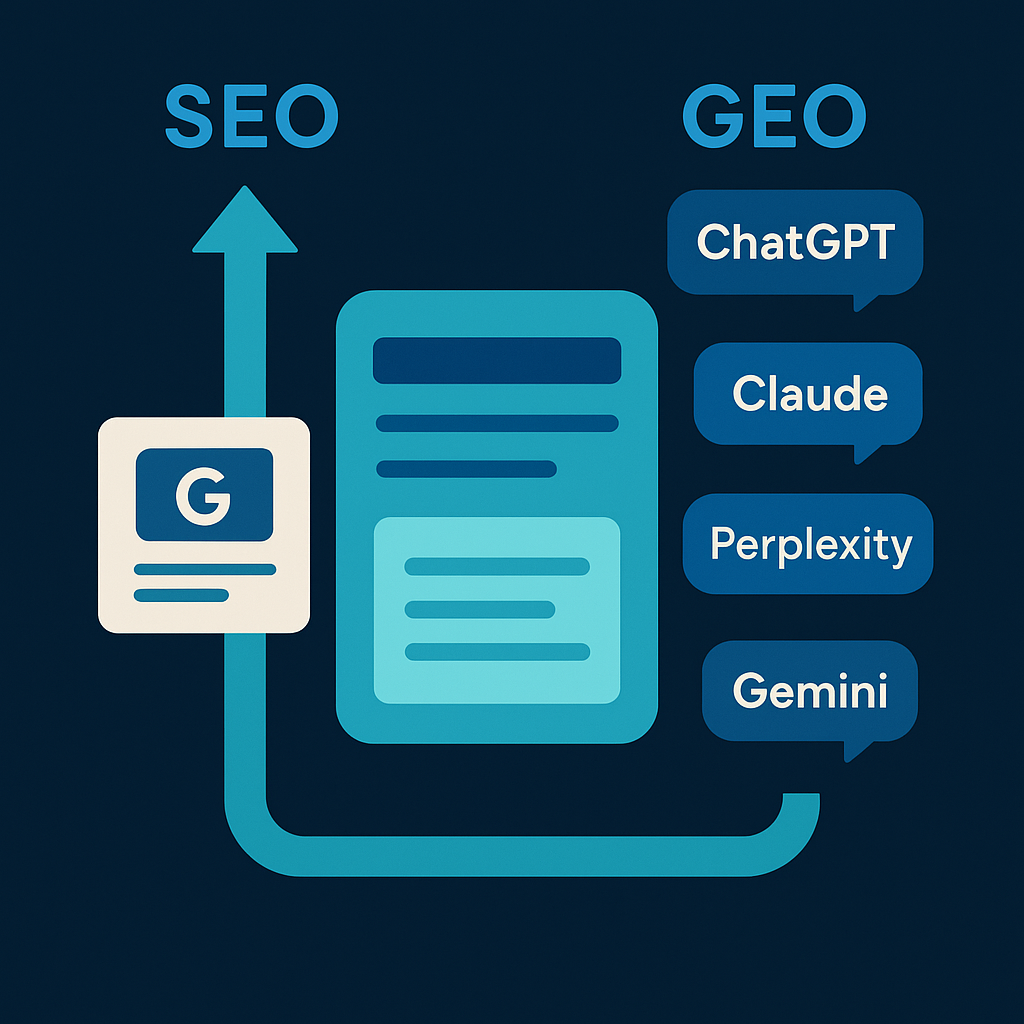
Generative Engine Optimization is the practice of structuring and signaling content so that large language models — ChatGPT, Claude, Perplexity, Gemini — cite your brand when synthesizing answers to user prompts. Where SEO produces a ranked link a user chooses to click, GEO produces an inline citation embedded inside an AI-generated answer that the user reads directly. The user experience is fundamentally different: instead of scanning a list of ten blue links, the user reads a synthesized paragraph and your brand either appears in that paragraph or it doesn't. GEO rewards content that is structurally clear, factually grounded, semantically dense, and written in a format that LLMs can confidently extract and reference. It's less about keyword density and more about being the most citable source on a topic — which means well-structured definitions, concrete data points, named frameworks, and authoritative prose that LLMs can quote without distortion.
How LLMs Decide What to Cite
Large language models don't crawl the web in real time the way Googlebot does — though retrieval-augmented models like Perplexity do pull live sources. For training-time citation signals, LLMs weight content that appeared frequently across high-authority domains, was structured clearly (short paragraphs, defined terms, FAQ blocks, schema markup), and demonstrated consistent factual accuracy across multiple sources. For retrieval-augmented models, the signals shift toward recency, domain authority, and structured data — essentially a hybrid of traditional SEO signals filtered through an LLM's preference for direct, extractable answers. This is why schema markup, FAQ sections, and answer-first paragraph structure matter so much for GEO: they make your content machine-parseable in the same way that alt text and structured data make content parseable for Google's crawlers. The GEO field is evolving fast — BrightLocal's Local Consumer Review Survey 2026 found that the use of generative AI for local recommendations climbed from 6% to 45% in a single year, confirming that AI-driven discovery is no longer a future consideration.
The Core Differences Between SEO and GEO
The most important structural difference between SEO and GEO is the output each optimizes for. SEO optimizes for a ranked position that a human user clicks. GEO optimizes for a cited mention inside a machine-generated answer that a human user reads. That distinction cascades into everything: the content format you write, the signals you build, the metrics you track, and the timeline over which results compound. SEO is a competition for position on a page; GEO is a competition for inclusion in an answer. Both are legitimate inbound channels, but they require distinct strategies and measurement frameworks. A team that treats them as identical — thinking that ranking on Google automatically produces AI citations — will underinvest in GEO signals until a competitor's brand is embedded in every AI-generated answer in their category.
Input Signals: Keywords vs. Prompts
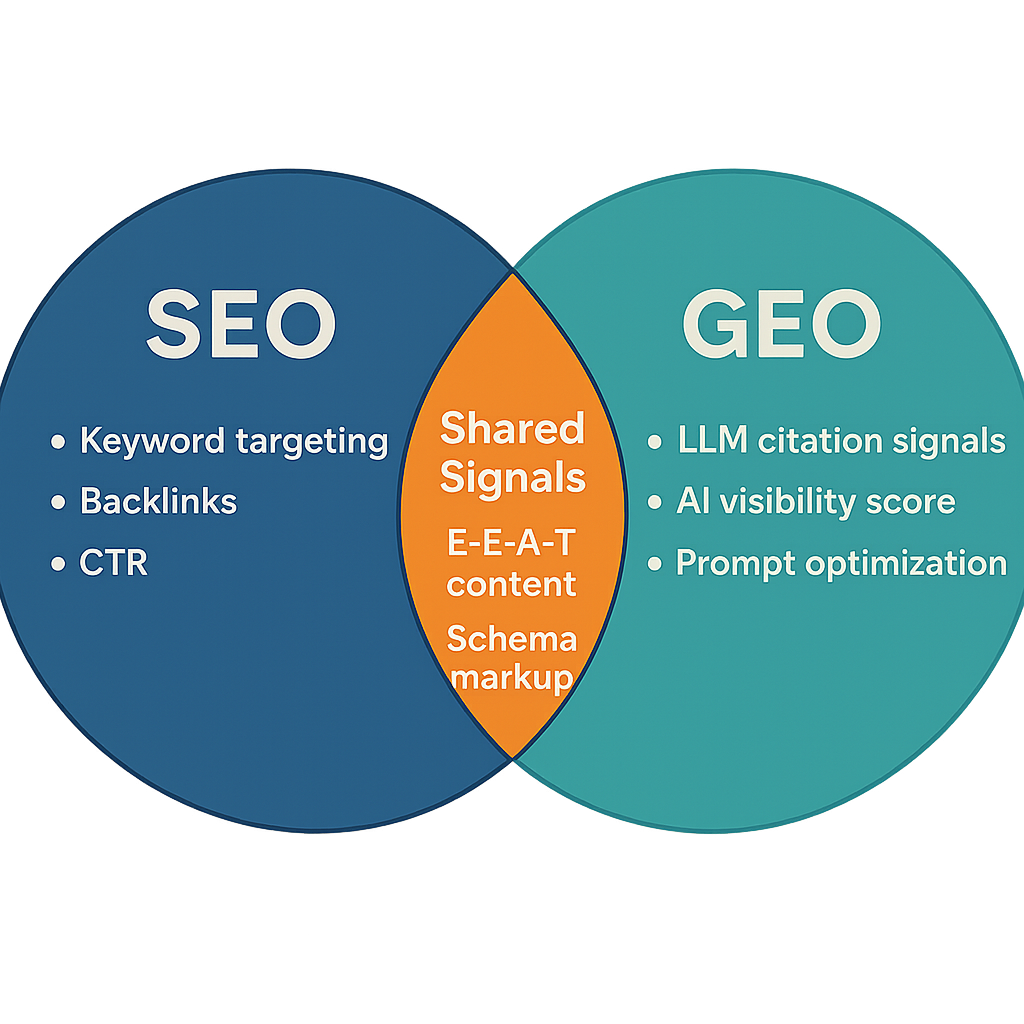
- SEO targets keywords — discrete search terms users type into a query box, with defined monthly search volumes and competitive difficulty scores.
- GEO targets prompts — conversational, intent-rich questions that users direct at AI engines, often several sentences long and highly specific.
- SEO rewards topical breadth and internal linking across a content cluster.
- GEO rewards topical depth and factual density within a single piece of content.
- SEO measures success through ranking position, organic traffic, and click-through rate.
- GEO measures success through brand citation frequency, AI visibility score, and share of voice across LLM engines.
- SEO builds authority through backlinks from external domains; GEO builds citability through structural clarity and named data points.
Measurement: Rankings vs. Citations
SEO measurement is mature: rank trackers, organic traffic graphs, and CTR data from Google Search Console give teams a clear feedback loop. GEO measurement is newer and requires purpose-built tooling. Platforms like Gofylo's AI Visibility Tracker monitor brand citation presence across ChatGPT, Claude, Perplexity, and Gemini and produce an AI Visibility Score — a single benchmark for share of voice across AI engines. Without a tracking layer like this, teams are flying blind on GEO performance. According to Semrush's GEO research, the shift from keyword rankings to citation tracking is one of the biggest measurement paradigm changes digital marketing has seen since the transition from pageviews to session-based analytics.
Where SEO and GEO Overlap — and Why That Matters
The disciplines are different, but they share a foundational content layer. High-quality, well-structured, authoritative content performs well on both channels — it earns Google rankings through E-E-A-T signals and earns LLM citations through factual density and structural clarity. This is why investing in content quality is never wasted: a piece that ranks on page one of Google and also gets cited in Perplexity answers delivers compounding returns across two separate discovery surfaces. The overlap also extends to technical signals: schema markup, structured data, and clear heading hierarchies help both Googlebot and LLMs parse and categorize content. Internal linking — a core SEO tactic for distributing page authority — also helps LLMs understand topical relationships across a domain when they index content through retrieval-augmented pipelines.
The content that earns Google rankings and the content that earns LLM citations are more similar than most teams assume. The difference is in the structural signals layered on top — schema, FAQ blocks, answer-first paragraph structure — that make content machine-readable for AI engines specifically.
Content Optimization: What Works for Both Channels
Content that performs well across both SEO and GEO tends to share a set of structural characteristics that serve both Google's crawlers and LLMs' extraction logic simultaneously. Understanding these overlapping signals is the most efficient way to get compounding returns from a single piece of content rather than maintaining separate content tracks for each channel.
Answer-first structure. Both Google's featured snippets and LLM answer synthesis reward content that delivers the direct answer to a question in the first paragraph after a heading — not buried in the fourth paragraph after a preamble. Writing the answer in the first 150 words of each section improves both featured snippet eligibility and LLM citation probability.
Schema markup and structured data. FAQPage, HowTo, and Article schema help both Google surface your content in rich results and help retrieval-augmented LLMs identify the authoritative structure of your content. FAQ blocks are particularly high-value because they match the question-answer format that both humans and AI engines use when synthesizing information.
Named data points and citations. LLMs strongly prefer content that includes specific, attributable statistics over content that makes vague qualitative claims. Including grounded figures with named sources — not round numbers pulled from memory — increases the probability that an LLM will cite your page rather than a competitor's when answering a data-related prompt.
Topical depth over breadth. A 1,400-word article that covers one sub-topic exhaustively will out-cite a 600-word article that skims five sub-topics. For GEO, depth signals competence; for SEO, depth signals topical authority. Both reward the same behavior: go deep on the topic rather than wide.
How AEO Fits Into the SEO and GEO Picture
Answer Engine Optimization (AEO) is a closely related discipline that focuses specifically on earning featured snippets, People Also Ask placements, and voice search results — structured answer surfaces within traditional search engines rather than within standalone AI engines. AEO sits conceptually between SEO and GEO: it still operates within Google's ecosystem (unlike pure GEO, which targets external LLMs), but it targets zero-click answer surfaces rather than ranked link positions. When teams ask about SEO and GEO and AEO together, the most useful framing is a stack: SEO builds the foundational domain authority and indexed content library; AEO captures Google's structured answer surfaces; GEO earns citations inside AI-native engines like ChatGPT and Perplexity. The three disciplines share a content foundation but require distinct formatting signals and measurement approaches. A team running all three in parallel achieves the broadest possible organic discovery coverage — across traditional SERPs, Google answer boxes, and AI-generated responses.
AEO, GEO, and SEO are not competing strategies. They're layers of the same organic growth system — each targeting a different surface where users discover content without paying for placement.
The Case for Running Both Simultaneously
The argument for treating SEO and GEO as a unified strategy rather than sequential phases comes down to compounding. SEO authority built today — through published content, earned backlinks, and technical optimization — becomes the foundation that makes GEO work better tomorrow. LLMs that index content through retrieval pipelines weight domain authority signals that are structurally identical to Google's ranking signals. A domain with strong SEO authority is, all else equal, more likely to be cited by retrieval-augmented LLMs than a domain with no indexed content history. This means every investment in SEO infrastructure accelerates GEO returns, and every GEO citation increases brand awareness that drives branded search volume — which in turn improves SEO performance. The compounding loop runs in both directions.
The operational challenge is execution speed. Running SEO and GEO in parallel requires a higher volume of structured, well-optimized content than most small B2B SaaS teams can produce manually. This is exactly the problem that autonomous content platforms like Gofylo solve: the Content Engine generates 30 fully optimized, E-E-A-T-compliant articles per month — with schema markup, FAQ blocks, internal linking, and AI-generated images — in under 4 minutes per article. The AI Visibility Tracker then monitors citation presence across ChatGPT, Claude, Perplexity, and Gemini, giving teams a live AI Visibility Score to benchmark GEO performance. Across active Gofylo accounts, that score averages 94 — a concrete benchmark for what well-executed simultaneous SEO and GEO looks like at scale. For teams comparing options in this space, tools like Surfer SEO and Clearscope address on-page SEO optimization but don't offer GEO citation tracking or autonomous publishing — which means they address one channel while leaving the other unmeasured.
FAQ
What is GEO in SEO?
GEO — Generative Engine Optimization — is the practice of structuring content so that AI engines like ChatGPT, Claude, Perplexity, and Gemini cite your brand in their generated answers. It's a distinct discipline from traditional SEO, which optimizes for Google rankings. GEO focuses on being included in AI-synthesized answers rather than ranked in a list of links.
Is GEO replacing SEO?
No — GEO is adding a second discovery channel alongside SEO, not replacing it. Google still processes billions of searches daily, and traditional ranking signals remain highly valuable. However, a growing share of research-intent queries are now handled by AI engines, which is why teams need both disciplines running in parallel rather than betting on one channel.
Which is better, SEO or GEO?
Neither is categorically better — they serve different user behaviors and discovery surfaces. SEO is better established, has mature measurement tooling, and compounds reliably for high-intent keyword queries. GEO is growing faster and captures AI-native discovery behavior that SEO cannot address. The most defensible organic strategy in 2026 runs both simultaneously.
What is AEO vs GEO vs SEO?
SEO earns ranked positions in traditional search engine results pages. AEO (Answer Engine Optimization) earns placement in Google's structured answer surfaces — featured snippets, People Also Ask boxes, and voice results — still within Google's ecosystem. GEO earns citations inside AI-generated answers from external LLM engines like ChatGPT, Claude, and Perplexity. Each targets a different surface and requires distinct content signals, though they share a foundational content quality layer.
What are good examples of SEO and GEO working together?
A B2B SaaS company that publishes a deeply structured article on a category topic — with schema markup, FAQ blocks, and grounded statistics — can simultaneously rank on page one of Google and get cited in Perplexity's answer when a user asks a related question. The same content investment produces returns on two separate channels. This is the core compounding mechanic that makes simultaneous SEO and GEO the most efficient organic growth strategy.
What tools cover both SEO and GEO tracking?
Most traditional SEO tools — including Ahrefs and Semrush — cover Google rankings but don't track AI engine citation presence. Purpose-built GEO platforms like Gofylo's AI Visibility Tracker monitor brand citations across ChatGPT, Claude, Perplexity, and Gemini and produce an AI Visibility Score benchmark. For teams that need both SEO content production and GEO citation tracking in one platform, Gofylo covers the full stack.
If your brand isn't tracked in AI search yet, start with Gofylo's free AI Search Grader — it grades your current AI visibility across major LLM engines and gives you a concrete score to benchmark against. From there, the Content Engine handles autonomous publishing for both SEO and GEO simultaneously. Try it free for 3 days at gofylo.com — no credit card required.