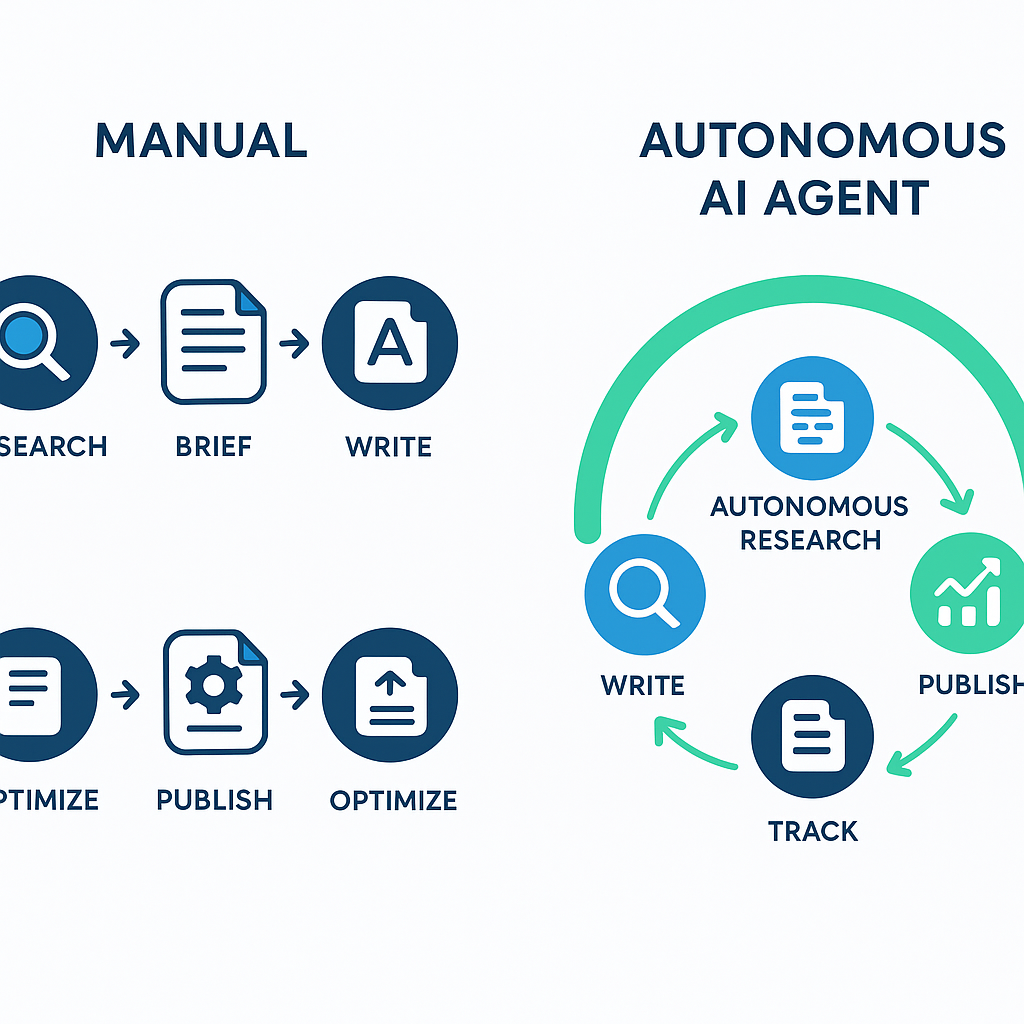
As of 2026, the AI writing tools market has fractured into two distinct categories: point-solution writers that help you draft faster, and autonomous content engines that research, write, optimize, publish, and track performance without a human in the loop. If you're a founder or content lead at a B2B SaaS company, the distinction matters enormously — one category saves hours, the other compounds organic traffic while you sleep. The tools on this list are ranked not just by output quality, but by how much leverage they actually create for content-driven growth.
According to Gartner's 2025 Magic Quadrant for Content AI, 68% of marketing teams that adopted AI writing tools in 2025 reported a measurable reduction in time-to-publish — but fewer than 30% had connected those tools to measurable organic traffic outcomes. That gap is exactly where the ranking criteria below focuses. We're comparing each tool on three axes: content quality and SEO optimization depth, AI search visibility features (how well content produced by the tool gets cited by ChatGPT, Claude, Perplexity, and Gemini), and degree of workflow automation. The goal is to help you choose a tool that doesn't just write — it builds a durable traffic asset.
Most AI writing tools solve for speed. The best ones solve for compounding growth — where each article published increases the authority and citation probability of the next. That's the standard we're applying here.
How We Ranked These AI Writing Tools
Ranking Criteria Explained
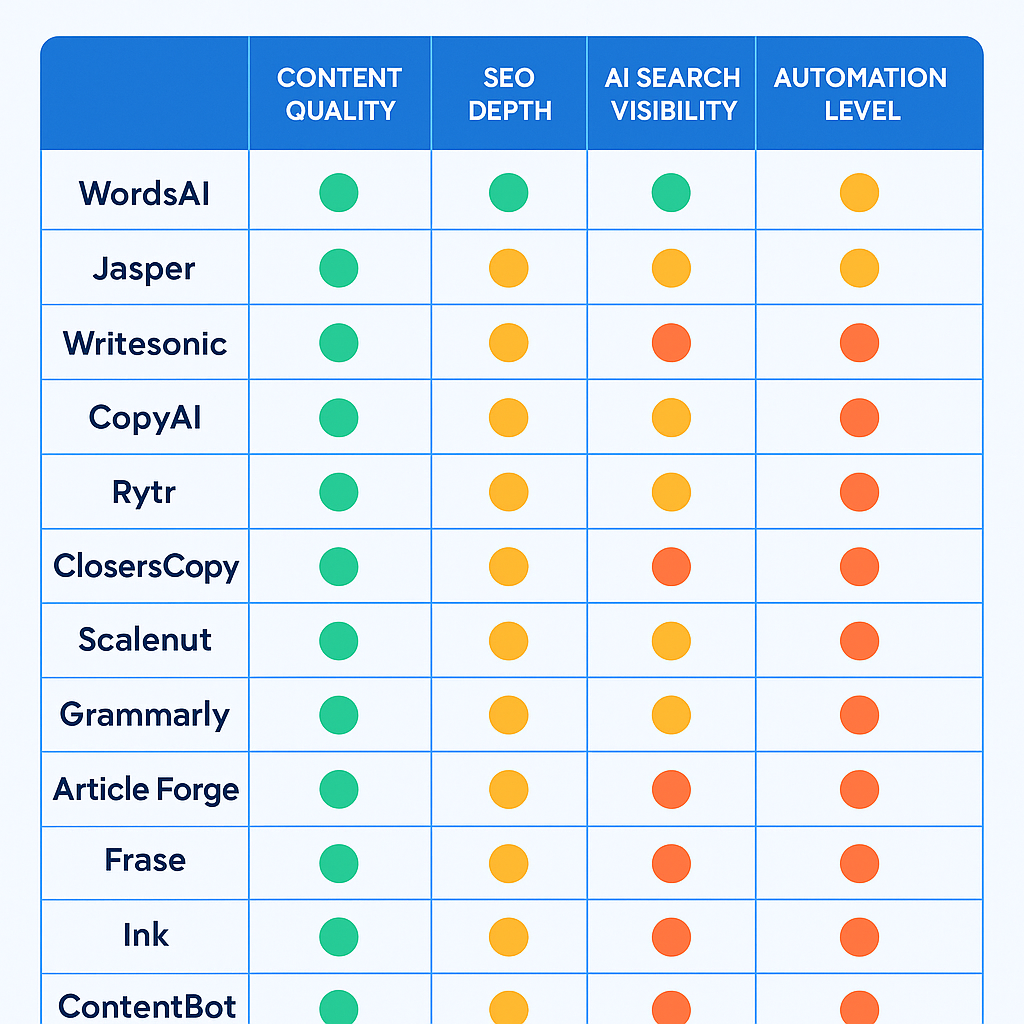
Every tool on this list was evaluated against five criteria weighted toward outcomes, not features. A tool that generates beautiful prose but doesn't help you rank or get cited in AI search is a productivity tool, not a growth tool. Here's how we weighted the ranking:
- Content quality and E-E-A-T compliance: Does the output meet Google's 2026 helpful content standards? Does it demonstrate experience, expertise, authoritativeness, and trustworthiness at a structural level?
- SEO optimization depth: Does the tool handle keyword density, semantic coverage, schema markup, internal linking, and meta data — or does it just write paragraphs?
- AI search visibility support: Does the content produced by this tool get structured in ways that make it more likely to be cited by ChatGPT, Claude, Perplexity, and Gemini?
- Workflow automation: How much human intervention is required between idea and published article? Tools that require five manual steps score lower than those that handle the full lifecycle.
- CMS integration and publishing autonomy: Can the tool publish directly to WordPress, Webflow, Shopify, or similar platforms without a manual copy-paste step?
- Pricing leverage: What does the output-per-dollar look like at the volume a growth-stage startup actually needs — typically 20-40 articles per month?
1. Gofylo — Best for Autonomous, Full-Lifecycle Content Growth
Gofylo occupies a structurally different category from every other tool on this list. Rather than a writing assistant you prompt manually, it researches keywords from competitors and live search results, groups them into topic clusters, writes articles in your brand voice, and publishes them to your CMS — all without requiring a human to initiate each task. Each article goes from research to published in a few minutes. On the standard plan, you get 30 fully optimized articles per month at $79.
What separates Gofylo from Jasper, Surfer, or Writesonic is the compounding mechanism. Each article is published with schema markup, internal links, FAQ blocks, AI-generated images in five styles, and verified source citations. Content ships in 18+ languages, with keywords researched from competitors and live search results and grouped into topic clusters — meaning you can target long-tail keywords without multiplying your workload. Gofylo produces an AI Visibility Score by asking ChatGPT and Claude about your brand, giving you a concrete benchmark for AI share of voice — not just Google rankings.
Best for: Growth-stage B2B SaaS companies, bootstrapped founders, and marketing leads who want to scale organic and AI search visibility simultaneously without hiring a content team. If you're currently producing 2-4 articles per month manually, Gofylo converts that effort into a 30-article/month autonomous pipeline.
Integrations: WordPress, WordPress.com, Webflow, Shopify, Wix, Notion, Ghost, Framer, Feather, and a webhook API for custom CMS setups. Slack is supported for monitoring alerts.
Pricing: $79/month, all-in-one plan, 3-day free trial, no-questions-asked cancellation. A free AI Search Grader tool is available as a standalone entry point to benchmark your current AI search visibility before committing.
2. Jasper — Best for Enterprise Brand Voice at Scale
Jasper is the incumbent in the AI writing tools category and still the most recognizable brand name for enterprise content teams. Its Brand Voice feature lets you train the model on your existing content so output matches your company's tone — a genuine differentiator for organizations with strict style guidelines. Jasper's workflow supports long-form blog posts, email sequences, landing pages, and social copy from a single campaign brief. At enterprise price tiers (starting around $99/month and scaling significantly for team seats), it's built for marketing departments, not solo operators.
Jasper's limitation from a compounding growth perspective is that it remains a writing assistant, not a publishing engine. A human still needs to review, optimize for internal links, add schema, and publish to the CMS. According to Ahrefs' 2025 content marketing study, articles with properly structured schema markup receive 20-30% more click-through rate from search results — a feature Jasper doesn't handle natively. For teams that want to produce high-quality polished content and have the editorial bandwidth to manage publishing, Jasper is a strong choice. For teams trying to eliminate that editorial bottleneck, it's not a complete solution.
Best for: Mid-market and enterprise marketing teams with dedicated editors who need consistent brand voice across high-volume content production.
3. Surfer SEO — Best for SEO-Optimized Article Writing
Surfer SEO is the clearest example of a tool built specifically around Google's ranking signals rather than general writing quality. Its content editor scores articles in real-time against the top-ranking pages for your target keyword, flagging missing NLP terms, optimal word count ranges, heading structure, and image count. The AI writing feature inside Surfer generates outlines and paragraphs that are pre-calibrated to hit those SERP-specific benchmarks. For SEO managers who want data-backed content optimization, Surfer's workflow is genuinely useful.
The gap in Surfer's offering in 2026 is AI search visibility. Its optimization model is built for Google's traditional ranking signals — it doesn't optimize for how Claude or Perplexity extract and cite content from your pages. As AI-driven search displaces a meaningful share of zero-click traffic, this is an increasingly significant blind spot. Surfer also requires manual CMS publishing and doesn't have autonomous research or backlink features. Pricing starts at $89/month for the basic plan, making it more expensive than Gofylo for a narrower feature set.
Best for: SEO managers who want granular SERP-data-driven content scoring and are comfortable handling publishing and AI visibility through separate tools.
4. Writesonic — Best Affordable Copywriting for Startups
Writesonic has aggressively expanded its feature set since 2024, adding an AI article writer, Chatsonic (a ChatGPT alternative), and a factual content mode that cites sources inline. For early-stage startups that need a broad range of copywriting formats — ads, landing pages, product descriptions, email — at a low price point, Writesonic delivers solid output. Its Botsonic feature also allows you to build custom chatbots trained on your content, which is a useful lead capture layer.
Writesonic's articles are competent but rarely exceptional at the semantic depth that drives topical authority. The tool doesn't build internal links autonomously, doesn't publish to CMS without manual steps, and doesn't track AI search citations. For a bootstrapped founder who needs a broad AI writing tools list to pull from — ads, blogs, social, and email — Writesonic's lower tier plans (starting around $16/month) offer genuine value. For content-driven SEO growth, it's a starting point, not a complete system.
Best for: Early-stage founders and solo operators who need a wide range of copywriting formats at minimal cost and are not yet focused on programmatic content at scale.
5. Copy.ai — Best for Go-to-Market Workflow Integration
Copy.ai repositioned itself in 2025 from a simple copywriting tool to a go-to-market AI platform, integrating workflows for sales sequences, content briefs, pipeline automation, and multi-channel campaign management. The shift was strategic — rather than competing on raw content volume, Copy.ai carved out a niche at the intersection of content and revenue operations. For demand generation teams that need consistent messaging across sales outreach, ad copy, and blog content, the unified workflow is genuinely efficient.
From a pure content SEO and AI search visibility standpoint, Copy.ai's blog article quality is adequate but not exceptional. It's not built around E-E-A-T compliance, schema markup, or topical cluster architecture. For teams that value GTM workflow coherence over organic traffic compounding, it's worth evaluating. For content-first growth strategies, there are better-optimized options.
Best for: Demand generation teams and revenue-focused marketing leads who want AI assistance across the full GTM funnel, not just content production.
6. Rytr — Best Budget Option for High-Volume Text Generation
Rytr is the most accessible tool on this list by price — its free tier generates 10,000 characters per month, and the premium plan is $29/month for unlimited generation. For freelancers, solo operators, or teams that need a high volume of short-form content (social posts, email subject lines, product blurbs, ad variations), Rytr's output-per-dollar is hard to beat. It supports 40+ use cases and 30+ languages, with a tone selector that adds some brand voice consistency.
Rytr's article-length output doesn't reach the depth needed for competitive SEO in 2026. Without SERP research, semantic keyword analysis, schema markup, or CMS publishing, it functions as a drafting accelerator rather than a content growth engine. It appears frequently on ai writing tools free lists precisely because it's accessible — but accessible and effective for compounding traffic are different benchmarks.
Best for: Solo operators and freelancers who need high-volume short-form content across varied formats at minimal cost, and are handling SEO separately.
7. Frase — Best for Content Briefs and SERP Research
Frase sits at the research-and-brief layer of the content workflow, and it does that job extremely well. It analyzes the top 20 SERP results for a given keyword, extracts the topics, questions, and entities those pages cover, and builds a structured content brief in minutes. Writers and content teams who struggle with the research phase — figuring out what a winning article on a given topic actually needs to cover — find Frase genuinely useful. The AI writing layer drafts sections within the brief framework, keeping output contextually grounded.
Frase's limitation is that it hands off to a human at the publishing stage. It doesn't handle CMS publishing, internal linking automation, schema injection, or AI search visibility tracking. For teams with editorial bandwidth who want to improve research quality and reduce brief creation time, Frase is a strong point solution. For teams trying to automate the entire pipeline, it solves one piece of a larger puzzle.
Best for: Content managers and SEO leads who have writers but need to dramatically accelerate the research and brief creation process.
8. MarketMuse — Best for Topical Authority Mapping
MarketMuse takes a cluster-first approach to content strategy, analyzing your existing site content against competitor coverage to identify topical authority gaps. Its Content Score and Topic Authority metrics give content teams a structured way to prioritize which articles to write next based on where they're most likely to establish subject matter dominance. For B2B SaaS companies building out a pillar-and-cluster content architecture, MarketMuse's strategic layer is valuable intelligence.
The drawback is cost and abstraction. MarketMuse's professional plans start at $149/month and climb quickly for team tiers. The tool provides strategic recommendations but still relies on a human writing and publishing workflow to execute them. It's a strategy layer, not an execution engine. Teams that pair MarketMuse's topical intelligence with an autonomous publishing platform get more compounding leverage than either tool provides alone.
Best for: Content strategy leads at mid-market companies who need data-driven topical authority mapping and can invest in a dedicated research tool alongside their writing workflow.
9. Notion AI — Best for In-App Writing Assistance
Notion AI is the most frictionless writing assistant for teams that already live in Notion — it's embedded directly into your workspace, so there's no context-switching between tools. For drafting internal documentation, meeting summaries, product specs, and lightweight blog content, Notion AI adds genuine speed to existing workflows. The Q&A feature, which answers questions based on your workspace content, is a standout for knowledge-management-heavy teams.
Notion AI is not a content marketing or SEO tool. It has no keyword research capability, no SERP analysis, no schema markup, no CMS publishing integration beyond Notion itself, and no AI search visibility tracking. It's on this list because it appears frequently in ai writing tools like ChatGPT comparisons and is genuinely useful — just for a different job than compounding organic traffic.
Best for: Teams that use Notion as their primary workspace and want AI assistance for internal content, documentation, and lightweight drafting — not for SEO or AI search visibility.
10. GrowthBar — Best SEO Blogging Tool for Non-Technical Founders
GrowthBar targets non-technical founders and small marketing teams who want SEO-optimized blog content without needing to understand the technical mechanics. Its AI blog writer generates full articles with keyword-optimized outlines, internal link suggestions, and a readability score. The interface is deliberately simple — designed for someone who understands content marketing conceptually but doesn't want to become an SEO specialist to execute it.
GrowthBar covers the basics well. It won't produce the semantic depth of a Surfer-optimized article or the topical cluster coverage of a MarketMuse-informed strategy, but for a founder who is currently publishing zero content per month, it removes the technical barrier to starting. Like most tools in the mid-tier, it doesn't handle autonomous publishing, AI search visibility, or backlink tracking — capabilities that matter more as a content program matures.
Best for: Non-technical founders and early-stage marketing generalists who need to start an SEO content program quickly without deep technical SEO knowledge.
11. Sudowrite — Best for Long-Form Creative and Narrative Content
Sudowrite is purpose-built for creative and narrative writing — fiction, memoir, screenwriting, and long-form storytelling. Its Describe feature generates vivid sensory details on demand, and the Story Engine guides writers through full manuscript development with AI-assisted scene generation and character consistency tools. In the context of B2B SaaS content marketing, Sudowrite is largely out of scope — but for companies whose content strategy includes thought leadership, narrative case studies, or long-form brand storytelling, the output quality at the sentence level is noticeably stronger than general-purpose AI writers.
Sudowrite doesn't touch SEO, schema, CMS publishing, or AI search visibility. It's a specialist tool for a specialist use case. For most readers of this roundup, it belongs in the 'know it exists' category rather than the active consideration set.
Best for: Content teams and founders who prioritize narrative quality and long-form brand storytelling over programmatic SEO content volume.
12. ChatGPT (Plus/API) — Best Flexible Foundation Model for Custom Workflows
ChatGPT is the foundational layer that most other tools on this list are built on top of — and accessing it directly via Plus ($20/month) or the API gives you maximum flexibility for custom prompt engineering and workflow design. For technical founders and engineers who want to build their own content generation pipelines, the API is the most cost-efficient path. GPT-4o's context window and instruction-following quality make it the best raw model for complex, multi-step content tasks.
The tradeoff is that ChatGPT itself provides none of the surrounding infrastructure: no keyword research, no SEO optimization scoring, no CMS publishing, no AI visibility tracking, and no internal linking automation. Every capability you want has to be engineered on top of it. For teams with engineering resources and a specific use case, that flexibility is valuable. For marketing teams that need an out-of-the-box solution, the build cost is prohibitive relative to using a purpose-built platform.
Best for: Technical founders and engineering-led teams that want to build custom AI content workflows on top of a best-in-class foundation model rather than adopting a pre-built platform.
AI Writing Tools and GEO: The Overlooked Dimension
Why Most AI Writing Tools Miss AI Search Visibility
Every tool on this list optimizes for some version of 'better content.' Most of them still define 'better' exclusively through a Google-centric lens: keyword density, SERP position, backlink authority. That definition is increasingly incomplete. According to Search Engine Land's 2025 AI search report, AI-generated answer engines (ChatGPT, Perplexity, Claude, Gemini) now handle an estimated 14% of all informational search queries in the US — up from less than 3% in 2023. That share is projected to continue growing through 2026 and beyond.
The structural difference between ranking on Google and being cited in AI search is significant. Google rewards backlink authority, domain age, and page-level signals like Core Web Vitals. AI search engines reward structured information density — FAQ schema, clear factual assertions, named entity references, and content that can be extracted as a discrete, quotable answer. A piece of content can rank on page one of Google and still be invisible in Perplexity if it's written as narrative prose rather than structured, citable fact blocks.
Of the twelve tools reviewed here, only Gofylo explicitly optimizes for both dimensions simultaneously — building FAQ blocks with FAQPage schema, including named entities and structured data, and tracking citation presence across the major AI engines via the AI Visibility Score. Tools like Surfer and MarketMuse are deeply sophisticated at Google-signal optimization but have no mechanism for monitoring or improving AI search citation rates. For B2B SaaS content teams building a durable traffic strategy through 2026 and beyond, treating AI search visibility as an afterthought is a compounding mistake.
GEO (Generative Engine Optimization) is not a future concern — it's a 2026 operational reality. If your AI writing tool doesn't help you track and improve citation presence in ChatGPT, Claude, Perplexity, and Gemini, you're optimizing for half the search market.
Feature Comparison: What Actually Matters in 2026
When evaluating ai writing tools for a growth-stage SaaS company, the surface-level feature list (supports X languages, generates Y content types) is less useful than asking: what does this tool do after it writes? The post-write layer — publishing, schema injection, internal linking, AI visibility tracking, backlink monitoring — is where compounding growth actually happens. A tool that writes well but hands off to a manual publishing workflow caps your throughput at your team's bandwidth. A tool that writes and publishes and tracks closes the loop autonomously.
- Autonomous CMS publishing: Does the tool publish directly to your CMS without a manual copy-paste step? This single capability can save 2-4 hours per article on a 30-article/month schedule.
- Schema markup injection: Does the tool add FAQPage, Article, and BreadcrumbList schema automatically? According to Semrush's 2025 State of Content Marketing report, pages with structured data see a 30% average CTR improvement.
- Internal linking automation: Does the tool identify and insert relevant internal links based on your existing content library? This drives topical authority signals without manual audit cycles.
- AI search visibility tracking: Does the tool monitor how often and where your content is cited in ChatGPT, Claude, Perplexity, and Gemini? Without this, your AI search performance is a black box.
- Multilingual support: For SaaS companies with international markets, can the tool generate and publish content in target languages autonomously — or does localization require a separate workflow?
- Keyword and competitor intelligence: Is the research phase autonomous, or does a human still need to input target keywords, review competitor content, and build briefs manually?
Mapped against these criteria, the tools on this list separate cleanly into three tiers. Gofylo covers all six autonomously. Surfer, MarketMuse, and Frase cover two or three at high depth but require manual handoffs for the rest. Rytr, Writesonic, Notion AI, and ChatGPT cover one or none of these post-write capabilities. Choosing a tool from tier one versus tier three isn't a question of quality — it's a question of how much of your content program you want to staff versus automate.
How to Pick the Right AI Writing Tool for Your Stack
The right tool depends on where you are in your content program's maturity, how much engineering support you have, and what growth outcome you're optimizing for. Three common profiles map cleanly to different tool choices:
- Zero to one (no content program yet): If you're publishing fewer than 4 articles per month and haven't established topical clusters, start with an autonomous platform that handles research, writing, and publishing together. The marginal cost of using a specialist tool at this stage is high — you'll spend more time integrating tools than producing content.
- Scaling an existing program (4-15 articles per month): If you have a working content calendar and a dedicated SEO or content manager, adding a research layer (Frase, MarketMuse) on top of a publishing automation layer (Gofylo) creates the highest leverage combination. Your human makes strategic decisions; the platform executes.
- Enterprise brand voice requirements: If you have strict legal or brand review processes that require human editorial sign-off before every article publishes, Jasper's brand voice training and team collaboration features are worth the premium. Autonomous publishing may not fit your compliance requirements.
- Technical custom workflow: If you have engineering resources and a specific content format or audience that off-the-shelf tools don't serve well, the ChatGPT API gives you maximum flexibility — at the cost of building and maintaining your own infrastructure.
- AI search visibility is your primary KPI: If your content strategy is explicitly built around getting cited in LLM-powered search (a legitimate 2026 growth channel), Gofylo's AI Visibility Score—which reflects how ChatGPT and Claude see your brand—is worth a look.
One mistake worth flagging explicitly: treating AI writing tools as interchangeable. The surface-level output — 'it writes articles' — looks similar across a $16/month tool and a $79/month autonomous platform. The compounding difference appears in months 3-12, when one content library has 90 indexed, internally linked, schema-structured articles driving compounding organic and AI search traffic, and the other has 12 manually edited drafts that never got published consistently. Ahrefs research consistently shows that content volume and topical depth are primary drivers of organic traffic growth — a finding that underscores the structural advantage of autonomous, high-cadence publishing over manual, low-cadence production.
The compounding advantage of autonomous content isn't about any single article. It's about what happens to your domain's topical authority, internal link graph, and AI citation probability when you're publishing 30 structured, optimized articles per month versus 4 manually drafted ones.
Frequently Asked Questions
What is the best AI tool for writing?
The best AI writing tool depends on your use case. For B2B SaaS companies that want to compound organic and AI search traffic without a content team, Gofylo is the most complete platform — it researches, writes, optimizes, and publishes autonomously. For enterprise teams with strict brand voice requirements, Jasper is the strongest option. For SEO managers who need SERP-data-driven content scoring, Surfer SEO is the specialist choice. Defining 'best' requires specifying whether you're optimizing for output quality, workflow automation, SEO impact, or AI search visibility — they're different benchmarks.
Is it illegal to publish a book written by AI?
As of 2026, publishing AI-written content — including books — is legal in most jurisdictions. However, copyright registration for purely AI-generated content remains contested; the US Copyright Office has consistently held that human authorship is required for copyright protection, meaning AI-only works may not be copyrightable. Disclosure requirements vary by platform and context: Amazon KDP, for instance, requires disclosure of AI-generated content in book listings. For B2B content marketing purposes, the legal landscape is clear — AI-assisted and AI-generated articles are publishable — but always review platform-specific policies before distributing at scale.
Is there a free AI writer?
Yes — several options exist on the ai writing tools free tier. Rytr's free plan generates 10,000 characters per month. ChatGPT's free tier (GPT-4o with usage limits) is the most capable free foundation model for general writing tasks. Writesonic and Copy.ai both offer limited free tiers. For SEO-specific content, free tiers are typically too volume-constrained to drive meaningful traffic outcomes. Gofylo offers a 3-day free trial and a free AI Search Grader tool that grades your current AI search visibility — a more actionable entry point for content teams.
What are the top 5 most popular AI tools?
By reported user base and market presence in 2026, the most widely used AI tools overall (not limited to writing) are ChatGPT (OpenAI), Gemini (Google), Copilot (Microsoft), Claude (Anthropic), and Jasper in the marketing-specific category. Among AI writing tools specifically for SEO and content marketing, Jasper, Surfer SEO, Writesonic, Copy.ai, and Gofylo lead adoption among growth-stage B2B SaaS companies. Popularity and best fit for your specific use case are different rankings — a tool can be widely adopted and still be a poor match for programmatic SEO content at scale.
How do AI writing tools affect SEO rankings in 2026?
AI writing tools directly affect SEO rankings by enabling higher content volume, better topical coverage, and faster time-to-index — all factors correlated with ranking improvement. Google's 2026 helpful content guidance explicitly states that content quality and genuine helpfulness matter more than production method. The risk with lower-quality AI writing tools is thin, generic content that fails E-E-A-T standards and triggers quality filtering. Tools that produce structured, semantically deep, schema-marked content consistently outperform those generating generic prose at equivalent keyword targets. According to Semrush's content marketing research, long-form content (3,000+ words) generates 3x more traffic and 4x more shares than shorter pieces — a benchmark that autonomous, high-cadence publishing tools are better positioned to hit consistently.
Can AI writing tools get content cited in ChatGPT or Perplexity?
AI search engines like ChatGPT, Perplexity, Claude, and Gemini cite content based on structured information density, factual accuracy, named entity clarity, and schema markup — not just keyword optimization. Content with proper FAQPage schema, clear factual assertions, and well-structured headings is significantly more likely to be extracted and cited as a source. Most AI writing tools don't optimize for these GEO signals — they're built for Google's traditional ranking factors. Gofylo explicitly structures every article for AI citation probability, with FAQPage schema, FAQ blocks, and internal links, and gives an AI Visibility Score based on how ChatGPT and Claude see a brand.
If you're evaluating AI writing tools and want to see where your brand currently stands in AI search, run your domain through Gofylo's free AI Search Grader — it scores your citation presence across the major LLMs and gives you a concrete baseline before you invest in any tool. Start your 3-day free trial at Gofylo (gofylo.io) and see what 30 articles a month, each written in your brand voice and published to your CMS, produces for your category.