
"We've spent a long stretch on content and I still can't tell the board what it returned." If you run marketing at a B2B SaaS startup, you have probably said some version of that sentence. The spreadsheet shows writer invoices, tool subscriptions and hours lost to editing. The revenue column shows a handful of demo requests that might have come from a blog post, or might have come from a podcast mention weeks earlier. On paper, content looks like a cost center with good intentions.
That uncertainty has a real price. Budgets get cut right before a program starts to work. Founders shift spend back to paid ads because ads produce a number on Monday. Content managers spend their weeks defending the channel instead of improving it. And the articles that were about to compound get abandoned at the point where their cost was already paid and their return had barely begun.
I want to explain why content marketing ROI behaves the way it does: why the curve starts below zero, why it bends upward for some teams and stays flat for others, and how AI assistants like ChatGPT, Perplexity, Claude and Gemini add a return that most models ignore. This is an explanation of the economics. Once you understand the shape of the curve, the measurement question gets much easier.
Content marketing ROI is the return a business earns from content (articles, guides, comparison pages and other owned assets) relative to what it spent producing, publishing and maintaining that content. It matters most to teams that rely on organic search and AI assistants to bring in buyers, because the return arrives slowly, accumulates over time and is easy to misattribute.

Why Content ROI Feels Impossible to Pin Down
Content ROI is hard to pin down because content's costs are immediate and concentrated, while its returns are delayed, spread across many touchpoints and often invisible to the tools that report revenue. A paid campaign has a start date, a spend and a click trail. An article has a production cost in month one and a stream of visits, mentions and influenced deals that may run for years.
Three properties make content different from most marketing spend. The first is time asymmetry: you pay for the asset before it can earn anything. The second is diffusion: a single buyer may read four of your articles, see your brand named by an AI assistant and then type your URL directly, so no single page gets credit. The third is persistence: a well-built page keeps working long after the invoice is paid, which means any ROI figure depends heavily on the time window you choose.
When a founder asks "what did content return?", the honest answer depends on the window. Measured over a short window, most programs look like a loss. Measured over a longer horizon, the same program can look like the cheapest acquisition channel the company has. Neither number is wrong. They describe different points on the same curve.
The core misunderstanding Teams often judge content with the same frame they use for paid acquisition, where spend and return happen in the same period. Content behaves more like a capital investment. You build an asset, it depreciates if neglected, and its return accrues across many periods. Judging a capital investment on a single short period's cash flow guarantees a disappointing answer.
The Cost Side Most Teams Undercount
Most content ROI calculations understate cost, which makes early results look better than they are and later disappointments more confusing. If you only count the writer's invoice, you will misjudge both the denominator of your ROI and the economics of scaling.
The full cost of a content program includes several components:
- Research time spent finding topics, reading the pages that already answer the query and deciding on an angle.
- Writing, whether that is a freelancer fee, an in-house salary share or a tool subscription.
- Editing and subject-matter review, often done by a founder or engineer whose time is the most expensive in the company.
- Design and images, including custom graphics, screenshots and cover art.
- Publishing work: formatting in the CMS, adding schema markup, internal links, meta descriptions and alt text.
- Software for keyword research, rank tracking, analytics and AI visibility monitoring.
- Maintenance: refreshing outdated pages, fixing broken links and rewriting articles that slip in position.
- Management overhead: briefs, calendars, feedback loops and the meetings that coordinate them.
- Opportunity cost: what the founder or marketer would have done with the hours spent on content.
Founder time is the line item most teams leave out. When a technical founder spends a few hours reviewing each article for accuracy, that review is a real cost. In bootstrapped companies, it is often the largest one. A program that looks cheap because the writing is outsourced can be expensive once the review and publishing hours are counted.
Maintenance is the second blind spot. Pages decay. Product features change, competitors publish newer answers and search results shift. A program that publishes steadily but never refreshes accumulates a library of slowly declining assets, and the cost of reviving them arrives later as a surprise.
What Content Actually Returns
Content returns value through four channels: direct pipeline, assisted pipeline, displaced spend and AI assistant mentions. Most ROI models count only the first, which is the smallest and slowest to build for many B2B SaaS companies.
Direct pipeline
Direct pipeline is the revenue from buyers who land on an article, convert on that visit or soon after, and can be traced back to it. A visitor reads a comparison page, starts a trial from the call to action and later becomes a paying customer. This is the cleanest return to measure and the one most analytics setups capture, though only when the conversion happens within the attribution window.
Assisted pipeline
Assisted pipeline is revenue where content shaped the decision without getting last-touch credit. A buyer reads three of your articles over a month, then converts through a branded search or a sales email. In B2B SaaS, where buying committees research for weeks, assisted pipeline is often larger than direct pipeline. It is also the return that disappears first when a team relies on last-click reporting.
Displaced spend
Displaced spend is the money you no longer need to spend elsewhere because content covers that job. If an article ranks for a query you previously bought ads on, the ad budget you can retire is a return. If sales reps send a guide instead of writing the same explanation in every email, the hours saved count too. Support documentation that deflects tickets belongs here as well. Teams rarely book these savings as content return, but finance teams understand them immediately.
AI assistant mentions
AI assistant mentions are the newest return and the hardest to see. When a buyer asks ChatGPT or Perplexity which tools solve their problem, the assistant names a few businesses and sometimes cites the pages it drew from. Being named puts your brand on the shortlist before the buyer ever visits a search results page. Much of that influence produces no click at all, so it surfaces later as direct traffic, branded searches or a prospect who says "an AI recommended you" on a sales call.
If your ROI model counts only direct, last-touch conversions, it measures the smallest of the four return channels. A program can be profitable and still look like a loss in that model.
Why the Curve Starts Below Zero
The content ROI curve starts below zero because you pay the full production cost before the asset can earn. A new article has to be discovered, indexed, evaluated against existing pages and trusted before it brings consistent traffic. During that period, the cost is sunk and the return is close to nothing.
Several factors set how long the negative period lasts:
- Domain authority: a site with an established backlink profile and topical history gets new pages evaluated and ranked faster than a young domain.
- Topical depth: a page that sits inside a group of related, interlinked articles inherits relevance that an isolated page lacks.
- Query difficulty: a page targeting a contested head term faces a longer climb than one targeting a specific long-tail question.
- Publishing cadence: steady publishing gives search engines and AI crawlers a reason to return often.
- Page quality and structure: answer-first sections, clear headings and schema markup make a page easier to rank and easier for AI assistants to quote.
- Freshness of the competing pages: when the pages already answering a query are outdated, a new, accurate page can displace them sooner.
The negative period is where most content programs die. A team publishes for a few months, sees modest traffic, compares it to the spend and pulls the budget. The articles stay live and some of them start ranking months later, but nobody is watching anymore and nothing new gets published to build on them. The company paid for the hardest part of the curve and walked away before the easier part.
A useful reframe for budget conversations Present the first months of a content program as asset building, with leading indicators such as indexed pages, impressions, positions for target queries and AI assistant mentions. Present revenue return as a later-stage measure. This keeps the program from being judged on a metric it cannot yet move.
Compounding and Decay: The Two Forces Behind Long-Run Return
Long-run content ROI is the result of two opposing forces. Compounding pushes return up as each new page adds to the value of the existing ones. Decay pulls return down as pages age, lose position and fall out of date. Whether a program becomes profitable depends on which force wins.
Compounding works through several mechanisms. Each new article adds a page that can rank on its own. It also adds internal links that pass relevance to older pages. A growing library on one topic signals to search engines and AI assistants that the site is a credible source for that subject, which helps new pages rank faster than the early ones did. Readers who arrive on one article read another, so each visit is worth more as the library grows. The same dynamic explains why organic traffic grows unevenly, a pattern laid out in Organic Traffic Explained.
Decay works less visibly. Product screenshots go out of date. Statistics age. A competitor publishes a more thorough page on your best query and takes your position. An AI assistant that cited you starts citing a fresher source. Each of these removes a slice of return from an asset you already paid for.
The practical consequence is that the cheapest return in a content program often comes from pages you already own. A page sitting just off page one has already been indexed, evaluated and partially trusted. Rewriting it to close the gap costs a fraction of a new article and can move it into the positions that get clicks. Teams that refresh systematically keep decay in check, so compounding has room to work.
A Working Content Marketing ROI Formula
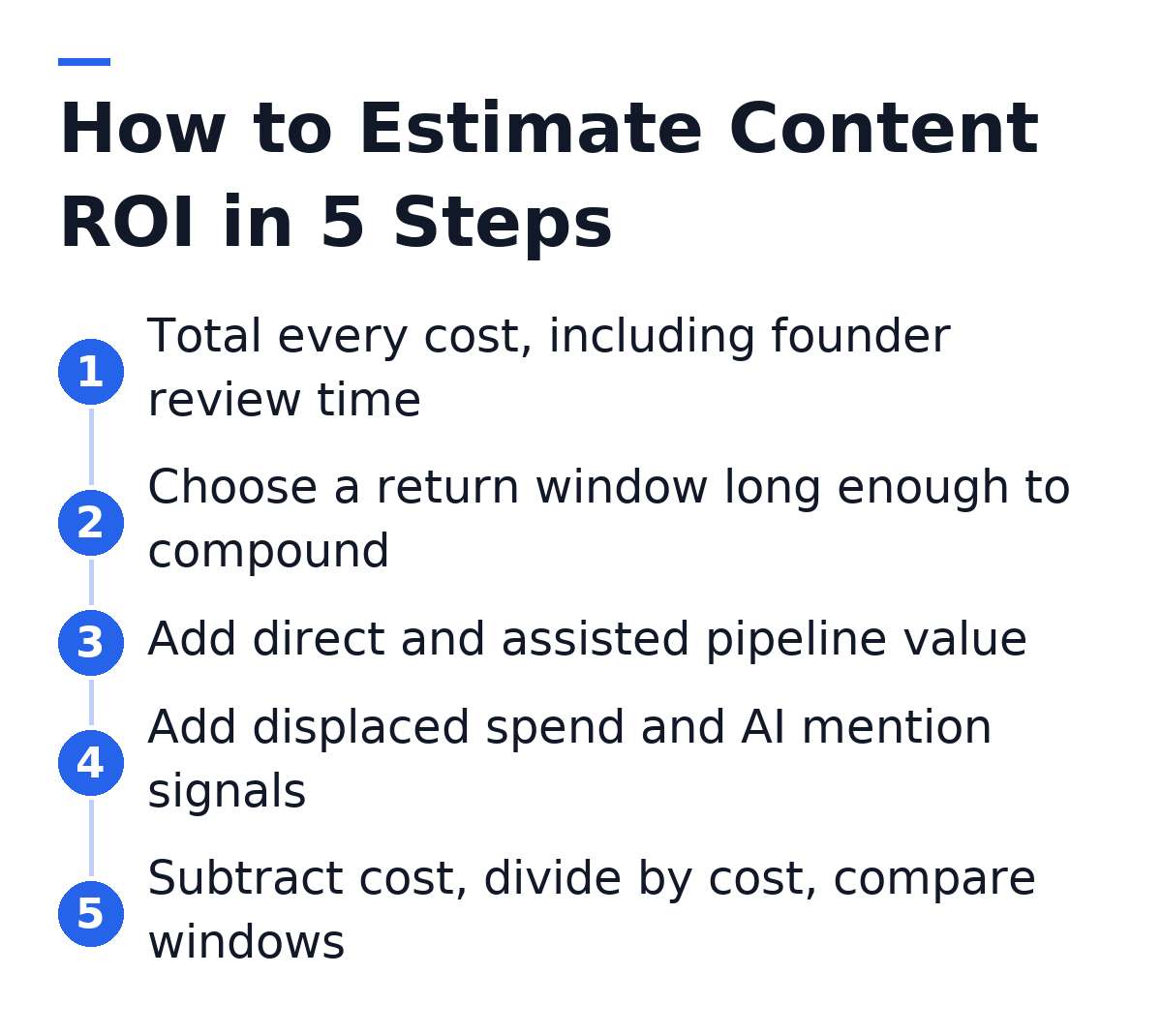
The standard content marketing ROI formula is return minus cost, divided by cost. The result is usually shown as a percentage. The formula is simple. The hard part is deciding what goes into each side and over which time window.
content_return = direct_pipeline_value + assisted_pipeline_value + displaced_spend
content_cost = production + review_time + publishing + software + maintenance
content_roi = (content_return - content_cost) / content_cost
roi_percent = content_roi * 100
The first line totals the return. Direct pipeline value is the revenue, or a weighted pipeline value, from conversions traced to content. Assisted pipeline value is the share of influenced revenue you choose to credit to content, based on your attribution model. Displaced spend is the ad budget, sales time or support cost that content made unnecessary.
The second line totals the cost, including every component from the cost section above. Review time should be priced at the hourly cost of whoever does it. Maintenance should include refresh work across the whole library, beyond the new articles alone.
The third and fourth lines produce the ratio and the percentage. A result of zero means the program paid for itself exactly. A positive result means it returned more than it cost. A negative result means it has not yet recovered its cost within the chosen window.
Notice what is missing: AI assistant mentions. They do not fit cleanly into a revenue line because most of their influence produces no trackable click. Some teams estimate them through branded search growth and self-reported attribution on sign-up forms. Others track them as a separate leading indicator next to the formula. Either approach is more honest than leaving them out entirely.
Turning the Formula Into a Simple Calculator
A content marketing ROI calculator is a spreadsheet that applies the formula across several time windows instead of one. Running the same program through multiple windows is what reveals the shape of the curve, and the shape is what you need to make a budget decision.
A useful calculator has a few parts:
- A cost table by month, with production, review, publishing, software and maintenance as separate columns.
- A return table by month, with direct pipeline, assisted pipeline and displaced spend as separate columns.
- A cumulative row for both cost and return, so you can see when the lines cross.
- ROI calculated at several cut-off points, such as the end of each quarter, using cumulative totals.
- A row of leading indicators (impressions, positions, AI assistant mentions) that move before revenue does.
- Scenario inputs for publishing cadence and refresh rate, so you can see how each changes the crossover point.
The crossover point, where cumulative return passes cumulative cost, is the single most useful output. It tells you how long the program needs before it pays for itself. It also tells you how much a change in cadence or cost moves that date. Cutting cost per article pulls the crossover earlier. Publishing more often builds topical depth faster, which tends to shorten the negative period for each new page.
Use your own conversion data A calculator is only as good as its inputs. Pull visit-to-trial and trial-to-paid rates from your own analytics and CRM, and pull average contract value from your billing system. Generic benchmarks from other companies will give you a number, but it will not describe your business.
How Production Models Change the Cost Curve
The way you produce content changes the cost side of the formula more than any other decision. Each production model sets a different cost per article, a different amount of internal time and a different ceiling on how many pages you can publish and maintain. The table below compares the common models on the points that drive ROI.
| Model | Cost per article | Internal time needed | Publishing cadence | Refresh capacity |
|---|---|---|---|---|
| In-house writer | Fixed salary spread across output | Moderate, for briefs and review | Steady but capped by one person | Competes with new writing |
| Freelancers | Variable, per piece | High, for briefs, edits and publishing | Uneven, depends on availability | Rarely included |
| Content agency | Higher, retainer based | Lower, mostly approvals | Contracted volume | Often billed separately |
| Autonomous platform | Flat monthly plan | Low, mostly review | Fixed monthly volume by plan | Built into the service |
No model is right for every team. An in-house writer with deep product knowledge produces work that is hard to replace, especially for technical topics. Agencies take the coordination load off a small team, and the field of best content marketing companies is wide enough to find specialists in most niches. Freelancers suit teams with strong editors and low volume. Autonomous platforms suit teams that want steady output without hiring, and that are willing to review rather than write.
The point for ROI is that internal time is part of the cost. A model that looks cheaper per article but needs a founder to brief, edit and publish every piece can cost more in total than a model with a higher price and almost no internal load. Price the hours honestly before comparing.
How AI Search Changes the Return Side
AI search adds a return channel that rewards the same pages Google rewards, but measures success differently. On Google, the return is a ranking and a click. In AI assistants, the return is being named in the answer, and sometimes being cited as a source, often without any click at all.
Buyers increasingly ask assistants direct questions: which tool handles this workflow, what is the difference between two approaches, who is best for a team of a given size. The assistant compiles an answer from sources it trusts and names a few businesses. If your brand is in that answer, you are on the shortlist. If a competitor is named instead, you may never get the chance to compete for that buyer, and no report in your analytics will show the loss.
Google's own AI features blur the line further. AI Overviews and AI Mode put a generated answer above or in place of the classic results, which changes how clicks are distributed for many informational queries. Understanding ai overviews seo is now part of understanding where content return comes from, because a page can lose clicks while gaining visibility inside the AI answer.
For ROI modeling, this has three consequences:
- Traffic alone understates return, because some of a page's value is delivered inside AI answers that never send a visit.
- Visibility needs its own measure: which assistants name you, for which buyer questions, and which competitors are named instead.
- Page structure affects return more than before, because assistants favor content with direct answers, clear sections and verifiable claims they can quote.
The good news is that the work overlaps. A page written answer-first, structured with clear headings, supported by schema markup and backed by verifiable sources tends to perform in both Google and AI assistants. That overlap is the core idea behind optimized content marketing: one asset, built once, earning return in two discovery systems.
Attribution Gaps That Distort the Number
Attribution gaps make content ROI look lower than it is in most B2B SaaS setups. The tools that record conversions were built to credit the last click, and content rarely gets the last click in a long buying cycle.
The most common gaps are these:
- Last-click reporting gives full credit to the final touch, usually a branded search, a direct visit or a sales email, and none to the articles that created the interest.
- Short attribution windows drop the influence of articles read weeks before a trial started.
- Cross-device journeys break the trail when a buyer reads on a phone and signs up on a work laptop.
- Buying committees split the research across several people, so the person who converts may never have visited the blog.
- Dark social sharing, where an article link is pasted into Slack or a private message, arrives as direct traffic with no referrer.
- AI assistant influence produces no referral for answers the buyer reads without clicking, and inconsistent referrals when they do click.
- Consent banners and privacy settings remove a share of sessions from analytics entirely.
None of these gaps can be closed completely. A few practices narrow them. Adding a free-text "how did you hear about us?" field to sign-up forms catches AI recommendations and word of mouth that tools miss. Watching branded search volume over time shows awareness that content and AI mentions create. Comparing multi-touch and last-touch reports side by side shows how much influence the default view hides. Treat the result as a range, and be explicit with stakeholders about which gaps remain.
Report a range, not a point A content ROI figure presented as a single precise number invites false confidence. A conservative estimate based on direct pipeline only, next to a fuller estimate that includes assisted pipeline and displaced spend, gives decision-makers a truer picture and protects the program from being judged on its weakest measure.
What Positive-ROI Content Programs Have in Common
Content programs that reach positive ROI share a set of structural habits more than any single tactic. They are built to survive the negative period, to compound rather than scatter, and to fight decay as a routine.
The habits that show up again and again:
- They choose topics from buyer questions with commercial intent, including the questions where AI assistants name competitors, instead of chasing broad traffic.
- They publish on a steady cadence for long enough to pass the crossover point, without stopping and restarting.
- They group articles around a small number of topics and link them together, so each page strengthens the others.
- They structure pages for quotation, with direct answers under each heading and claims backed by named sources.
- They refresh pages that sit just off page one before writing new ones on the same subject.
- They track leading indicators in the early months and revenue measures later, with stakeholders agreeing on both in advance.
- They price internal time into the cost side and choose a production model that keeps that time low.
Most of these habits come down to consistency and maintenance, the two things small teams find hardest to sustain. A founder can write a strong article. Writing four a month for a year while also refreshing the old ones, monitoring AI answers and running the company is a different job. This is where the choice of production model starts to decide ROI more than the quality of any single piece.
One option for teams without a content function is an autonomous platform such as Gofylo, which tracks how six AI assistants (ChatGPT, Google AI Overviews, Google AI Mode, Gemini, Perplexity and Claude) answer your buyers' searches, shows where competitors are named instead of you, and researches, writes and publishes 10, 20 or 30 articles a month to your CMS depending on the plan, with plans from $149 a month. Published articles are refreshed from your Search Console data, which addresses the decay side of the curve. Whatever route you take, the economics stay the same: keep cost per page low, publish long enough to compound and protect the pages you already own.
FAQ
What does "ROI" mean?
ROI stands for return on investment. It measures how much value an investment produced relative to what it cost, calculated as return minus cost, divided by cost. In content marketing, the investment is everything spent producing, publishing and maintaining content, and the return is the pipeline, savings and visibility that content creates.
Is ROI 100% good?
An ROI that matches the investment's cost means you recovered the full cost and earned the same amount again as profit. For most marketing spend that is a healthy result. For content, the judgment depends on the time window. A given ROI measured over a short window points to a strong program, while the same figure over several years may be modest for a library that should be compounding. Compare the result against your other acquisition channels over the same period.
Want to see where your content return is leaking before you spend another quarter on it? Get the free AI Visibility report to find out which businesses AI assistants name for your buyers' searches, then start a 7-day free trial of Gofylo to have articles researched, written, published and refreshed for those gaps.