The strongest Profound alternatives fall into two groups. Trackers such as Peec AI, Otterly AI, AthenaHQ, Scrunch, Ahrefs Brand Radar, Semrush and SE Ranking show how AI assistants describe your brand. Content platforms such as Writesonic, Outrank, Rankai and Babylovegrowth produce the pages that change those answers.
Pick a tracker if you have writers but lack data. Pick a content platform if you have data but nobody to act on it. Pick a tool that does both if you are a team of one.
I wrote this list for B2B SaaS founders, marketing leads, SEO and content managers, demand generation teams and solo builders. You already know what Profound is. You have probably seen a demo or a pricing page, and you are now asking whether a different tool fits your team size, budget and workflow better. I skip the category basics and go straight to what each alternative does, who it suits and where it overlaps with Profound.
Profound is built for enterprise brand and marketing teams that want deep answer-engine data: prompt tracking across many assistants, conversation-level insight into what people ask, and analytics on how AI crawlers hit your site. That depth is the reason teams pick it. It is also why smaller teams look elsewhere. A five-person SaaS startup rarely needs enterprise-grade prompt volume data. It needs to know which competitors ChatGPT names for its buyer searches, and then it needs pages that fix the gap.
I chose these resources on four criteria. First, does the tool cover more than one AI assistant, ideally ChatGPT, Google AI Overviews, Gemini, Perplexity and Claude? Second, does it connect AI visibility back to classic Google SEO, since the same pages earn both rankings and citations? Third, can a small team get value without a dedicated analyst? Fourth, does it help you act on the data, or only report it? No tool here scores perfectly on all four. That is why the list mixes trackers, suites and content engines.
The table below names every resource in the order it appears, what it is mainly for and who it suits best.
| Resource | Primary job | Best-fit team |
|---|---|---|
| Peec AI | Prompt-level AI visibility tracking | Marketing teams wanting clean multi-assistant data |
| Otterly AI | Lightweight AI search monitoring | Solo operators and small teams |
| AthenaHQ | AI visibility tracking with action guidance | Growth-stage teams with writers on staff |
| Scrunch | AI visibility plus AI-crawler-facing site layer | Brands with complex sites and dev support |
| Ahrefs Brand Radar | AI mention data inside an SEO suite | Existing Ahrefs users |
| Semrush AI Toolkit | AI visibility inside a full SEO platform | Teams already running Semrush |
| SE Ranking | Rank tracking with AI search visibility | Agencies and budget-conscious SEO teams |
| Writesonic GEO | AI visibility tracking plus AI writing | Content teams that want tracking and drafting together |
| Outrank | Automated SEO article publishing | Founders who want daily content without writers |
| Rankai | Managed AI SEO content service | Teams that prefer a done-for-you service |
| Babylovegrowth | Automated content plus AI search tracking | Small businesses and solo builders |
| Gofylo | AI visibility tracking plus autonomous publishing | Small teams wanting tracking and published articles in one plan |
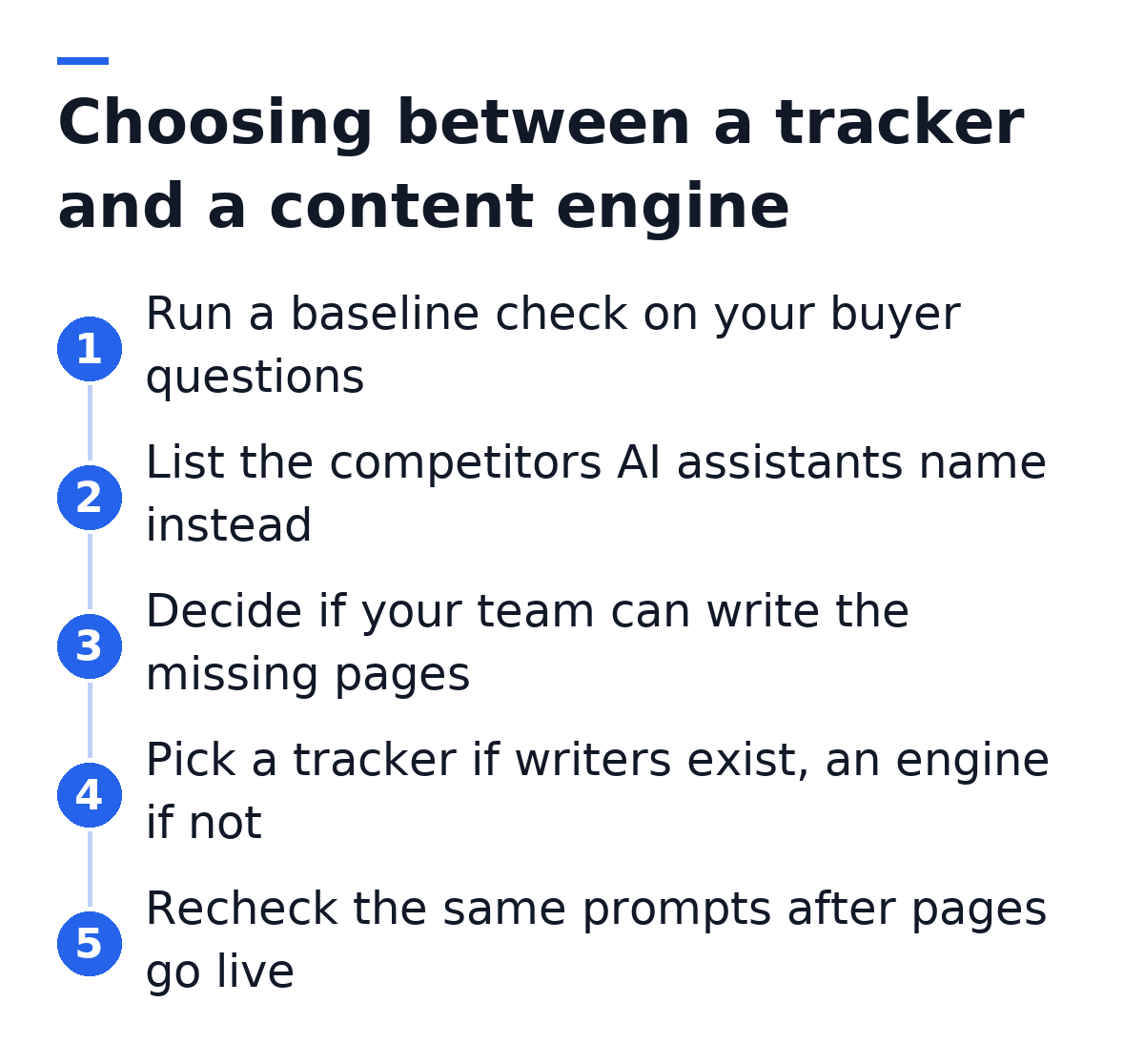
If you pick only one resource, start with Peec AI's trial or any free AI visibility check you can run on your own domain. Before you pay for any platform, you need a baseline: which buyer questions you lose, on which assistants, and to which competitors. That baseline decides whether you need a tracker, a content engine or both.

Peec AI
Peec AI is a Berlin-based AI search analytics platform and the alternative I hear compared to Profound most often. You define the prompts your buyers would type, choose the assistants to monitor, and Peec runs those prompts on a schedule. It reports your visibility, your position in each answer, the sentiment around your brand and the sources the assistants cite. The interface is clean, and setup takes an afternoon rather than an onboarding project.
The source data is the most useful part for SEO work. When Peec shows that Perplexity keeps citing a specific review site or a competitor's comparison page for your category, you have a concrete target. You can pitch that review site, or publish a better page on the same question. That links the AI view straight to Google work: the pages assistants cite are very often the pages that already rank well in Google for related queries.
Peec is a measurement tool. It does not write or publish content for you. Teams with a writer or an agency will act on its data quickly. Teams without one will collect good dashboards and then need to find the capacity to respond.
Best for Marketing leads and SEO managers who want Profound-style prompt tracking across several assistants without the enterprise sales cycle, and who already have someone to turn the data into pages.
- Scheduled prompt runs across multiple AI assistants
- Visibility, position and sentiment scores per prompt
- Source and citation reporting showing which domains assistants rely on
- Competitor benchmarking on the same prompt set
- Tagging to group prompts by product line, persona or funnel stage
Otterly AI
Otterly AI is a lighter, more affordable AI search monitoring tool. It tracks how your brand and your URLs appear in ChatGPT, Google AI Overviews, Perplexity and other assistants for the prompts you choose. Otterly also includes a GEO audit that checks pages for factors tied to AI citation, such as structure and crawlability.
I like Otterly for one specific job: getting a solo founder or a two-person marketing team from zero to a weekly AI visibility habit. Reports are simple to read, link citations are easy to export, and you do not need to learn a new analytics vocabulary. It covers fewer advanced options than Profound or Peec, and that is the trade a smaller team usually wants.
Pair it with Google Search Console for the SEO side. Otterly tells you whether AI Overviews cite your page for a prompt. Search Console tells you whether that page ranks and earns clicks in the classic results. Reading the two together shows whether a page is losing on relevance or only on AI framing.
Best for Solo operators, bootstrapped builders and small teams who want a low-friction way to monitor AI mentions and citations each week.
- Brand and URL monitoring across major AI assistants
- Link citation tracking per prompt
- GEO audit for page-level AI readiness
- Simple exports for client or stakeholder reporting
AthenaHQ
AthenaHQ tracks brand visibility across AI assistants and pairs that tracking with recommendations on what to fix. Beyond share of voice and citation sources, it suggests content and site changes intended to lift your presence for specific prompts. That puts it closer to the action end of the spectrum than a pure monitoring tool.
The recommendation layer is the reason a growth-stage team might pick AthenaHQ over Profound. A content manager with a backlog does not need more charts. They need a ranked list of what to write or rewrite next. AthenaHQ aims to give that list. The writing itself still sits with your team, so the value depends on how quickly your writers can ship.
On the Google side, treat its suggestions like any brief: check the target page against the queries it already ranks for, so an AI-focused rewrite does not drop a phrase that brings in organic traffic.
Best for Growth-stage SaaS teams with at least one writer or content marketer who want tracking plus a prioritized to-do list.
- Share of voice across multiple AI assistants
- Citation source analysis by prompt and competitor
- Content and optimization recommendations tied to tracked prompts
- Competitor comparison views
Scrunch
Scrunch monitors how AI assistants represent your brand and adds a layer aimed at the crawlers themselves. Alongside visibility and citation tracking, Scrunch's agent experience platform serves AI bots a version of your content structured for machine reading, while human visitors see your normal site. It also surfaces misinformation, where an assistant states something wrong about your product or pricing.
That crawler-facing layer is the clearest difference from most tools on this list, and it is the part closest to Profound's agent analytics. It suits brands with large or complex sites where content is buried in JavaScript, gated docs or sprawling product pages. A small SaaS with a clean marketing site and a blog will get less from that layer, because its pages are already readable.
Watch the Google angle here. Google's guidance has long warned against showing crawlers different content from what users see, so review how any AI-facing version stays consistent with your public pages before you switch it on.
Best for Larger brands and well-resourced growth teams with developer support and complex sites that AI crawlers struggle to parse.
- AI visibility and citation monitoring
- Detection of inaccurate brand statements in AI answers
- Agent experience layer that serves AI-optimized content to bots
- Insight into AI crawler activity on your site
Ahrefs Brand Radar
Ahrefs Brand Radar brings AI mention data into the Ahrefs suite. Rather than asking you to write every prompt by hand, it draws on a large prompt and query dataset to show how often your brand and your competitors appear in AI answers, across assistants including ChatGPT, Perplexity, Gemini and Google AI Overviews.
Brand Radar is strongest when you already live in Ahrefs. You can move from an AI share-of-voice view to backlinks, organic keywords and content gaps without exporting anything. Ahrefs has published its own research on how AI Overviews affect clicks, including its analysis of AI Overviews and click-through rates, which is useful context when you explain to a founder why AI visibility now sits next to rankings in the report.
Because Brand Radar draws on a broad dataset, it is excellent for category-level benchmarking. If you need to track a narrow set of very specific buyer prompts, a prompt-first tool such as Peec may fit that job better.
Best for SEO managers and agencies already paying for Ahrefs who want AI mention data next to their backlink and keyword data.
- AI mention and share-of-voice data from a large prompt dataset
- Competitor benchmarking across several AI assistants
- Direct connection to Ahrefs keyword, backlink and content gap tools
- Category-level views for market positioning
Semrush AI Toolkit
Semrush has added AI visibility reporting to its SEO platform through its AI Toolkit and enterprise AI optimization products. You can see how assistants such as ChatGPT and Google's AI features mention your brand, how the sentiment reads, and how you compare with competitors, inside the same tool you use for keyword research, site audits and position tracking.
Semrush also publishes a lot of research on AI search. Its AI search SEO traffic study is one of the more cited pieces on how AI search visitors behave compared with organic visitors, and it is worth reading before you set targets for this channel.
The appeal is consolidation. A content and SEO manager at a growth-stage company may already have Semrush on the budget, and adding AI visibility there avoids a new vendor review. The trade is depth: a specialist tracker gives you more control over prompt sets and run frequency. For many teams, good-enough AI data inside a tool they already use beats perfect data in another tab.
Best for Teams already running Semrush who want AI visibility reporting without adding another platform.
- AI visibility and brand sentiment reporting
- Competitor comparison for AI mentions
- Integration with keyword research, site audit and position tracking
- Content tools for briefs and optimization in the same workspace
SE Ranking
SE Ranking is a rank tracking and SEO platform that has added AI search tracking. Its AI visibility features show whether your brand and URLs appear in Google AI Overviews, AI Mode, ChatGPT and other assistants for tracked keywords, next to your standard Google positions for the same terms.
That side-by-side view is SE Ranking's strongest point for this list. You can see a keyword where you rank third in Google but get no AI Overview citation, or the opposite: a page cited in AI answers that sits on page two of the classic results. Both cases point to different fixes, and seeing them in one row speeds up the triage.
SE Ranking is popular with agencies for its white-label reports and client management, and its pricing has long been aimed at smaller teams than enterprise suites. If you want an all-in-one SEO platform with credible AI tracking and you do not need Profound's conversation-level data, SE Ranking deserves a trial.
Best for Agencies and budget-conscious SEO teams who want Google rankings and AI search visibility in the same report.
- AI Overview and AI Mode presence tracking by keyword
- ChatGPT and other assistant visibility tracking
- Classic rank tracking, site audit and backlink tools
- White-label reporting for agencies
Writesonic GEO
Writesonic started as an AI writing tool and has expanded into generative engine optimization. Its GEO product tracks how your brand appears across AI assistants, shows which competitors and sources show up instead, and then helps you act inside the same platform with content generation and optimization tools.
This is the first entry where tracking and writing sit together, and that changes the workflow. With Profound or Peec, the data leaves the tool and goes to a writer. With Writesonic, a content manager can see a missed prompt and start a draft aimed at it in the same session. You still review, edit and publish the draft yourself, but the handoff is shorter.
Writesonic suits content teams that want to keep humans in the loop on every article while cutting research time. On the Google side, its SEO writing tools handle keyword targeting and on-page structure, so one draft can aim at both a ranking and a citation.
Best for Content teams that want AI visibility tracking and AI-assisted drafting in one platform, with editors still approving each piece.
- AI visibility tracking across multiple assistants
- Competitor and citation source analysis
- AI writing and content optimization tools in the same workspace
- SEO-focused drafting for Google and AI search together
Outrank
Outrank is an automated SEO content platform. It researches keywords for your site, writes articles, and publishes them to your CMS on a schedule, with the aim of building organic traffic without an in-house writer. It also runs a backlink exchange among its users to help new content gain authority.
Outrank comes from the opposite direction to Profound. Profound starts with measurement and leaves the content to you. Outrank starts with content and puts less emphasis on AI visibility measurement. For a founder whose real constraint is that nobody writes, that is a reasonable starting point: published pages are the raw material both Google and AI assistants need before they can cite you at all.
If you pick Outrank, add a separate way to check AI visibility, such as a free check or a light tracker, so you can confirm that the content is reaching the buyer questions you care about. Teams weighing writing tools in this space often compare it with surfer seo alternatives, which come from the optimization side and leave the writing to you.
Best for Founders and solo operators who need steady published SEO content and have no writer on staff.
- Keyword research and content planning for your site
- Automated article writing and scheduled publishing
- CMS integrations for hands-off publishing
- Backlink exchange network among users
Rankai
Rankai positions itself as an AI SEO agency. It combines AI-generated content with a managed service, producing and optimizing pages for your site and handling much of the SEO work for you. The model sits between software and an agency retainer.
The difference from Profound is the operating model. Profound gives your team data and expects your team to act. Rankai acts for you. For a growth-stage company that has tried hiring and managing freelance writers and found it slow, a managed approach removes that coordination work.
Ask about AI search during evaluation. Find out how Rankai reports on visibility in ChatGPT, Perplexity, Gemini and Google AI Overviews, and whether it targets the questions where those assistants name competitors. That answer tells you whether the service covers both lenses or mostly classic SEO.
Best for Teams that prefer a done-for-you SEO service to another self-serve tool and are comfortable delegating content decisions.
- AI-generated SEO content with a managed service layer
- On-page optimization of new and existing pages
- Ongoing publishing handled for you
Babylovegrowth
Babylovegrowth is an automated growth platform for small businesses. It generates SEO articles, publishes them to your site, supports backlink building, and tracks how your brand appears in AI assistants such as ChatGPT. The goal is to give a small business one subscription that covers content, links and AI visibility.
That bundle makes it a practical Profound alternative for a solo builder who cannot justify an enterprise analytics budget but still wants to know whether AI assistants recommend them. You give up the depth of Profound's prompt data. In return you get published content and a view of AI mentions in one place.
As with any automated content platform, set aside time to review what gets published. Your product's positioning and the specific claims in each article are still your responsibility, for Google's quality guidance and for how AI assistants describe you.
Best for Small businesses, bootstrapped founders and solo operators who want automated content, backlinks and basic AI visibility tracking in one plan.
- Automated SEO article generation and publishing
- Backlink building support
- AI assistant visibility tracking
- Simple setup aimed at non-specialists
Gofylo
Gofylo publishes this article. It is an AI visibility and SEO content platform that tracks how six AI assistants (ChatGPT, Google AI Overviews, Google AI Mode, Gemini, Perplexity and Claude) answer your buyers' searches, shows which businesses they name instead of you and which sites they cite, then researches, writes and publishes articles aimed at those gaps to your CMS.
Articles ship with schema markup, internal links, FAQ blocks, verified source citations and AI-generated images, in 18+ languages. Gofylo publishes to WordPress, WordPress.com, Webflow, Shopify, Wix, Notion, Ghost, Framer, Feather and GitHub, plus a webhook. Published articles that sit just off page one are rewritten from your Google Search Console data, and the earlier version is kept so you can restore it. That ties the Google lens and the AI lens to the same set of pages.
Plans are Starter at $149 a month (10 articles, 50 tracked searches), Pro at $299 a month (20 articles, 150 searches) and Business at $599 a month (30 articles, 350 searches). Yearly billing costs 10 months' price, and every plan has a 7-day free trial with a card. A free AI Visibility report shows any site which businesses AI assistants name for its buyers' searches and which pages to write.
The choice between a Profound-style tracker and a tool that also publishes is the core of the Profound AI vs. Autonomous GEO question. A tracker suits a team with writers. A publishing platform suits a team where the bottleneck is output. If you want a closer look at what Profound itself does well, the profound geo breakdown covers it, and From Rankings to LLM Mentions covers how tracking shifts when you measure mentions alongside positions.
Best for Founder-led SaaS companies and small marketing teams that want AI visibility tracking and published, refreshed articles in one plan, without hiring a content team.
- AI visibility tracked on six assistants, with the competitors they name and the sites they cite
- 10, 20 or 30 articles a month published to your CMS, by plan
- Schema markup, internal links, FAQ blocks, source citations and images in each article
- Search Console refresh for pages just off page one, with the earlier version kept
- Free AI Visibility report for any site
Whichever tool you choose, keep the fundamentals in view. According to Google Search Central's guidance on AI features, "There are no additional requirements to appear in AI Overviews or AI Mode, nor other special optimizations necessary." The same page quality that earns rankings earns citations. Google's guidance on helpful content says its systems are designed to present "helpful, reliable information that's primarily created to benefit people, not to gain search engine rankings." Every alternative on this list is ultimately a way to find where those pages are missing and get them written.
Related: Your Guide to LLM Visibility Tools That Actually Work
Want to see where you stand before choosing any Profound alternative? Run the free Gofylo AI Visibility report to see which businesses six AI assistants name for your buyers' searches, then start a 7-day free trial on the Starter plan to have the missing articles researched, written and published to your CMS.