A buyer asks ChatGPT for the best onboarding tool for a 40-person SaaS company. The answer names three vendors, cites two review sites and a competitor's comparison page, and never mentions you. Your Google rankings for the same topic are fine. Your analytics show nothing unusual. That gap between ranking and being recommended is the problem generative engine optimization tools exist to measure and close.
We build in this space, so we have spent a lot of 2026 looking at how these tools work, what they actually record, and where each one stops. The category is crowded and the labels overlap. Some products only track mentions. Some score your pages. A few produce and publish content. Very few connect all of it to your existing Google performance. This guide explains the categories, the leading trackers, how answer engine optimization tools get rated, what free options can and cannot do, and how to assemble a stack that matches the size of your team.
GEO tools are software that measure and improve how often AI assistants such as ChatGPT, Google AI Overviews, Gemini, Perplexity and Claude name or cite your business when buyers ask questions in your category. They matter to any SaaS founder, marketing lead or SEO manager whose buyers now research vendors inside AI chat interfaces as well as on Google.
Key takeaways
- GEO tools fall into distinct jobs (visibility tracking, page analysis, content production and refresh), and most products cover only one or two of them.
- Enterprise trackers such as Profound and AthenaHQ are strongest at measurement depth, while small teams often struggle to act on that data without someone producing content.
- Answer engine optimization tools are best judged on prompt coverage, engine coverage, refresh frequency and whether their data leads to a specific page you can publish.
- Free GEO tools are useful for a first diagnosis, but they rarely track enough prompts or engines to guide a monthly content plan.
- Traditional SEO tooling still matters in a GEO stack, because AI assistants frequently cite pages that already perform well in organic search.
What generative engine optimization means for a SaaS team
Generative engine optimization is the practice of making your business the one AI assistants mention, recommend and cite when they answer questions your buyers ask. For a B2B SaaS company, those questions are usually comparisons, shortlists and problem statements: which tool handles SOC 2 evidence collection, what is a cheaper alternative to a known incumbent, how do teams automate invoice reconciliation.
An AI answer is assembled differently from a results page. The assistant retrieves a set of sources, extracts claims, and writes a summary that may name a handful of vendors. Your brand appears in that summary for one of a few reasons: a retrieved page names you, the model already associates you with the category, or your own page is cited as a source. GEO work targets all of those paths.
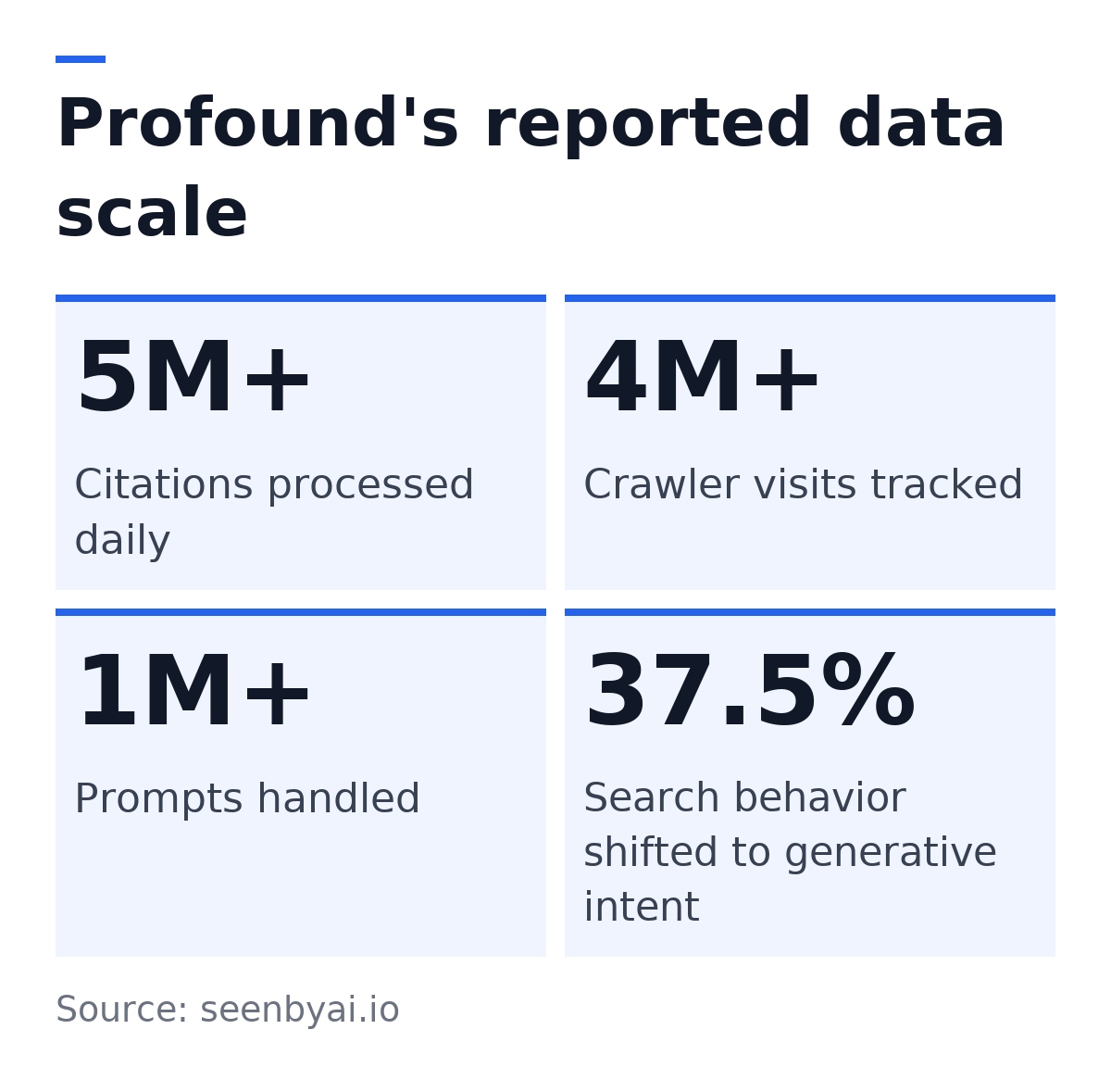
The scale of the shift is the reason the tool category grew so quickly. Profound's own research, as summarized in a review of the Profound platform, found that 37.5% of search behavior has fundamentally shifted to generative intent. Whatever the exact share in your niche, the practical point holds for most SaaS teams in 2026: a meaningful part of vendor research now ends in an AI answer, and you cannot see that answer in Google Search Console.
That invisibility is what the tools address first. Before you can improve AI visibility, you need to know which prompts matter, what each assistant says for them, which competitors it names and which sources it pulls from. Everything after that (analysis, content, refresh) depends on that baseline being accurate.

How SEO, AI SEO, AEO and GEO differ
The four terms describe overlapping goals. SEO aims for rankings on search engine results pages. AI SEO usually means using AI to do SEO work faster. AEO (answer engine optimization) aims to be the direct answer in features like AI Overviews and voice results. GEO aims to be named and cited inside generated answers across chat assistants.
- SEO measures positions, impressions and clicks from Google and Bing, and it is driven by relevance, links, technical health and content quality.
- AI SEO describes the method: AI-assisted keyword research, drafting and optimization that still targets classic rankings.
- AEO targets answer surfaces, so it rewards concise, quotable passages, structured data and question-led headings.
- GEO targets generated recommendations, so it tracks brand mentions, citation share and the third-party sources assistants trust in your category.
In practice, the disciplines share most of their inputs. A page that answers a question clearly, carries schema markup, earns links and sits on a fast, crawlable site tends to do well in both Google and AI answers. Google's own documentation on AI features and your website states that the same SEO best practices apply to AI Overviews and AI Mode, and that there are no special optimizations required beyond them.
Where they diverge is measurement and source mix. SEO tools report your positions. GEO tools report whether an assistant mentions you at all, in what order, with what sentiment, and which domains it cites. Chat assistants also lean heavily on third-party content such as review sites, community threads and comparison pages, so GEO work often includes getting covered on sites you do not own.
The four jobs a GEO tool can do
Most confusion in this category disappears once you sort products by the job they perform. A tool that tracks citations and a tool that writes articles are both sold as GEO software, but they solve different problems and a team usually needs more than one of them.
Visibility tracking
A GEO brand tracker runs a defined set of prompts against one or more AI assistants on a schedule and records the answers. From those answers it derives metrics: mention rate, share of voice against named competitors, average position in lists, sentiment and the domains cited as sources.
- Prompt set: the buyer questions you track, ideally grouped by product line, persona and funnel stage.
- Engine coverage: which assistants are queried, such as ChatGPT, Perplexity, Gemini, Claude, Google AI Overviews and Google AI Mode.
- Refresh frequency: how often prompts are rerun, since AI answers change between runs.
- Competitor mapping: which other brands appear and how often.
- Citation sources: the pages and domains each assistant relies on for your category.
GEO analysis
A GEO analysis tool looks at your pages and site rather than at AI answers. It checks whether AI crawlers can access your content, whether pages contain extractable answers, whether schema is present and valid, and whether your entity information is consistent. Some analyzers also compare your page against the sources an assistant already cites for a prompt.
Content production
Content tools turn visibility gaps into pages. At the simple end, this means a writing assistant that drafts from a brief. At the full end, it means a system that picks the topic from tracking data, researches it, writes the article with citations, schema, internal links and FAQ blocks, and publishes it to your CMS. The difference matters for small teams, because tracking data with no one to act on it changes nothing.
Refresh and measurement
Published pages decay. Competitors publish newer comparisons, assistants pick up fresher sources, and Google rankings slide from position 6 to position 14. Refresh tools use performance data, typically Google Search Console impressions and positions, to find pages close to page one and rewrite them. For GEO, a refresh also means rechecking whether the updated page starts appearing in AI answers.
How we evaluated the tools in this guide
We judged each tool against the jobs above and against the reality of a SaaS team with limited headcount. A platform with deep data and no path to action scores well for an enterprise brand team and poorly for a two-person marketing function.
- Engine coverage, including whether Google AI Overviews and AI Mode are tracked alongside chat assistants.
- Prompt capacity and how prompts are chosen, since a tracker is only as useful as the questions it asks.
- Data depth: citation sources, competitor names, position and sentiment, not only a single visibility score.
- Actionability: whether the output points to specific pages to create or update.
- Execution: whether the tool produces or publishes content, or leaves that to your team.
- Fit for team size, including setup effort, pricing transparency and compliance for regulated buyers.
We did not rank tools against one universal winner. The right GEO tool for an enterprise with a dedicated analyst is rarely the right one for a bootstrapped founder, and the sections below explain why for each.
Profound: enterprise-scale citation intelligence
Profound is an enterprise AI visibility platform built for large brands that want the deepest possible measurement of how AI assistants describe them. Its strength is data volume and engine breadth. According to a Profound platform review, it processes 5M+ citations daily, tracks 4M+ crawler visits, and handles 1M+ prompts.
On coverage, a comparison of Profound and Peec AI reports that Profound tracks 10+ engines and refreshes queries hourly. The company also has significant backing: a 2026 Profound review notes it is backed by a $35 million Series B from Sequoia Capital.
- Answer engine insights that show how often and where your brand appears across assistants.
- Citation analysis that identifies which domains and URLs assistants rely on in your category.
- AI crawler analytics that show which bots visit your site and which pages they read.
- Prompt volume research that estimates which questions buyers ask assistants.
- Multi-brand and multi-region reporting for large marketing organizations.
The crawler analytics deserve attention. If GPTBot, PerplexityBot or Google's crawlers rarely reach a key product page, no amount of content polish will get that page cited. Seeing crawler activity next to citation data is something few lighter tools provide.
The tradeoff is fit. Profound is priced and designed for enterprise teams with analysts who can turn dashboards into briefs, and briefs into pages. A growth-stage SaaS company with one marketer will get accurate data, but still needs a separate way to produce the content that closes the gaps it reveals.
AthenaHQ: monitoring with an action layer
AthenaHQ is a GEO platform that pairs visibility monitoring with recommendations for what to change. It sits between pure trackers and execution tools: it tells you where you are missing and suggests the content or source work most likely to fix it.
Its data footprint is large. An AthenaHQ platform review lists 1.7B page views monitored and 85M unique AI sources tracked. On engines, a separate AthenaHQ review states that it monitors across ChatGPT, Perplexity, Gemini, Claude, and eight or more additional AI platforms depending on plan tier.
Buyers in regulated industries often ask about security first. According to the AthenaHQ platform review, "AthenaHQ is EU & UK Data Processing compliant, has achieved CSF 2.0 cybersecurity certification at Tier 3," and the same review reports it completed its SOC 2 Type I audit in October 2025. User sentiment is positive as well, with a consensus score of 8.28/10 on one aggregator.
- Share of voice and mention tracking against named competitors.
- Source analysis that shows which publications and pages drive AI answers.
- Recommendations that suggest pages to create or optimize.
- Compliance posture suitable for security-conscious procurement.
AthenaHQ narrows the distance between insight and action more than most trackers do. The recommendations still need a writer, an editor and someone to publish, so a team without content capacity will see a growing list of good ideas rather than shipped pages.
Other GEO brand trackers worth knowing
Beyond the two enterprise leaders, a wave of lighter trackers launched for mid-market and agency use. They differ mainly in price, engine coverage and how much analysis they layer on top of raw answers.
- Peec AI focuses on clean share-of-voice reporting across major assistants and is popular with agencies managing several brands.
- Otterly.AI is a lightweight monitor for brand mentions and cited links, with a low barrier to start.
- Rankscale tracks visibility and rankings within AI answers and appeals to SEO practitioners who think in positions.
- Scrunch AI emphasizes how assistants perceive and describe a brand, including inaccuracies in AI answers.
- Promptwatch combines prompt tracking with crawler monitoring for teams that want both views in a mid-priced tool.
These trackers are good at telling you where you stand. They share a structural limit with the enterprise tools: none of them writes and publishes the page you need. For many SaaS teams, the tracker becomes a monthly report that confirms the same gaps until someone has time to work on them.
When comparing trackers, test them on your own prompts during a trial. Run ten real buyer questions and compare the answers a tool records with what you see when you ask the assistants yourself. AI answers vary between sessions, so the useful signal is the pattern across several runs, not any single response.
How answer engine optimization tools get rated
The best rated answer engine optimization tools earn their ratings on four things: how many engines they cover, how accurately they reflect real AI answers, how often they refresh, and whether their findings lead to a concrete next step. Review scores on aggregator sites tend to reward ease of use and support, so read the written reviews for details on data accuracy.
AEO tools overlap almost entirely with GEO tools in 2026, and most vendors use both labels. The practical distinction is emphasis. AEO tools often focus on answer surfaces inside Google, such as AI Overviews and featured snippets, while GEO tools emphasize chat assistants. A good AEO/GEO tool for a SaaS team covers both, because buyers move between Google and ChatGPT during the same research session.
- Engine coverage that includes Google AI Overviews and AI Mode as well as ChatGPT, Gemini, Perplexity and Claude.
- Prompt quality, meaning prompts that resemble what buyers actually type rather than short keyword strings.
- Answer accuracy, checked by spot-testing recorded answers against live ones.
- Source visibility, showing which URLs each assistant cited.
- Competitor detail, naming the brands that appear instead of you.
- A path to action: specific pages to write or update, ideally with briefs or drafts.
Rating sites rarely weight the last item, yet it is the one that decides whether your visibility changes. A tool with a slightly lower review score that produces publishable pages may move your numbers more than a highly rated dashboard.
A GEO tool that only reports visibility will not improve it. Before buying, ask what happens the day after the report: who writes the page, who publishes it, and how you will know whether it worked.
Free and low-cost GEO tools
Free GEO tools are good for a first diagnosis and weak for ongoing work. They typically run a handful of prompts once, on a limited set of engines, and return a snapshot of where you appear. That snapshot is enough to confirm whether you have a problem and which competitors assistants prefer.
- Free AI visibility reports and graders that show which brands assistants name for a site's buyer questions.
- Manual testing: asking ChatGPT, Perplexity, Gemini, Claude and Google AI Mode your top buyer questions and logging the answers in a spreadsheet.
- Google Search Console, which is free and shows the queries and pages that already earn impressions, a strong signal of what AI Overviews may draw on.
- Schema validators and robots.txt checks that confirm AI crawlers can reach and parse your pages.
- Free trials of paid trackers, which let you test full prompt sets for a short period.
The limits show up within a month. Free tools rarely track enough prompts to cover a product line, rarely rerun them on a schedule, and rarely tell you which page to write. Manual testing also breaks down quickly, because results differ by session, location and account history. Treat free tools as the diagnostic step, then move to a paid tracker or an execution platform once you know which prompts matter.
Gofylo offers a free AI Visibility report for this diagnostic step. It shows which businesses six AI assistants name for a site's buyer searches, along with the pages worth writing to change that.
Where traditional SEO tools fit in a GEO stack
Traditional SEO tools remain part of a GEO stack because AI assistants draw heavily on content that already performs in organic search. Google's AI Overviews and AI Mode are built on Google's index and ranking systems, and chat assistants that browse the web retrieve pages through search indexes too. A page that never ranks is less likely to be retrieved, which makes it less likely to be cited.
- Rank tracking shows whether the pages you want cited are visible in classic results at all.
- Search Console data shows impressions and positions, which helps find pages close to page one.
- Technical audits catch crawl and indexing issues that block both Googlebot and AI crawlers.
- Backlink analysis shows the authority signals that influence both rankings and which sources assistants trust.
- Content optimization tools check coverage of subtopics that both readers and models expect.
If you are choosing classic tools to sit alongside a GEO tracker, the options for best rank tracking now increasingly include AI answer positions next to Google positions. The same convergence applies to seo monitoring tools, many of which have added alerts when a page drops out of AI Overviews. For authority work, the best backlinking tools still matter, because links from respected publications tend to be the same domains assistants cite.
Writers on your team will also use general AI writing assistants. Many ai tools for content creators help with drafting speed, but drafting is a small part of what gets a page cited. Research depth, verified sources, structure, schema, internal links and publishing consistency matter more than writing speed alone.
GEO tools compared by the job they do
The comparison below shows that most GEO tools specialize in measurement, and only a few connect measurement to published content. Use it to see which jobs your current stack leaves uncovered.
| Tool | Primary job | Engine coverage | Produces content | Best fit |
|---|---|---|---|---|
| Profound | Visibility tracking and crawler analytics | 10+ engines | No | Enterprise brand teams with analysts |
| AthenaHQ | Tracking plus recommendations | ChatGPT, Perplexity, Gemini, Claude and more by tier | Recommendations only | Mid-market and regulated buyers |
| Peec AI | Share-of-voice tracking | Major chat assistants | No | Agencies managing several brands |
| Otterly.AI | Lightweight mention monitoring | Major chat assistants and AI Overviews | No | Small teams starting to track |
| Gofylo | Tracking, content production, publishing and refresh | Six assistants including AI Overviews and AI Mode | Yes, 10 to 30 articles a month | SaaS teams with little or no content staff |
| Free graders and manual tests | One-time diagnosis | Varies, usually limited | No | First check before buying |
The table also shows why many teams end up with two tools: one to measure and one to execute. That works when there is budget and headcount to connect them. When there is not, a platform that handles both jobs removes the handoff where most GEO programs stall.
Why execution is the bottleneck for small teams
For most SaaS teams, the hard part of GEO is producing and maintaining the pages that close visibility gaps, week after week. Trackers can surface twenty missing comparison pages in an afternoon. Writing, sourcing, formatting, publishing and later refreshing those twenty pages takes a content team most startups do not have.
Manual workflows also compound slowly. A founder who writes one strong post a month has published twelve by year end, and some of those start decaying before the last one ships. Visibility in AI answers depends on breadth across many buyer questions, so a small number of excellent pages often loses to a larger set of solid, well-structured, current ones.
Autonomous production changes the math. When articles are researched, written and published to your CMS on a schedule, with schema, internal links, FAQ blocks and verified citations included, coverage grows every month without adding headcount. Each new page creates another entry point for Google and another candidate source for AI assistants.
Refresh keeps the gains. Pages that sit just off page one are often the cheapest wins in organic search. Rewriting them from Search Console data, while keeping the earlier version available to restore, protects past work instead of letting it decay.
Tracking closes the loop. When the same system that publishes also tracks which businesses assistants name for your buyers' searches, the next month's topics come from real gaps, not guesses.
This is the approach we took with Gofylo. It tracks how six AI assistants (ChatGPT, Google AI Overviews, Google AI Mode, Gemini, Perplexity and Claude) answer your buyers' searches, shows where they name competitors instead of you, and researches, writes and publishes articles aimed at those gaps. Articles ship in 18+ languages to WordPress, WordPress.com, Webflow, Shopify, Wix, Notion, Ghost, Framer, Feather or GitHub, or through a webhook. Published articles are refreshed from your Google Search Console data.
The output differs from a dashboard. Instead of a report listing pages you should write, you get the pages, live on your site, plus a view of whether assistants start naming you. For teams that already own a tracker, this fills the execution gap. For teams without one, it covers both jobs.
Choosing a GEO stack by team size
The right GEO stack depends on headcount more than on budget. The question to ask is who will act on the data each week. Match the tool to the answer.
Solo founders and bootstrapped builders
Start with a free AI visibility report and Google Search Console to see where you stand. If assistants name competitors for your core buyer questions, you need pages more than dashboards. An execution platform that tracks and publishes in one place avoids paying for data you have no time to use. Gofylo's Starter plan is $149 a month for 10 articles and 50 tracked searches, with a 7-day free trial.
Startups with one or two marketers
A small team can usually review and edit content but cannot produce it at volume. Pair autonomous production with light editorial review so the marketer's time goes into positioning, product accuracy and distribution. Gofylo's Pro plan covers 20 articles and 150 tracked searches for $299 a month, which suits teams tracking several product lines or personas.
Growth-stage content and SEO teams
With dedicated content and SEO staff, the stack often includes a classic SEO suite, a GEO tracker and a production layer. The risk at this size is fragmentation: insights in one tool, briefs in another, drafts in a third. Consolidating tracking and publishing reduces handoffs. Gofylo's Business plan includes 30 articles and 350 tracked searches for $599 a month, and yearly billing on any plan costs 10 months' price.
Enterprise brand teams
Large organizations with analysts and in-house writers can justify enterprise trackers like Profound or AthenaHQ for their measurement depth, crawler analytics and compliance posture. They still benefit from an execution layer for long-tail buyer questions that internal writers cannot cover at scale.
- Map your top buyer questions by product and persona before choosing any tool.
- Run a free diagnosis to see which competitors assistants name.
- Decide who acts on the data each week, and buy for that person's capacity.
- Keep Google Search Console and basic rank tracking in place, because organic performance feeds AI citations.
- Review results monthly against both Google metrics and AI mention rates.
FAQ
Is GEO better than SEO?
GEO is not better than SEO. The two depend on each other. AI assistants, including Google AI Overviews and AI Mode, frequently draw on pages that already rank, and Google states that standard SEO practices apply to its AI features. GEO adds measurement of AI mentions and attention to third-party sources, so the strongest approach for a SaaS team in 2026 runs both from the same content program.
Is SEO still relevant in 2026?
Yes, SEO is still relevant in 2026. Organic search still sends qualified traffic, and the pages that rank well are among the sources AI assistants retrieve and cite. Crawlability, structured data, links and clear answers help a page in both Google results and AI answers, so SEO work now supports GEO results as well as rankings.
Want to see which businesses ChatGPT, Gemini, Perplexity, Claude, Google AI Overviews and Google AI Mode name for your buyers' searches? Start with Gofylo's free AI Visibility report, then try any plan free for 7 days and get researched, cited articles published to your CMS from $149 a month.
Sources
- Profound AI Review: #1 GEO & AI Visibility Platform - seenbyai.io
- Profound Review 2026: Features, Pricing, Pros & Cons - geotoolsreview.ai
- Profound vs PEEC AI: The Ultimate GEO Platform Battle for 2026 - nicklafferty.com
- AthenaHQ Review: GEO Platform Beyond Monitoring - seenbyai.io
- AthenaHQ Review 2026 - AI Search Visibility Tool - tooliverse.ai
- AthenaHQ Review 2025: Features, Pricing & Real Results - farmanrind.com