Most B2B SaaS teams start looking for the best search optimization company after a quarter of flat organic traffic, or after someone asks ChatGPT about their category and a competitor's name comes back. The search then turns into a pile of agency proposals, platform demos and freelancer quotes that all promise growth in similar words. I have sat on both sides of those calls. The proposals that sound alike usually sell very different things.
This explainer breaks down what a search optimization company sells in 2026, how the delivery models differ, which signals separate useful partners from expensive ones, and how AI assistants have changed what good work looks like. It assumes you already know what SEO is and are comparing options.
A search optimization company is any agency, platform or hybrid service that is paid to increase how often a business is found through search. In 2026 that covers two surfaces: Google's ranked results and the answers AI assistants such as ChatGPT, Gemini, Perplexity and Claude write. It matters most to founders and small marketing teams who need organic pipeline but have no in-house content staff.

What a Search Optimization Company Actually Sells
A search optimization company sells a mix of diagnosis, production and maintenance. The proportions decide what you get. Two firms can both say they "do SEO" while one mostly sends audits and the other mostly ships pages.
Breaking the work into parts makes proposals comparable. Almost every engagement is built from some of these components:
- Technical auditing: crawlability, indexation, site speed, structured data and duplicate content.
- Keyword and topic research: which buyer searches to target and in what order.
- Content production: briefs, drafts, edits, images and publishing to your CMS.
- On-page optimization: titles, headings, internal links and schema on existing pages.
- Link acquisition: outreach, digital PR and partnerships that earn references from other sites.
- Measurement: rank tracking, traffic and conversion reporting, and visibility inside AI answers.
- Maintenance: refreshing pages that decay or sit just off page one.
For a startup with a thin site, content production and maintenance usually move results most, because there are few pages to optimize yet. For a large site with years of content, technical auditing and on-page fixes often matter more. Know which half of that split you are in before you read a proposal.
The Four Delivery Models
Search optimization in 2026 is delivered in four broad ways, and each shifts a different share of the work onto your team. The model matters more than the brand name on the invoice.
Full-service agencies
A full-service agency assigns an account team that plans, writes, builds links and reports. You get human judgment and a single point of contact. The trade-off is cost and speed: retainers are priced around staff hours, output depends on who is assigned, and a strategy call often comes before every content batch. Agencies fit companies with budget and a need for broad work such as digital PR.
Specialist consultancies
A consultant or small specialist firm sells expertise in one area, usually technical SEO, migrations or strategy. The output is recommendations, and your team implements them. This model is excellent for a site migration or an indexation problem. It is a poor fit if you have nobody to execute the findings, because an audit without implementation changes nothing.
Self-serve software platforms
Suites such as Semrush and optimization tools such as Clearscope give you data and editors, and your team does the work. They are cheaper than agencies per month but expensive in hours. A content manager still researches, writes, optimizes and publishes. Teams that already have writers get a lot from this model. Solo founders often pay for seats they rarely open.
Autonomous content platforms
The newest model researches, writes, publishes and updates content with little manual prompting, and pairs it with visibility tracking. The structural difference is that output does not scale with your headcount. A fixed number of articles ships each month whether or not anyone on your team has time that week. This suits founder-led companies and small marketing teams who need execution, though it still benefits from someone reviewing positioning and product claims.
The table below summarizes how each model splits the work. The pattern: the less in-house capacity you have, the more the delivery model should own production.
| Model | Who produces content | Main strength | Main limit |
|---|---|---|---|
| Full-service agency | Agency staff | Broad scope and human judgment | Highest cost, slower cycles |
| Specialist consultancy | Your team | Deep expertise on one problem | No execution included |
| Self-serve platform | Your team | Data and editing tools | Time cost on your staff |
| Autonomous platform | The platform | Steady output without headcount | Needs review of brand claims |
Why AI Search Changed the Definition of Best
In 2026, the best search optimization company is one that measures and improves visibility in AI answers as well as Google rankings. Buyers increasingly ask an assistant for a shortlist before they ever click a result, and a firm that only reports keyword positions cannot see that channel.
Google itself now places generated answers above the classic results. Its own documentation on AI features and your website states that the same SEO best practices apply to AI Overviews and AI Mode, and that there are no extra requirements to appear in them. That is useful: it means good SEO and good GEO overlap heavily. It also means a partner should be checking whether your pages are cited in those features, not just whether they rank.
Research from Ahrefs gives a sense of the stakes. Its study on AI Overviews reducing clicks found a 34.5% lower click-through rate for the top-ranking page when an AI Overview appeared. A first-position ranking is worth less when an answer sits above it, unless your brand is named inside that answer.
Assistants outside Google behave differently again. ChatGPT, Perplexity and Claude pull from their own retrieval sources and favor pages with clear, quotable statements, structured sections and named facts. A partner fit for 2026 writes content shaped for extraction: answer-first paragraphs, FAQ blocks, schema markup and cited sources. Ask any firm you evaluate how it formats content for citation, and which assistants it monitors.
The Signals That Separate Good Partners From Expensive Ones
Good partners are specific about output, measurement and ownership. Expensive ones are specific about effort. When I review a proposal, I look for these signals:
- A stated number of published pages per month, not a number of hours.
- Measurement on both surfaces: rankings and traffic in Google, plus brand mentions and citations across named AI assistants.
- A plan for existing pages, including how pages stuck on page two get rewritten.
- Use of your own Search Console data, not only third-party estimates.
- Direct publishing to your CMS, so drafts do not wait in a shared folder.
- Clear ownership: you keep the content, the history and the account access if you leave.
- Content that cites real sources, since AI assistants and human readers both check claims.
Measurement deserves extra scrutiny. Many firms bundle a rank report and call it done. A proper setup uses the best rank tracking you can get for Google positions alongside a tracker for AI answers, and connects both to conversions. If you want to compare dedicated seo monitoring tools against what a vendor includes, do it before signing, because reporting gaps are hard to fix mid-contract.
First-party data is the other test. Third-party keyword tools estimate traffic. Your Search Console shows the queries and pages that actually earn impressions. A partner that asks you to Connect Google Search Console in week one is working from your reality. One that never asks is working from a model of it.
Ask for one example page. Request a published article the firm produced for a client in a comparable niche, then check it yourself: does it answer its question in the first lines, cite sources, use structured sections and appear for any buyer question when you ask an assistant? One real page tells you more than a deck of case-study percentages.
How Pricing Models Shape the Work You Get
Pricing structure changes incentives. The same budget buys different behavior depending on how it is charged.
- Hourly or retainer pricing rewards time spent. You pay for meetings and audits whether or not pages ship.
- Per-article pricing rewards volume. Check edit quality and research depth, because cheap articles rarely get cited.
- Performance pricing tied to rankings sounds aligned, but firms often pick easy keywords with no buying intent.
- Flat subscription with a set output fixes cost and volume, which makes cost per published page easy to calculate.
Cost per published, maintained page is the cleanest comparison metric across models. Divide the monthly fee by pages actually shipped and kept up to date. Audits, strategy calls and reports are inputs. Pages that rank and get cited are what compound.
Red Flags in Proposals and Pitches
Some warning signs show up repeatedly across sales calls. Any one of these is reason to slow down:
- Guaranteed first-page rankings. Google's own guidance on hiring an SEO warns that no one can guarantee a number one ranking.
- No mention of AI assistants, or a vague promise to "optimize for AI" with no tracking.
- Long minimum contracts before any output is visible.
- Link packages sold by quantity, which can violate Google's spam policies.
- Reports full of impressions and keyword counts with no tie to signups or demos.
- Content that ships to a document instead of your live site.
According to Google Search Central, "No one can guarantee a #1 ranking on Google." A proposal that promises otherwise is telling you how it plans to sell, not how it plans to work.
Matching the Model to Your Stage
The right search optimization company depends on your team, not on a universal ranking. Stage and capacity decide fit.
Solo founders and bootstrapped builders. You have no time to manage writers or learn a tool suite. An autonomous platform with a fixed monthly output and AI visibility tracking gives you steady pages without a hire. Spend your own time reviewing product claims, not drafting.
Seed to Series A teams with one marketer. That marketer is usually running demand gen, events and email too. Offloading production to an autonomous platform frees them for distribution and positioning. Add a consultant for a one-off technical audit if the site has indexation problems.
Growth-stage teams with content staff. If you already have writers, self-serve tools or a strong best ai writing assistant can multiply their output, and an autonomous platform can cover long-tail and refresh work they never reach. Agencies make sense here for digital PR and link earning.
Whatever the stage, judge the first month on pages published and on whether those pages start appearing in Search Console and in assistant answers. Results in SEO lag, but output should be visible immediately.
Frequently Asked Questions
Is SEO replaced by AI?
No. AI assistants change where answers appear, but they still draw on indexed, well-structured web pages, so SEO fundamentals feed AI visibility directly. What changes is the target: pages now need to rank and also be quotable enough to get cited.
Can ChatGPT do SEO?
ChatGPT can draft text, suggest keywords and outline pages, but on its own it does not research your live search data, publish to your CMS, track rankings or refresh pages over time. It is a writing aid inside an SEO process, not the process.
How much should SEO cost for a small business?
It depends on the delivery model. Agency retainers are priced around staff time and usually cost the most, while self-serve tools cost less per month but consume your team's hours. Subscription platforms sit between them: Gofylo, for example, starts at $149 a month for 10 articles and 50 tracked searches, with Pro at $299 for 20 articles and Business at $599 for 30. Compare options on cost per published, maintained page.
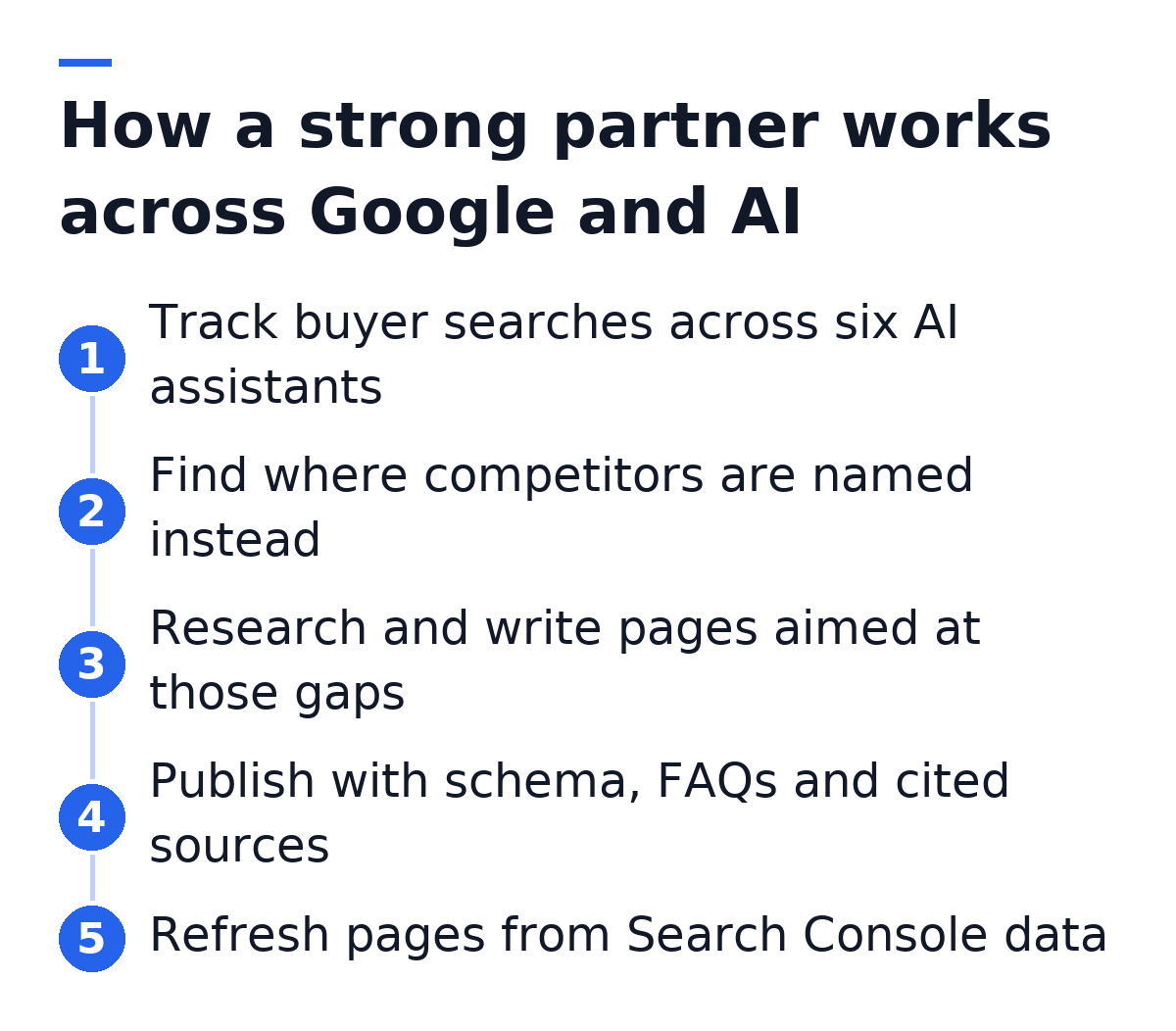
Want to see where AI assistants name your competitors instead of you? Start with Gofylo's free AI Visibility report, then try a plan free for 7 days: Gofylo tracks your buyer searches across ChatGPT, Google AI Overviews, Google AI Mode, Gemini, Perplexity and Claude, and researches, writes and publishes 10 to 30 articles a month to your CMS, refreshed from your Search Console data.