You commissioned the article. The writer delivered on time, the draft reads cleanly, it hits the keyword, and months later it sits buried deep in the search results with no clicks and no mention in any AI answer. Nobody did anything obviously wrong. The writer followed the instructions. The instructions were the problem.
I have seen this pattern at almost every B2B SaaS company I have worked with. The brief was a keyword, a word count and a vague note like "make it authoritative." The writer filled the gaps with guesses, and the guesses produced a generic article that looks like the other generic articles already ranking. That article costs real money and real calendar time, and it fails so subtly that the cause rarely gets traced back to the brief.
This explainer breaks down what an SEO content brief is, why most briefs fail, which components carry the weight, and how the brief changes now that ChatGPT, Claude, Perplexity and Gemini answer questions that used to send traffic to your blog. It is written for founders, marketing leads and SEO managers who already publish content and want to understand why some pieces compound while others stall.
An SEO content brief is the document that tells a writer (human or AI) what an article must accomplish before a single sentence is drafted: the query it answers, the reader it serves, the angle it takes, the evidence it must include, the structure it follows and how it connects to the rest of your site. It matters to anyone who publishes content to earn organic traffic or AI citations, because the brief sets the ceiling on how well the finished article can perform.

Why Articles Fail Before the Writing Starts
Most underperforming articles fail at the brief stage, not the drafting stage. A writer can only produce what the brief makes possible. If the brief does not say which question the article answers, who is asking it and what the existing results already cover, the writer has to invent those answers, and the default invention is the safest, most average version of the topic.
Average is the one thing that does not rank. Search engines already have several competent pages on almost every B2B SaaS topic. AI assistants already have a summary they can assemble from those pages. A new article earns a position only when it adds something the existing set lacks: a sharper answer, a missing angle, firsthand detail or better structure. That addition has to be planned. It almost never appears by accident.
The Hidden Cost of a Thin Brief
A thin brief does not look expensive on the day it is written. The cost shows up later, spread across several places that rarely get connected:
- Revision cycles, because the draft misses an expectation that existed only in someone's head
- Writer time spent researching the SERP that the strategist already researched and did not record
- Articles that cannibalize each other because no brief stated which page owns which query
- Pages that rank briefly and then decay because they answered the wrong version of the question
- Missed AI citations because the article buries its answer under three paragraphs of preamble
- Opportunity cost: every slot on the calendar filled by a weak article is a slot a strong one could have used
For a startup publishing a handful of articles a month, each of those costs is felt directly. For a growth-stage team publishing at volume, the costs multiply, because one weak brief template gets copied across dozens of pieces.
What a Content Brief Actually Decides
A content brief decides the strategic questions so the writer can focus on execution. It separates the thinking about what an article should be from the craft of writing it. When those two jobs blur, writers end up doing strategy badly and strategists end up rewriting drafts.
In practice, a brief settles a set of decisions that would otherwise be made implicitly, inconsistently or not at all:
- Which single query or tight group of queries this page is meant to own
- What the person searching wants to walk away with
- What the reader already knows, so the article can skip it
- What the article will say that existing pages do not
- Which sections are required and in what order
- What evidence, examples and sources must appear
- Where the article sits in your site and which pages it links to and from
- What the reader should do next when they finish
Each of those decisions is cheap to make in a planning document and expensive to fix in a finished draft. That asymmetry is the whole economic case for briefing well.
How an SEO Brief Differs From a Standard Content Brief
A standard content brief describes a piece of communication. An SEO content brief describes a piece of communication that has to compete for a position. The difference is the competitive context: an SEO brief is written with the existing results, and increasingly the existing AI answers, in view.
A campaign brief for an email or a landing page can be written entirely from inside the company: the offer, the audience, the message. An SEO brief cannot. It needs outside information about what already exists for the query, how those pages are structured, what they cover and what they leave out. Without that information, you are writing into a contest you have not looked at.
The table below shows how the two kinds of brief diverge on the points that matter most for organic performance.
| Point | Standard content brief | SEO content brief |
|---|---|---|
| Starting input | Business goal and message | Target query plus existing results |
| Audience definition | Persona and segment | Persona plus search intent behind the query |
| Success measure | Engagement or conversion | Rankings, clicks, AI citations, conversions |
| Structure | Set by the writer | Planned around the questions readers ask |
| Competitive research | Optional | Required before writing |
| Linking | Rarely specified | Internal and external links planned |
| Shelf life | Campaign length | Ongoing, with planned refreshes |
The Components That Carry the Weight
Not every field in a brief template matters equally. Some fields, like tone notes or target word count, feel important and change little. A smaller set of components does most of the work of turning an assignment into a page that can compete. These are the ones worth getting right.
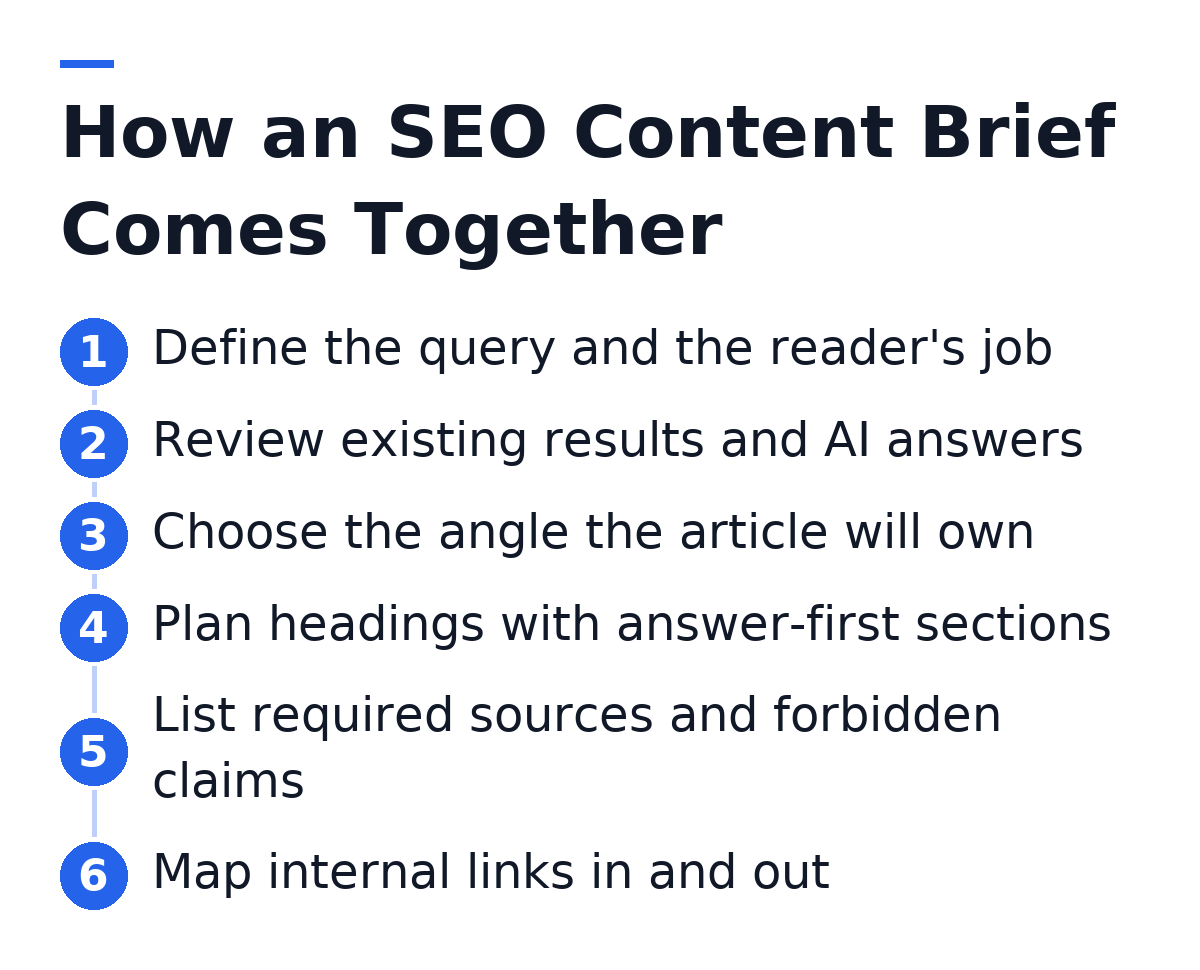
The Query and the Job Behind It
The brief should name the primary query and describe the job the searcher is trying to get done. A keyword alone is ambiguous. "Content brief template" could come from someone who wants a downloadable file, someone deciding whether templates are worth using, or someone building a process for a team. Each of those readers needs a different article.
A good brief states the job in a sentence: "The reader runs a small content team and wants to understand why their articles underperform and what a better brief contains." That sentence does more to shape the draft than any keyword density target.
The Reader and Their Starting Point
The brief should say what the reader already knows. This is the most commonly skipped field and one of the most useful. A founder comparing content approaches does not need a paragraph explaining what SEO is. An article that opens with one signals immediately that it was not written for them.
Stating the starting point lets the writer cut the dictionary-definition intro, skip the basics and spend the word budget on depth. It also helps with AI search: assistants tend to pull the passage that answers the specific question most directly, and articles padded with basics dilute that passage.
The Angle Nobody Else Has Taken
The angle is what makes the article worth publishing. The brief should state it explicitly, ideally as a claim the article will defend or a gap it will fill. Examples of angles that work for B2B SaaS topics include:
- A firsthand perspective the company has from building or using the product
- A contrarian claim that the existing results get something wrong
- A narrower audience the existing pages ignore, such as solo founders or technical buyers
- A dimension competitors skip, such as how the topic behaves in AI search
- A worked example with real constraints instead of an idealized one
- A comparison on criteria that the reader actually uses to decide
If the strategist cannot name the angle, the article is not ready to be assigned. That is a useful test on its own.
Structure and Heading Plan
The brief should outline the headings and the question each section answers. Structure matters for readers who scan, for search engines that interpret sections and for AI assistants that extract passages. A heading plan written as questions or clear statements, each followed by a direct answer, produces sections that can be quoted on their own.
A heading plan also prevents scope creep. When every section has a stated job, the writer knows what belongs and what to leave out. Sections without a stated job tend to fill with filler.
Evidence, Sources and Proof
The brief should say what proof the article needs and where it should come from. This includes primary sources for any statistic, product details that must be accurate, customer examples the company is allowed to share and claims the writer must not make. Unsourced numbers damage credibility with readers and give AI assistants a reason to cite someone else.
I find it helpful to list forbidden claims as clearly as required ones. A line like "do not state performance figures we cannot source" saves a round of legal or founder review later.
Links In and Out
The brief should specify which existing pages this article links to and which pages should link back to it. Planned internal linking tells search engines how your pages relate and helps readers move from one question to the next. It also clarifies ownership: if two briefs target overlapping queries, the linking plan exposes the overlap before both articles get written.
External links belong in the brief too. Pointing writers to primary sources (the original study, the official documentation, the standards body) produces better citations than letting them grab whatever ranks first.
Why the Brief Now Has to Serve AI Search Too
In 2026, a brief written only for Google leaves half the opportunity on the table. ChatGPT, Claude, Perplexity and Gemini answer a growing share of the questions B2B buyers used to type into a search box, and they cite the pages they draw from. Google's own AI Overviews do the same inside the search results. Any team thinking about ai overviews seo is already thinking about how pages get extracted, not just ranked.
AI assistants reward a slightly different set of qualities than classic ranking signals do. A brief that plans for both covers these additions:
- An answer-first structure, where the sentence after each heading answers it directly
- Self-contained paragraphs that make sense when quoted without the surrounding text
- Clear definitions stated in plain words early in the article
- Named entities and specific facts in place of vague references
- Sources that are primary and verifiable, so the assistant can trust the claim
- Schema markup and FAQ-style structure where they fit the content
- Consistent brand and product descriptions, so assistants describe you accurately
None of these conflict with good SEO. They mostly sharpen it. The change is that the brief now has to request them explicitly, because writers trained on older SEO habits often bury the answer under context to keep readers on the page.
A page can rank on page one and still never be cited by an AI assistant if its answers are buried, vague or unsourced. Brief for extraction as well as ranking: every key question should get a direct, quotable answer in the first sentence of its section.
How Briefs Change Team Collaboration
A brief is a collaboration tool before it is an SEO tool. It moves the disagreements that usually happen during editing to the planning stage, where they are cheap to resolve. When a founder, an SEO manager and a writer all sign off on the brief, the draft is judged against a shared standard instead of three private ones.
Teams that brief consistently tend to see several changes in how they work:
Fewer revision loops. Feedback shifts from "this is not what I wanted" to "section three misses the point the brief set." That second kind of feedback is specific and quick to act on.
Clearer ownership. The strategist owns the decisions in the brief. The writer owns execution. When an article underperforms, the team can see whether the strategy or the execution fell short.
Easier handoffs. A freelancer, an agency or an AI system can pick up a good brief without a kickoff call. That matters for small teams that rely on outside help.
Institutional memory. Briefs record why an article exists and what it was meant to achieve. When it is time to refresh the page, that record tells the next person what to preserve and what to update.
Room for creativity. Constraints on strategy free writers from guessing. A writer who knows the angle, reader and required proof can spend energy on examples and phrasing instead of on second-guessing scope.
Briefing a Human Writer Versus Briefing an AI
Human writers and AI writers fail in different ways when the brief is thin, so they need different emphasis. A human writer fills gaps with judgment and research. An AI writer fills gaps with the statistical average of everything it has read, which is exactly the generic content that does not rank.
The comparison below shows where the brief needs extra attention for each.
| Brief element | Human writer | AI writer |
|---|---|---|
| Angle | Can propose one if missing | Must be stated explicitly |
| Facts and figures | Will research and source | Must be supplied or verified |
| Brand voice | Learns from examples | Needs explicit rules and samples |
| Forbidden claims | Usually inferred | Must be listed |
| Structure | Can adapt sensibly | Follows the outline literally |
| Competitive context | Can review the results | Needs the research fed in |
This is why the quality of an ai seo content generator depends so heavily on what sits upstream of the writing step. A tool that only accepts a keyword and returns an article is skipping the brief, and the output shows it. Systems that research the live results, competitors and your existing content before drafting are, in effect, writing a detailed brief for themselves.
Writers using general assistants like ChatGPT or Claude directly run into the same issue. The quality of the prompt is the quality of the brief. A one-line prompt gets an average article. A prompt that carries the reader, angle, structure, sources and constraints gets something much closer to publishable.
Where Briefs Break Down at Scale
Briefing well is straightforward for one article. It gets hard at volume. A team publishing a few pieces a month can afford an hour or two of research per brief. A team trying to cover an entire topic area cannot, and that is where quality usually slips.
The common failure points at scale look like this:
- Research shortcuts, where the strategist stops reviewing the live results and fills briefs from memory
- Template drift, where the brief template fills with boilerplate fields nobody reads
- Overlapping targets, because no one holds a map of which page owns which query
- Stale briefs, written months before the article and no longer matching the results
- Missing feedback, because performance data never flows back into how briefs are written
- Refresh neglect, as published articles decay while all effort goes into new briefs
The last two points matter more than they first appear. A brief is usually treated as a one-time input, but the information it captures (target query, intent, angle) is exactly what you need to diagnose why a page stalls on page two. Teams that keep briefs alongside Search Console data can see when a page ranks for queries the brief never targeted, or misses the ones it did. That turns refreshing into a planned activity instead of guesswork.
Clustering is the other scale problem. Briefs written one at a time rarely add up to coherent topical coverage. Grouping queries into clusters first, then briefing each article as a defined part of the cluster, keeps pages from competing with each other and makes the linking plan obvious. It is the difference between a set of articles and a body of work that search engines and AI assistants treat as an authority on the topic.
The Shift From Briefs as Documents to Briefs as Systems
The most useful way I have found to think about briefs in 2026 is as a system instead of a document. A document is written once, handed off and forgotten. A system takes in research, produces decisions, feeds those decisions to a writer, publishes the result and then takes in performance data to improve the next round.
Manual workflows can run that loop, but every step depends on a person remembering to do it: pull the results, check competitors, write the brief, assign it, edit the draft, add links, publish, check Search Console weeks later, decide on a refresh. Each handoff is a point where the loop breaks. That is why so many teams end up with a backlog of half-briefed articles and a library of published pages nobody revisits.
Autonomous content systems are structurally different because they run the whole loop without waiting for a prompt. Agents research keywords from competitors and the live results, group them into clusters, write each article to an internal brief, add internal links and schema, publish to the CMS and then revisit pages using search data. The brief still exists. It is generated and applied every time instead of skipped when the team gets busy.
Gofylo is one example of that approach. It researches and clusters keywords, writes 30 articles a month in your brand voice (each in a few minutes), publishes them to your CMS in 18+ languages with schema, internal links, FAQ blocks and verified citations, rewrites articles that sit just off page one using your Search Console data and scores how ChatGPT and Claude see your brand. Whether you build that loop with people, software or both, the principle is the same: the strategic decisions a brief captures have to happen for every article, and the results have to feed back in.
If you are working out your approach to creating seo content, start by auditing your last ten briefs against the components above. Look for missing angles, missing reader definitions and missing linking plans. The gaps you find will usually explain the articles that stalled.
Related: SEO Content Creation in 2026: What Ranks and Gets Cited
Want to see what a fully briefed, researched and AI-ready article looks like without building the process yourself? Start a 3-day free trial of Gofylo: it researches your competitors, plans topic clusters and publishes 30 articles a month to your CMS for $79/month, and you can cancel any time. Or run the free AI Search Grader first to see how AI assistants currently describe your brand.