SEO monitoring is the continuous practice of tracking the signals that determine whether your content gets found — by humans through search engines, and increasingly by AI systems that synthesize answers before a user ever clicks a result. As of 2026, this distinction matters more than it ever has. AI-generated answers now cause 60% of searches to end without a click (Semrush, 2025), which means the traditional model of ranking on page one and harvesting traffic is no longer the full story. A brand can rank in position one on Google and still be invisible inside the AI-generated answers that are reshaping how buyers actually research software, vendors, and solutions.
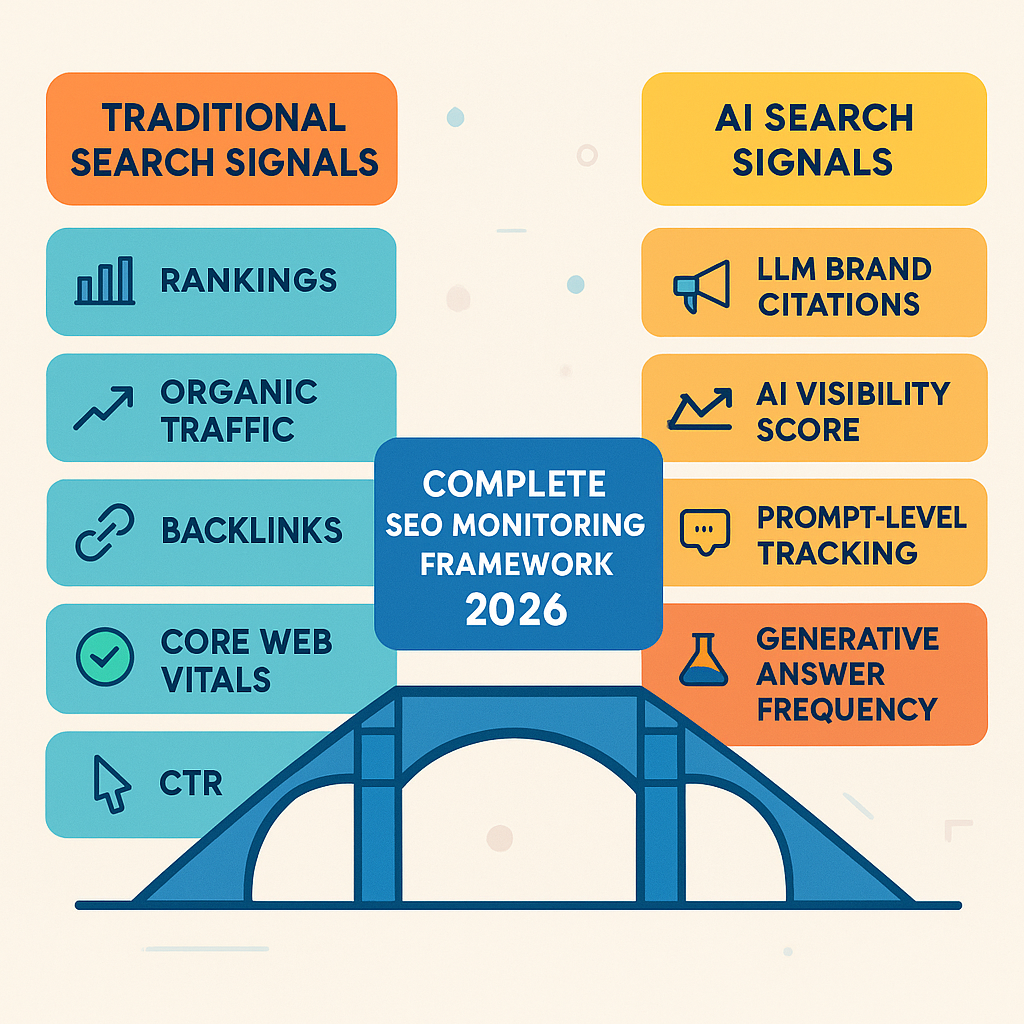
The shift has forced a rethink of what monitoring even means. Historically, SEO monitoring was synonymous with rank tracking — you checked keyword positions, watched for drops, and correlated movement with traffic in Google Analytics. That remains necessary but no longer sufficient. A complete SEO monitoring framework in 2026 also accounts for AI search visibility: whether your brand gets cited in ChatGPT, Claude, Perplexity, and Gemini responses, and with what frequency and authority. These two layers — traditional search and generative engine presence — together constitute the real surface area your content needs to cover.
Thesis: SEO monitoring has expanded from rank tracking into a dual-layer discipline — traditional search signals and AI citation presence. Teams that track only one layer are working with an incomplete map of their organic visibility.
What SEO Monitoring Actually Measures
SEO monitoring is the ongoing process of measuring, recording, and interpreting the signals that determine a website's visibility in search — both in traditional search engines like Google and Bing, and in AI-powered answer engines like ChatGPT, Perplexity, Claude, and Gemini. It's not a one-time audit. Audits produce a snapshot; monitoring produces a timeline. The distinction matters because search visibility is not static — algorithm updates, competitor content, technical regressions, and shifts in query intent all cause rankings and citation rates to move continuously. Without monitoring, teams are flying blind between audits, often discovering drops only after traffic has already fallen. Effective SEO monitoring captures changes as they happen, attributes them to probable causes, and gives teams enough context to respond before the damage compounds. In 2026, it's also the mechanism by which teams understand their presence inside AI-generated answers — a channel that Google's own search generative experience and third-party LLMs are rapidly expanding.
It's worth clarifying what monitoring is not. It's not content creation, keyword research, or link building — those are SEO activities. Monitoring is the observational layer that sits above those activities and measures whether they're working. Think of it as the feedback loop that validates or invalidates every strategic decision you make in organic search. Without it, you're running experiments with no results readout. The core purpose of rank tracking — as defined even at the platform level by Google — is to understand how search algorithms interpret and surface your content over time, and monitoring operationalizes that understanding at scale.
The Four Signal Layers Every Monitoring Setup Should Cover
A robust SEO monitoring setup doesn't collapse all signals into a single number. Different signal types answer different questions, and conflating them produces misleading conclusions. The most useful way to think about monitoring architecture is in four distinct layers, each of which surfaces a different dimension of organic visibility. These layers are not sequential — they run in parallel — but understanding them separately makes it much easier to diagnose what's actually changing and why. Teams that treat SEO monitoring as a single dashboard often miss the specific layer where a problem originates, leading to misattributed root causes and wasted remediation effort. By contrast, teams that segment their monitoring by signal type can quickly isolate whether a traffic drop is a ranking problem, a technical problem, a CTR problem, or an AI visibility problem — four very different root causes requiring very different responses.
Rankings and Keyword Visibility
Rank monitoring tracks where specific URLs or domains appear in search engine results pages (SERPs) for targeted keywords. This is the oldest and most familiar layer of SEO monitoring. Tools like Ahrefs and Semrush have made rank tracking scalable across thousands of keywords, with daily or near-real-time refresh rates. In 2025, around 64% of SEO tools launched real-time ranking dashboards, improving decision-making speed by 50% across marketing teams (Business Research Insights, SEO Market Report 2026-2035). What makes rank monitoring particularly valuable is its sensitivity — it often surfaces algorithm updates or competitor movements before those changes register in traffic data, giving teams a lead-time window to respond.
For B2B SaaS teams, rank monitoring typically focuses on a layered keyword set: branded terms (your company name, product name), high-intent commercial terms (category keywords, comparison queries), and informational long-tail terms tied to the content clusters your team is building. Each subset behaves differently. Branded rankings are relatively stable; commercial terms fluctuate more with algorithm updates; informational content can gain or lose significant ground based on content freshness and topical authority signals. Monitoring all three separately gives a more accurate read on where the business stands and where effort should be redirected.
Organic Traffic and Engagement
Traffic monitoring translates rank changes into business-level outcomes. A keyword can rank on page one while generating negligible traffic if the SERP is dominated by featured snippets, People Also Ask boxes, or AI-generated answers that intercept the click. Conversely, a page ranking in position four on a high-volume term can generate more qualified traffic than a page ranking first on a lower-volume term. Organic traffic monitoring — typically drawn from Google Search Console and web analytics platforms — contextualizes rankings by showing actual click volume, click-through rate (CTR) by URL and query, impressions, and session behavior. Engagement metrics like bounce rate, time on page, and scroll depth provide a secondary signal about content quality and intent alignment: are visitors finding what they came for, or leaving immediately?
Technical Health Signals
Technical monitoring tracks the infrastructure that makes content indexable and rankable in the first place. Core Web Vitals (Largest Contentful Paint, Cumulative Layout Shift, Interaction to Next Paint) measure page experience signals that Google uses as ranking inputs. Crawl monitoring identifies broken links, redirect chains, orphaned pages, duplicate content, and indexation errors before they accumulate into structural problems. Site speed monitoring, mobile usability, schema markup validation, and structured data health all fall into this layer. Technical issues rarely cause overnight visibility collapses — they tend to erode performance gradually, which is exactly why continuous monitoring is more valuable than periodic audits. A crawl error that goes undetected for three months can quietly suppress dozens of pages.
AI Search and LLM Citation Presence
This is the newest and, for many teams, the least-understood layer of SEO monitoring. AI search monitoring tracks whether and how often your brand, content, or URLs appear in responses generated by large language models across platforms like ChatGPT, Perplexity, Claude, and Gemini. This matters because AI search referral traffic grew 527% year-over-year from January–May 2024 to the same period in 2025 (Semrush, 2026), and the volume is only accelerating. Being cited in an AI-generated answer drives brand recognition, referral clicks, and trust in ways that parallel traditional organic rankings — but the signals are different. LLMs cite sources based on authority, structured data, topical depth, and citation patterns across the web, not purely on PageRank or backlink volume. Monitoring this layer requires purpose-built tooling that submits representative prompts to LLMs, parses responses for brand mentions, and tracks citation frequency over time — a capability distinct from traditional rank tracking tools.
AI citation monitoring is not optional for B2B SaaS brands in 2026. When buyers ask ChatGPT or Perplexity to recommend a category solution, whether your brand appears in that answer — and with what framing — shapes purchase consideration before a single Google click happens.
Why Traditional Rank Tracking Is No Longer the Whole Answer
For most of search engine history, a brand's organic visibility could be reasonably approximated by its keyword rankings and the traffic that flowed from them. That model has broken down. The emergence of AI-generated answers, zero-click searches, and answer engine interfaces has decoupled ranking from visibility in ways that traditional monitoring frameworks were never designed to handle. A brand can hold its position-one ranking while losing a growing share of the potential audience to an AI summary that appears above the organic results and answers the query without a click. According to Semrush (2025), AI-generated answers now cause 60% of searches to end without a click — a figure that represents a structural shift in how search-generated demand actually reaches websites. Teams that still define SEO success purely by ranking position are measuring the right thing for the wrong era.
This doesn't mean keyword rankings have become irrelevant — they remain a critical signal, and there's a strong correlation between high organic rankings and likelihood of LLM citation, since both reward authoritative, well-structured content. But rankings are now a necessary rather than sufficient condition for organic visibility. The monitoring question has shifted from 'where do we rank?' to 'where do we rank, who sees that ranking, and are we being cited when AI systems answer queries in our category?' These are related but distinct questions that require different data sources, different tooling, and different interpretive frameworks.
Zero-click growth is real. When buyers research solutions through AI interfaces, the brand that gets cited most consistently in those generated answers earns share of consideration that never registers in traditional traffic analytics. Monitoring for LLM citation frequency is how teams measure this otherwise invisible channel.
Algorithm updates hit faster. Google's update cadence has accelerated significantly — core updates, spam updates, and helpful content updates now ship multiple times per year. Without continuous monitoring, teams often discover the impact of an update weeks after the ranking changes have already settled, leaving them with historical data instead of actionable intelligence.
Competitor movements compound. When a competitor publishes a cluster of well-optimized content targeting your keywords, the impact builds gradually over weeks. Monitoring surfaces these movements early, while there's still time to respond with updated content, additional backlinks, or structural improvements — rather than after the competitor has consolidated authority.
Content decay is silent. Published content doesn't stay relevant without maintenance. Articles that ranked well in 2024 may have lost position by 2026 due to freshness signals, evolving query intent, or newer competing content. Monitoring flags these decays by URL, allowing teams to prioritize refreshes on content that still has ranking potential rather than publishing new articles into a market where existing assets are quietly losing ground.
The Metrics That Actually Matter for B2B SaaS Teams
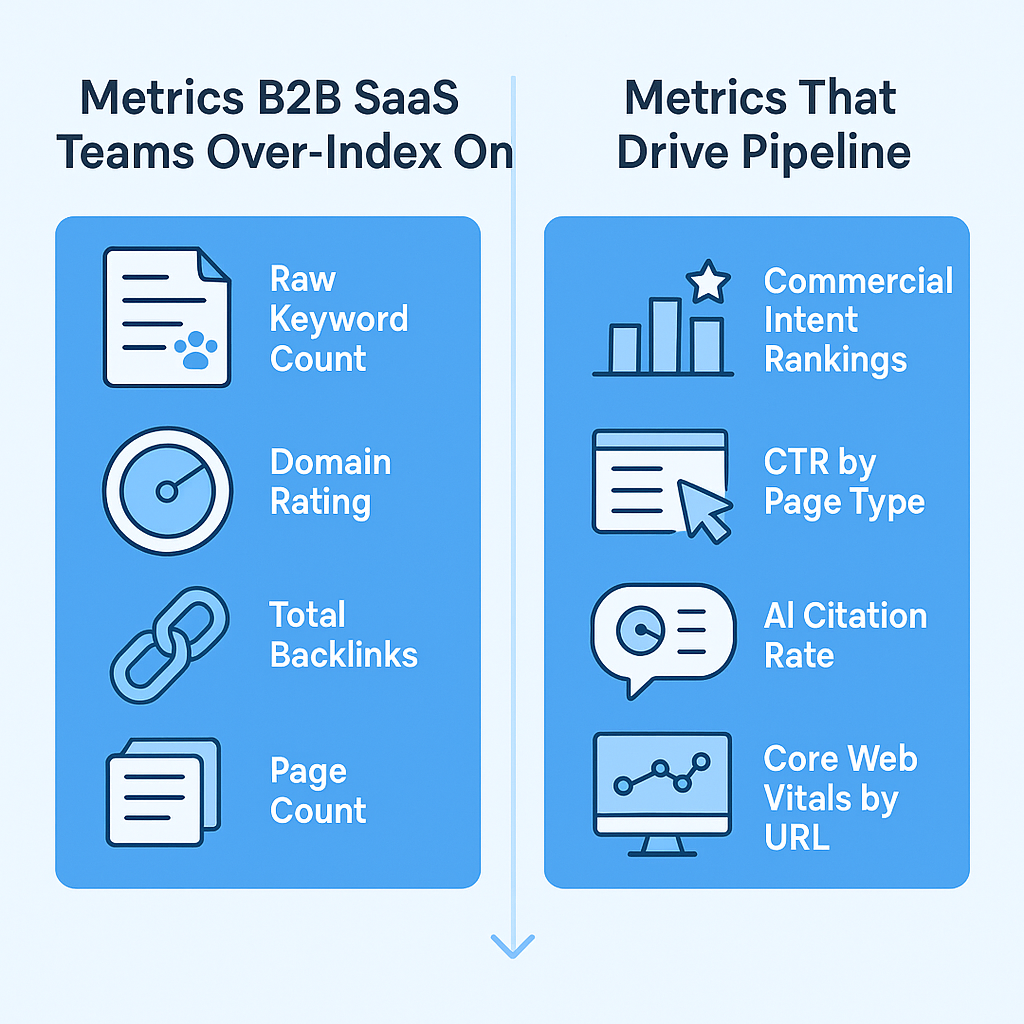
Not every metric in an SEO monitoring dashboard deserves equal attention from a B2B SaaS team. Many monitoring tools surface dozens of data points, and the practical challenge is knowing which signals to act on versus which to observe. For founders, marketing leads, and content managers at growth-stage SaaS companies, the metrics worth prioritizing fall into a relatively tight set — organized around intent, authority, and AI presence rather than vanity indicators like raw keyword count or domain rating alone.
- Organic keyword rankings by intent tier — branded, commercial, informational — tracked separately rather than aggregated
- Organic click-through rate (CTR) segmented by page type and query category, pulled from Google Search Console
- Backlink velocity and referring domain quality — new links acquired, lost links, and domain authority distribution
- Core Web Vitals scores per URL and site-wide, with pass/fail status against Google's defined thresholds
- Index coverage — pages indexed vs. pages submitted, with error categorization (soft 404s, redirect loops, excluded by robots.txt)
- AI Visibility Score or LLM citation rate — how frequently the brand appears in AI-generated answers across major LLM interfaces
- Organic traffic by landing page, segmented by conversion stage to correlate visibility with pipeline contribution
The SEO monitoring software market has matured rapidly around these metrics. According to Semrush's own documentation, the most actionable monitoring setups focus on metrics that have a clear line to business outcomes — not metrics that simply describe the content library. For SaaS teams in particular, organic traffic at the top of funnel matters, but traffic that converts to trial signups, demo requests, or MQL-level engagement is the actual north star. Monitoring should ultimately support that chain of attribution, even if the monitoring tool itself doesn't complete the attribution loop directly.
How Monitoring Connects to Content Strategy
SEO monitoring is not just a reporting function — it's a strategic input that should directly shape what content gets created, updated, or retired. The feedback loop between monitoring data and content decisions is where high-performing content programs differentiate themselves from teams that publish on a schedule and hope for the best. When monitoring surfaces that a cluster of informational articles has lost ranking position over six months, that's a signal to refresh those articles with updated information, stronger internal linking, and better structured data — not to abandon the topic or write competing new articles on the same keywords. When monitoring shows that a specific comparison page is generating high CTR but low conversion, that's a signal about intent misalignment, not a ranking problem. The diagnostic value of monitoring is highest when teams are disciplined about asking 'what does this data mean for our next content decision?' rather than treating dashboard data as a reporting endpoint.
In 2023, nearly 58% of enterprises adopted predictive analytics tools for SEO tracking, with a reported 52% efficiency improvement in search performance monitoring (Business Research Insights, SEO Market Report 2026-2035). By 2026, that trend has evolved further — predictive monitoring now includes content decay forecasting, where platforms flag articles likely to lose position based on freshness signals and competitor content velocity, allowing teams to refresh proactively rather than reactively. This shift from reactive to predictive monitoring is one of the most significant structural changes in how sophisticated content programs operate. It's the difference between reading a post-mortem and reading a leading indicator.
The connection between monitoring and content strategy is also where AI search visibility data becomes actionable. If monitoring reveals that your brand is not being cited in ChatGPT or Perplexity responses to category-level queries — 'what's the best [your category] tool for B2B teams?' — that's a content strategy signal. It typically means the content library lacks sufficient topical depth, that existing content doesn't include the structured data formats (FAQ blocks, clear definitions, authoritative claims) that LLMs prefer to cite, or that brand authority signals across the web are insufficient. Monitoring surfaces the problem; content strategy addresses it. Without monitoring, teams often invest heavily in content production without any mechanism for detecting whether that investment is building AI citation presence or simply adding to a library that LLMs ignore.
SEO monitoring is the feedback loop that makes content strategy self-correcting. Teams without it are running a content program on intuition alone — publishing based on what seems right rather than what the data confirms is working.
The Role of Automation in Modern SEO Monitoring
The scale at which modern content programs operate has made manual SEO monitoring functionally obsolete for growth-stage teams. When a content library runs into hundreds or thousands of URLs — each with its own ranking signals, technical health indicators, and AI citation status — the monitoring task exceeds what any individual or small team can perform through manual review. Automation has filled this gap, but in 2026 the automation landscape has stratified significantly. There's a meaningful difference between tools that automate data collection (pulling in rankings, traffic, and backlink data on a schedule) and platforms that automate insight generation (surfacing anomalies, prioritizing issues, and generating recommended actions without requiring a human to interpret raw data). The former saves time; the latter changes the organizational model.
The broader market reflects this shift. In 2024, approximately 72% of SEO software providers introduced automation-based content optimization features, reducing manual workload by 60% in enterprise workflows (Business Research Insights, SEO Market Report 2026-2035). The direction of the market is clearly toward autonomous monitoring that doesn't require analysts to manually review dashboards and generate interpretations. Platforms that ship autonomous agents — systems that continuously observe SEO signals, detect anomalies, and surface prioritized actions — represent the leading edge of where enterprise and growth-stage teams are moving. The alternative is a monitoring stack that requires significant human bandwidth to operate, which creates a scaling problem: as the content library grows, monitoring costs grow proportionally unless automation absorbs the incremental load.
Gofylo's approach is illustrative of what autonomous monitoring looks like in practice. Alongside its Content Engine — which publishes fully optimized articles in a few minutes — the platform includes an AI visibility score based on how ChatGPT and Claude see a brand. Rather than requiring teams to manually check LLM responses or synthesize data from multiple disconnected tools, the system asks ChatGPT and Claude about a brand and produces an AI Visibility Score that gives teams a single benchmark for AI share of voice. For bootstrapped operators and small marketing teams, this kind of autonomous monitoring is particularly valuable: it delivers the observational coverage of a dedicated SEO analyst without requiring the headcount.
Autonomous agents change the model. Traditional monitoring requires humans to periodically check dashboards and draw conclusions. Autonomous monitoring agents operate continuously, surface anomalies in real time, and flag issues before they compound — fundamentally changing the economics of maintaining visibility at scale.
AI visibility is not a bolt-on. Platforms that treat AI search monitoring as an afterthought — a single report added to a traditional rank tracking tool — typically offer shallow coverage. Genuine AI visibility monitoring requires submitting thousands of representative prompts to LLMs, parsing responses for brand mentions, and tracking citation trends over time. This is infrastructure-level work, not a feature.
Scale requires instrumentation. As content libraries grow — whether through autonomous publishing or manual production — the monitoring surface area grows with them. Teams that invest in monitoring infrastructure early don't face a scaling cliff; teams that defer it until the library is large often find themselves unable to diagnose performance problems across hundreds of URLs with the tools they have.
How Tools Differ — And What to Look For
The SEO monitoring tools category is crowded, and the differences between platforms are often obscured by overlapping feature lists. Every major tool tracks keywords, most surface backlink data, and nearly all integrate with Google Search Console. The meaningful differentiators lie in coverage depth, refresh frequency, AI search visibility capabilities, and the degree to which the platform generates insights rather than just data. Choosing between platforms ultimately depends on what monitoring layer is most critical for your team and what level of automation you need to operate at your current content scale.
Traditional rank tracking tools like Ahrefs Rank Tracker and Semrush Position Tracking are strong at the rankings and backlink layers. Both offer daily rank updates, SERP feature tracking, and historical position data at scale. What they don't natively offer — as of 2026 — is LLM citation monitoring. If your primary monitoring gap is AI search presence, you need either a dedicated AI visibility platform or a combined tool that covers both layers. Purpose-built AI SEO platforms have emerged to address exactly this gap, tracking brand citations across ChatGPT, Claude, Perplexity, and Gemini with methodologies that differ significantly from traditional rank tracking: instead of checking a URL's position for a fixed keyword, they submit representative prompts and analyze whether the brand appears in the generated response, with what sentiment, and in what competitive context.
For SEO monitoring software selection, the questions worth asking include: Does the platform track LLM citation presence, or only traditional search rankings? What is the keyword or prompt refresh cadence — daily, weekly, or on-demand? Does the tool surface anomaly alerts without requiring manual dashboard review? How does it handle technical monitoring — crawl errors, Core Web Vitals, index coverage — versus outsourcing those to Google Search Console? And critically: does it integrate with your CMS and publishing workflow, or does it sit as a disconnected reporting layer? Monitoring tools that integrate with publishing workflows — so that a content decay alert can trigger a content refresh task in the same system — provide compounding operational value that standalone dashboards cannot match.
- LLM citation tracking across ChatGPT, Claude, Perplexity, and Gemini — not just Google rankings
- Daily or real-time rank refresh cadence for high-priority commercial keywords
- Anomaly detection and alert systems that surface issues without manual dashboard review
- Technical health monitoring including Core Web Vitals, crawl errors, and index coverage
- Integration with CMS platforms so monitoring data connects to content workflow
- Competitor visibility tracking to surface market-level shifts alongside your own brand signals
- Backlink monitoring with referring domain quality scoring, not just raw link count
The global SEO software market was valued at $94.5 billion in 2025 and is projected to reach $262.4 billion by 2035, at a CAGR of 10.7% from 2026 to 2035 (Emergen Research, 2026). The scale of that growth reflects the reality that monitoring is becoming a baseline operational requirement rather than an optional sophistication for well-resourced teams. As search engine optimization continues to evolve, the platforms that win market share will be those that cover both traditional search and AI search signals in a single coherent monitoring layer — because teams don't have bandwidth to operate two completely separate stacks for two overlapping channels.
Frequently Asked Questions
What is SEO monitoring?
SEO monitoring is the ongoing process of tracking, measuring, and interpreting the signals that determine a website's visibility in search — including keyword rankings, organic traffic, backlink health, technical performance, and, as of 2026, brand citation presence in AI-generated answers across LLMs like ChatGPT, Claude, and Perplexity. Unlike a one-time SEO audit, monitoring is continuous, providing teams with the real-time or near-real-time data needed to detect changes, attribute causes, and respond before performance problems compound. Effective SEO monitoring covers both traditional search engine signals and the newer generative engine signals that increasingly shape how buyers discover and evaluate software products.
Is SEO dead now with AI?
SEO is not dead — it has expanded in scope. Traditional search rankings remain important, but they now coexist with AI-generated answer visibility as a parallel organic channel. The underlying skills and disciplines of SEO — topical authority, structured content, technical health, backlink authority — are directly transferable to AI search optimization, since LLMs preferentially cite sources that score well on those same dimensions. What has changed is the monitoring requirement: teams now need to track both traditional rankings and LLM citation presence to have an accurate picture of total organic visibility, because a brand can rank well in Google while being absent from the AI answers that increasingly intercept buyer research.
What is the best SEO monitoring tool?
There is no single best tool for every team — the right choice depends on which monitoring layer is most critical for your specific situation. Ahrefs and Semrush are industry standards for rank tracking and backlink monitoring at scale. For AI search visibility and LLM citation tracking, purpose-built platforms that submit prompts to ChatGPT, Claude, Perplexity, and Gemini provide coverage that traditional rank trackers don't offer. Platforms like Gofylo combine AI visibility tracking with autonomous content publishing and a single AI Visibility Score benchmark — a useful structure for teams that want to correlate content output with monitoring outcomes in one system rather than managing two separate stacks.
Can ChatGPT do an SEO audit?
ChatGPT can assist with certain SEO analysis tasks — reviewing a page's content for clarity, suggesting title tag improvements, or identifying structural issues in an article — but it cannot perform a real SEO audit in the technical sense. It doesn't have live access to your site's crawl data, Google Search Console metrics, backlink profile, or real-time ranking positions. A genuine SEO audit requires tools that pull live data from search engines, analytics platforms, and crawl systems. ChatGPT is useful as a reasoning layer on top of data you provide, but it's not a substitute for purpose-built SEO monitoring software with real data integrations.
If your team is running SEO and publishing content without a monitoring layer that covers both traditional rankings and AI citation presence, you're operating with an incomplete view of your organic visibility. Gofylo's AI visibility score shows how ChatGPT and Claude see your brand, and the platform autonomously publishes 30 SEO-optimized articles per month — so you can compound organic reach while keeping a clear read on what's actually working. Start your 3-day free trial at gofylo.io.